Background
The traditional starting point of Galician history is the year 981, when, according to the Rus’ Primary Chronicle, the grand prince of Kiev, Volodymyr (reigned 980-1015), went to the Liakhs and took Przemysl, Cherven, and other cities.
The same source mentions that in 993 Volodymyr attacked the Croats who allegedly inhabited Galicia at the time. These terse statements in the Primary Chronicle have generated numerous and yet unresolved questions about the status of Galicia before Volodymyr’s appearance-for example, was the region retaken by the Rus’ prince, or did he take it for the first time from Poland or Great Moravia? Whatever answers subsequent writers have provided to such questions, it is certain that after the late tenth century Galicia and its White Croatian inhabitants became part of the political, socioeconomic, and cultural sphere of Kievan Rus’.Kievan Rus’ was itself no more than a loosely knit federation of principalities, each with its own ruler or rulers representing various branches of the founding Rurykovych dynasty and nominally subordinate, though more often than not independent of the senior, or grand prince residing in Kiev. More important as a unifying factor was culture and religion. Galicia received Christianity in its eastern Orthodox form from Kiev in the late tenth century and later a cultural language, Old Slavonic, from the same source.
It was also arrangements reached within the Kievan political order that provided Galicia, in the second half of the eleventh century, with its own branch of the Rurykovych dynasty, the Rostyslavyches from Prince Rostyslav (d. 1065), grandson of the powerful prince of Kiev, laroslav the Wise (reigned 1019-1054). Rostyslav’s three sons, the real founders of the Galician dynasty, divided the
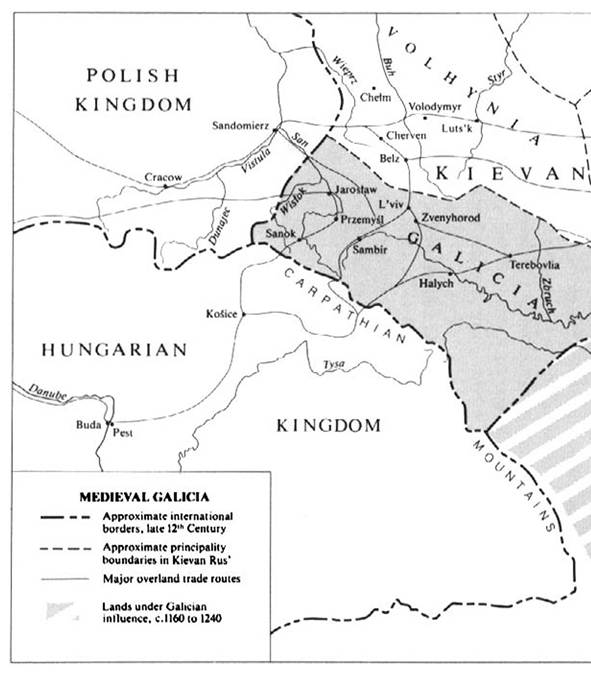
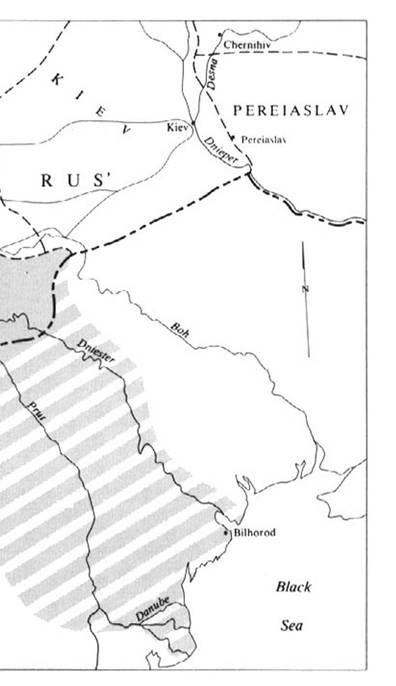
realm and ruled from the fortresses of Zvenyhorod, Przemysl, and Terebovlia, but their successors during the twelfth century-Volodymyrko (reigned 1124-1153) and laroslav Osmomysl’ (reigned 1153-1187)-united these cities, founded a new capital at Halych (1141), and extended the principality’s territorial extent from its original base along the upper Buh and Dniester rivers toward the southeast as far as the Black Sea.
It was also during this period that Galicia’s economic wealth increased, mainly because of its exports of salt (mined near Halych) to Kiev and revenue derived from international trade with Byzantium, Kiev, and east-central Europe.Like other lands within Kievan Rus’, Galicia experienced several periods of chronic wars caused by interprincely rivalry over the throne of Kiev and over each other’s principalities. During the eleventh and twelfth centuries, the princes of Kiev and especially neighboring Volhynia frequently attempted to take the Galician throne. Galicia also had problems that distinguished it from other Kievan principalities. Both the neighboring Hungarian Kingdom south of the Carpathians and the Polish principalities to the west claimed Galicia as their patrimony and on numerous occasions invaded the region (sometimes at the invitation of Galician princes or discontented boyars). Finally, the boyars (a class of wealthy landowners) grew to be a politically and economically influential group, and after the twelfth century often served as a potent restraint on centralized princely authority; at times they contributed to internal chaos that was exploited by the Poles or Hungarians.
In 1199, the Rostyslavych dynasty died out, and the local boyars invited Prince Roman of Volhynia (reigned 1199-1205) to be their ruler. This heralded the establishment of a new branch of the Rurykovych dynasty-the Romanovyches -as well as the unification of Galicia and Volhynia through the person of their ruling prince. After a period of civil war, foreign invasion, and declining economic fortunes, Galicia-Volhynia reached its apogee under Danylo (reigned 1238-1262) and his son Lev (reigned 1264-1301). And since Kiev had already lost its preeminent political and economic role by the early thirteenth century, Galicia-Volhynia replaced it as the dominant force within the southern Rus’ lands. This position was maintained even after the Mongol invasion, which devastated parts of Galicia in 1240.
Danylo reached an accommodation with the Mongols, while at the same time negotiating with western states, including the Pope, from whom he received a crown in 1253. As king of Rus’ (Rex Rusiae), Danylo was recognized as a full-fledged monarch in the context of the western European feudal order. The Kingdom of Galicia-Volhynia (regnum Galiciae et Lodomeriae) continued to flourish, especially in the economic sphere, under Danylo’s successor Lev. It was also at this time (1260s) that L’viv was made the capital of Galicia. In order to enhance further the prestige of the Galician-Volhynian Kingdom, a new Galician Orthodox metropolitanate was established in 1303 with its seat in Halych.However, at the moment of its seeming height, a period of decline set in, which ultimately was to prove fatal. The first decades of the fourteenth century witnessed the death of the last male in the Romanovych dynasty (1323), an increase in antiprincely activity on the part of the boyars, new friction with the Mongols, and frequent incursions on the part of the Poles, Hungarians, and a new power from the north, the Lithuanians. In 1340, the last Romanovych ruler (on the female side) was poisoned by the boyars. This act immediately plunged the kingdom into a period of internal civil war and anarchy as well as foreign invasion and diplomatic maneuvering that was to last for almost half a century, at the end of which Galicia was annexed by the Polish Kingdom.
Sources
The most important sources for the study of Galicia during the medieval period are the Old Rus’ chronicles. Of these, the Kievan Chronicle (covering the years 1113-1200) and especially the Galician-Volhynian Chronicle (covering the years 1201-1292) are of greatest value for Galician events. The Galician-Volhynian Chronicle has, like the other chronicles, survived only in later-day copies, the oldest of which is found in the second part of the so-called Hypatian text (from the early fourteenth century). The Hypatian text has been published four times.14 There are also annotated translations in English and Ukrainian.15 The Hypatian text and its second component part, the Galician-Volhynian Chronicle, have been the subject of numberous studies, mostly of a linguistic nature.
These studies, as well as the various existing texts and translations, are listed in a comprehensive bibliography on the chronicles by Rufina P. Dmitrieva and in a historiographical survey by George A. Perfecky.16 From the historical point of view, the analysis of14 Polnoe sobranie russkikh lietopisei, vol. II: Ipatievskaia lietopis' (St Petersburg: Arkheografi- cheskaia kommissia 1843), 2nd rev. ed. (St Petersburg: Arkheograficheskaia kommissia 1908; reprinted Moscow: Izd. vostochnoi literatury Instituta istorii AN SSSR, 1962); A.S. Petrushevych, ed., Volynsko-Halytskaia litopys' sostavlennaia s kontsem XIII vika 1205-1292 (L’viv 1871), supplement to Lyteraturnyi sbornyk Halytsko-russkoi Matytsy, [III—IV] (L’viv 1870-71); Lietopis' po Ipat'evskomu spisku (St Petersburg: Arkheograficheskaia kommissia 1871).
15 George Perfecky, The Galician-Volynian Chronicle: The Hypatian Codex, pt 2, Harvard Series in Ukrainian Studies, vol. XVI, pt 2 (Munich: Fink Vlg. 1973); L. Makhovets’, “Halyts’ko- volyns’kyi litopys,” Zhovten’, XXXIII, 7 (L’viv 1982), pp. 14-87.
16 R.P. Dmitrieva, comp., Bibliografiia russkago letopisaniia (Moscow and Leningrad: Akademii Nauk SSSR 1962); George Perfecky, “Studies on the Galician-Volynian (Volhynian) Chronicle,” Annals of the Ukrainian Academy of Arts and Sciences in the United States, XII, 1-2 (New York 1969-72), pp. 62-112.
Izydor Sharanevych and the establishment of the chronicle’s chronology (the Hypatian text had no dates) by Mykhailo Hrushevs’kyi are invaluable.[194] The Galician-Volhynian Chronicle as well as other Rus’ chronicles and western European, Byzantine, and Arabic sources for the history of medieval Galicia are discussed in works by Ivan Lynnychenko, Mykhailo Hrushevs’kyi, Vladimir Ikonnikov, Dmytro Bahalii, and Vladimir Pashuto.[195]
General histories of Galicia-Volhynia
The medieval Galician-Volhynian principality and later kingdom marked the only time when the area was more or less independent.
It is not surprising, then, that some of the earliest histories written by natives of the region concentrated on what they considered to be their homeland’s heroic period. As early as 1837, Denys Zubryts’kyi published a Polish-language history of Galicia covering the years 988 to 1340.[196] This was followed by a three-volume history providing much greater detail, though the narrative ended with 1337.[197]Besides glorifying the era of Galician princely rule, Zubryts’kyi also put forth two propositions that were to become standard in writings on the subject: that the Rus’ population of Galicia was autochthonous, and that it originally was settled much farther west than the nineteenth-century Polish-Ukrainian ethnographic boundary. Other surveys of medieval Galician Rus’ history were published by the local scholar, Izydor Sharanevych, who brought his coverage down to the midfifteenth century,[198] and in briefer works by the Galician philologist lakiv Holo- vats’kyi and the Russian and Polish historians Mikhail Smirnov and Anatol Lewicki.[199]
Since medieval Galicia was part of the Kievan federation, and since both Russian and Ukrainian writers consider Kievan Rus’ the starting point for the development of their respective nations, it is not surprising that Galician Rus’ often figures to a greater or lesser degree in Russian and Ukrainian national histories. Russian historians generally give Galicia only scant attention, because they consider it a peripheral area, i.e. the farthest western land of Kievan “Russian” influence, but one which had little impact on developments that eventually led to the growth of Muscovy. The best representative of the Russian national school is Sergei Solov’ev, who in the second and third volume of his monumental History of Russia from Oldest Times discusses at some length events in the Galician principality and Galician-Volhynian Kingdom.[200]
Medieval Galicia plays a more important role in Ukrainian national histories, since the area is viewed as one where the “true” culture of Kiev was preserved (something much different from what later arose in Muscovy)-at first independently, then within the Polish-Lithuanian Commonwealth, until it was carried on later in Ukrainian history during the Cossack era. The idea of Galicia as a crucial link in the Ukrainian historical continuum from Kievan Rus’ to the present was developed by the greatest Ukrainian historian, Mykhailo Hrushevs’kyi. As a result, the Galician-Volhynian principality is given much attention in two volumes of his History of Ukraine-Rus’,[201]
More on the topic Background:
- Background Context
- The Iconoclastic Controversy
- SUMMARY
- Mammary Neoplasia
- AAP. Guidelines for Air and Ground Transport of Neonatal and Pediatric Patients. 4th edition. — American Academy of Pediatrics,2015. — 488 p., 2015
- GARDEN REWILDERS
- BIBLIOGRAPHY FOR BEHAVIORAL AND ANATOMIC FEATURES
- Alsharari Nizar Mohammad (ed.). Banking and Accounting Issues. ITexLi,2022. — 175 p., 2022
- North Korea: the last Stalinist state
- Hare C., Neo D. (eds.). Trade Finance: Technology, Innovation and Documentary Credit. Oxford University Press,2021. — 417 p., 2021