Books and Articles
Abakumov, A. A. et al. Narodnoe obrazovanie v SSSR: Obshchesobrazovat shkola. Sbornik doikumentov, 1917-1973 gg. Moscow: Pedagogica, 1974.
Abramson, Henry. A Prayer for the Government: Ukrainians and Jews in Revolutionary Times, 1917-1920.
Cambridge, Mass.: Harvard University Research Institute and Center for Jewish Studies, 1999.Adler, Eliyana. In Her Hands: The Education of Jewish Girls in Tsarist Russia. Detroit: Wayne State University Press, 2010.
Alpert, Yakov. Making Waves: Stories from My Life. New Haven, Conn.: Yale University Press, 2000.
Altshuler, Mordechai. “Escape and Evacuation of Soviet Jews at the Time of the Nazi Invasion: Policies and Realities.” In The Holocaust in the Soviet Union, edited by Lucjan Dobroszycki and Jeffrey S. Gurock, 77-104. Armonk, N.Y.: M.E. Sharpe, 1993.
-----. “The Jewish Anti-fascist Committee in the USSR in Light of New Documentation.” In Studies in Contemporary Jewry, edited by Jonathan Frankel, 271-80. Bloomington: Indiana University Press, 1984.
-----. Religion and Jewish Identity in the Soviet Union, 1941-1964. Waltham, Mass.: Brandeis University Press, 2012.
-----. “Religion in the Soviet Union in the late 1930s in the Light of Statistics.” Jews and Jewish Topics in the Soviet Union and Eastern Europe 14 (1991): 23-26.
-----. Soviet Jewry on the Eve of the Holocaust: A Social and Demographic Profile. Jerusalem: Hebrew University of Jerusalem; Yad Vashem, 1998.
-----. Soviet Jewry since the Second World War: Population and Social Structure. New York: Greenwood Press, 1987.
-----. “Synagogues and Rabbis in the Soviet Union in the Light of Statistics, 1953-1964.” Jews in Eastern Europe 35, no. 1 (1998), 39-46.
Altschuler, Mordechai, ed. and trans. “Antisemitism in Ukraine toward the End of the Second World War.” Jews in Eastern Europe 22, no. 3 (1993): 40-81.
Altskan, Vadim, “On the Other Side of the River: Dr. Adolph Herschmann and the Zhmerinka Ghetto, 1941-1944.” Holocaust and Genocide Studies 26, no. 1 (Spring 2012): 2-28.
Ancel, Jean. Transnistria. Bucharest: Atlas, 1998.
-----. “The Romanian Campaigns of Mass Murder in Transnistria, 1941-1942.” In The Destruction of Romanian and Ukrainian Jews during the Antonescu Era, edited by Randoph L. Braham, 87-133. New York: Rosenthal Institute for Holocaust Studies, 1997.
Anderson, John. “The Council for Religious Affairs and the Shaping of Soviet Religious Policy.” Soviet Studies 43, no. 4 (1991): 689-710.
Angrick, Andrej. “Annihilation and Labor: Jews and Thoroughfare IV in Central Ukraine.” In Shoah in Ukraine: History, Testimony, Memorialization, edited by Ray Brandon and Wendy Lower, 190-223. Bloomington: Indiana University Press, 2008.
An-sky, S. Deryidisher khurbn fun Poylin, Galitsye un Bukovine. Wilno: Farlag An-ski, 1921.
Arad, Yitzhak, ed. Unichtozhenie evreev SSSR vgody nemetskoi okkupatsii, 19411944: sbornik dokumentov i materialov. Jerusalem: Yad Vashem, 1991.
Arad, Yitzhak. In the Shadow of the Red Banner: Soviet Jews in the War against Nazi Germany. Jerusalem: Yad Vashem, 2010.
-----. The Holocaust in the Soviet Union. Lincoln: University of Nebraska Press, 2009.
Arad, Yitzhak et al., eds. The Einsatzgruppen Reports: Selections from the Dispatches of the Nazi Death Squads' Campaign against the Jews July 1941-January 1943. New York: Holocaust Library, 1989.
Asher, Harvey. “The Holocaust and the USSR.” In Lessons and Legacies VII: The Holocaust in International Perspective, edited by Dagmar Herzog, 253-68. Evanston, Ill.: Northwestern University Press, 2006.
Assman, Aleida. “History, Memory, and the Genre of Testimony.” In Poetics Today 27, no. 2 (Summer 2006): 261-73.
Avrutin, Eugene M., Valerii Dymshits et al. Photographing the Jewish Nation: Pictures from S. An-sky's Ethnographic Expeditions. Waltham, Mass.: Brandeis University Press, 2009.
Bahloul, Joelle. The Architecture of Memory: A Jewish-Muslim Household in Colonial Algeria, 1937-1962. Cambridge: Cambridge University Press, 1996.
Bakaev, Iu. N. Vlast' i religiia: istoriia otnoshenii, 1917-1941. Khabarovsk: Izd-vo KhGTU, 2002.
Balashov, E. M. Shkola v rossiiskom obshchestve, 1917-1927gg. St. Petersburg: Dmitrii Bulanin, 2003.
Ball, Alan M. Russia's Last Capitalists: The Nepmen, 1921-1929. Berkeley: University of California Press, 1987.
Ballard, Leslie Roy et al., History of Oral History: Foundations and Methodologies. New York: Altamira Press, 2007.
Ballinger, Pamela. History in Exile: Memory and Identity at the Borders of the Balkans. Princeton, N.J.: Princeton University Press, 2002.
Band, Arnold J. “Agnon's Synthetic Shtetl.” In The Shtetl: New Evaluations, edited by Steven T. Katz, 233-43. New York: New York University Press, 2007.
Bartal, Israel. “Imagined Geography: The Shtetl, Myth, and Reality.” In The Shtetl: New Evaluations, edited by Steven T. Katz, 179-92, New York: New York University Press, 2007.
Bartov, Omer. The Eastern Front, 1941-45: German Troops and the Barbarisa- tion of Warfare. Basingstoke, Hampshire: Macmillan in association with St. Antony's College, Oxford, 1985.
-----. Erased: Vanishing Traces of Jewish Galicia in Present-Day Ukraine. Princeton, N.J.: Princeton University Press, 2007.
Bauer, Yehuda. The Death of the Shtetl. New Haven, Conn.: Yale University Press, 2010.
Bemporad, Elissa. Becoming Soviet Jews: The Bolshevik Experiment in Minsk. Bloomington: Indiana University Press, 2013.
-----. “Behavior Unbecoming a Communist: Jewish Religious Practice in Soviet Minsk.” Jewish Social Studies 14, no. 2 (2008): 1-31.
-----. “Red Star on the Jewish Street: The Reshaping of Jewish life in Soviet Minsk, 1917-1939.” Ph.D. diss., Stanford University, 2006.
Benz, Wolfgang, and Brigitte Mihok, eds. Holocaust an der Peripherie: Juden und Judenmord in Rumanien und Transnistrien 1940-1944.
Berlin: Metropol, 2009.Berger, Shlomo, ed. From the Shtetl to the Metropolis. Amsterdam: Menasseh Ben Israel Institute, 2012.
Berkhoff, Karel C. Harvest of Despair: Life and Death in Ukraine under Nazi Rule (Cambridge, Mass.: Belknap Press of Harvard University Press, 2004).
Bertelsen, Olga. “New Archival Documentation on Soviet Jewish Policy in Interwar Ukraine. Part One: GPU Repression of Zionist Parties and Groups in the 1920.” On the Jewish Street: A Journal of Russian-Jewish History and Culture 1, no. 1 (2011): 75-76.
-----. “New Archival Documentation on Soviet Jewish Policy in Interwar Ukraine. Part Two: GPU Repression of Jews and Jewish Groups in 1937-1940.” On the Jewish Street: A Journal of Russian-Jewish History and Culture 1, no. 2 (2011): 172.
Bilokin, Sergei. “Dvatsat let evreiskoi gosudarstvennosti v Ukraine, 1918-1938.” Personal 2 (2004): 19.
Blackwell, Martin. “Regime City of the First Category: The Experience of the Return of Soviet Power to Kyiv, Ukraine, 1943-1946.” Ph.D. diss., Indiana University, 2005.
Bogoraz, V. G., ed. Evreiskoe mestechko v revoliutsii. Ocherki. Leningrad: Gosu- darstvennoe izdatel'stvo, 1926.
Bonch-Bruyevich, Vladimir. “New Pogroms.” Soviet Russia: Official Organ of the Soviet Russia Government Bureau 2, no. 5 (January 31, 1920): 97-98.
Borovoi, S. Ia. “Gibel’ evreiskogo naseleniia Odessy vo vremia rumynskoi okku- patsii.” In Katastrofa i opir ukrain'skogo evreistva. Kiev: Nationalna akademiia nauk Ukraini, 1999.
-------. Vospominaniia. Moscow: Evreiskii universitet v Moskve, 1993.
Braham, Randolph L., ed. The Destruction of Romanian and Ukrainian Jews during the Antonescu Era. New York: Columbia University Press, 1997.
Brandon, Ray, and Wendy Lower, eds. The Shoah in Ukraine: History, Testimony, Memorialization. Bloomington: Indiana University Press, 2008.
Brown, R., and J. Kulik. “Flashbulb Memories.” Cognition 5 (1977): 73-99.
Browning, Christopher. Remembering Survival: Inside a Nazi Slave-Labor Camp.
New York and London: W.W. Norton & Company, 2010.Bruce, Gary. The Firm: The Inside Story of the Stasi. Oxford; New York: Oxford University Press, 2010.
Budnitskii, Oleg. “Jews, Pogroms, and the White Movement: A Historiographical Critique.” Kritika: Explorations in Russian and Eurasian History 2, no. 4 (2001): 751-72.
-----. Russian Jews between the Reds and the Whites, 1917-1920. Philadelphia: University of Pennsylvania Press, 2011.
Carp, Matatias. Transnistrie. Buenos Aires: Besaraber landslayt-farayn in Argentine, 1950.
Center for Advanced Holocaust Studies and United States Holocaust Memorial Museum. The Holocaust in the Soviet Union: Symposium Presentations. Washington, D.C: Center for Advanced Holocaust Studies, United States Holocaust Memorial Museum, 2005.
Chasanowitch, Leon. Der yidisher khurbn in Ukrayne. Berlin: Yehuda, 1920.
Cherikover, I. M. Antisemitizm un pogromen in Ukrayne, 1917-1918. Berlin: Miz- reh Yidishn historishn arkhiv, 1923.
Chervinsky, Julie, ed. Lives of the Great Patriotic War: The Untold Stories of Soviet Jewish Soldiers in the Red Army during WWII. New York: Blavatnik Archive Foundation, 2011.
Chklonikova, Elina. “The Transformation of the ‘Shtetl’ in the USSR in the 1930s.” Jews in Russia and Eastern Europe 52, no. 1 (2004): 91-129.
Chumachenko, Tatiana. Church and State in Soviet Russia: Russian Orthodoxy from World War II to the Khrushchev Years, translated by Edward E. Roslof. New York: M.E. Sharpe, 2002.
Cohen, Alan. The Wonder of Their Voices: The 1946 Holocaust Interviews of David Boder. Oxford: Oxford University Press, 2010.
Cohen, Gillian. Memory in the Real World. Hillsdale N. J.: Lawrence Erlbaum, 1989.
Confino, Alon. “Collective Memory and Cultural History: Problems of Method.” American Historical Review 102, no. 5 (December 1997): 1386-1403.
Connerton, Paul. How Societies Remember. Cambridge: Cambridge University Press, 1989.
Crombag, Hans F. M., Willem A. Wagenaar, and Peter K.
Van Koppen. “Crashing Memories and the Problem of ‘Source Monitoring.'” Applied Cognitive Psychology 10, no 2 (April 1996): 95-104.Crowley, David, and Susan E. Reid, eds. Pleasures in Socialism: Leisure and Luxury in the Eastern Bloc. Evanston, Ill.: Northwestern University Press, 2010.
Crowley, David, and Susan E. Reid, eds. Socialist Spaces: Sites of Everyday Life in the Eastern Bloc. New York: Oxford University Press, 2002.
Cutler, Irving. The Jews of Chicago: From Shtetl to Suburb. Urbana: University of Illinois Press, 2008.
Dashevsky, Arnold, and Ira Sheskin, eds., American Jewish Year Book 2012. London: Springer, 2012.
Dashevsky, Arnold, Sergio DellaPergola, and Ira Sheskin, eds., World Jewish Population, 2010. Storrs, Conn.: Mandell L. Berman Institute, 2010.
Davies, R. W. The Socialist Offensive: The Collectivization of Soviet Agriculture, 1928-1930. Cambridge, Mass.: Harvard University Press, 1980.
Davies, Sarah. Popular Opinion in Stalin's Russia: Terror, Propaganda and Dissent, 1934-1941. Cambridge: Cambridge University Press, 1997.
Dean, Martin. Collaboration in the Holocaust: Crimes of the Local Police in Belo- russia and Ukraine, 1941-44. New York: St. Martin's Press, 2000.
Dekel-Chen, Jonathan L. Farming the Red Land: Jewish Agricultural Colonization and Local Soviet Power, 1924-1941. New Haven, Conn.: Yale University Press, 2005.
Deletant, Dennis. “Ghetto Experience in Golta, Transnistria, 1942-1944.” Holocaust and Genocide Studies 18, no. 1 (Spring 2004): 1-26.
-----. 1Tebensbingungen in den Ghettos und Arbeitslagern in Transnistrien 1942-1944: Der Fall Golta.” In Holocaust an der Peripherie: Judenpolitik und Judenmord in Rumanien und Transnistrien 1940-1944, edited by Wolfgang Benz and Brigitte Mihok, 45-70. Berlin: Metropol, 2009.
-----. “Transnistria and the Romanian Solution to the ‘Jewish Problem.'” In The Shoah in Ukraine History: Testimony, Memorialization, edited by Ray Brandon and Wendy Lower, 156-89. Bloomington: Indiana University Press, 2008.
Desbois, Patrick. The Holocaust by Bullets: A Priest's Journey to Uncover the Truth Behind the Murder of 1.5 Million Jews. New York: Palgrave Macmillan, 2008.
Deutsch, Nathaniel. The Jewish Dark Continent: Life and Death in the Russian Pale of Settlement. Cambridge, Mass.: Harvard University Press, 2011.
Dimanshtein, Semen Markovich. Yidn in F.S.S.R. Moscow: Der emes, 1935.
Diner, Hasia. Hungeringfor America: Italian, Irish, and Jewish Foodways in the Age of Migration. Cambridge, Mass.: Harvard University Press, 2003.
Dolot, Miron. Execution by Hunter: The Hidden Holocaust. New York: W.W. Norton, 1987.
Draitser, Emil. Shush! Growing Up Jewish under Stalin: A Memoir. Berkeley: University of California Press, 2008.
Dubson, Vadim. “On the Problem of the Evacuation of Soviet Jews in 1941 (New Archival Sources).” In Jews in Eastern Europe 3, no. 40 (1999): 37-56.
Dymshits, V. A. “Evreiskoe kladbishche: mesto, kuda ne khodiat.” www.jewish- petersburg.ru/modules.php?name=News&file=article&sid=6ii4.
-----. “Idish v byvshikh shtetlakh Podolii: po materialam polevykh issledovanii 2004-2006.” In Idish: iazyk i kultura v sovetskom soiuze, edited by L. Katsis, M. Kaspina, and D. Fishman, 347-55. Moscow: RGU, 2009.
Dymshits, V. A., A. L. Lvov, and A. V. Sokolova. Shtetl xxi vek: polevye issledova- niia. St. Petersburg: Izd-vo Evreiskogo universiteta v Sankt-Peterburga, 2008.
Edele, Mark. Soviet Veterans of the Second World War: A Popular Movement in an Authoritarian Society, 1941-1991. Oxford: Oxford University Press, 2009.
Eliach, Yaffa. 'There Once Was a World: A 900-Year Chronicle of the Shtetl of Eishyshok. Boston: Little, Brown, 1998.
Estraikh, Gennady. “Di metamorfozn fun Khanuke,” Forverts, December 17-23, 2010, p. 11.
-----. Soviet Yiddish: Language Planning and Linguistic Development. New York: Clarendon Press, 1999.
-----. “The Soviet Shtetl in the 1920s.” Polin: Studies in Polish Jewry 17 (2004): 197-212.
-----. In Harness: Yiddish Writers’ Romance With Communism. Syracuse, N.Y.: Syracuse University Press, 2005.
Estraikh, Gennady, and Mikhail Krutikov, eds. The Shtetl: Image and Reality: Papers of the Second Mendel Friedman International Conference on Yiddish. Oxford: Legenda, 2000.
Evtuhov, Catherine. Portrait of a Russian Province: Economy, Society, and Civilization in Nineteenth-Century Nizhnii Novgorod. Pittsburgh: University of Pittsburgh Press, 2011.
Figes, Orlando. The Whisperers: Private Life in Stalin’s Russia. New York: Metropolitan Books, 2007.
Fishman, David Eliahu. “Preserving Tradition in the Land of Revolution: The Religious Leadership of Soviet Jewry, 1917-1930.” In The Uses of Tradition: Jewish Continuity in the Modern Era, edited by Jack Wertheimer, 85-118. New York: JTS, 1992.
Fishman, Joshua. In Praise of the Beloved Language: A Comparative View of Positive Ethnolinguistic Consciousness. Berlin; New York: Mouton de Gruyter, 1997.
Fitzpatrick, Sheila. Everyday Stalinism: Ordinary Life in Extraordinary Times: Soviet Russia in the 1930s. New York: Oxford University Press, 1999.
-----. Stalin’s Peasants: Resistance and Survival in the Russian Village after Collectivization. New York: Oxford University Press, 1994.
Fletcher, William C. The Russian Orthodox Church Underground, 1917-1970. New York and Oxford: Oxford University Press, 1971.
Frankel, Jonathan, ed. Studies in Contemporary Jewry: An Annual. 4, The Jews and the European Crisis, 1914-1921. Bloomington: Indiana University Press, 1988.
Garros, Veronique et al. Intimacy and Terror. New York: New Press, 1997.
Gatrell, Peter. A Whole Empire Walking: Refugees in Russia during World War I. Bloomington: Indiana University Press, 1999.
Gershuni, A. A. Yahadut ba-Rusyah ha-Sovyetit. Jerusalem: Mosad ha-Rav Kuk, i960.
-----. Yehudim ve-Yahadut bi-Verit ha-moatsot; Yahadut Rusyah mi-tekufat Stalin ve’ad ha-zeman ha-aharon. Jerusalem: Feldheim, 1970.
Gheith, Jehanne M., and Katherine R. Jolluck. Gulag Voices: Oral Histories of Soviet Incarceration and Exile. New York: Palgrave Macmillan, 2011.
Gilboa, Yehoshua A. The Black Years of Soviet Jewry, 1939-1953. Boston: Little Brown, 1971.
Gitelman, Zvi Y. Bitter Legacy: Confronting the Holocaust in the USSR. Bloomington: Indiana University Press, 1997.
-----. “History, Memory and Politics: The Holocaust in the Soviet Union.” Holocaust and Genocide Studies 5, no. 1 (1990): 23-37.
-----. Jewish Identity in Postcommunist Russia and Ukraine: An Uncertain Ethnicity. Cambridge: Cambridge University Press, 2012.
-----. Jewish Nationality and Soviet Politics: The Jewish Sections of the CPSU, 1917-1930. Princeton, N.J.: Princeton University Press, 1972.
-----. “Thinking about Being Jewish in Russia and Ukraine.” In Jewish Life after the USSR, edited by Zvi Y. Gitelman, Musya Glants, and Marshall I. Goldman, 49-60. Bloomington: Indiana University Press, 2003.
Gittleman, Sol. From Shtetl to Suburbia: The Family in Jewish Literary Imagination. Boston: Beacon Press, 1978.
Golbert, Rebecca. “Holocaust Sites in Ukraine: Pechora and the Politics of Me- morialization.” Holocaust and Genocide Studies 18, no. 2 (Fall 2004): 205-233.
Gold, Ruth Glasberg, Ruth’s Journey: A Survivor’s Memoir. Gainesville: University Press of Florida, 1996.
Goldberg, B. Z. The Jewish Problem in the Soviet Union: An Analysis and Solution. New York: Crown Publishers, 1961.
Gordon, Shmuel. Di fayl un der boygn. Moscow: Sovetski pisatel, 1985.
Gorsuch, Anne. Youth in Revolutionary Russia: Enthusiasts, Bohemians, Delinquents. Bloomington: Indiana University Press, 2000.
Gottreich, Emily. The Mellah of Marrakesh: Jewish and Muslim Space in Morocco’s Red City. Bloomington: Indiana University Press, 2007.
Gould, Jeffrey, and Aldo Lauria-Santiago. To Rise in Darkness: Revolution, Repression, and Memory in El Salvador, 1920-1932. Durham, N.C.: Duke University Press, 2008.
Greenbaum, Avraham. “The Jewish Religion in the Soviet Union in the 1930s.” Shvut 1-2 [17-18] (1995): 146-60.
Grele, Ronald. Envelopes of Sound: The Art of Oral History, Revised and Enlarged. New York: Praeger, 1991.
Gross, Jan Tomasz. Fear: Anti-Semitism in Poland after Auschwitz. New York: Random House, 2006.
-----. Golden Harvest: Events at the Periphery of the Holocaust. New York: Oxford University Press, 2012.
-----. Neighbors: The Destruction of the Jewish Community in Jedwabne, Poland. New York: Penguin, 2002.
Gruner, Frank. “Judischer Glaube und religiose Praxis unter dem stalinistischen Regime in der Sowjetunion wahrend der Kriegs- und Nachkriegsjahre.” Jah- rbucher fur Geschichte Osteuropas 52, no. 4 (2004): 534-56.
Hagen, Mark von. “From ‘Great Fatherland War' to the Second World War: New Perspectives and Future Prospects.” In Stalinism and Nazism: Dictatorships in Comparison, edited by Ian Kershaw and Moshe Lewin, 238-50. Cambridge: Cambridge University Press, 1997.
Halbwachs, Maurice. On Collective Memory, translated by Lewis A. Coser. Chicago: University of Chicago Press, 1992.
Hartman, Geoffrey. Holocaust Remembrance: The Shapes of Memory. Oxford: Wiley Blackwell, 1993.
Heifetz, Elias. The Slaughter of the Jews in the Ukraine in 1919. New York: T. Seltzer, 1921.
Hellbeck, Jochen. Revolution on My Mind: Writing a Diary under Stalin. Cambridge, Mass.: Harvard University Press, 2006.
Heskes, Irene. Yiddish American Popular Songs 1895-1950. Washington: Library of Congress, 1992.
Himka, John Paul. “The Holodomor in the Ukrainian-Jewish Encounter Initiative.” Accessed at http://ualberta.academia.edu/JohnPaulHimka/Papers /492282/The_Holodomor_in_the_Ukrainian-Jewish_Encounter_Initiative.
-----. “How Many Perished in the Famine and Why Does It Matter.” Brama: News and Community Press, February 2, 2008. Accessed at http://ualberta.academia.edu/JohnPaulHimka/Papers/495038/ How_Many_Perished_in_the_Famine_and_Why_Does_It_Matter.
Hirsch, Marianne, and Leo Spitzer. Ghosts of Home: The Afterlife of Czernowitz in Jewish Memory. Berkeley: University of California Press, 2010.
-----. “Testimonial Objects: Memory, Gender, and Transmission.” Poetics Today 27, no. 2 (Summer 2006): 353-83.
Hoffman, Charles. Red Shtetl: The Survival of a Jewish Town under Soviet Communism. New York: American Jewish Joint Distribution Committee, 2002.
Hoffman, Eva. Shtetl: The Life and Death of a Small Town and the World of Polish Jews. Boston: Houghton Mifflin, 1997.
Holmes, Larry E. The Kremlin and the Schoolhouse: Reforming Education in Soviet Russia, 1917-1931. Bloomington: Indiana University Press, 1991.
Holtzman, Jon D. “Food and Memory.” Annual Review of Anthropology 35 (October 2006): 361-78.
Huberman, Nahman. Bershad: Be-tsel ayara. Jerusalem: Entsiklopedyah shel galuyot, 1956.
Hundert, Gershon David. Jews in Poland-Lithuania in the Eighteenth-Century: A Genealogy of Modernity. Berkeley: University of California Press, 2006.
Ioanid, Radu. The Holocaust in Romania: The Destruction of Jews and Gypsies under the Antonescu Regime, 1940-1944. Chicago: Ivan R. Dee, 2000.
Ioannides, Dimitri, and Mara Cohen Ioannides. “The Jewish Past as a ‘Foreign Country': The Travel Experiences of American Jews.” In Tourism, Diasporas, and Space, edited by Tim Edward Coles and Dallen J. Timothy, 95-109. London and New York: Routledge, 2004.
Jagendorf, Siegfried. Jagendorf's Foundry: Memoir of the Romanian Holocaust, 1941-1944. New York: HarperCollins Publishers, 1991.
James, Daniel. Dona Marta’s Story: Life History, Memory, and Political Identity. Durham, N.C.: Duke University Press, 2001.
Joffe, Natalie F. “The Dynamics of Benefice among East European Jews.” Social Forces 27, no. 3 (March 1949): 238.
Judd, Robin. “Circumcision and Modern Jewish Life: A German Case Study, 1843-1914.” In The Covenant of Circumcision: New Perspectives on an Ancient Jewish Rite, edited by Elizabeth Wynder Mark, 142-55. Hanover, N.H. and London: Brandeis University Press, 2003.
Kaczerginski, Szmerke. Liderfun di getos un lagern. New York: Tsiko, 1948.
Kagedan, Allan L. “Revival, Reconstruction or Rejection: Soviet Jewry in the Postwar Years, 1944-48.” In Jews and Jewish Life in Russia and the Soviet Union, edited by Yaacov Ro'i, 189-98. Portland, Ore.: Frank Cass, 1995.
Kamenetz, Rodger. Burnt Books: Rabbi Nachman of Bratslav and Franz Kafka. New York: Schocken: 2010.
Kassow, Samuel. “The Shtetl in Interwar Poland.” In The Shtetl: New Evaluations, edited by Steven T. Katz, 121-39. New York: NYU Press, 2007.
Katz, Dovid. Words on Fire: The Unfinished Story of Yiddish. New York: Basic Books, 2004.
Katz, Steven, ed. The Shtetl. New York: NYU Press, 2006.
Kazdan, H. Sh. Fun kheyder un shkoles biz Tsisho. Dos ruslendisheyidntum in ge- rangel far shul, shprakh, kultur. Mexico City: Shlomo Mendelson fond bay der gezelshaft far kultur un hilf, 1956.
Kelly, Catriona. Children’s World: Growing Up in Russia, 1890-1991. New Haven, Conn.: Yale University Press, 2008.
-----. “Ordinary Life in Extraordinary Times: Chronicles of the Quotidian in Russia and the Soviet Union.” In Kritika: Explorations in Russian and Eurasian History 3, no. 4 (Fall 2002): 631-51.
Kerler, Dov-Ber. “The Soviet Yiddish Press: Eynikayt during the War, 1942-1945.” In Why Didn’t the Press Shout? American and International Journalism during the Holocaust, edited by Robert Moses Shapiro, 221-49. Hoboken, N.J.: Yeshiva University Press, 2003.
Khakkarainen, Marina. “Mestechko vspominaet o proshlom: rasskazy o evre- iskikh remeslennikakh i remeslakh.” In Shtetl xxi vek: polevye issledovaniia, edited by V. A. Dymshits, A. L. Lvov, and A. V. Sokolova, 159-76. St. Petersburg: Izd-vo evreiskogo Universiteta v Sankt-Peterburga, 2008.
Kharkhordin, Oleg. The Collective and the Individual in Russia: A Study of Practices. Berkeley: University of California Press, 1999.
Kiper, Motl. Dosyidishe shtetl in Ukrayne. Kharkov: Melukhe farlag fun Ukraine, 1929.
Kipnis, Itsik. Di shtub un untervegns. Tel Aviv: I. L. Peretz, 1977.. Mayn shtetele Sloveshne, 2 vols. Tel Aviv: I. L. Peretz, 1971. Kirschenbaum, Lisa A. Small Comrades: Revolutionizing Childhood in Soviet Russia, 1917-1932. New York: Routledge, 2000.
Klier, John D. “What Exactly Was a Shtetl?” In The Shtetl: Image and Reality: Papers of the Second Mendel Friedman International Conference on Yiddish, edited by Gennady Estraikh and Mikhail Krutikov, 23-35. Oxford: Legenda, 2000.
Kobrin, Rebecca. Jewish Bialystok and Its Diaspora. Bloomington: Indiana University Press, 2010.
Kostyrchenko, Gennadii. Tainaia politika Stalina: Vlast' i antisemitism. Moscow: Mezdunarodnye otnosheniia, 2001.
Kotkin, Stephen. Magnetic Mountain: Stalinism as a Civilization. Berkeley: University of California Press, 1995.
Kruglov, Aleksandr Iosifovich. Poteri evreev ukrainy v 1941-1944 gg. Kharkov: Tarbut laam, 2005.
Krutikov, Mikhail. Yiddish Fiction and the Crisis of Modernity, 1905-1914. Stanford, Calif.: Stanford University Press, 2001.
Kugelmass, Jack, and Jonathan Boyarin, eds. From a Ruined Garden: The Memorial Books of Polish Jewry. New York: Schocken Books, 1985.
Kuper, Mordechai. Di yidn fun mayn benkshaft: zikhroynesfun mayn heymshtot Shargorod. Buenos Aires: Poalei tsiyon, 1968.
Kuromiya, Hiroaki. The Voices of the Dead: Stalin's Great Terror in the 1930s. New Haven, Conn.: Yale University Press, 2007.
Kvavilashvili, Lia, Jennifer Mirani, Simone Schlagman, and Diana E. Kornbrot. “Comparing Flashbulb Memories of September 11 and the Death of Princess Diana: Effects of Time Delays and Nationality.” Applied Cognitive Psychology 17 (2003): 1017-31.
Laban Hinton, Alexander, and Kevin Lewis O'Neill, eds. Genocide: Truth, Memory and Representation. Durham, N.C.: Duke University Press, 2009.
Langer, Lawrence L. Holocaust Testimonies: The Ruins of Memory. New Haven, Conn.: Yale University Press, 1993.
Lebina, Nataliia Borisovna. Povsednevnaia zhizn'sovetskogo goroda: Normy i anomalii, 1920-e-1930 gody. St. Petersburg: Zhurnal Neva and Letnii sad, 1999.
Lehmann, Rosa. Symbiosis and Ambivalence: Poles and Jews in a Small Galician Town. New York; Oxford: Berghahn Books, 2001.
Leibovich, Oleg. Vgorode M: Ocherki sotsialnoi povsednevnosti sovetskoi provint- sii v40-50-khgg. Perm: Iuilmedia, 2009.
Lestschinsky, Jacob. Dos sovetishe idntum: zany fargangenhayt un kegnvart. New York: Yiddisher kemfer, 1941.
Levy, Andre. “To Morocco and Back: Tourism and Pilgrimage among Moroccan-Born Israelis.” In Grasping Land: Space and Place in Contemporary Israeli Discourse and Experience, edited by Eyal Ben-Ari and Yoram Bilu, 25-46. Albany, N.Y.: SUNY Press, 1997.
Lewin, Moshe. The Making of the Soviet System: Essays in the Social History of Interwar Russia. London: Methuen; New York: Pantheon, 1985.
-----. Russian Peasants and Soviet Power: A Study of Collectivization. New York: Norton, 1968.
Liber, George O. Soviet Nationality Policy, Urban Growth, and Identity Change in the Ukrainian SSR, 1923-1934. Cambridge: Cambridge University Press, 2002.
Liphshiz, Cnaan. “With 25,000 Breslaver,Chasidim Coming to Uman for Rosh Hashanah, Small Ukrainian City Braces Itself.” JTA, September 11, 2012. http:// www.jta.org/news/article/2012/09/11/3106681/with-25000-breslaver-chasidim- coming-to-uman-for-rosh-hashanah-small-ukrainian-city-braces-itself.
Lipphardt, Anna. Vilne. Die Juden aus Vilnius nach dem Holocaust. Eine Transnationale Beziehungsgeschichte. Paderborn, Germany: Schoningh, 2010.
Lipset, Harry. “Jewish Schools in the Soviet Union, 1917-1941: An Aspect of Soviet Minorities Policy.” Ph.D. diss., Columbia University, 1965.
Lohr, Eric. Nationalizing the Russian Empire: The Campaign against Enemy Aliens during World War I. Cambridge, Mass.: Harvard University Press, 2003.
Lower, Wendy. Nazi Empire-Building and the Holocaust in Ukraine. Chapel Hill: University of North Carolina Press, 2005.
Lukin, V. M., A. V. Sokolova, and B. N. Khaymovich. 100 evreiskikh mestechek Ukrainy: istoricheskiiputevoditel'. 2 vols. Jerusalem: Jerusalem Center for Documentation of the Diaspora Heritage; St. Petersburg: Institute for Investigation of the Jewish Diaspora, 1997-2000.
Lukin, V. M., B. N. Khaimovich, and V. A. Dymshits, Trudypo iudaike: istoriia evreev na Ukraine i v Belorussii: ekspeditsii. pamiatniki. nakhodki. St. Petersburg, Peterburskii evreiskii universitet, 1994.
Luvish, Ilya. “Post World War 2 Pogroms in Eastern Eu
rope—Kiev Pogrom.” http://www.ilyaluvish.com/2008/07/10/ post-world-war-2-pogroms-in-eastern-europe-kiev-pogrom/#_ftnref16.
Magocsi, Paul Robert. A History of Ukraine: The Land and Its Peoples. 2nd ed. Toronto: University of Toronto Press, 2010.
Manley, Rebecca. To the Tashkent Station: Evacuation and Survival in the Soviet Union at War. Ithaca, N.Y.: Cornell University Press, 2009.
Martin, Terry. The Affirmative Action Empire: Nations and Nationalism in the Soviet Union, 1923-1939. Ithaca, N.Y.: Cornell University Press, 2001.
Matveev, Yoel. “Di ‘toyte khsidim’ praven dem 200stn geboyrn-tog.” Forverts August 12-18, 2011, p. 11.
McDannell, Colleen. The Christian Home in Victorian America 1840-1900. Bloomington: Indiana University Press, 1986.
Meckler, David. Mentsh un mashin in Sovyetn-Iand. Warsaw: J. Zyman, 1936. Megargee, Geoffrey P. USHMM Encyclopedia of Camps and Ghettos, 1933-1945.
Bloomington: Indiana University Press, 2009.
Meir, Natan. “From Prok to ‘Kapores:’ Transformations in Religious Practice among the Jews of Late Imperial Kiev.” Jewish Quarterly Review 97, no. 4 (2007): 616-45.
Melamud, Khayim. “In a Nokhmilkhomedikn shtetl.” Eynikayt, April 8, 1947, p. 2.. “Ineynem mit di landslayt.” Eynikayt, March 27, 1947, p. 3.
Mendelsohn, Daniel. The Lost: A Search for the Six Million. New York: HarperCollins, 2006.
Merridale, Catherine. Ivan's War: Life and Death in the Red Army, 1939-1945. New York: Metropolitan Books, 2006.
-----. Night of Stone: Death and Memory in Twentieth-Century Russia. New York: Penguin, 2002.
Messana, Paola. Soviet Communal Living: An Oral History of the Kommunalka. New York: Palgrave Macmillan, 2011.
Michman, Dan. The Emergence of Jewish Ghettos during the Holocaust. Cambridge: Cambridge University Press, 2011.
Miliakov, L. B., I. A. Ziuzina et al., eds. Kniga pogromov: pogromy na Ukraine, v Belorussii i evropeiskoi chasti Rossii vperiodgrazhdanskoi voiny, 1918-1922. Sbornik dokumentov. Moscow: ROSSPEN, 2007.
Miron, Dan. The Image of the Shtetl and Other Studies of Modern Jewish Literary Imagination. Syracuse, N.Y.: Syracuse University Press, 2000.
Miron, Guy, ed. The Yad Vashem Encyclopedia of the Ghettos during the Holocaust. Jerusalem: Yad Vashem, 2009.
Mitsel, Mikhail. Obshchiny iudeiskogo veroispovedaniia v Ukraine: Kiev, l'vov, 1945-1981. Kiev: Sfera, 1998.
Moore, Deborah Dash. GI Jews: How World War II Changed a Generation. Cambridge, Mass.: Belknap Press of Harvard University Press, 2004.
Murav, Harriet. Musicfrom a Speeding Train: Jewish Literature in Post-Revolution Russia. Stanford, Calif.: Stanford University Press, 2011.
Myerhoff, Barbara. Number Our Days. New York: Simon & Schuster, 1978.
Nakhimovsky, Alice. “You Are What They Ate: Russian Jews Reclaim Their Foodways.” Shofar: An Interdisciplinary Journal of Jewish Studies 25, no. 1 (2006): 63-77.
Neisser, U., and N. Harrsh. “Phantom Flashbulbs: False Recollections of Hearing the News about Challenger.” In Affect and Accuracy in Recall: Studies of ‘Flashbulb Memories, edited by E. Winograd and U. Neisser, 9-31. Cambridge: Cambridge University Press, 1992.
Nora, Pierre. Realms of Memory: Rethinking the French Past, edited by Lawrence D. Kritzman, translated by Arthur Goldhammer. New York: Columbia University Press, 1996-98.
Nourkova, Veronika, Daniel M. Bernstein, and Elizabeth F. Loftus. “Altering Traumatic Memory.” Cognition and Emotion 18, no. 4 (2004): 575-85.
Ofer, Dalia. “The Holocaust in Transnistria: A Special Case of Genocide.” In The Holocaust in the Soviet Union: Studies and Sources on the Destruction of the Jews in the Nazi-Occupied Territories of the USSR, 1941-1945, edited by Lucjan Dobroszycki and Jeffrey S. Gurock, 133-54. Armonk, N.Y.: M. E. Sharpe, 1993.
Olgin, Moyshe. Mayn shtedtel in Ukrayne. New York: M. Gurevitshes farlag, 1921.
Olick, Jeffrey K., Vered Vinitzky-Seroussi, and Daniel Levy, eds. The Collective Memory Reader. New York and Oxford: Oxford University Press, 2011.
Orla-Bukowska, Annamaria. “Maintaining Borders, Crossing Borders: Social Relationship in the Shtetl.” In Polin: Studies in Polish Jewry 17 (2004): 171-95.
Osherowitch, Mendl. Shtet un shtetlekh in Ukrayne. New York: M. Osherowitch Jubilee Committee, 1948.
-------. Vi menshen leben in sovet Rusland. New York: M. Osherowitch, 1933.
Osokina, E. A., Kate S. Transchel, and Greta Bucher. Our Daily Bread: Socialist Distributions and the Art of Survival in Stalin's Russia, 1927-1941. Armonk, N.Y.: M.E. Sharpe, 2001.
Paperno, Irina. “Personal Accounts of the Soviet Experience.” Kritika: Explorations in Russian and Eurasian History 3, no. 4 (Fall 2002): 577-610.
Passerini, Luisa. “Work Ideology and Working-Class Attitudes to Fascism.” In Our Common History: The Transformation of Europe, edited by Paul Thompson with Natasha Burchardt, 54-78. Atlantic Highlands, N.J.: Humanities Press.
Peltz, Rakhmiel. From Immigrant to Ethnic Culture: American Yiddish in South Philadelphia. Stanford, Calif.: Stanford University Press, 1997.
Peris, Daniel. Storming the Heavens: The Soviet League of the Militant Godless. Ithaca, N.Y.: Cornell University Press, 1998.
Pinchuk, Ben-Cion. “The East European Shtetl and Its Place in Jewish History.” In Revue des etudes juives 164, nos. 1-2 (January-June 2005): 187-212.
-----. “How Jewish Was the Shtetl?” In Polin: Studies in Polish Jewry 17 (2004): 109-118.
-----. Shtetl Jews under Soviet Rule: Eastern Poland on the Eve of the Holocaust. Oxford: Blackwell, 1991.
-----. “Was There a Soviet Policy for Evacuating the Jews? The Case of the Annexed Territories.” Slavic Review 39, no. 1 (1980): 44-55.
Pinkus, Benjamin. Jews of the Soviet Union: The History of a National Minority. Cambridge and New York: Cambridge University Press, 1988.
Polonsky, Antony, ed. From Shtetl to Socialism: Studiesfrom Polin. Washington, D.C.: Littman Library of Jewish Civilization, 1993.
Polyanker, Hershl. Geven amol a shtetl: roman in dray teyln. Moscow: Sovetski pisatel, 1991.
Portelli, Alessandro. The Death of Luigi Trastulli and Other Stories: From and Meaning in Oral History. Albany, N.Y.: SUNY University Press, 1990.
-----. They Say in Harlan County: An Oral History. New York and Oxford: Oxford University Press, 2010.
Qualls, Karl. From Ruin to Reconstruction: Urban Identity in Soviet Sevastopol after World War II. Ithaca, N.Y.: Cornell University Press, 2009.
Raleigh, Donald J. Russia's Sputnik Generation: Soviet Baby Boomers Talk about Their Lives. Bloomington: Indiana University Press, 2006.
-------. Soviet Baby Boomers: An Oral History of Russia's Cold War Generation.
Oxford; New York: Oxford University Press, 2012.
Ransel, David. Village Mothers: Three Generations of Change in Russia and Tataria. Bloomington: Indiana University Press, 2000.
Rapoport, Iakov Lvovich. Na rubezhe dvukh vekov: Delo vrachei 1953 goda. Moscow: Kniga, 1988.
Redlich, Shimon. Together and Apart in Brzezany: Poles, Jews, and Ukrainians, 1918-1945. Bloomington: Indiana University Press, 2002.
Richmond, Theo. Konin: One Man's Questfor a Vanished Jewish Community. New York: Vintage, 1996.
Ricoeur, Paul. Memory, History, Forgetting, translated by Kathleen Blarney and David Pellauer. Chicago: University of Chicago Press, 2006.
Ro'i, Yaacov. “Ha-pesakh mul ha-mishtar ha-sovyeti.” BarIlan 24/25 (1989): 173-95.
-----. “The Jewish Religion in the Soviet Union After World War II.” In Jews and Jewish Life in Russia and the Soviet Union, edited by Yaacov Ro'i, 263-89. Ilford: Frank Cass, 1995.
-----. “The Reconstruction of Jewish Communities in the USSR, 1944-1947.” In The Jews Are Coming Back: The Return of the Jews to Their Countries of Origins after WWII, edited by David Bankier, 186-205. Jerusalem: Yad Vashem, 2005.
Roseman, Mark. A Past in Hiding: Memory and Survival in Nazi Germany. New York: Metropolitan Books, 2001.
Rosenthal Stopnicka, Celia. “Social Stratification of the Jewish Community in a
Small Polish Town.” American Journal of Sociology 59, no. 1 (July 1953): 1-10.
Roskies, David G. The Jewish Search for a Usable Past. Bloomington: Indiana University Press, 1999.
Rothenberg, Joshua. The Jewish Religion in the Soviet Union. New York: Ktav, 1972.
Rubenstein, Joshua et. al., The Unknown Black Book: The Holocaust in the German-Occupied Soviet Territories. Bloomington: Indiana University Press, 2007.
Rubenstein, Joshua, and Vladimir P. Naumov, eds. Stalin's Secret Pogrom: The Postwar Inquisition of the Jewish Anti-Fascist Committee. New Haven, Conn.: Yale University Press, 2001.
Rubin, Ruth. “Nineteenth-Century Yiddish Folksongs of Children in Eastern Europe.” Journal of American Folklore 65, no. 257 (July-September 1952): 231-32.
Sacks, Michael Paul. “Privilege and Prejudice: The Occupations of Jews in Russia in 1989.” Slavic Review 57, no. 2 (Summer 1998): 247-66.
Safran, Gabriella. Wandering Soul: The Dybbuk's Creator, S. An-sky. Cambridge, Mass.: Harvard University Press, 2010.
Safran, Gabriella, and Steven J. Zipperstein, eds. The Worlds of S. An-sky: A Russian Jewish Intellectual at the Turn of the Century. Stanford, Calif.: Stanford University Press, 2006.
Salsitz, Norman, and Richard Skolnik. A Jewish Boyhood in Poland: Remembering Kolbuszowa. Syracuse, N.Y.: Syracuse University Press, 1999.
Samuel, Maurice. Little Did I Know: Recollections and Reflections. New York: Alfred A. Knopf, 1963.
Schmolck, H., E. A. Buffalo, and L. R. Squire. “Memory Distortions Develop over Time: Recollections of the O. J. Simpson Trial Verdict after 15 and 32 Months.” Psychological Science 11 (2000): 39-45.
Schulman, Elias. “The Yiddish School in the Soviet Union, 1918-1948.” Ph.D. diss., Dropsie College, 1965.
Schwarz, Solomon M. The Jews in the Soviet Union. Syracuse, N.Y.: Syracuse University Press, 1951.
Shachan, Avigdor. Burning Ice: The Ghettos of Transnistria, translated by Shmuel Himelstein. Boulder, Colo.: East European Monographs, 1996.
Sharansky, Natan. Fear No Evil. New York: Public Affairs, 1998.
Shneer, David. Through Soviet Jewish Eyes: Photography, War and the Holocaust. New Brunswick, N.J.: Rutgers University Press, 2011.
-----. Yiddish and the Creation of Soviet Jewish Culture: 1918-1930. Cambridge: Cambridge University Press, 2004.
Shopes, Linda. “Human Subjects and IRB Review.” http://www.oralhistory.org/ about/do-oral-history/oral-history-and-irb-review.
Shternshis, Anna. “May Day, Tractors, and Piglets: Yiddish Songs for Little Communists.” In The Art of Being Jewish in Modern Times, edited by Barbara Kirshenblatt-Gimblett and Jonathan Karp, 83-97. Philadelphia: University of Pennsylvania Press, 2008.
-----. “Passover in the Soviet Union, 1917-1941.” In East European Jewish Affairs 31, no. 1 (2001): 61-76.
-----. Soviet and Kosher: Jewish Popular Culture in the Soviet Union, 1923-1939. Bloomington: Indiana University Press, 2006.
Siegelbaum, Lewis H. Carsfor Comrades: The Life of the Soviet Automobile. Ithaca, N.Y.: Cornell University Press, 2008.
Slezkine, Yuri. The Jewish Century. Princeton, N.J.: Princeton University Press, 2006.
Sloin, Andrew Jay. “Pale Fire: Jews in Revolutionary Belorussia, 1917-1929.” Ph.D. diss., University of Chicago, 2009.
Snyder, Timothy. Bloodlands: Europe between Hitler and Stalin. New York: Basic Books, 2010.
Sokolova, Alla. “Arkhitektura shtetla v kontekste traditsionnoi kul'tury.” In 100 evreiskikh mestechek Ukrainyi: istoricheskiiputevoditel, edited by V. A. Lukin, A. V. Sokolova, and B. Khaimovich, vol. 2, 53-84. Jerusalem: Jerusalem Center for Documentation of the Diaspora Heritage; St. Petersburg: Institute for Investigation of the Jewish Diaspora, 1997-2000.
-----. “Evreiskie mestechki pamiati: lokalizatsia shtetla.” In Shtetl, XXI vek: Polevyie issledovaniia, edited by V. A. Dymshits, A. L. Lvov, and A. V. Sokolova. St. Petersburg: Jewish University Press, 2008, 29-64.
-----. “House-Building Tradition of the Shtetl in Memorials and Memories (Based on Materials of Field Studies in Podolia).” East European Jewish Affairs 41, no. 3 (December 2011): 111-35.
-----. “The Podolian Shtetl as Architectural Phenomenon.” In The Shtetl: Image and Reality: Papers of the Second Mendel Friedman International Conference on Yiddish, edited by Gennady Estraikh and Mikhail Krutikov, 36-79. Oxford: Legenda, 2000.
Solonari, Vladimir. Purifying the Nation: Population Exchange and Ethnic Cleansing in Nazi-Allied Romania. Baltimore: Johns Hopkins University Press, 2009.
Starr Sered, Susan. Women as Ritual Experts: The Religious Lives of Elderly Jewish Women in Jerusalem. New York and Oxford: Oxford University Press, 1992.
Stiff, Nahum. Pogromen in Ukrayne. Berlin: Vostok, 1923.
Sutton, David E. Remembrance of Repasts: An Anthropology of Food and Memory. Oxford and New York: Berg, 2001.
Swet, Gershon. “Jewish Religion in Soviet Russia.” In Russian Jewry 1917-1967, edited by Gregor Aronson et al. 209-222. New York: Thomas Yoseloff, 1969.
Tartakovsky, Dmitry, “Parallel Ruptures: Jews of Bessarabia and Transnistria Between Romanian Nationalism and Soviet Communism, 1918-1940.” Ph.D. diss., University of Illinois at Urbana-Champaign, 2009.
Teich, Meir. “The Jewish Self-Administration in Ghetto Shargorod (Transnistria).” In Yad Vashem Studies 2, no. 1 (1958): 219-54.
Teller, Adam. “The Shtetl as an Arena for Integration in the Eighteenth Century.” In Polin. Studies in Polish Jewry 17 (2004): 25-40.
Thelen, David. “Memory and American History.” Journal of American History 75, no. 4 (March 1989): 1117-29.
Thompson, Paul. The Voice of the Past: Oral History. New York: Oxford University Press, 2000.
Timo Vikhavainen, ed. Normy i tsennosti povsednevnoi zhizni: Stanovlenie sotsi- alisticheskogo obraza zhizni v Rossii, 1920-1030-e- gody. St. Petersburg: Zhurnal Neva, 2000.
Tonkin, Elizabeth. Narrating Our Pasts: The Social Construction of Oral History. Cambridge: Cambridge University Press, 1992.
Tshernovetski, Valentine. Teplik, mayn shtetele. Buenos Aires: Argentiner magazin, 1946-1950.
Tumarkin, Nina. The Living and the Dead: The Rise and Fall of the Cult of World War II in Russia. New York: Basic Books, 1994.
Uehling, Greta Lynn. Beyond Memory: The Crimean Tatars' Deportation and Return. New York: Palgrave Macmillan, 2004.
Vaksberg, Arkadii. Stalin against the Jews. New York: Knopf, 1994.
Veidlinger, Jeffrey. Jewish Public Culture in the Late Russian Empire. Bloomington: Indiana University Press, 2009.
-----. The Moscow State Yiddish Theater: Jewish Culture on the Soviet Stage. Bloomington: Indiana University Press, 2000.
Viola, Lynne. Peasant Rebels under Stalin: Collectivization and the Culture of Peasant Resistance. New York: Oxford University Press, 1996.
Viola, Lynne, and Denis Danilov. War against the Peasantry, 1927-1930, vol. 1: The Tragedy of the Soviet Countryside. New Haven, Conn.: Yale University Press, 2005.
Viola, Lynne, Denis Kozlov, and V. P. Danilov, eds. The War against the Peasantry, 1927-1930. New Haven, Conn.: Yale University Press, 2005.
Vsesoiuznaia perepis naseleniia 1926goda. Moscow: TSSU Soiuza SSSR, 19281933. 56 volumes.
Walters, Philip. “A Survey of Soviet Religious Policy.” In Religious Policy in the Soviet Union, edited by Sabrina Petra Ramet, 3-30. Cambridge: Cambridge University Press, 1993.
Weinberg, Bob. “The Politics of Remembering: The Treatment of the Holocaust in the Soviet Union.” In Lessons and Legacies VII: The Holocaust in International Perspective, edited by Dagmar Herzog, 314-29. Evanston, Ill.: Northwestern University Press, 2006.
Weiner, Amir. Making Sense of War: The Second World War and the Fate of the Bolshevik Revolution. Princeton, N.J.: Princeton University Press, 2001.
Weissler, Chava. Voices of the Matriarchs: Listening to the Prayers of Early Modern Jewish Women. Boston, Mass: Beacon Press, 1998.
Werth, Alexander. Russia at War, 1941-1945. London: Pan, 1965.
Wiesel, Elie. Jews of Silence: A Personal Report on Soviet Jewry. New York: Holt, Rinehart and Winston, 1966.
-----. “The World of the Shtetl.” In The Shtetl: New Evaluations, edited by Steven T. Katz, 290-306. New York: NYU Press, 2007.
Wood, Elizabeth A. Performing Justice: Agitation Trials in Early Soviet Russia. Ithaca, N.Y.: Cornell University Press, 2005.
Xinxin Zhang, and Sang Ye. Chinese Lives, an Oral History of Contemporary China, edited by W. J. F. Jenner and Delia Davin. New York: Pantheon, 1987.
Yalen, Deborah. “Documenting the New Red Kasrilevke.” In East European Jewish Affairs 37, no. 3 (2007): 353-75.
-----. “Red Kasrilevke: Ethnographies of Economic Transformation in the Soviet Shtetl, 1917-1939.” Ph.D. diss., University of California, Berkeley, 2007.
Yekelchyk, Serhy. Ukraine: Birth of a Modern Nation. Oxford; New York: Oxford University Press, 2007.
Yodfat, Aryeh. “The Closure of Synagogues in the Soviet Union.” Soviet Jewish Affairs 3 (1973): 48-56.
-----. “Jewish Religious Communities in the USSR.” Soviet Jewish Affairs 2 (1971): 61-67.
Young, Glennys. Power and the Sacred in Revolutionary Russia: Religious Activists in the Village. University Park: Pennsylvania State University Press, 1997.
Young, James E. The Texture of Memory: Holocaust Memorials and Meaning.
New Haven, Conn.: Yale University Press, 1994.
Yurchak, Alexei. Everything Was Forever, Until It Was No More: The Last Soviet
Generation. Princeton, N.J.: Princeton University Press, 2005.
Zabarko, Boris, ed. The Holocaust in Ukraine. London and Portland: Vallentine Mitchell, 2005.
Zborowski, Mark, with Elizabeth Herzog. Life Is with People: The Culture of the Shtetl. New York: Schocken Books, 1952.
Zeltser, Arkadii. Evrei Sovetskoi provintsii: Vitebsk i mestechki, 1917-1941. Moscow: ROSSPEN, 2006.
-------. “Shkola na idishe i samoidentifikatsiia belorusskikh evreev.” In Idish:
iazik i kultura v sovetskom soiuze, edited by L. Katsis, M. Kaspina, and D. Fishman, 218-28. Moscow: RGU, 2009.
Zemskov, V. I. “K voprosy o repatriatsii sovetskikh grazhdan 1944-1951 gody.” Istoriia SSSR 1990, no. 4.
Zielinski, Konrad. “The Changing Shtetl in the Kingdom of Poland during the First World War.” In Polin. Studies in Polish Jewry 17 (2004): 119-31.
Zinger, L. G. Dos banayte folk (tsifern un faktn vegn diyudn in FSSR). Moscow: Der emes, 1941.
Zinger, Sh. “Inem shtetl Sharhorod.” Eynikayt, June 19, 1947, p. 2.
Zipperstein, Steven J. Imagining Russian Jewry: Memory, History, Identity. Seattle: University of Washington Press, 1999.
-----. “Underground Man: The Curious Case of Mark Zborowski and the Writing of a Modern Jewish Classic.” Jewish Review of Books 2 (Summer 2010): 38-42.
Zubkova, Elena Iur'evna. Russia after the War: Hopes, Illusions, and Disappointments, 1945-1957. Armonk, N.Y.: M.E. Sharpe, 1998.
This page intentionally left blank
ACKNOWLEDGMENTS
This book is the product of a collective effort. I am grateful to all those people throughout Ukraine who allowed us to interview them, often on multiple occasions. I recognize that it is sometimes difficult to speak about the past on camera to strangers, and I hope that all those who chose to engage with us came out of the process gratified with the experience. I hope as well that they feel this book has done them justice.
The initial idea to interview Yiddish-speakers in Eastern Europe came from Dovid Katz, and I am grateful to him for joining us on several of our early expeditions, and for generously sharing with us his expertise. Dov-Ber Kerler extended Dovid's project into Ukraine, and conducted most of the interviews: his enthusiasm, exuberance, and optimistic energy always bring out the best in people. I have seen elderly, frail, and somber people come to life when they speak with Dov-Ber, joyfully relieving their youthful vigor. I cannot thank Dov-Ber enough for inviting me along with him and for helping me with this book at every step of the way.
I appreciate the assistance we were given in Ukraine by Liudmilla Makedonskaya, who helped organize several of our trips, and by our drivers, Petr Ivanov and Yuri Shpuryk. Artur Fraςzak and Pawel Figurski kept the cameras rolling for many hours and often shared with us their own distinctive viewpoints on what we were hearing. Our graduate students, Margot Valles and Anya Quil- itzsch, were always helpful when they came along on expeditions. Pearl Gluck came with us in 20r0, filmed every moment, and is working with us on a film about the project. I am grateful as well to Moyshe Lemster, who joined a few expeditions and lent us his humor and expertise on Bessarabia.
In Bloomington, I had the benefit of having several graduate student assistants, who helped construct summaries of the interviews and aided with translations: Sebastian Schulman, Margot Valles, Charles Bonds, and especially Anya Quilitzsch, who also compiled the Appendix and sat with me for hours pouring over video. Anya, Sebastian, and Charles also read the complete manuscript and provided helpful suggestions. I thank Amy Simon and Anthony Zannino for helping me identify and photocopy documents at the United States Holocaust Memorial Museum in Washington D.C., and Vadim Atskan at the museum for sharing archival guides with me. I also appreciate having the opportunity to share ideas with my colleagues in Bloomington. Hiroaki Kuromiya and Dov-Ber Kerler, in particular, read the entire manuscript and gave helpful comments; Mark Roseman also read and commented on significant portions. I benefited particularly from discussions about Soviet and Ukrainian history with Ben Eklof, David Ransel, and Padraic Kenney; about oral history with Jeff Gould and John Bodnar; about Jews and Judaism with Matthias Lehmann and Shaul Magid; and about all of the above with Mark Roseman. Thanks also to those who read the entire manuscript as referees for IU Press: Anna Shternshis and a referee who remained anonymous, and to others who have read chapters or commented on presentations at various points: Zvi Gitelman, Samuel Kassow, Antony Polonsky, Jonathan Dekel-Chen, and Louis Greenspan.
The entire Archive of Historical and Ethnographic Yiddish Memories (AHEYM) was collected and preserved thanks to the generous assistance of two Preservation and Access grants from the National Endowment for the Humanities. I am grateful to the NEH for its support of the project. The NEH grants allowed us to work with the Archives of Traditional Music at Indiana University in preserving, cataloguing, and transcoding the interviews. Thanks to Alan Burdette, Suzanne Mudge, Will Cowan, Daniel Reed, and Marilyn Graf for their cooperation, and especially to graduate student assistant Anthony Guest-Scott for diligently transferring and transcoding the entire collection. I owe a special thanks to Asya Vaisman who came on as project director to oversee the archive for two years.
The title for the book was proposed by Dan O'Connell, and I thank him for working with me at an early stage in conceiving the project. Thanks to Paul and Jeannette Smedberg for designing the maps. Thanks to Indiana University Press and Janet Rabinowitch in particular, for working with me on this project from the beginning to the end. As university presses have come under increasing threat, IU Press has been stalwart in its commitment to extending the frontiers of knowledge by publishing cutting edge scholarship in high quality editions at affordable prices. I am privileged to be among those who have published multiple books with the press, and am grateful to Janet for her constant guidance and support.
Finally, I would like to thank my family—Rebecca, Naomi, and Leah Mae— for their love.
Italicized page numbers refer to illustrations, maps, and tables.
Aberbukh, Rabbi L. Sh., 272 Abramovitsh, Sholem Yankev. See
Mendele Moykher Sforim
actors, 58
Adler, Jacob, 200
agriculture, xv, 59, 66, 82
“Aheym” [Homeward] (song), 198-200,
203
“Aheym, briderlekh aheym” (song),
200
Akeydes Yitskhok (near-sacrifice of Isaac), 131
Aktions (Nazi “pogroms”), 168, 285 Alexander, Aharon, 288
Altshuler, Mordechai, 323n46
Amidah prayer, 93
anarchists (Greens), 32
An-sky, S., xviii
anthropology, xxv antisemitism, 48, 101, 236, 246-47,
338n2; after the war, 111, 242, 245-48; closing of synagogues and, 270; in contemporary Ukraine, 288; in Red Army, 246; as Soviet state policy, xvi
Apikoyres (The Heretic), 111 apothecaries, 26
Arad, Yitzhak, 338n2
Archives of Historical and Ethnographic Yiddish Memories Project (AHEYM), xix, 291
Argentina, emigration to, 37
artels (collective labor brigades), 62, 63, 249, 323n45
artisans, 10, 12, 21, 60; in artels, 323n45; collectivization and, 74-75; Jews as percentage of, 58; Nazi occupation and, 168; in Pechera concentration camp, 227; as percentage of shtetl population, 78; pogroms of Civil War and, 32; in postwar Ukraine, 248; in Sharhorod, 28; social status of, 66; synagogues of, 115; taxes on, 43; in Tulchyn ghetto, 210, 244; in villages, 70; women as, 73
Askoldov, Aleksandr, 41 assimilation, xxiv, 234, 283, 289 atheism, 83, 91, 111
Avrom son of Meir, 27, 205
Baal Shem Tov (Master of the Good Name; Besht; Israel ben Eliezer), 12, 24, 174, 256
Babi Yar, massacre in, 160 bakers, 28, 61, 72, 210 Balonivka, village of, 228 Balta, town of, 187 Band, Arnold, 4 Bandera, Stepan, 286-87 Banderists, 242-43
Bar, town of, xvi, 11,161, 263, 274 barbers, xiv, 64, 65, 292, 294, 308; collectivization and, 76; Jews as percentage of, 60; synagogues of, 115
Barksy, David, 179
Barshteyn, Asya, 26-27, 73, 108-109; biography of, 291; on disease in ghetto, 208; on food customs, 140; on kindness of non-Jews, 220; postwar antisemitism and, 247; on religious traditions of Romanian Jews, 207; on synagogues, 116; on synagogues of Sharhorod, 113
Bartal, Israel, 4 beggars, 57 Beilis, Mendl, 271 Belarus, 72, 78, 111 Benedict, Ruth, 3 Berdichev, town of, xvii, 103-104, 239, 305; Hasidism in, xviii; map, xvii; Nazi murder of Jews in, 277; poverty in, 38-41; in Reichskommissariat Ukraine, 161; return to, after the war, 267-68; Ukrainian spelling of, xxxiv Berdichev District, xvi, 59; Jewish population of, 70; Yiddish-language schools in, 81, 84, 87-88
Berdyczewski, Mikhah Yosef, 19 Beregovsky, Moisei, xviii Bergelson, Dovid, 85
Bershad, town of, xvi, xix, 10, 14-15, 144; antireligious propaganda in, 112-13; cemetery of, 226, 253, 263, 286; electricity availability in, 44; famine in, 52; German capture of, 190-91; ghetto under Romanian rule, 195, 221, 263, 284-85; history of, 17-20; houses of, 15-16; Jewish population of, 68, 69, 69, 186; liberated by Red Army (1944), 169, 228, 338n51; map, 11; postwar rebuilding in, 248, 249; prisoners taken by Germans from, 223; refugees from Romanian territories in, 197; religious observance in, 151; songs from ghetto of, 197-205; synagogues in, 16-17, 79, 113, 120, 121, 126, 271; in Transnistria, 161, 168, 188; in Tulchyn District, 310n12; Yerusalimka district, 15, 16, 87; Yiddish-language schools in, 79-80, 84-85, 93, 99-100
Bershadskaia, Elizaveta, 70, 101, 136, 238, 242; biography of, 292; death of, 286; on food customs, 138, 143, 144; on liberation by Red Army (1944), 228, 243-44
besmedresh (house of study), xxix, 8,
78, 117, 118
Bessarabia, xix, 37, 116, 186; Jews expelled from, 187, 195, 196; Yiddish song from, 226
Bezhilianski, Rabbi Moshe Yehoshua (Alter of Teplyk), 21
Bible, Hebrew, 36, 57, 82, 96, 131-32 Bilohano, Ivan, 100
Bilokin, Serhiy, 288 black market, 60
Blavatnik Archive Foundation, 179, 237,
339n2
“Bloodlands,” xvi
Bloody Monday massacre, 265
Boas, Franz, 58
Bogdanovka, town of, 161, 208 Bogoraz, Vladimir (V. G. Tan), 36, 72, 98-99, 319n7
Bolsheviks, 17, 20, 31, 34, 41
Bondar, David Chaimovich, 263-64 Bondar, Hershl, 50-51
borsht, 143-44
Bortnyky, village of, 217, 219 Borukh, Rebbe of Tulchyn, 24 Botvinik, Berl, 154
Braduchan, Nestervarka Afanasii, 33 Bratslav, town of, xvi, 11-14, 169, 219,
299; bypassed by railroads, 64; cemetery in, 8, 9; circumcision in, 123; evacuation of Jews in Second World War, 164; Hasidism in, xviii; Jewish population of, 69; map, 11; return to, after the war, 241; in Transnistria, 161, 167, 172, 189
Braverman, Fania, 53, 77, 89
Breslov Hasidism, 12, 21, 27, 125-26,
328n32
Browning, Christopher, xxvi Bucharest (Romania), city of, 197, 208, 210-11
Bukovina, Northern, 186-88, 195, 196,
226
Bundism, 26
“Burgher and the Pauper, The” (Nah- man of Bratslav), 13
burial societies, 208
Burshtein, Arkadii, 67, 100, 183, 243; biography of, 292; on Jewish-Christian relations, 101-102; on labor for Nazi rulers, 166, 168-69; on memorial in Sobolivka, 263; on speaking Yiddish after the war, 248; on synagogue attendance, 119, 120-21; on tashlikh custom, 151-52
butchers, 29, 76, 112, 267
Canada, 37
cantors, 272-73
Carmelly, Felicia Steigman, 220 carpenters, 57, 61, 75
Catholic churches, 8, 24, 26 Catholicism, 27 cemeteries, Christian, 8-9, 53, 191, 263 cemeteries, Jewish, xviii, 7, 183-84;
in Bershad, 228, 253, 263, 286; in
Bratslav, 8, 9; Christian cemeteries compared with, 8-9; images of human figures on gravestones, 264; in Sharhorod, 27, 205; in Teplyk, 255; vandalism of, 255
census records, xxxi, 5, 12, 68; in 1890s, 22; in 1920s, 20, 38, 44, 58-59, 73; in 1930s, 323n46; in 1980s, 287
Central Archives for the History of the Jewish People (Jerusalem), xxxi Central Asia, evacuation to, 278, 294, 301, 302
Central Rada, 31-32, 33 Chagall, Marc, 8, 61 Chajes, Akiva Sholem, 24-25 challah bread, 136, 138, 140, 141 chauffeurs, 64-65, 308 Chechelnitskii, Boris, 21 Chechelnyk, town of, 11, 15, 69, 197, 221, 337n45
Cherkasy, city of, xvii Cherkasy Province, xvii, xvii, 46 Chernihiv Province, xvii Chernivitsi (Czernowitz), city of, 168, 210, 271; Jewish population of, xviii; liberated by Red Army (1944), 228; map, xvii, 11
Chernivitsi Province, xvii Chernyatka,village of, 101, 136, 144, 292
children: High Holidays and, 151-52; Nazi murder of, 160, 174, 184, 257, 333n18; nostalgia for childhood, 150, 283; orphaned, 31, 33, 34, 46, 47, 65, 107, 175, 255
Chirkova, Bella, 129-131, 132, 149, 292 cholent, 136, 138-39
Christians, 22, 27; as famine victims, 52-53; interaction with Jewish community of shtetls, 6; Jewish houses occupied by, after World War II, 14, 15, 241, 242; medieval disputations with Jews, 112; as slave laborers for Nazis, 177. See also Jewish-Christian relations; peasants, Christian Christmas, 154 Chuk, Raisa, 51, 60, 90 chuppah, 251 churches, 110, 131, 155, 266 circumcision, 95, 122-24, 253-54
Civil War, Russian, xv, 19, 58, 74, 310n12; pogroms accompanying, 32-38; in Ukraine, 31-32; “War Communism” and, 41-42
coachmen, 57, 59, 60, 63-64, 65, 72, 274 cobblers, 21, 28, 60, 297; in artels, 63;
collectivization and, 75, 76; as merchants, 65; Nazi occupation and, 176; synagogues of, 115, 116; in Tulchyn ghetto, 210
Cold War, xxv
collaborators, Nazi, xv, 160, 216, 281 collective farms (kolkhozy), 78, 134, 143, 164-65, 191, 200, 211. See also Gigant collective farm; Lunacharskii collective farm
collectivization, xv, 48-50, 55, 74, 156 commentaries, rabbinical, 97 Commissar (Askoldov film, 1967), 41 communism, xiii, xv, 20, 163-64; absent from oral histories, 284; Civil War in Ukraine and, 31; communist clubs, 105, 106; communists in Nazi camps, 170-72; “Great Patriotic War” cult and, 230, 256; Nazi amalgamation of Jews and communists, 159-160, 220; Soviet education policy and, 82-83
Communist Party, Jewish Sections of, xxxi, 20, 151, 157; antireligious campaigns of, 110-13, 117; collective labor brigades promoted by, 62; dissolution of, 117; “face to the shtetl” movement, 67; heders opposed by, 93; “Red Haggadahs” and, 111, 150; in Vinnytsya, 43; Yiddish-language schools and, 81, 83; Zionism opposed by, 102-103
concentration camps, 184, 186, 278. See also Pechera concentration camp
Confino, Alon, 313n31 Connerton, Paul, xxvii Constructivism, 8
“Convoy, The” (Aleichem), 21-22 Cooper, Mordechai, 26-27, 104 coopers, 57, 61, 115, 116
Cossacks, 1, 8, 18, 29, 180-81
Council for Affairs of Religious Cults, xxxi, 266-67, 270, 273, 280
Crimea, xvii, 75-76, 132, 143 customs, xxvii
Dankivka, village of, 281
David, Rebbe of Talne, 25 dentists, 26, 58, 60, 73
Derazhnya, town of, 91, 95, 96, 123 Derbaremdiker, Motl, 53, 54, 292-93 diaries, xxv
Diary of Anne Frank, The, 183 Diaspora, 3, 4, 203, 288 disease, 206-208 districts, xxxiv
Dnipropetrovsk, city of, xvii, xviii-xix Dnipropetrovsk Province, xvii doctors, 26, 58, 60, 73
Dolot, Miron, 55
Domadovka, town of, 161
Domanevka, town of, 208
Donetsk, city and province of, xvii Dorohoi (Bukovina), town of, 206 drama circles, 105 dreydls, playing with, 154
Dubasari (Dubosar), town of, 161, 187 Dymshits, Valery, 255-56
Dzhuryn, village of, 120, 173 Dzygovke, town of, 270
Ehrenburg, Ilya, 238 EinsatzgruppenZEinsatzkommandos, 159
“Ekhod mi yodoyo?” [Who Knows One?] (song), 95
El Mole Rachamim (Linke painting), 259
electricity, availability of, 44
Emden, Rabbi Jacob, 27
Emes, Der (newspaper), 43, 88, 105; on antireligious campaigns, 112; on Jewish religious education, 93
eruv (border), 9 ethnographic reports, xxxi, 57-58 Europe, Eastern, xiii, xiv, xix, 230;
Ashkenazic pronunciation of Hebrew in, 23; fieldwork expeditions in, xix; shtetls with Jewish majorities, 5; Yiddish language in, xxiii
Evacuation Council, 162-63 Everything Is Illuminated (Safran
Foer), 2-3
evil eye, 137
Exodus story, 96, 149; in Passover seder, 149, 150; in “Red Haggadahs,” 111
Extraordinary State Commissions, xxx-xxxi, 176, 281, 333n18, 334n22
Eynikayt [Unity] (newspaper), 248, 249
factory workers, 66, 67, 73 family structure, xx, 45 famine, 37, 156, 244-45, 283 Federation of Jewish Communities in
Ukraine, 145
Feldblium, L., 105
Feldman, Brukhe, 244-45, 253, 254-55,
264, 293
Fiddler on the Roof (Jewison), 2 Figurski, Pawel, xix
Fishman, Joshua, xxiii
Five-Year Plans: First, 49, 73-74; Second, 78
flashbulb memories, xxvi folklore, xviii, xx, xxiii food, religion and, 136-50 forests, survival in, 181 forgetting, xxix Fraczalk Artur, xix Frank, Anne, 207 free professions, 58, 59 freethinkers, 21, 92, 97
French Revolution, radical ideas of, 25 Friedman, Israel, 28
Furer, Avrom, 89, 98, 152; biography of, 293; on childhood friends, 99; life as veteran, 239; as Red Army soldier, 238, 293; on synagogues by trade, 115
Furer, Rafail, 248
Furman, David, 239, 277, 293 furriers, 28
Futiran, Alexei, 10, 65, 236-37, 239, 241-42, 293-94
Gaiviker, Naum, 34-35, 65, 76, 106, 294 Gammer, Brukhe, 67-68, 127, 294 Ganiyevva, Manya, 186, 190, 193, 218 Gedalya Shoykhet (Gedalya the Butcher), 272
gefilte fish, 136, 137; matzo as essential ingredient in, 145; as Passover food, 148; as Sabbath food, 138, 140-41
Geller (nee Dikkerman), Sime, 123, 127, 135, 164, 252; on antisemitism, 236; biography of, 295; on food customs, 146; marriage to Dovid, 251-52; on Yom Kippur, 152
Geller, Binyomin, 50, 88; on antireligious campaigns, 119; biography of, 294; on childhood friends, 100; on forced collectivization, 74-75
Geller, Dovid, 124, 243, 284; biography of, 294-95; on evacuation in Second World War, 163-64, 165; marriage to Sime, 251-52
Gelman, Arkadii, 65, 129, 295
geniza, 17
genocide: anthropology of, xxv-xxvi; “double genocide” myth, 55, 288; Nazi perpetration of, 256, 285, 289
German language: education in, 81, 85, 87; Jews under Nazi occupation and, 168
Germans, 76, 81, 220, 221, 222
Germany: emigration to, xvi, xxi, 287, 288; occupation of Ukraine in First World War, 32
Gershkovich, Shoyel Zus, 273 Gershkovitch, Avrum, 60
Gershuni, A., 325n31
Gestapo, 171, 223
ghettos, 166-67, 172-73, 183, 237; antiNazi songs in, 197-205; disease in, 206-208; ignorance of existence of, 245; refugees from Romanian territories in, 206; in Transnistria, 188
Gigant collective farm, 51, 91, 191, 195, 303
Gilrod, Louis, 200
Gingold, Manya, 195, 295 Gitelman, Zvi, 154
glaziers, 28, 60, 71, 176, 180, 302 Goldberg, B. Z., 62-63
Golddiggers, The (Aleichem), 85 Goldfadn, Avrom, 4, 93
Golfeld, Pinia, 88-89, 209, 211, 221; biography of, 295; on kindness of Ukrainians, 218; on Pechera concentration camp, 214, 215; on prayer quorums, 274
Gordon, Shmuel, 4
Gorenshtein, Fridrikh, 4 Gorshman, Shire, 4
Gorshteyn, Avrom, 249 Gotlober, Abraham ber, 18
GPU (secret police), 102 grain shortage, 49
Granovsky, Aleksandr, 8
Great Famine (1932-1933), xv, 66; as Holodomor or “Hidden Holocaust,” 55; Jewish life and suffering during, 50-54, 56; Jews seen as instigators of, 54, 55
Great Terror (1937-1938), xv, 77, 156, 310n10; antireligious actions during, 120; kosher butchers targeted during, 142
Grinberg, Clara, 197
Gross, Jan, xxvi Grossman, Vassili, 41 Groysman, Tsolik, 64, 133, 239-40, 250, 253; biography of, 295-96; on rebuilding of Jewish community, 272
GULAG, 184
Guzman, Dora, 195, 196, 296
Gvinter (nee Oistrakh), Khayke, 35-36, 45-46, 269; on antireligious campaigns, 120; biography of, 296; death of, 286; on food customs, 136; on German capture of Bershad, 190-91; on humanity of German soldier, 220; on Pechera concentration camp, 224-26; on refugees from Romanian territories, 196; on women's roles in synagogues, 128; on Yiddish-lan- guage schooling, 84
Gvinter, Nukhim, 253, 296-97
Haggadah, 94, 95, 111 Haidamaks, 12, 29, 174
Halbwachs, Maurice, xxiv handicrafts, traditional, 22, 43, 58,
321n9; industrialization and, 66; passed through generations, 61; targeted for elimination in Soviet Union, 62
Hanukkah, 83, 153-54, 155
Hasidism, xviii, 1, 17, 288; in Ber- shad, 18-19; founder of, 12; Habad Lubavitch, 24; pilgrims, 13, 205, 287; Sadagora, 28; in Teplyk, 21, 23; in Tulchyn, 24. See also Breslov Hasidism
Hasmoneans, 154
Haysyn (Gaysin), town of, xvi, 22, 244, 248; Hanukkah in, 153-54; Jewish population of, 69, 77; map, 11; matzo produced in, 276; Nazi murder of Jews in, 169; in Reichskommissariat Ukraine, 161; synagogue of, 268-69
Hebrew language, xxvii, xxxiii, 259, 272; Ashkenazic pronunciation of, 23, 85-86; literature in, 13; Sephardic pronunciation of, 23, 85; Soviet rejection of, 82, 93; women's knowledge of, 126-27
heders (Jewish religious schools), 78,
81, 92-98, 105, 155, 277, 297 Herzog, Elizabeth, 3 Heydrick, Reinhard, 159, 331n13 High Holidays, 28, 110, 120, 273; during
Holocaust, 207; memories of, 150-52; prayer book (Mahzor), 94; secret religious services for, 122
Himka, John Paul, 55
History of Love (Kraus), 3
Hitler, Adolf, xvi, 29, 149, 157, 288; pact with Stalin, 158, 159; songs against, 198, 201, 202-203
Hofman, Moyshe, 248 Hofshteyn, Dovid, 4 holidays, xxix, 116, 126, 142, 156, 277. See also High Holidays; Passover
Holocaust, 33, 229-231; absence of memorials in Ukraine, 183; cannibalism during, 214; Great Famine compared with, 55; historiography of, xxix; Jewish Red Army soldiers' desire for vengeance, 237-38; Jews aided by Christians during, 205-206; Jews aided by Ukrainians during, 217222; Lviv memorial, 288; memorial- ization of victims of, 254-266, 26062; numbers of victims in Ukraine, xv; oral history testimonies, xxvi, 314n35; racial character of genocide downplayed in Soviet Union, 230-31, 256; Star of David badges, 167, 189, 191; stories of survival during, xiii; survivors of, 186-87, 229, 231, 240, 285; tattoos on prisoners, 237. See also genocide
homiletic teachings, 96
hospitals, 25
Huberman, Nahman, 52, 113, 151 “Humble King, The” (Nahman of Brat- slav), 13
Hundert, Gershon, 6
Ilnytsya, town of, 44-45, 69; map, 11; Nazi murder of Jews in, 168, 175, 176-78; in Reichskommissariat Ukraine, 161
“In the City of Berdichev” (Grossman), 41
industrialization, 63, 77 intelligentsia/intellectuals, Soviet Jewish, xiv, xv, xxi, xxv intermarriage, 21, 101 internationalism, 15 Iron Curtain, xiv, 231
Israel, xiii, 16, 132, 156; emigration to, xvi, xxi, 287, 288; Holocaust survivors in, 186; Museum of Fighting Glory (Dimona), 182; Sephardic Hebrew of, xxvii; Soviet Jews seen as agents of, 279; tourists from, 287
Ivanka, village of, 68, 101, 178, 184 Ivano-Frankivsk Province, xvii Ivanopil (Yanushpol), town of, 98
Jewish Anti-Fascist Committee, xxxi Jewish Century, The (Slezkine), xiv Jewish communities, 17, 120, 289; annihilated in Reichskommissariat Ukraine, 232; of Bucharest (Romania), 197; Christian interaction with, 6; Cossack attacks on, 18; memori- alization of the Holocaust and, 25466, 260-62; rebuilding of, 266-73; in Sharhorod, 28, 29; socioeconomic basis of, xxxi
Jewish identity, xxi, xxiv, 99, 277, 285; architecture as marker of, 16; artisanal work as essence of, 70; food customs and, 137, 141, 142; hidden under Nazi occupation, 161; Red Army service and, 237; Soviet shunning of religion and, 83; synagogue attendance and, 108; “thin culture” and, 154; Yiddish-Ianguage education and, 283
Jewish Sections. See Communist Party, Jewish Sections of
Jewish Shtetl in Revolution (Bogoraz), 57 Jewish-Christian relations, 28, 29, 263;
Christian attitudes toward returning evacuees, 245-48; friendly prewar relations, 48, 99-102; Holocaust and, 161, 196, 206, 229; pogroms and, 33-34, 48
Jewison, Norman, 2
Jews: absence from countryside, 68-69; American, 52; dissident intellectual as image of Soviet Jew, xiv; effects of Revolution on, 42-43; Holocaust victims, xv, 159-60; migration to escape persecution and violence, 38; money sent by relatives abroad, 53-54; occupations of, 58-66, 78; partisans during Second World War, 181-82; pogroms during Civil War and, 32-38; in poverty, 38-41, 43; relatives abroad, 86; survivors' return to shtetls after the war, 240-45; urban identification of, 67, 69
Jews for Jesus, 130 Joffe, Natalie, 1 Judaism, xvi, 145, 154, 280; constraints on public expression of, 155-56; converts to, 76; domestic religion and, 155; rejection of, xxi
Judenrat (Jewish council), 213 Judeophobia, 32 judges, 60
kabbalism, 141 Kaczerginski, Szmerke, 203 Kafta, Franz, 13
Kaganovich, Lazar, 162
Kamyanets-Podilskyy, town of, xvii, 65, 160, 161, 256
kashrut, 142, 143
Kassow, Samuel D., 5
Katsman (nee Chechelniker), Klara, 194, 253-54, 258, 272, 297
Katz, Dovid, xix, xxi
Katz, Nesye Sulimanovna, 107-108, 166, 297
Kaviner, Aba, 91, 95-96, 97, 99, 273; biography of, 297; on moyel of Derazh- nya, 123; on postwar antisemitism, 248; on rebuilding of synagogue, 267; as Red Army soldier, 238; on sacrilegious song, 109
Kazakhstan, xv, 165, 305
Kazatin, town of, xvi
Kerler, Dov-Ber, xix, xxi, 114 “Khad Gadya” (song), 95
Khaiut, Tsilia, 53, 98, 297 Khakkarainen, Marina, 63
Kharkiv, city of, xvii, 31, 103
Kharkiv Province, xvii
Kherson Province, xvii
Khmelnitsky, Bogdan, uprising and pogrom of, 18, 33, 174
Khmelnytskyy (Proskurov), town of, xvi, 34-35, 65, 76, 253; Cold War repression of Jewish community in, 270; in Reichskommissariat Ukraine, 161
Khmelnytskyy Province, xvii, xviii Khmilnyk, town of, 11, 68, 69, 308 khurbn (destruction), 33
Khust, town of, 142-43
Kiev, city of, xiv, 5, 132, 252, 253; anti- Jewish riot after the war, 246; antireligious campaigns in, 120; artisans in, 63; in Civil War, 32; intellectuals in, 103; Jewish population of, xviii- xix, 3; Khmelnitsky statue in, 18; kosher butchers in, 142; map, xvii;
matzo produced in, 276; neo-Nazi attacks in, 288; in Reichskommis- sariat Ukraine, 161; Ukrainian spelling of, xxxiv
Kiev Province, xvii, xvii, 31, 102
Kiper, Motl, 5
Kipnis, Itsik, 4
Kirovohrad Province, xvii
Kiselman, Nisen, 51, 135; biography of, 297-98; on establishment of ghetto in Tomashpil, 195; on German capture of Tomashpil, 191-92; on war memorial in Tomashpil, 257 Kislinskaia, Tseytl, 46, 48, 63; biography of, 298; on prayer quorums, 27374; on relations with Ukrainians, 100; on women's roles in synagogues, 126; on Yiddish-language schooling, 83, 86, 89
klezmers, 104, 115, 253
Klier, John, 6
Koch, Johann, 168
Kogan, Yosl, 51, 99-100, 193, 220-21; on accusations that Jews didn't fight in war, 246; biography of, 298; death of, 286; on Jewish refugees in Transnistria, 197; on liberation by Red Army (1944), 228, 232; as Red Army soldier, 232-34, 285; on secret religious services, 121, 122; songs from Bershad ghetto, 197-205
Kol Nidre ceremony, 151, 152
Kolodenker (nee Tolkovitz), Yente, 104, 150, 189; biography of, 299; on liquidation of Tulchyn ghetto, 209; on Pechera concentration camp, 213-14, 218; on rebuilding of synagogue, 268 Kolodenker, Lev, 162, 234, 286, 298 Kolodenker, Pesia, 54, 131, 132, 274; biography of, 298-99; on the “kindly uncircumcised,” 217-18; on liquidation of Tulchyn ghetto, 209-10, 211; on memorialization of Pechera, 258;
373 on Passover food customs, 150; on Pechera concentration camp, 213, 214, 215; on Sabbath customs, 135; on Yiddish-language schooling, 86-87 Kolodenker, Sasha, 194, 209, 213, 259260; biography of, 298; on Pechera concentration camp, 216 Komsomol (Young Communist League), xxix, 77, 103, 239, 302 Kopayhorod (Kopaygorod, Keparet), town of, 88, 118-19, 136; Passover food customs in, 147; Sabbath customs in, 141-42; in Transnistria, 187 korenizatsiia (nativization), 81 Korosten, town of, 161 Koroteska, Liudmila, 176-77 Korsun-Shevchenkivskyy, town of, xvii, 46, 231, 273, 296 kosher: dishes, 143, 144; meat, 113, 136, 142; utensils, 147. See also shoykhets (kosher butchers)
Kozak (nee Shafir), Evgeniia, 46, 60, 114, 272; biography of, 299; on burrthrowing custom, 153; on food customs, 139, 141, 142-43, 144, 147-48 Kraft, Robert, xxvi Krasnenke, village of, 180 Krasner, Evgeniia, 144, 148, 251, 299 Kraus, Nicole, 3 krishmeleyenen ceremony, 123, 327n27 Kryzhopil (Khryzhopol), town of, xvi, 105; electricity availability in, 44; Holocaust in, 192; Jewish population of, 68, 69; map, 11; Yiddish-language schooling in, 89 kulaks, 49, 74, 75, 282 Kupershmidt, Moyshe, 12, 13-14, 60, 182-84; biography of, 299; as chauffeur, 64, 65, 169-70; death of, 286; luck and agency in survival of, 284; in Red Army, 234; on Sabbath customs, 135; survival as driver for Germans, 170-74
Kurman, Klara, 207, 300
Kvitko, Leyb, 85
language, in Soviet ideology, 81 latkes, 138, 139, 145, 146, 147, 153
Law on Religious Association (1929),
110
lawyers, 58, 60
League of Militant Atheists, 110
League of the Militant Godless, 326n7 Left Bank Ukraine, 32
Leiderman (nee Bronfman), Gisia, 300
Lemster, Moyshe, xix, xxi
Lenin, Vladimir, xvii, xix, 43
Leningrad, 54, 77, 132
Lestchinsky, Jacob, 325n20 letters, personal, xxv
Levi Yitzhak of Berdichev, 292 libraries, 105 life cycles, xx
Life Is with People (Zborowski and
Herzog), 3
Likutei Moharan (Nahman of Brat- slav), 13
Linke, Bronislaw Wojciech, 259
Lipman, Rabbi Yankl, 264, 272
Lipovets, town of, xvi
Lipset, Harry, 325n20 literacy, 86, 90
Lithuania, xviii, xix, 13, 181
Litvak, Sonia, 36, 300
Lityn, town of, 11 locksmiths, 60, 65-66, 295
“Lomir ale in eynem” [Let us all together] (song), 108
Losinsky family, 281
Lost, The (Mendelsohn), 3
“Lost Princess, The” (Nahman of Brat- slav), 13
Loyanich, Ksenia Vasilovna, 206
Luhansk Province, xvii
Lukin, Binyomin, 112
Lunacharskii, Anatolii, 75
Lunacharskii collective farm (Crimea),
75, 143, 152, 300, 301 Lutsk, town of, xvii Lviv, city of, xvii, 242, 288 Lviv Province, xvii Lyakhovich gang, 30, 33 Lypovets, town of, 44, 45, 101; Jewish
population of, 69, 69; map, 11; in
Reichskommissariat Ukraine, 161
Magazanik (landowner), 40-41 Magazanik family, 84 Magdeburg Law, 27 Malina, Zhenya, 216-17 malnutrition, 45
Mapu, Abraham, 23 Marchak, Eli, 125-26, 191, 228 Marinina (nee Palatnikova), Tatiana,
75-76, 103, 166; biography of, 300; on Hanukkah, 153; in Nazi labor camp, 167-68; on Passover food customs,
143, 144-45
market squares, xxi, 9, 70 Markish, Peretz, 85 marriage and weddings, xvi, 73, 104,
116, 250-53
Marx, Karl, xvii, 109 mass grave sites, xxi, xxii, 257, 258-59,
260-62; at Berdichev, 265-66; at
Pechera, 257, 258-59, 260-62 matzo: as Jewish identity marker, 141,
144, 146; matsukah machine for making, 17; Passover and, 111, 130, 143-47, 275-76, 286; Sabbath and, 140
May Laws, 28 Mead, Margaret, 3 Meckler, David, 122 Mehmet IV, Sultan, 18 melamed (teacher), 23, 96, 98 memoirs, xxvi, xxxi, 280 memory, xiv, xviii, xxii, 18, 278, 282;
core memories, xxvi, xxx; food and, 137, 138, 148; Holocaust and, 183, 192, 222, 231; oral history and, xxiv-xxxi; postwar integration of Jewish survivors and, 185; religious observance and, 131, 143; suppression or repression of, xxv-xxvi; Yiddish language and, xxiii
Mendele Moykher Sforim, 4, 7, 85
Mendelsohn, Daniel, 3 merchants, 12, 29, 32, 74
Meyerowitz, David, 200 mezuzahs, 14, 15, 26, 131, 155 midwives, 26
Miedzyboz, town of, xviii
Mikhelkis, Yankl, 269
Mikhoels, Solomon, 279 mikveh (ritual bath), 125, 328n34 milk with meat, taboo against, 142-43 Minsk (Belarus), city of, 103, 132, 159 minyans (prayer quorums), 121, 273-74 Misha the Russki (Misha Katsop), 221-22
Mishnah, 96
Misinov, Aryeh Leib, 288
Mogilev District, xvi, 59, 310n12 Mohyliv-Podilsky (Mogilev Podolsk), town of, xvi, 98, 141, 147; “face to the shtetl” movement in, 67; ghetto established in, 194; ghetto under Romanian rule, 211-12; liberated by Red Army (1944), 234; map, xvii, 11; in Mogilev District, 310n12; in Transnistria, 161, 187, 194, 206
Moldova, Republic of, xviii
Moscow, city of, xiv, 3, 54, 132, 243; intellectuals in, 103; shtetl Jews' migration to, 77-78
Moscow State Yiddish Theater, 8 mosques, 110, 155, 266
movie theaters (cinemas), 105, 116, 121 moyel (ritual circumcisers), 123, 253, 272
Mudrik, David, 181-82, 184
Murafa, town of, xvi
Murovanaia, Mire, 276-77, 300-301 music and musicians, 60, 70-71, 106,
252, 272-73. See also klezmers; songs Muslims, 266
Myerhoff, Barbara, 331n20
Mykolayiv Province, xvii mysticism, 27
Naftole Herts son of Aaron Kohen, 27,
205
Nahman of Bratslav, Rebbe, 4, 11-12, 13, 24, 173; death of, 124-25; grave of, 50, 125, 126, 287
Nayhorg, Yashe, 249
Nazis, xiii, 184, 237, 245, 251; Ein-
satzgruppen, 159-60; neo-Nazis, 288 Nemyriv (Nemirov), town of, xvi, 21,
183; Hasidism in, xviii; Jewish community destroyed in, 189; Jewish population of, 68, 69; map, 11; in Reichskommissariat Ukraine, 161,
172
New Economic Policy (NEP), 43, 49,
117
newspapers, xxv, xxvi, xxxi, 105, 110,
280
Nicholas II, Tsar, 31
Night (Wiesel), 183
NKVD (People's Commissariat of Internal Affairs), xv, 126, 160, 246, 310n10
Nora, Pierre, xxii
nostalgia, xiv, 2, 4, 61, 113, 283; food customs and, 138, 139; Passover celebrations and, 150, 152
Novohrad-Volynskyy (Zvhil), 36
Odessa, city of, xiv, 71, 132, 276; map,
xvii; in Transnistria, 161, 187
Odessa Province, xvii
Olgin, Moyshe (Moyshe-Yoysef No-
vomiski), 7-8, 48
Olhopil, town of, 15
oral histories, xiii, xxiv-xxxi, 70, 280, 313n31; daily life illuminated by, 281; details added or omitted, xxviii; religious observance and, 156; Soviet state in, 283; written record in relation to, 282
Orange Revolution, 286 Orland, Hershl, 85 orphanages, 31, 51-52, 65, 168 Ortenberg, David, 236, 338n2 Orthodox Christianity, 26, 27, 117, 156; antireligious campaigns and, 121; landholdings of Orthodox Church, 110; pogroms and, 33; Soviet wartime recognition of, 266, 341n34
Orthodox Judaism, 23, 83 Osherowitch, Mendl, 52, 67, 134, 135
Palatnikov family, 75-76
Palatnikova, Sofia, 140-41, 142, 183; biography of, 301; on evacuation in Second World War, 165-66; on Passover food customs, 143, 144; return to Teplyk after the war, 242, 260; in Romanian-ruled Bershad, 168 Pale of Jewish Settlement, xviii, 92 Palestine, 20, 37, 207 partisans, 181, 263 Paryivko, village of, 281 Passover, 83, 94, 122, 155, 286; food customs and, 143-50; Holocaust and, 195; kashrut laws and, 143; postwar celebrations of, 275-77; seder meal, 148-49; women and customs of, 130 passports, internal, 119 Paulus, Field Marshal Friedrich, 236 peasants, Christian, 22, 67, 156; agriculture as archetypal Ukrainian occupation, 66; collectivization program and, 48-50; Jewish survival in Holocaust and, 178; “kulaks,” 49; on periphery of shtetls, 69. See also Ukrainians
Pechera, town of, 11,161, 219
Pechera concentration camp, xxxii, 173, 228, 295-99, 301, 304; brutal conditions in, 211-17; escape from, 233; Jews aided by Ukrainians, 217-19; locations of, 212, 215; memorialization of victims of, 258-62; Nazi atrocities in, 223, 224, 226
Pecherskaia (nee Disyatnik), Frida, 51-52, 212-13, 219; on baking matzo, 276; biography of, 301; marriage of, 250-51; on return to Bratslav after the war, 241
Pentateuch, 93, 96, 97, 128, 132
People's Will Party, 58
Peretz, Yitskhok Leybush, 85 personal narratives, xx-xxi, xxiii Pestel, Col. Pavel, 25
Petliura, Semyon, 32 Petrescu, Lt. Col. Gheorghe, 197 Petrograd, 31, 74
pilgrimages, 125, 126, 150, 287 Pinchuk, Ben-Cion, 4, 5, 6 Pinhas of Korets, 18
Pinhasovich, Yosef, 221 “Pintele yid, Dos” (song), 200 Pishchanka, town of, 11, 192 Poberevskaia, Khone, 68, 301
Podolia Province, xviii, 4, 25; factory workers in, 66; locations of shtetls, 8; poverty in, 44; refugees from pogroms in, 37; Soviet state in shtetl life, 73-74; in UNR, 31; Zionist movement in, 102-103
Pogrebishche, town of, xvi, 11 pogroms, xxxi, 12, 19-20, 74, 154; in 1880s, 28; during Civil War, 23, 29, 32-38, 226, 319n7; Holocaust massacres referred to as, 230, 285; Jewish self-defense in, 64; men as primary victims of, 73; pogrom narratives, 35-36
Poland and Poles, xviii, 6, 20, 35; Jews aided during Holocaust by, 30, 31, 221; Khmelnitsky Cossack rebellion
against, 18; literacy rate, 90; Nazi occupation and, 171-72, 184, 186; Piast dynasty, 27; pogrom refugees fleeing to, 37; Poles as targets of Stalin's Great Terror, 77; Polish nobility, 8, 12, 21; Polish schools, 87; Potocki family, 21, 24, 105, 211; Soviet-German Nonaggression Pact and, 158-59 Poltava, city and province of, xvii Polyanker, Hershl, 4, 249 Portelli, Alessandro, xxx Potocki, Felix, 23 Potocki, Stanislaw, 23 Potocki family, 21, 24, 105, 211 prayer books (siddur), 80, 92, 93, 94,
127, 128 prayer houses (kloyzn), xxix, 23, 25, 125 prayer shawls (talliths), 19 prayers, xxiii, xxvii, 286; Adon Olam,
248; Amidah, 93; El Malei Rakha- mim (God full of mercy), 94; kad- dish, 122, 254; Kol Nidre, 151, 152; Ma Tovu, 17; Shema, 156, 327n27; tkhines (supplicatory prayers), 128-29; Un- esane Tokef, 152; yizkor, 122, 254 Preger, Esther, 301-302 Presler (nee Tolba), Donia, 41, 50, 54,
63; biography of, 302; on family of musicians, 70-72; on food customs, 139, 141, 147; on Jewish weddings, 252-53; on kindness of Ukrainians, 219; on Pechera concentration camp, 214, 216, 223-24; on postwar antisemitism, 247; on rebuilding of Jewish community, 268 prisoners of war, 170, 196, 333n13 prostitutes, 57 proverbs, xxiii provinces, xxxiv Provisional Government (Petrograd),
31, 32, 42 Purim, 71, 83 Pyatka, village of, 100, 119
Quilitzsch, Anya, xix
rabbis, 74, 91, 112, 132; graves of, 264; internal passports denied to, 119; mass arrests of, 120; matzo from outside USSR and, 146; officially registered synagogues and, 271-72
Rabinovitz, Shalom. See Sholem Aleichem
radio, 105
Railroad Stories (Aleichem), 22 Raphael, Rebbe, 18-19 Rapoport, Nathan, 258-59 Rashi (Shlomo Yitzhaki), 96 Raygorod, town of, 11, 167, 168 Red Army, 33, 41, 124, 158, 159, 178, 223; collectivization and, 49; in Finnish war, 169, 299, 308; retreat before Nazi advance, 189; Ukraine liberated by, 227-28, 232; Ukrainian attitudes toward, 278
Red Army, Jews in, 235, 236-38, 302, 304-305, 306, 308, 338n2; death in battle, 182; drafted before occupation, 162; drive on Berlin, 232-34, 246, 295, 298; Jewish veterans after the war, 238-40, 277-78, 285; at Stalingrad, 236, 239, 277, 293, 294, 296 refusniks, xiv Reichskommissariat Ukraine, xxxi- xxxii, 171, 172, 188; deportees from Transnistria to, 223; Jewish communities destroyed in, 232; Jewish survival in, 161-62; labor camps in, 292; map, 161; refugees in Transnistria from, 206
religious observance, xx, 154-57; denial of religion in Soviet education, 83-84; domestic religion, 155, 331n20; food and, 136-43; “Great Tradition” of, 135, 151, 152, 330n2. See also prayers; synagogues
Renewed People, The (Zinger), 78 Ribnitsa, town of, 187
Right Bank Ukraine, 31, 38, 43, 49 ritual murder, 271
Rivelis, Feyge, 208, 302 Rivne, town of, xvii, 171 Rivne Province, xvii Romania and Romanians, 7, 54, 222, 233; brutality of gendarmes, 217; cooperation with Germans in Operation Barbarossa, 187; ghettos established by, 193-96; humanity shown by gendarmes, 218, 220, 223-24, 227, 337n45; Jews executed by Romanians, 192, 193; pogrom refugees fleeing to, 37; response to typhus epidemic in ghettos, 208-12; retreat from Vinnytsya Province, 228, 229; Transnistria under rule of, xviii, xxxii, 161
Rosh Hashanah, 125, 135, 150, 151, 277; foods associated with, 152; Hasidic pilgrimage and, 287; Holocaust and, 195; Nazi massacres of 1941 and, 160 Rozen, Yosef Leibovich, 275 Rozenshteyn, Joseph, 246-47 Rozhansky, Mikhl, 123
Rubin, Chaim, 50-51, 53, 61; biography of, 302; on Passover food customs, 143, 146; on women's roles in synagogues, 127; on Yiddish-language schooling, 84-85
Rusakovskaia, Raisa, 247, 302
Russian Empire, xxii, 5, 25, 31. See also tsarist era
Russian language, xx, xxiii, xxxiii, 85, 121; on graves and memorials, 259, 260, 261, 262, 263-64; interviews in, xxix; mestechko, 5; as mother tongue of Jews, 324n14; in Red Army, 234, 236; spoken by Jews in contemporary Ukraine, 288; Yiddish combined with, 236
Russian Revolution (1905), 25
Russian Revolution (1917), 15, 31, 42-43, 58, 146
Russian-language schools, 90, 283, 294, 295, 301; antireligious propaganda in, 91; majority of Jewish children in, 100; as parents' preference, 81; Russian children in, 87
Ruzhin dynasty, 28
Sabbath, xxvii, 65, 84, 129, 155; foods associated with, 138-40; heders and, 92; home customs of 1930s, 134-36; synagogue caretakers and, 126
Sabbatianism, 27
Sacks, Michael Paul, 321n9 Safran Foer, Jonathan, 2-3 St. Petersburg, city of, xiv, 3, 243 Samuel, Maurice, 1 Sapozhnik, Klara, 53, 91, 127, 192, 251, 303
Schreiber, Gerhard, 210-11, 337n38 Schweisser, Oberleutnant, 168 secret police, 49, 132 secularism, 154
Sefer hamidot (Nahman of Bratslav), 13 Sered, Susan Starr, 328n36, 330n6 sexuality, 94
“Shabes zol zayn” [Let there be Sabbath] (song), 108
Shabetai Tsevi, 27
Shames (nee Goldes), Rakhil, 98, 127, 303 Sharhorod (Shargorod), town of, xvi, xix, 26-27, 61, 270; businesses in, 10; cemetery in, 9; electricity availability in, 44; ghetto under Romanian rule, 203, 206-208, 300; graves in cemetery of, 205, 256; Hasidism in, xviii; history of, 27-29; houses of, 44; Jewish population of, 68, 69, 69, 77; klezmer in, 104; as “Little Istanbul,” 27; map, 11; in Mogilev District, 310n12; postwar rebuilding in, 249-50; Sabbath customs in, 140; synagogues in, 8, 113, 115, 207; in Transnistria, 161, 187; Yiddish- Ianguage schools in, 105 Shekhtman, Elye, 4 Shmidel, Rabbi P. N., 272 Shneur Zalman of Liady, 24 Shoah Foundation, USC: interviews conducted by, 76, 106, 181, 182, 216, 238; Visual History Archive, xxiii, xxix, 314n35
Sholem Aleichem, 2, 4, 21-22, 62, 85 Shor, Grigorii, 118, 119, 122; biography
of, 303; on Passover food customs, 147; on Sabbath customs, 136, 141 Shor, Liudmila, 107, 108, 118, 303 Shor, Naftoli, 79, 80, 82, 84, 97; biography of, 303; death of, 286; prayers and songs recited by, 94-95; religious education of, 95, 99; on Sabbath customs, 92, 140
Shor, Pinhas, 95 Shoykhetman, Ron, 274, 304 shoykhets (kosher butchers), 125-26,
149, 202, 253; antireligious campaigns and, 112, 119; murdered in Holocaust, 228; targeted in Great Terror, 142
Shpykiv, town of, 10, 11, 144, 249, 251 Shtern, Der (newspaper), 105 Shternshis, Anna, 142 Shtetlekh: rayze bilder [Shtetls: Travel
Portraits] (Gordon), 4 shtetls: in American Jewish culture
and imagination, xiv, 1-3; definition of, 4-5; as foil to Jewish modernity, xiv; houses of, 9-10, 15, 44, 152, 320n22; industrialization of 1930s, 63; Jewish population of, 5-6, 68-70, 69; nostalgic image of, xiv, 2, 4; number of Jews living in, 5; postwar revival of life in, 248-50; poverty in, 38-41, 46-47; as realms of memory, xxii, 1; in Soviet Jewish imagination, 3-4; as ur-homeland of Jewish people, xiii
Shvartzbroit, Etia, 83, 135, 138, 144, 276, 304
Shveibish, Rita, 210, 211, 213, 258; biography of, 304; on kindness of Ukrainians, 218; on shoykhet of Tulchyn, 272
Siberia, xv, 49, 58, 179
Sikor, Chaim, 249
Simon Wiesenthal Center, 286
Skliarskii, Shloyme, 68, 101, 183, 184; biography of, 304; death of, 286; on Ilnytsya massacre, 174-82, 334n22; luck and agency in survival of, 284
Skliarskii, Yasha, 179-80, 182, 184
Skoblitsky, Chaim, 40, 60, 61, 99; biography of, 304-305; death of, 286; on heder education, 96-97; as Red Army soldier, 237; on women's lives, 72; on Yiddish-language schooling, 84
Slezkine, Yuri, xiv smiths, 21, 28, 29, 61, 64
Smolenskin, Peretz, 23
Snyder, Timothy, xvi, 310n10
Sobol, Molke, 251, 305
Sobolivka, town of, 67, 101-102; German capture of, 166; Jewish community destroyed in Holocaust, 243; map, 11; memorial to Jewish victims, 263; Nazi murder of Jews in, 168; synagogue attendance in, 119; synagogue in, 120-21
Society for the Promotion of Enlightenment Among the Jews of Russia, 92
Sokal, town of, 159-60
songs, xxi, xxiii, xxvii, 226; antireligious, 107-109, 111; from Bershad
ghetto, 197-205; at Jewish weddings, 252-53; in Pechera concentration camp, 225-26; on poverty and destitution, 46-47; religious, 94-95 source monitoring, of memories, xxiv Sovetish heymland [Soviet Homeland]
(journal), 4
Soviet and Kosher (Shternsis), 142 Soviet Union, xiv, 238; antireligious campaigns in, xxxi; campaign against artisans, 61-64; collapse of, xxv, 15, 103, 134, 222, 287; ethnic diversity of, 137; Extraordinary State Commissions, xxx-xxxi, 176, 281, 333n18, 334n22; Finnish wars, 169; Holocaust eclipsed in war narrative of, 230-31, 256; Jewish experience suppressed in history of, xxix, 270, 273-74; Jewish identification with, 238, 277-78; Nazi invasion of, xiv, 158-60; occupations targeted for elimination in, 62; paranoia in public discourse, 37-38; roads and railways in, 64; seven-year schools in, 80, 324n3; state-sponsored Yiddish education in, 80; transformation to planned economy, 73-76 Soviet-German Nonaggression Pact, 158
Soyfer, David, 146, 246, 267-68, 305
SS (Schutzstaffel), 170, 193, 227 Stalin, Joseph, xv, xvi, 29; admiration for, 238; death of, 279; “dekulakization” campaign, 49; Great Terror unleashed by, 77; pact with Hitler, 158, 159; as Pharaoh, 150; Second World War and, 158, 230
Stalingrad, Battle of, 221, 236, 239, 277, 293, 296
Stalinism, xxv, 78
Stanislavchyk, town of, 68
Star of David: badges worn during Holocaust, 167, 189, 191, 195; on graves and memorials, 257, 263, 266; as Zionist symbol, 203, 205
Stempenyu (Aleichem), 104 Sternhartz, Natan, 12, 13, 21, 24, 125;
father-in-law of, 27; grave of, 173 stonemasons, 57 subjectivity, xxv
Succoth festival, 152-53, 170
Suceava (Bukovina), town of, 161, 188, 206
Sumy Province, xvii
Svoboda (Freedom) Party, 287, 288 synagogues, xxi, xxix, 8, 68, 83, 155; antireligious propaganda and, 112-13; in Berdichev, 40; in Bershad, 79, 113, 126, 269-70; in Bratslav, 12-13, 173; closure/confiscation of, 113, 116-22; dvatsatki (groups of twenty) control of, 110; “fortress synagogues,” 8; generations and, 156, 284; heders in, 96-97; Jewish identity and, 108; postwar rebuilding of, 184, 254, 256, 266-72; segregation by trade and, 63, 113-16, 114, 267; in Sharhorod, 26-27, 113, 115; as “showpieces” under Soviet rule, 17; in Teplyk, 22; in Tulchyn, 25, 117; women's role in, 126-32
tailors, 21, 28, 60, 61, 249; in artels, 63; collectivization and, 75; Nazi occupation and, 176; reputation of, 64; synagogues of, 114, 116; in town and village, 68; in Tulchyn ghetto, 210; women as, 73
Tajikistan, 165
Talmud, 17, 82, 96, 97, 121
Talmud Torah (Jewish public school), 19, 27, 96
Tashkent, evacuation to, xvi, 164-65, 240, 245, 246
Tatars, 8, 76 teachers, 26, 73 Teich, Meir, 206, 207
Teller, Adam, 5
Teplitskaia, Raisa, 147, 305
Teplyk (Teplik), town of, xvi, 5, 20-23, 91; artisans in, 60; cemetery in, 255; collectivization in, 75-76; entertainment in, 105; famine in, 52-53; German capture of, 166; ghetto under Nazi occupation, 167; houses of, 7; klezmer in, 104; kosher meat in, 142; map, 11; in Reichskommissariat Ukraine, 161, 167-68; return to, after the war, 242; in Uman District, 310n12
Teplyk, My Shtetl (Tshernovetski), 20-21
Ternivke, town of, 147, 168 Ternopil, town and province of, xvii Tevye the Dairyman (Aleichem), 2 theater, 103, 104 Tighina Treaty, 222 tinsmiths, 60, 70, 76, 168, 297 Tiraspol, town of, 161, 187 Tishah b'Av, 79, 92, 153 Tkach, Anna, 228, 305
Todt, Fritz, and Todt project, 167 Toldot Yaakov Yosef, 27 Tomashpil (Tomashpol), town of, xvi, 10, 44; famine in, 53; German capture of, 191-92; ghetto under Romanian rule, 195, 220, 302; Jewish population of, 68, 69, 77; Jews murdered in, 187; map, 11; memorial to Holocaust victims, 257; return to, after the war, 242; Sabbath customs in, 135; in Transnistria, 161, 187, 195; in Tulchyn District, 310n12
Tonkin, Elizabeth, xxv
Torah/Torah scrolls, 16, 27, 96, 118, 121, 155; Sabbath customs and, 135, 136; smuggled by Christian into Pechera, 221
Torgsin stores, 37, 54 Transcarpathian Province, xviii translation, xxxiii-xxxiv
Transnistria, xviii, xxxii, 161, 183; camps and ghettos in, 186, 193-96; establishment of, 187; German incursions into, 222-24; Jewish population of, 187, 335n3; Jews expelled from Romanian territories to, 187-88, 196-97, 335n4; Jews massacred in, 208; kindness of non-Jews in, 220-22; liberated by Red Army (1944), 232; liquidation of ghettos in, 208-12; map, 161; Romanian policy in, 187-88. See also Pechera concentration camp; Romania and Romanians
trauma, anthropology of, xxv travel accounts, xxxi
Trhovitse, Yitzhak Ber Meir, 21 Trostyanets, town of, 11, 15
Trotsky, Leon, 42
tsadiks (righteous ones), 126, 132, 292; of Breslov Hasidism, 12, 24; graves of, xviii, 205, 255-56
tsarist era, xvii-xviii, 32, 92-93. See also Russian Empire
Tshernovetski, Valentin (Velvl), 7, 20-23, 104
Tulchyn (Tulchin), town of, xvi, xix, 10, 23-26, 30, 251; artisans in, 58; bypassed by railroads, 25, 64; electricity availability in, 44; “face to the shtetl” movement in, 67; famine in, 52; German capture of, 189-90; ghetto under Romanian rule, 194-95, 284-85; Holocaust survivors in, 231; houses of, 44; Jewish population of, 69, 77, 186; Jews under Bolshevism of 1920s, 42; krishmeley- enen in, 123; liberated by Red Army (1944), 227; liquidation of ghetto in, 208-12; map, xvii, 11; musicians in, 71; pogroms in, 33-34, 319n5; rebuilding of synagogue in, 268; return to, after the war, 241; Russian-language education in, 88-89; Second World War in, 162; synagogues in, 115, 117; in Transnistria, 161, 187, 188, 194; in Tulchyn District, 310n12; wedding in, 104
Tulchyn District, xvi, 133, 310n12; industrial workers in, 60; map, 59; Yiddish-language schools in, 80, 93 Tumarkin, Nina, 230 Turkmenistan, 165
Turks, 27 “Twenty Years of Jewish Statehood in
Ukraine, 1918-1938” (Bilokin), 288 Two Hundred 'Thousand (Aleichem), 85 Tzevi, Dovid, 27
Ukraine, xv, 3; Great Terror in, 77; Holocaust memorials absent from, 183; Jewish cemeteries in, 255; Jewish population of, 42, 77, 287, 332n4; map, xvii; number of Jews murdered by Nazis in, 160-61; Orange Revolution, 286; partisans in, 181; post-Soviet, 145; Red Army victory in eastern part of, 42; Soviet annexation of eastern Poland and, 158; synagogues in, 117; war following Russian Revolution, 31-32; Yiddish language in, xix, xxvii, xxxiii, 80, 89, 325n20; Zionist movement in, 93 Ukrainian Directorate, 32 Ukrainian language, xx, xxxiv, 14, 85, 265-66, 324n14
Ukrainian nationalists, 20, 30-31, 33, 55 Ukrainian-language schools, 79, 89, 91, 294, 303, 305, 306; antireligious propaganda in, 91; majority of Jewish children in, 100; teachers transferred from Yiddish schools, 88; Ukrainian children in, 81, 87
Ukrainians, 81, 90; deported to Germany as laborers, 184; as famine victims, 53; Jews aided during
Holocaust by, 205-206, 217-22; move from countryside to city, 77; as Nazi collaborators, 216; pogroms carried out by, 226; police under Nazi occupation, 167, 168, 172, 175; tensions with Jews, 99; Victory Day celebrations and, 278; Yiddish spoken by, 100. See also peasants, Christian Uman, city of, xvii, 3, 183; German capture of, 170; Hasidism in, 12, 124-25, 126; map, xvii; postwar building of synagogue in, 271; in Reichskommis- sariat Ukraine, 161
Uman District, xvi, 70, 310n12 United States, xiii, 156; emigration to, xvi, xxi, 20, 28-29, 37, 287, 288; Holocaust survivors in, 186; relatives of shtetl Jews in, 86; Soviet Jews seen as agents of, 279
United States Holocaust Memorial
Museum (Washington, D.C.), 186, 314n35
Utesov, Leonid, 71
Uzbekistan, 165, 279, 306, 307
Vainer-Shpak, Nekha, 148, 153, 157, 242,
305-306
Vaisman (nee Rainsdorf), Beyle, 39, 40, 116, 123, 139, 149, 306
Vaisman, Abram, 10, 61-62, 205-206,
306
Vaisman, Isaak, 38-40, 103-104, 123, 235> 306
Valles, Margot, xix Vanshelboim, Moyshe, 60, 106; at Ber-
dichev mass grave site, 265-66; biography of, 306-307; on synagogues by trade, 115; on Yiddish-language schooling, 85
Vapnyarka, town of, 11, 69, 69,161, 211 Varshavskay, Minna, 83
Vaynman, Klara, 242, 263, 274, 276, 307 Veidlinger, Jeffrey, 114
Victory Day (Den Pobedy), 277-78
Vilna (Lithuania), city of, 92 Vinnytsya, town of, xvi, 43, 131; Jewish Women's Choir, 107-109, 291, 292; map, 11; matzo from, 147, 276; in Reichskommissariat Ukraine, 161; in Vinnytsya District, 310n12
Vinnytsya District, 58, 59, 70, 310n12
Vinnytsya Province, xvi, xvii-xviii, 68, 187, 288; antireligious propaganda in, 111-12; factory workers in, 66; under German occupation, xxxi- xxxii; Holocaust in, 160, 193; Jewish population of cities in, 70; Jewish religious education in, 93; liberated by Red Army (1944), 227-28, 232; map, xvii, 11; memorial books in, 6; number of Jews murdered by Nazis in, 161; partisans in, 181; Romanian retreat from, 228, 229; shtetls of, xxi, 77; survivors of Holocaust in, 183; synagogues in, 16, 271
Vinokur, Lt. Col. Leonid, 236 Vishkivtsi, village of, 219
Vishnia, Ostap, 246
Vitebsk (Belarus), city and province of, 72, 132
Vitniatski, Khotskl, 75
Volhynia, 31
Volyn Province, xvii Voronovitsa, town of, xvi, 168 Vygodner, Efim, 15, 16, 17, 114, 269-70
War Communism, 41-42, 62 war medals, xxi, 236, 238, 278, 338n2 Warsaw Ghetto Monument, 259 watchmakers, 28, 29, 64 weddings. See marriage and weddings Wehrmacht (German army), xv, 159, 169
Weiner, Amir, xvi
“What Have You Given Us, Hitler?” (song), 202-205
White Guard, 32 white-collar occupations, 60, 78
Wiesel, Elie, 1-2, 183 wine, 141-42 women: choir, 107-109; domestic religion and, 155, 156; food customs and, 136-37, 330n6; literacy rate, 90; mikveh (ritual bath), 125, 328n34; Nazi murder of, 160; occupations of, 72-73; postwar gender ratio and, 251; in Red Army, 297; religion of the home and, 135-36; synagogue roles of, 126-32 workers' clubs, 120
World War, First (Great War), xiv, 32, 36, 102, 187
World War, Second, xxv, xxxi-xxxii, 7, 89, 287; end of, 229; evacuation of Jews, 162-66, 332n4; German retreat and capitulation, 221, 227-28, 232-34, 236-38; “Great Patriotic War” as Soviet cult, 230, 231, 236; Jews as prisoners of war, 170, 331n13; murder of Jews during, 101; Nazi invasion of Soviet Union, 158-60; orphans of, 107; religious observance and, 157; Transnistria in, xviii
Ya'akov Yosef of Polonne, 27 Yablonsky, Shloyme, 176 Yad Vashem (Jerusalem), 182, 314n35 Yakuta, Maria, 45, 52, 60, 125, 282; biography of, 307; on collectivization in Teplyk, 75; on klezmer in Teplyk, 104; on newspapers in Yiddish, 105; on Passover food customs, 148; religious faith and identity of, 131-32; on Soviet education, 82, 90-91; on Tishah b'Av, 153; Ukrainian identity of, 288; on women's roles in synagogues, 127-28
Yampil (Yampol), town of, xvi, 120, 270, 271; Jewish population of, 69; map, 11; rabbi of, 272
Yanukovych, Viktor, 286 Yarmulnik, Sonia, 253, 307
Yatskova (nee Kremer), Dora, 88, ιoo, 118-19, 3o7
yeshivas, 88, 132, 272, 288; in Shar- horod, 27; underground or clandestine, 96, 297; in Warsaw, 39
Yiddish language, xiii, 129, 156, 281; abandonment of, xxi; American Jewish culture and, 2; anti-Nazi songs in, 197-2o5; antireligious propaganda in, 11o-11; dialectological data on, xxi; disappearance of, 14; on graves and memorials, 257, 261, 262; Hebraic roots of words and expressions in, 83, 93-94; interviews in, xix, xx, xxvii; judicial courts using, 67; literacy in, 86; literature in, 13; memory and, xxiii, xxvii-xxviii; as mother tongue of Jews, 87; postwar antisemitism and, 247-48; Russian combined with, 236; songs in, 1o7-1o9; spoken by non-Jews, 1oo, 222; translation from, xxxiii
Yiddishist intellectuals, 1o3 Yiddish-language schools, xv, 84-87, 97, 98, 283, 293, 3o1; lack of higher educational institutions, 89-9o; nonJews in, 99-1oo; parents and, 87-9o; percentage of Jewish children in, 87; secular curriculum of, 82; seven-year schools, 1o5; Soviet education policy, 81-84, 91; teachers in, 88, 324n17
Yidishe glikn [Jewish Luck] (film, 1925), 8
yidishkayt (Jewishness), 135 yizker bikher (memorial books), 6, 317n27
yizkor (memorial service for the dead), 122, 254
Yom Kippur, 112, 15o-52, 194, 244, 268; fasting on, 273-74; mourning in month of Elul and, 258; Nazi massacres of 1941 and, 16o yortsayt (anniversary of a death), 122, 125, 135
Young, Glennys, 156
Young Pioneers, 99, 12o Yudovin, Solomon, 61 Yurkovetsky, Nisen, 3o-31, 33-34, 42;
biography of, 3o7-3o8; on circumcision, 123-24; on famine, 53-54; on kindness of Ukrainians, 221-22; on liquidation of Tulchyn ghetto, 2o9; on Pechera concentration camp, 218; on postwar life, 25o; on synagogues by trade, 115
Yushchenko, Viktor, 286
Zakarpat Province, xvii Zamoyski, Jan, 27
Zaporizhzhya Province, xvii Zavalinsky (Ukrainian police captain), 176
Zborowski, Mark, 3
Zhabokrich, village of, 193 “Zhankoye” (song), 2oo
Zhmerynka (Zhmerinka), town of, xvi, 68, 88, 243, 249; evacuation of Jews in Second World War, 163, 294; Jewish population of, 69; map, xvii, 11; synagogues in, 271; in Transnistria, 187
Zhornishche, town of, 68, 1o1, 177; German capture of, 175; Nazi murder of Jews from, 175-78, 334n2o; in Reichs- kommissariat Ukraine, 161
Zhovtis, Mikhail, 3o8
Zhvanets, town of, 69
Zhytomyr, town of, 4o, 183; map, xvii;
Nazi SS headquarters in, 17o; rabbinical school in, 92; in Reichskom- missariat Ukraine, 161
Zhytomyr Province, xvii, xvii Zinger, Lev, 78, 323n45 Zinger, Sh., 249
Zionism, xvii, 20, 23; Hanukkah and, 154; Hebrew language and, 85, 93; heder reform and, 93; self-defense brigades and, 19; songs, 200; Soviet opposition to, 82, 102-103, 112; youth movement, 26
Zipperstein, Steven, 3
This page intentionally left blank
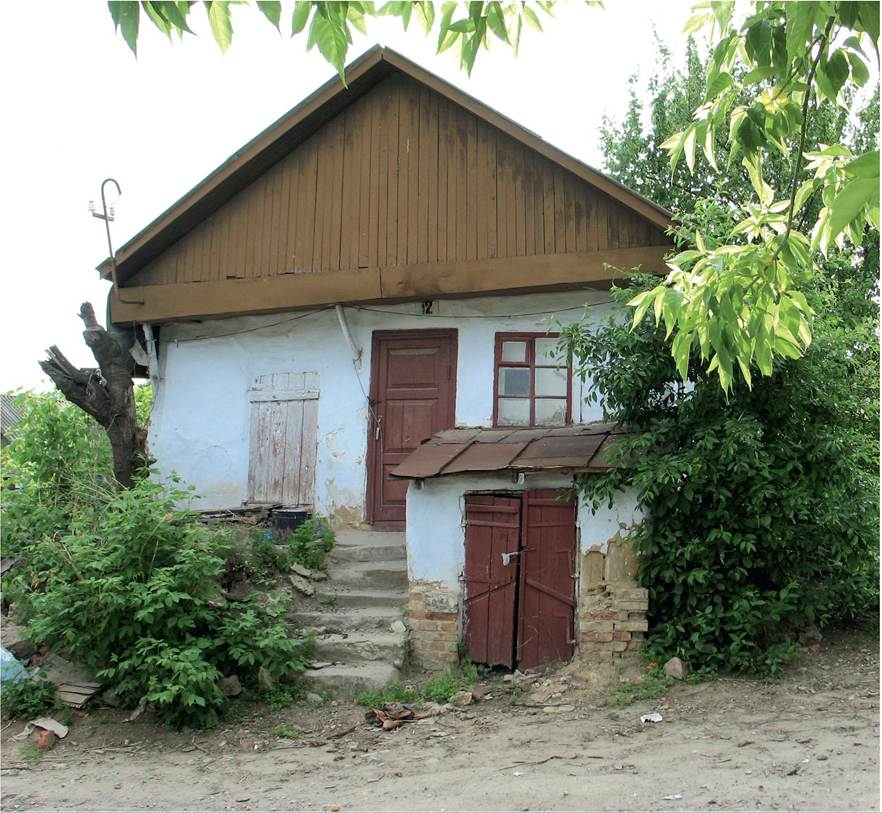
A typical “Jewish” house in Tomashpil, 2007. Residents commonly ascribed ethnicity to the houses in the shtetl. Photo by Artur Fragzak.
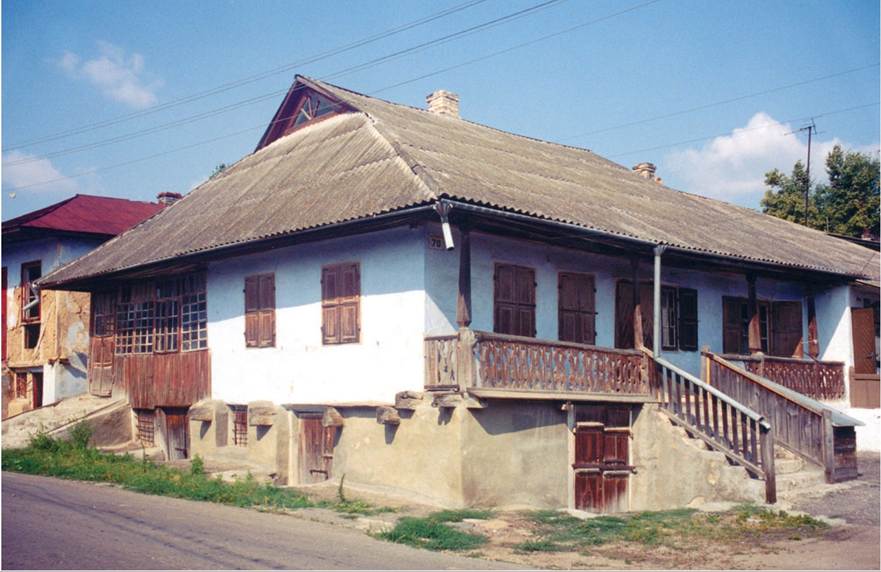
A typical “Jewish” house in Sharhorod, 2002. Photo by Jeffrey Veidlinger.
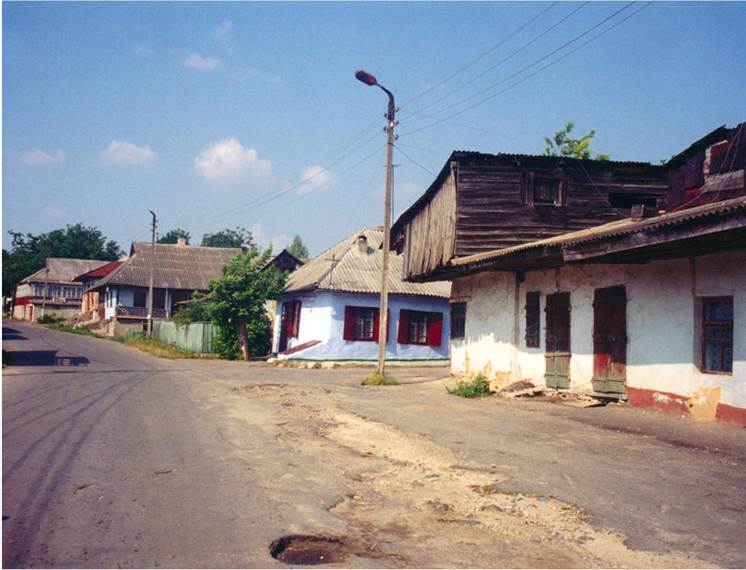
A view down Karl Marx Street from the main square of Sharhorod, 2002.
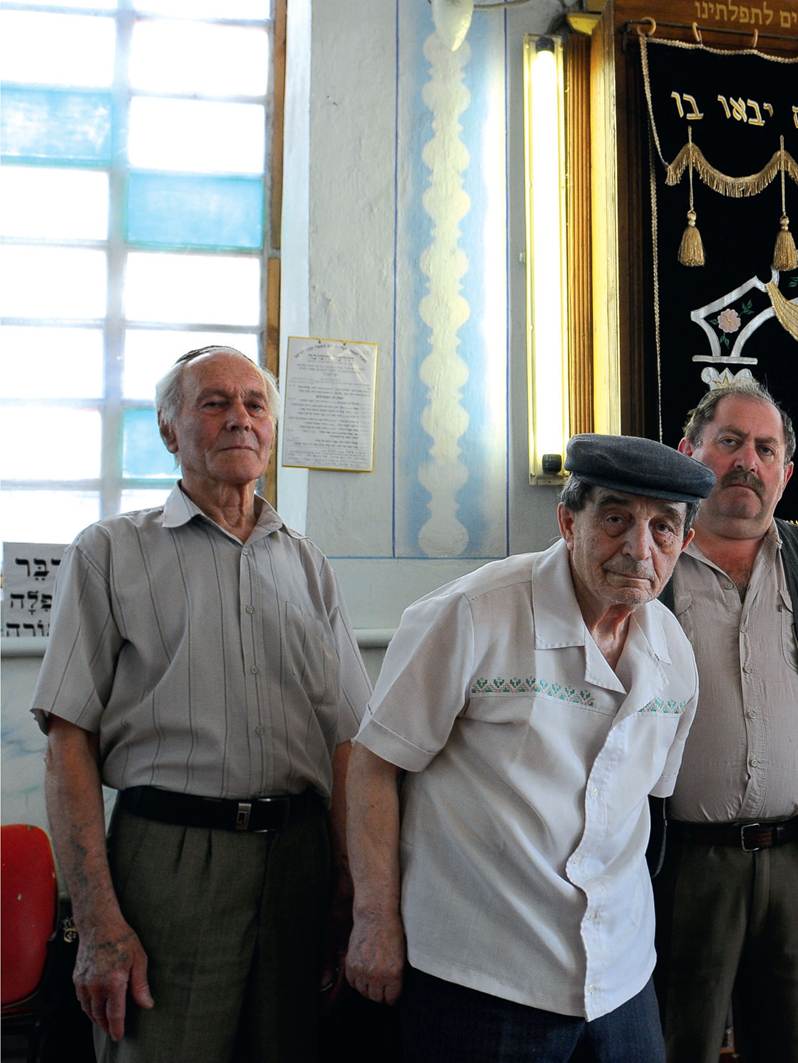
After services in the synagogue of Berdichev. Isaak Vaisman leans forward second from left. Moyshe Vanshelboim stands at far right. Photo by Artur Frayzak.
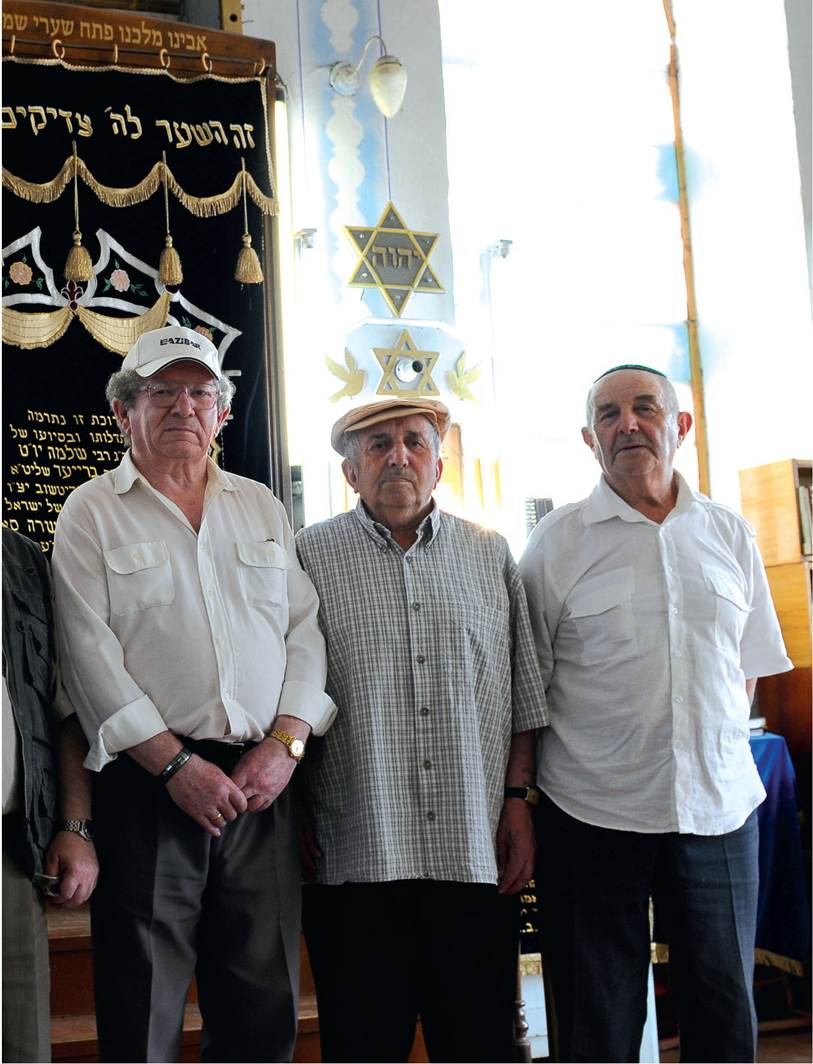
(above) “We are Jews and we must thank God and believe in God and one must not forget God.” Pesia Kolodenker and Nisen Kiselman, 2009. Photo by Artur Fraczak.
(right) “There were woodchoppers, there was a little synagogue for goose butchers, every trade had its own synagogue.” Nisen Yurkovetsky, 2007. Photo by Artur Fraczak.
Alexei Futiran showed us where his name is tattooed on his arm: “During the war, before battle,” he explained, “in case we were killed, so that our name would be known,” 2007. Photo by Artur Fniczak.
“When they set up the ghetto, goyim immediately took our house.
Immediately.” Klara Katsman, 2009. Photo by Artur Fraczak.
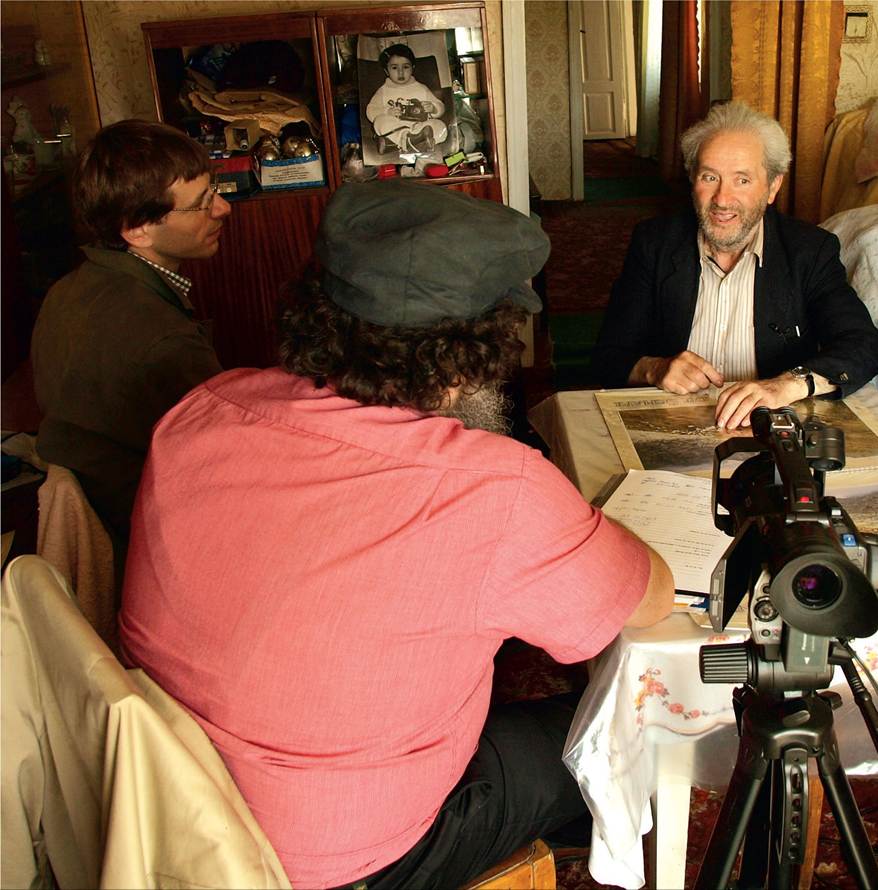
(above) Dov-Ber Kerler and I interview Nukhim Gvinter in 2005 in his Bershad home and workshop. Partially finished leather boots that Gvinter makes are visible behind him to his left.
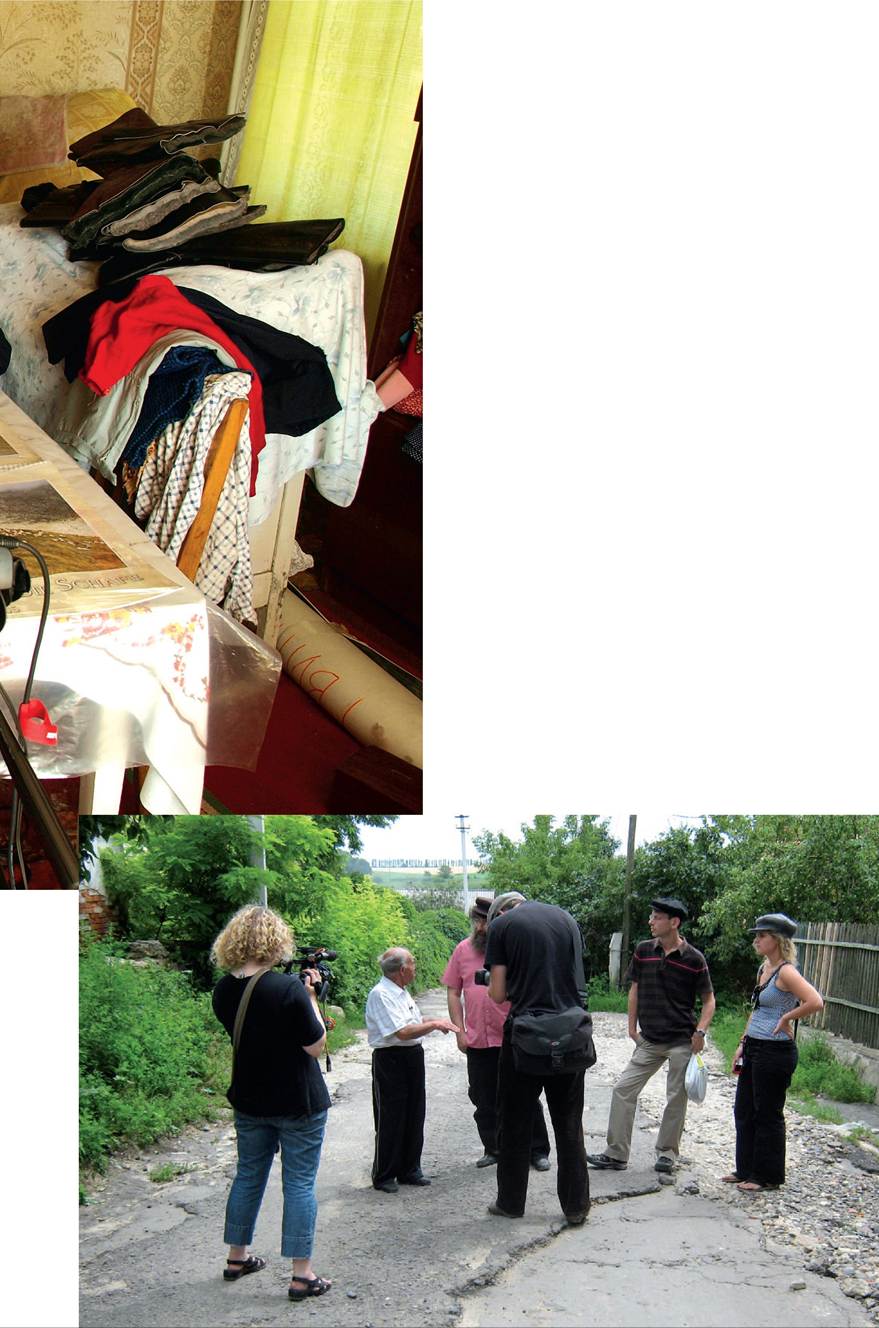
(below) 'The research team in 2009 interviewing Alexei Futiran on the streets of Tomashpil. Artur Fraςzak is videotaping Dov-Ber's conversation with Futiran. Pearl Gluck films Artur. Our graduate student Anya Quilitzsch stands to the side with me. Four of us are wearing hats that we had just purchased from Futiran's home workshop. Photo by Margot Valles.
(right) “There will come a time when all the Jews will be free, and then we will sing a new song.” Yosl Kogan reading from his poetry notebook, 2009. Photo by Artur Fraczak.
(below) “The more I studied the more I learned. And the deeper I studied, the more I was drawn into it.” Aba Kaviner in his
Khmelnytskyy home, 2007. Photo by Artur Fraczak.
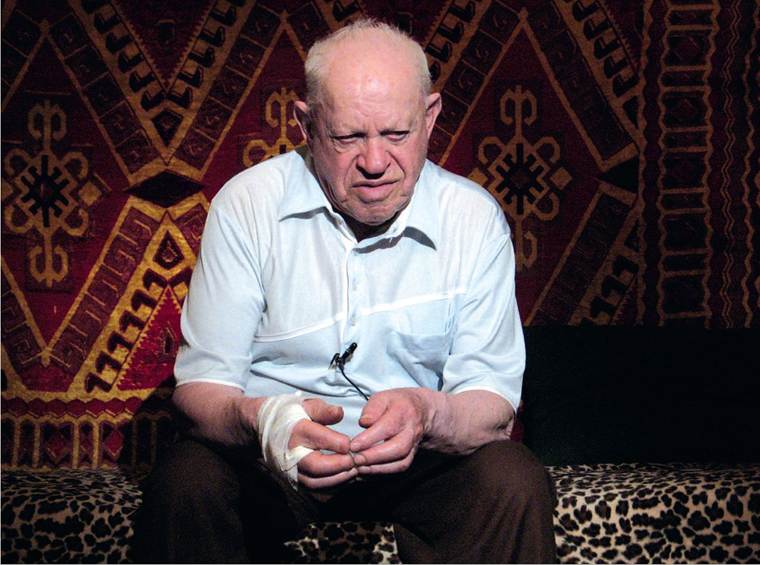
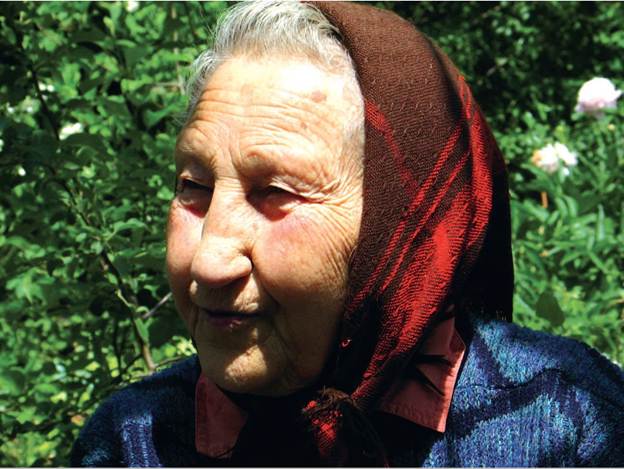
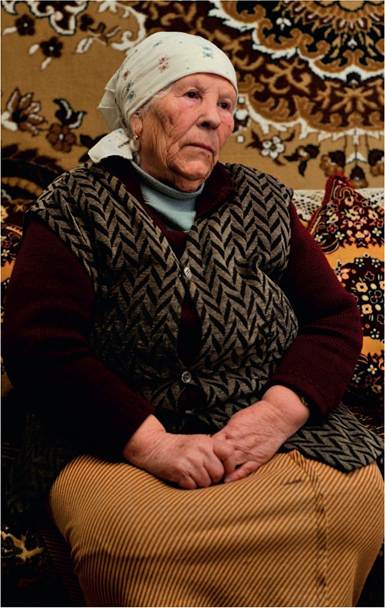
(above) “The war began and the Jewish boys left. Then very many of them were killed.” Klara Sapozhnik in Tomashpil, 2007. Photo by Artur Fraczak.
(left) Frida Pecherskaia in her Tulchyn home, 2009. Photo by Artur Fraczak.
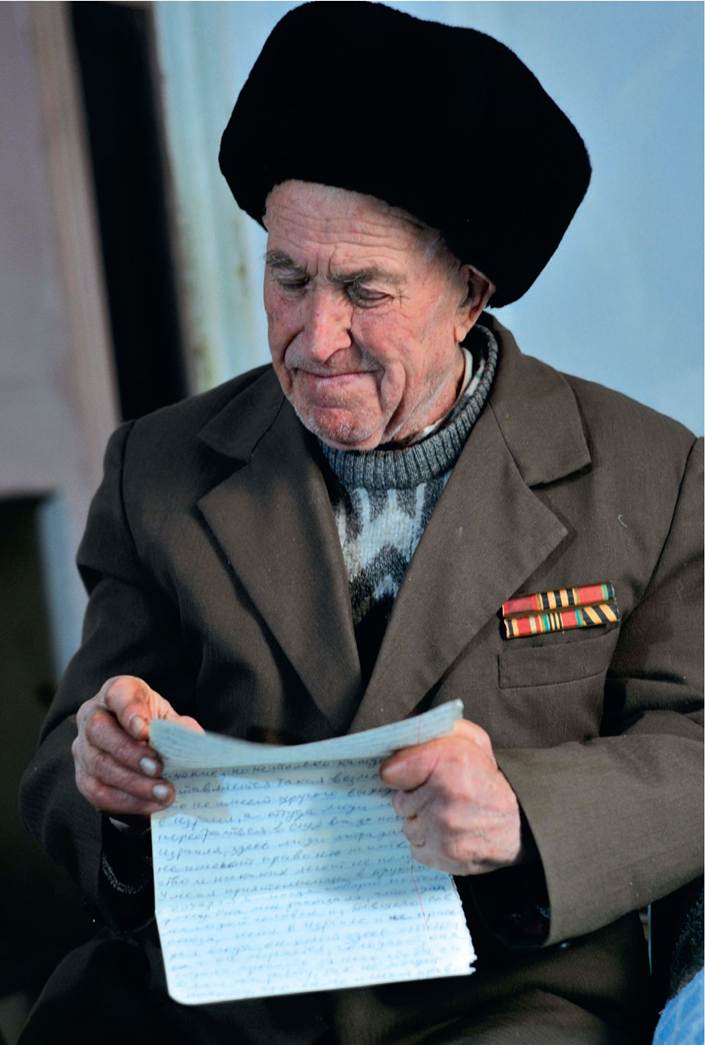
Shloyme Skliarskii reads from the note he wrote to remember the Messiah's message to him. He credits his life-saving decision to hide in the field instead of the forest during the war to a mysterious voice from the Messiah. Photo by Artur Fmczak, 2009.
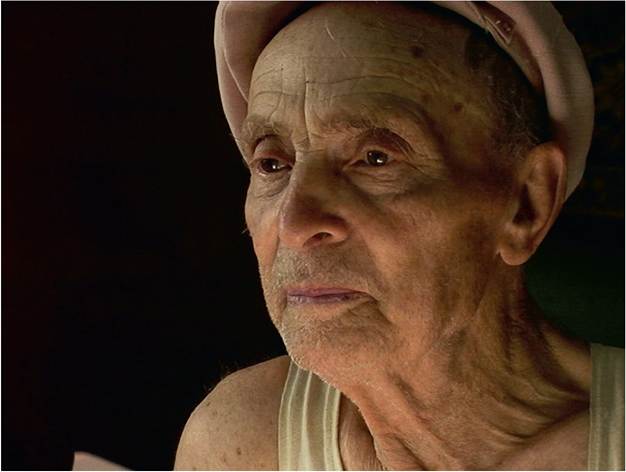
“Our children’s children’s children’s children must know!” Moyshe Kupershmidt in 2002. Photo by Pawel Figurski.
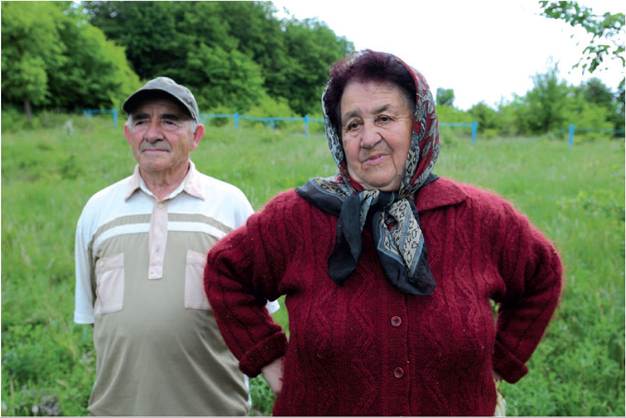
Sasha Kolodenker and Rita Shveibish in the forest clearing by the site of the mass grave near Pechera in 2009. Photo by Artur Fragzak.
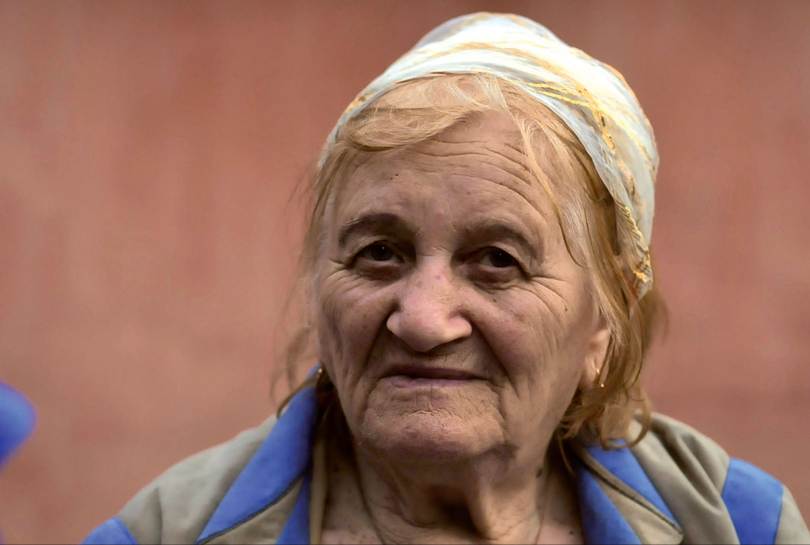
(above) “They forced my father to bury the dead people.” Yente Kolodenker in 2009. Photo by Artur Fragzak.
(right) “My mother didn’t sing. She would cry. She would cry over the world she had lost so young.” Khayke Gvinter in 2005.
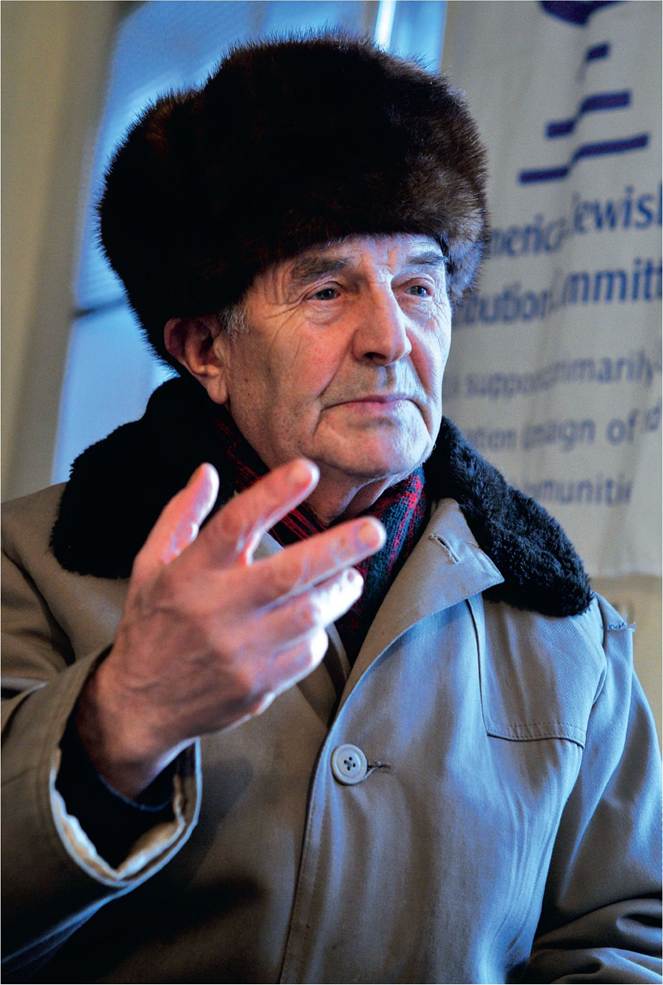
“I remember in the evening the whole street of boys and girls would come and he would play and they would dance.” Moyshe Vanshelboim in 2007. Photo by Artur Fraczak.
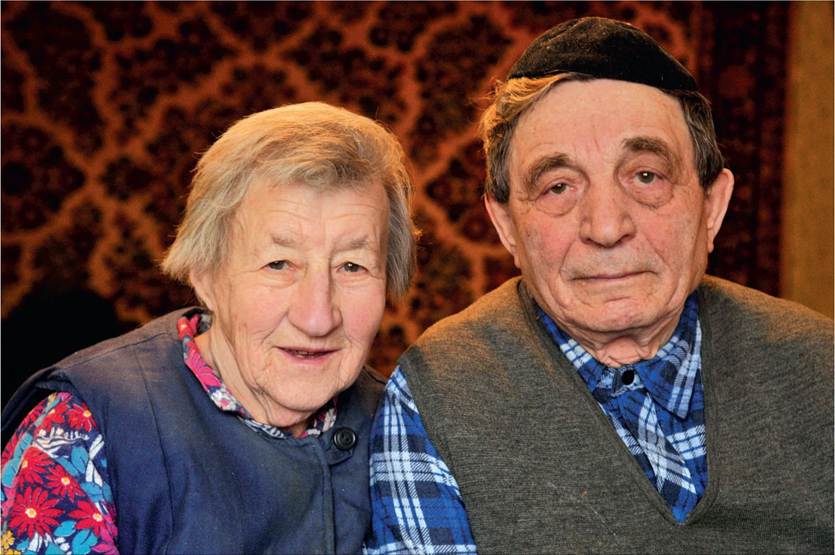
“We lived in the same courtyard. Now he complains to me. Why? Because before the war, I didn't support him: ‘You lived well, so why didn't you?'” Beyle Vaisman and her husband Isaak in 2009. Photo by Artur Fraczak.
JEFFREY VEIDLINGER is Joseph Brodsky Collegiate Professor of History and Judaic Studies at the University of Michigan. He is author of The Moscow State Yiddish Theater (IUP, 2006) and Jewish Public Culture in the Late Russian Empire (IUP, 2009).