Chapter Notes
Preface
1. The name “Ruthenian” is a misnomer, since the term refers to a Gaelic tribe which inhabited the Carpathian Mountains.
2. See for example R. Magocsi (1996), O.
Sub- telny (1994).3. Typical examples would be N.S. Riazanov (1993), G. Vernadsky (1948). For Imperial Russian historiography see V.O. Kluchevsky (1911).
4. A. Wilson (2002). Not only is the territorial location of Rus misplaced, the author follows the common error of designating “the Rus” as a people, whereas the term stood for only a specific territory, the lands of the princes of Kyiv and Chernihiv (see my Chapter 4).
5. P.N. Nadinsky (1951), quoted in A.W. Fisher (1978), 81.
6. The exclusion of Slavs from European history dates to at least Hegel, who recommended in his “Lectures on the Philosophy of History” that Slavs “...remain from our consideration.”
7. From the circular sent to the office of censorship on 18 July 1863, by the Minister of the Interior, Count Peter Valuev.
Introduction
1. A. Reid (1997), A. Wilson (2002).
2. R.D. Kaplan (2012), Harm de Blij (2012).
3. L. Gordon (1983),208.
4. See for example D. Doroshenko, and O. Gerus (1975), O. Subtelny (1994), R. Magocsi (1996).
5. C. Ford “Introduction,” I. Maistrenko (2007).
6. See the panel discussion in I.L. Rudnytsky (1981), 233-68.
7. Interestingly, the only similarity to Ukrainian Cossack rule at the time was CromwelFs England, following the abolition of the Rump Parliament.
8. What is remarkable about Ukrainian is that 70 percent Ofthevocabularyhas common (Proto) Slavic roots. B. Comrie, and G.G. Corbett (1993), 937. Such a high estimated percentage of ProtoSlavic in Ukrainian is what would be expected in a region where the Slavs originated.
9. See L. Gordon (1983), G.P. March (1990). There is a superficial similarity between the Caribbean buccaneer pirates’ activities and Cossack sea raids on Turkish and Persian parts.
10. The complete article is available online at time.com (17 August 2011).
11. VO. Kluchevsky (i960), Vol. 3, 108.
12. See for example T Snyder (2012), A. Beevor(2012).
13. K.C. Berkhoff (2004), 226-31. Anoted exception was the German-speaking settlements, which greeted the German troops.
14. Of Hitler’s allies, only Bulgaria refused to send troops to the Eastern Front.
15. Tukhachevsky was the first to introduce paratroop brigades into the military and experimented with tactics using massed tank formations.
16. UkrainianAcademy of Sciences. See also B. Krawchenko (1986).
17. V Grossman (2005), 248.
18. G. Drozdov, and E. Ryabko (1987), 209. This source claims 3,000, which must be a misprint.
19. K.C. Berkhoff (2004), B. Krawchenko (1986). Some two million young Ukrainian men and women were also deported to Germany and occupied countries as slave labor.
20. Alternatively the Ukrainian People’s Republic, since Ukrainian does not distinguish between “national” and “people’s.”
21. A statistical record of ethnic self-identification is available from Canadian census data which begins in 1901.
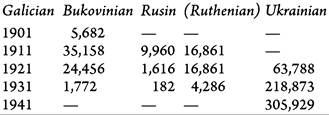
(W. Darcovich, and Yuzyk, 19 8 θ). Ethnicity was only asked beginning in 1911, and in 1901 was given voluntarily. The change in self-identification began during World War I when 60 percent declared themselves “Ukrainian.” Some of the change may be due to events in Europe and to post-war emigration from Galicia and the Carpathian region, but the main reason is due to the Canadian Government. Galicians, Bukovinians, and Rusins (general term, but commonly applied to inhabitants of the Carpathian region) were subjects of the Austrian Crown, and with the outbreak of the war many were imprisoned in camps as “enemy aliens.” Ukrainians, on the other hand, were subjects of the Russian Tsar and thus Canadian allies, and most of the change in self-identification occurred as a defensive measure against imprisonment.
22. P. Sudoplatov, and A. Sudoplatov (1994),
15.
23. B.F. Sabrin (1991), 231. The programme of the OUN is outlined in Y. Bozhyk (1986), 173.
24. Sudoplatov and Sudoplatov, 104-06. Kono- valets was assassinated by the first author, who as a Soviet agent had penetrated the leadership of the OUN Another senior OUN member, Lebed, was also a Soviet agent.
25. See, for B. example, Krawchenko (1986), Subtelny (1994), 375,487. The latter author points out that differences between the “two Ukrainian societies” were major and rested on political, historical, cultural, socio-economic and psychological factors.
26. See, for example, Armstrong (1955).
27. As pointed out by T Kuzio, “nationalism” also requires the quest for a state which embodies independence for a people and their territory.
28. EJ. Hosbawn (1990), 10.
29. E. Gellner (1964), 168.
30. We avoid the common term “Ruthenian,” which is a misnomer. The Ruthenians were a Gaelic (Celtic) people who inhabited western Galicia and the Carpathian highlands before the Slavic invasion.
31. Much terminology (and some grammar) of the Galician and Carpathian “dialects” differs markedly from Ukrainian and they easily qualify as distinct Slavic languages. Thus Sudoplatov points out that the leadership of the OUN spoke Ukrainian “very poorly” and he often had to correct their usage of the Ukrainian language (Sudoplatov and Sudoplatov, 38).
32. Differences and a bitter conflict developed in the early 20th Centurybetween Ukrainian intellectuals such as the historian M. Hrushevsky and the Galician intelligentsia including the great writer
I. Franko (see F.E. Sysyn, XXXIV-V in Hrushevsky, M., 2002).
33. Ukrainians are traditionally Greek Orthodox, and historically have viewed the Greek Catholic Church (“Uniates”) with hostility.
34. O. Figes (2013), 798.
35. The Ukrainian Communist Party (“Uka- pisty”), CommunistParty (Bolshevik) of Ukraine; Ukrainian Communist Party (Borotbisty).
36.
I. Maistrenko (2007), 79.37. A.E. Adams (1977),250.
38. Many Galician soldiers were also being affected by Bolshevik and other communist propaganda.
39. The somewhat fantastic claim that the Ukrainian national movement and language took its inspiration from Galicia can still be encountered in recent writings. See for example M. Yurkevich (1986), O. Figes (2013), 84).
40. Testimony from Captain M. Basilevsky of the Divisions’ Doroshenko Regiment.
41. T Snyder (2010), K.C. Berkhoff (2004).
42. B.F. Sabrin (1991), 260; Sudoplatov and Sudoplatov, 250.
43. The Greek Catholic Church owed its presence to the repression of the Greek Orthodox Church by the Polish Commonwealth, followed by the Austrian Imperial Government policy to close all remaining Greek Orthodox churches following the last partition of Poland. Also, between 1929 and 1938 hundreds of Ukrainian Orthodox churches were either destroyed or converted to Roman Catholicism in Polish-occupied western Volynia, Polissia, Cholm, Pidlachia and southwestern Belarus.
44. The claim can be found in well-known publications on Ukrainian history, such as R. Magocsi (1996), 632; O. Subtelny (1994), 472.
45. J.P. Himka (1990), 494.
46. See Berkhoff (2004), 296.
47. S. Shevchuk and the Polish Archbishop J. Michalik met in Warsaw on 28 June 2013 to sign an appeal for reconciliation, as reported in the 4 July 2013 edition of the Ukrainian weekly “New Pathway,” published in Toronto, Canada.
48. J.A.Armstrong (1955), 48; D.Pohl (2004). Emigre Galicians from “Western Ukraine” attest to high school education.
49. Other local collaboration occurred in the lands of the Don and Kuban Cossacks. Soviet prisoners of war also joined Vlassov’s German organized brigade but most prisoners refused to collaborate, and some two million died from starvation and maltreatment. Individual Ukrainians also collaborated but this was not common, due in part to the brutal German behavior as was admitted by Hitler’s Minister of Propaganda in his personal diary: “We have hit the Russians and especially the Ukrainians, too hard...
a clout on the head is not always a convincing argument.” The same cannot be said however of much of the German-speaking settlements. Berkhoff (2004), 226-31.50. Berkohoff (2004), B.F. Snyder (2010).
51. Sudoplatovandsudoplatov.
52. Associated Press, as reported by the Winnipeg Free Press, June 15, 2013, A30.
53. J. Erickson (1983), 234.
54. The Gestapo and the S.S. were declared criminal organizations by the Allies.
Chapter One
1. WJ. Burroughs (2005).
2. MV. Anikovich, et al. (2007).
3. WJ. Burroughs (2OO5).
4. J. Hawkes, ed (1974).
5. M. Gimbutas (1989), 71.
6. M.P. Hijma, and K.M. Cohen (2010).
7. Today the Dnipro Rapids are under water, flooded by the dams and reservoirs built between 1927 and 1958.
8. J.P. Mallory (1989),268.
9. Some common Indo-European words (V.G. Childe, 1987).
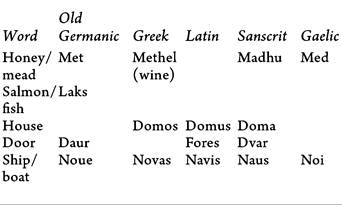
Slavic/ Baltic
Med/medu
Loksha/ Ioshika
Dom Dver/dverus Nav (Armenian)
10. Mallory (1989), 149.
11. K. Jacobs (i993).
12. DW Anthony (2007).
13. M. Gimbutas (1992).
14. Gimbutas (1989).
15. Gimbutas (1977).
16. E.N. Chernykh (i992).
17. Gimbutas (1973).
18. Gimbutas (1991).
19. Chernykh (i992).
20. E.D. Phillips (1965).
21. A. Underhill (2000), R.R. Wells, et al. (2001).
22. Anthony (2OO7), 181.
23. Anthony (2OO7), M. Gimbutas (1992), Mallory (1989).
24. Chernykh (i992) 42-43.
25. Anthony (2007), 200.
26. The view has been popularized by historically unsound works such as M. Jankovich (1971). Some recent archaeological evidence for the Asian origin of horse domestication also seems to be misinterpreted such as in Dolukhanov (1996), 70. The site at Batai (Kazakhstan) is dated to 3300 вc, later than on the Pontic-Caspian steppe.
27. Anthony (2007), 402.
28. C.V. Kremetski, et al. (1999).
29. Bokonyi (1987).
30. Mallory (1989), 199.
31. See Anthony (2OO7) and M. Levine (1999) for the horse controversy.
32. Fagan (1992).
33. Gimbutas (1992), 40.
34. A. Smith (1776), 674, text and footnote 26.
35. Gimbutas (1977).
36. H.A. Bankoff (1977).
37. Some authors such as A.M. Khazanov (1994,90) deny the existence of a common system by pointing out the differences between the subcultures, rather than what was common to them all.
38. It is tempting to think that the height of the burial mound depended on the number of warriors that showed at the funeral feast, and to contribute to the pile of soil which was being erected over the pit grave. The mounds were probably erected out of respect, to prevent animals from grazing on the grave.
39. Anthony (2OO7), E.N. Chernykh (1992), Mallory (1989).
40. Even silver was used occasionally to make weapons, such as the spearhead found in the Borodino hoard in Moldavia. Chernykh (1992), 230.
41. Surprisingly authors such as T Champion, et al. (1984) ignore archaeology from eastern Europe and continue to espouse Outdatedviews.
42. Chernykh (1992), 101-05; Gimbutas (1973), 175.
43. Chernykh (1992), 66, 106.
44. S.R. O’Brian, et al. (1995), H.H. Leuschner, etal. (2002).
45. As pointed out in A.M. Khazanov (1994, 72), a single horse would require some 2400- 2500 kg of hay over the entire winter.
46. Anthony (2007), Gimbutas (1992).
47. Gimbutas (i973).
48. WJ. Burroughs (2005).
49. M. Gimbutas (1992).
50. Rig Veda; quoted in tr. W Doniger (1981), 52-53.
51. Ibid., 90-91.
52. Ibid., 69.
53. Ibid., 25.
54. Ibid., 27.
55. See Penka (1883), Kossima (1921).
56. Gimbutas (i973).
57. D. Ya. Telegin (2005), 354.
58. Anthony (2007), 367.
59. Anthony (2OO7), Chernykh (1992).
60. Even to this day the white pieces, representing the Aryans, open the game by attacking the black pieces, representing local inhabitants.
61. Giles (1921). Modern Hindi and the Slavic languages share many similar words.
62. The first preserved human remains were uncovered in the Siberian permafrost at Pazaryk. S. Rudenko, et al. (1970).
63. VH. Moir (1995), E.B. Russo, et al. (2008).
64. Rig Veda; quoted in tr. W Doniger (1981), 236-37.
65. The first metal to be smelted was probably gold, which has a melting point similar to copper.
66. S. Rudnicki (1918), A.L. Mongait (1961).
67. Anthony (2007), 336.
68. Burroughs (2OO5).
69. Fagan (2000).
70. M. Dolukhanov (1996), 94.
71. N. Bird (1982), J.P. Mallory (1989).
72. Herodotus IV, 108. Quoted from trans. A. de Selincourt, revised introd, and notes J. Marin- cola, 276.
73. Herodotus I, 214. Quoted from trans. A. de Selincourt, revised introd, and notes J. Marincola, 93.
74. Herodotus IV, 13. Quoted from trans. A. de Selincourt, revised introd, and notes J. Marincola,
245.
75. Herodotus VII, 60. Quoted from trans. A. de Selincourt, revised introd, and notes J. Marin- cola, 439.
76. Herodotus I, 106. Quoted from trans. A. de Selincourt, revised introd, and notes J. Marincola, 49.
77. Herodotus IV, 17. Quoted from trans. A. de Selincourt, revised introd, and notes J. Marincola,
246.
78. Pseudo-Hippocrates, Airs, Waters, Places, quoted from “Hippocratic Writings,” ed. and intro G.E.R. Lloyd, trans J. Chadwick and WN. Mann, 163.
79. Ammianus Marcellinus, Histories; quoted from trans M. Rolfe, 1954.
80. S.S. Hall (2007).
81. Cited in S. Rudenko (1970), 212.
82. J. Davis-Kimball (1997), 45.
83. Herodotus IV, 127-28. Quoted from transl. A. de Selincourt, revised introd, and notes J. Mar- incola, 282-83.
84. Some Scythian tombs contain skeletal remains of women who were buried with their weapons.
85. See also Jeremiah, 5: 15-18 of the King James version of the Old Testament.
86. M. Hrushevsky (1997), Vol. 1, 100, 85.
87. Herodotus, IV, 62 whose account is supported by archaelogical evidence from Zaporozhia, southern Ukraine.
88. Herodotus, IV 73-75. Quoted from trans. A. de Selincourt, revised introd, and notes J. Mar- incola, 264.
89. R. Rolle (1989).
90. Herodotus, IV. 114-117. Quoted from trans. A. de Selincourt, revised introd, and notes J. Marincola, 278.
91. N.I.C. Field (2006).
92. J. Davis-Kimball (1997), 44-45.
93. Perhaps related to the Latin “tagma” or a military unit consisting of about three centuries of 100 men each. In the Turkic languages “tamga” meant “seal.”
94. See C.S. Littleton, andL.A. Malcor (2000).
95. There were many Sarmatians in the Avar host who themselves seem to have been of a mixed racial background.
96. Maurice, "Strategicon,” XI, 2; quoted from transl. GT. Dennis (1984), 116.
97. Maurice, “Strategicon” Book VII, 11; quoted from transl. GT. Dennis (1984), 72.
98. The word derives from the old Iranian root “raokh” which means “light” or alternatively “white.” The term “light” was also used for “west.”
99. Ammianus Marcellinus; “Histories”; quoted from trans. J.C. Rolfe.
100. Quoted in Mallory (1989). Judging by the amount of feed which each horse received, they could not have been very big.
101. E.B. Russo, et al. (2008).
Chapter Two
1. The intellectual achievements of Greek thinkers was truly unprecedented. Although owing much to previous civilizations the Greeks advanced knowledge and understanding of our world to a greater extent than any time before. By inventing logic they originated mathematics as we know it today, based on rigorous proofs. At Thebes one Philolaus the Pythagorean described the spherical earth as one amongst other planets revolving about a central fire, while one of his students, Leucippus, attributed the origin of the stars to the combustion and concentration of matter drawn in the movement of circular vortex (the nebulae?). His student in turn, Democritus, is famous to this day for his view of the atomic composition of matter. He saw the Milky Way as a multitude of stars and considered the universe as a periodic collision and destruction of an infinite number of worlds. About 500 вс Heraclitus noticed limestone imprints of seashells high in the mountains and concluded that the mountains had risen from the sea, and continued to do so. He went on to propose that everything is in motion and change, and nothing remains constant. Also Greek philosophers such as Empedocles understood something about the evolution of animal species, holding that all organisms had originally come from earth, moisture and heat. They had therefore come from each other by change, so that man also evolved from lower animal forms. Aristotle, for example, held the view that man had developed beyond other animals because his erect posture freed his hands for grasping things. On the technical side, Heron of Alexandria had developed a rudimentary form of steam engine in the 3rd century вс. Results in geometry (such as the Pythagorean Theorem) are described in the SanscritVedic Iiteraturewhich (probably) pre-date much of Greek geometry. We also owe our numerical (“Arabic”) numbers to the north IndianVedas.
2. The modern European continent, as opposed to the original Greek “Evropa” which consisted only of Greece and parts of the Balkans.
3. For greater detail see TJ. Cornell (1995), C.S. Mackay (2004).
4. The Etruscans, a non Indo-European people were the original inhabitants of Italy, and part of the agricultural system of Old Europe.
5. The Senate was an elected body of government of the Republican State, consisting of 300 former magistrates, but sometimes expanded to 600 or 900 members. Magistrates were elected by the Roman citizens in assemblies, and formed the executive branch of the state. The two consuls or chief magistrates were also elected in this way and had the power to expel members from the senate for immoral behaviour.
6. Le Glay et al. (2005) 112.
7. From the Greek “oligarkkes” or rule by the few (“oligoi” or few; “arkko” or rule).
8. Tribunes were elected by popular assemblies for one year only and had wide powers in order to defend the Plebians—see Le Glay et. al (2005) for a description of the Roman dual (and parallel) system of laws and government.
9. Mackay (2004).
10. These numbers probably included non- combatants such as old people, women and children.
11. Cicero, “De Officius,” I, 150-51, quoted in Walbank (1967).
12. Consuls became the heads of state under the Republic with two elected every year. They survived under the Empire but with reduced powers.
13. Le Glay et al. (2005).
14. There is a possibility that Commodus was not Marcus Aurelius’ natural son given his wife Faustina’s loose lifestyle.
15. Ad Demetrium, 3; WR. Inge, The Philosophy of Plotinus (London: Longmans, Green & Co., 1929).
16. Many refer to this period as the beginning of the fall of the Roman Empire, yet this was not the case, as future events would show.
17. S. Williams (1985).
18. “Christ” is from the Greek “christos” or the “anointed one,” implying that he was the Jewish Messiah sent by God to free the Jewish people.
19. Paul of Tarsus’ father had obtained Roman citizenship by serving as a tent-maker in the Roman army
20. Mackay (2004). The term “pagensis” gave rise to “pagan” meaning anyone who worshipped the old gods.
21. The catacombs also served as meeting places for assemblies, the entrances being marked by drawing a fish, the secret Christian logo at the time rather than the cross, perhaps symbolizing the “miracle” of the multiplying loafs of bread and fish. The word for fish in Greek was IXOYE, which were also the initials for “Jesus Christ God’s Son, Savior,” with Jesus being referred to in code as “the fisherman.”
22. By the end of the 4th century the population of the Empire totaled some 70 million inhabitants, 20 million of those in Gaul and 6 million in Italy (Le Glay et. al., 2005).
23. Constantine the Great, as he became known, was born in the city of Naissus, Province of Moesia around ad 274.
24. Quoted in S. Williams (1985).
25. From the Latin “religare,” to bind.
26. In today’s Turkey
27. Patriarch, from the Greek “pater” or father, and “arches” or ruler; Pope, from the Latin (and late Greek) meaning father.
28. Recounted in a 13th century Icelandic saga due to Snorre Sturlason, who describes the wanderings of Odin and the Ases, who traveled from the Don River to the Malaren region of Sweden. Odin seized a part of the territory laid down laws, and established a religion. The saga is based on a 9th century Norwegian epic, the “Yuglingatal” by Thiodolf of Hvin. The Caucasian Ossetians, who speak a Sarmatian language, also have a tale of “Odin’s” travels, but in reverse.
29. H. Wolfram (1988), 115; C.S. Littleton, and L.A. Malcor (2000).
30. G. Vernadsky (1943), Vol. 1. 118-19.
31. Jordanes was a Romanized Greek who was commissioned by Cassiodorus, Flavius Magnus Aurelius (490-483) to prepare a one-volume summary of his much fuller work entitled “DeRebus Geticum,” which is now lost. Cassiodorus himself was a Roman scholar attached to Theodoric, the Ostrogoth King of Italy.
32. Quoted in N.I.C. Fields (2006), from N.Y. Bichurin (i95θ).
33. M. Kulikowski (2007). Sources other than Ammianus also comment on the rapacious behavior of Roman slavers. In what follows we use the term “Romanian” rather than “Roman” to distinguish the Eastern Roman Empire from the disintegrating western part.
34. It is not clear whether the elimination of Gothic units in the Roman eastern forces was due to an attempted uprising or in order to prevent one.
35. D. Nicolle (1992).
36. The term “Byzantine” is of recent origin and has been the source of much confusion, at times suggesting that the eastern part was somehow not a legitimate continuation (and evolution) of the Roman Empire. Indeed a citizen would have been puzzled if addressed as a “Byzantine,” referring to himself as Roman. The term “byzantinism” has acquired a negative connotation and is still used today to imply a devious, convoluted and bureaucratic activity.
37. The name Peter was presumably given from the Greek “petra” meaning rock.
38. Gaiseric had a record of betraying agreements and alliances. Earlier while still in Spain he had unexpectedly turned on his Alan allies, massacring many of them.
39. To vandalize; a willful or ignorant destruction of something of value.
40. Following the Huns’ military aid under their leader King Rugila, Theodosius II had agreed to a payment of 350 lbs of gold per year. By Attila’s time, the tribute grew three times this amount, with Theodosius granting Attila a large area in central Europe.
41. This virtual annihilation of the Burgundians forms the background to Wagner’s cycle “Der Ring des Nibelungen” (The Ring of the Nibelungs).
42. See S. Turnbull (2004) for a detailed description of the defensive structures of Constantinople.
43. To affix his official signature, he would in later life use a golden template to trace his name.
44. See, for example, D. Kagan (1967).
45. D. Nicolle (1992).
46. The Eastern Empire still referred to itself as Roman or “Rhomaioi” in Greek, and not Byzantine as it is often called.
47. Procopius; SecretHistory, III, G.A. Williamson (1990 transl), 51.
48. A jurist, Tribonian was appointed as Quaestor in 529; the highest law officer in the Empire. A man of great knowledge and learning; he was a non-Christian pagan and; paradoxically; known for great personal corruption.
49. Procopius, Secret History, III, G.A. Williamson (1999 transl.), 61-62.
50. The enthusiasm of the troops was maintained by the custom that they could loot anyone whom they had killed.
51. The tallest cathedral in Western Europe would be built in Chartres, France, with walls reaching 118 feet and requiring flying buttresses for support.
52. Interestingly, the spoils included the sacred Jewish seven-branched candlestick or “menorah,” which had been taken from the Temple in Jerusalem by Emperor Titus in ad 71 and brought to Rome. Gaiseric had taken it in turn to Carthage when he looted Rome. The “menorah” was returned to Jerusalem by Justinian together with the other Temple Vessels.
53. Sherrard (1966), 12.
Chapter Three
1. Procopius, SecretHistory, quoted from G.A. Williamson (1999 transl), 85.
2. Linguistic analysis indicates the Balto- Slavic languages to be the closest to Latin, of the languages not based on it.
3. Archaeological finds can be found illustrated in M. Gimbutas (1971) and M. Barford (2001).
4. The lack of interest is illustrated by S. Runciman (1948). “The great works of the Byzantines in conserving the culture of the ancients is well known and often emphasized. Their achievement of almost equal importance in disseminating their own civilization to barbarian nations is less fully recognized, chiefly because the nations which benefited most stand somewhat apart from the main course of European history. These are the nations of the Slavs, in particular the Slavs of the south and east.” A somewhat astonishing claim given that Slavic nations, particularly those of eastern Europe, helped to shape much of European (and world) history. Other caricatures of Slavic history can also be found, surprisingly, in fairly well-known sources (see, for example; The Cambridge Medieval History, Vol. II, Chapter XIV).
5. See K. Polanski (1993). Wendish is spoken by a minority in the vicinity of Cottbus and Goritz on the Elbe River, to the northeast and east of Dresden. These are survivors of a larger population most of which perished under the Nazi genocide program.
6. Jordanes; Gothica Some authors deny that the Veneti on the Vistula were a Slavic-speaking people. Schenker (1995), for example, mentions a non-Slavic tribe living in today’s Latvia which were called “Vindi” or “Winden” in German, in the 13th century. This however, could be a simple transferring of an older name to a more recently encountered people. The name “Veneti” was also borne by different European tribes at different times (See Chapter 2), but the balance of evidence points to the Vistula Veneti as being Slavs.
7. Procopius; Wars, Vol. 27.1. Procopius was born around 500, but the exact date of the writings is not known.
8. The Greek insertion of a “k” (“c” in Latin) to the proper noun “Slovin” was due to the fact that the consonant permutation “si” did not exist in the classical languages.
9. Procopius; Wars (V11.14, 25).
10. There is some confusion on this point in the literature, for example the contradictory statement that although Spali in Slavic means giants, such an unfriendly name is typically used to label foreigners, and thus the Spali were probably not Slavs (Wolfram, H. 1987, 43) (IX, 3).
11. Procopius, 269-273.
12. Theophylact Simocatta (Vl.6.7-7.2).
13. Theophylact Simocatta (Vl.8.5).
14. Theophylact Simocatta (Vl.2.7).
15. Procopius; Wars (VII 14.22).
16. Leo the Wise; Tactica?
17. Maurice’s Strategikon (XI, 4).
18. Barford, M., 140.
19. Procopius; Wars (VI16-22).
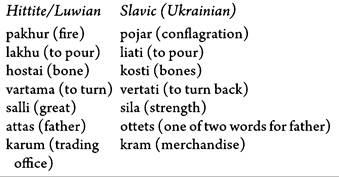
20. Some words in Hittite and Slavic (Ukrainian) O.R. Gurney (199θ), J.P. Mallory (1989):
21. See Barford, M., Fig. 9.
22. See also M. Kazanski (1999) The Slavs would provide the last barbarian prisoners of war for the Romanian Empire; many of whom were sold as slaves. This provided the term for “slave”: “sklabos” in Greek; “sclavus” in Latin, and “saqlob” in Arabic. Needless to say, ethnic solidarity did not prevent Slavic tribes from raiding and selling members of another tribe into slavery.
23. The pagan Slavs were sun worshipers with priests referred to as “sviat-chenik” or “he of the (sun) light.”
24. “Bog” in Gaelic, “Baga” in Iranian and “Bhaga” in Sanscrit. In contemporary Slavic, “Bagno” refers to a wetland such as a marsh or bog.
25. Lithuanian “Perkunas,” Sanscrit “Parjanya,” thought to derive from the proto-Indo-European “per” (“perk,” “perg”) meaning to strike. Perun was the Slavic equivalent of the Greek and Roman divinities of the sky, Zeus and Jupiter, who were also Gods of rain, thunder and lightning.
26. Today in Ukrainian, the term “Vidma” designates a witch, and is used to scare children.
27. Even today in most Christian European countries (except where English is spoken), Christmas is simply referred to as (the) “Birth.”
28. Quoted in M. Barford (2001).
29. Procopius (Wars VII.14, 22-30).
30. W.J. Burroughs (2005), M. Dolukhanov (1996).
31. R.B. Stothers (1984).
32. Menander the Guardsman; Historia, Part Three, R.C. Blockley (ed.) (1985), ARCA Classical and medieval Texts, 17; F. Cairns, Liverpool.
33. John of Ephesus; Historia Ecclesiastica. The size of the Avar force seems to be exaggerated.
34. Procopius; The Secret History, VI. G.A. Williamson (1999 transl.), 106. The term “Europe” did not include the western and northern parts of the continent.
35. Maurice’s Strategicon. G.T. Dennis (1984 transl.), 8.
36. Maurice’s Strategikon; Book I, Introduction. G.T. Dennis (1984 transl.), 11-13.
37. Maurice’s Strategikon; Book II, The Cavalry Battle Formation. G.T. Dennis (1984 transl.), 23.
38. By contrast the Strategicon is less generous towards the individual qualities of the Germanic troops, the "... light-haired peoples such as Franks, Lombards and others like them.” After praising the love of freedom and fierce fighting methods of the Germanic forces, it is less impressed by their individual qualities. “They are easily corrupted by money, greedy as they are. They are hurt by suffering and fatigue. Although they possess bold and daring spirits, their bodies are pampered and soft, and they are not able to bear pain calmly. In addition, they are hurt by heat, cold, rain, lack of provisions, especially of wine, and postponement of battle.”
39. Thus even today populations of Bulgaria and Serbia have no more than 8 million and 10 million inhabitants, respectively. Other Slavic states in southern and central Europe are even less populated.
40. The Strategicon further describes in detail the ambush techniques and surprise attacks both in daytime and at night.
41. Using place-names the German archaeologist Vasmar (1941) has shown that by the 7th century the number of Slav settlements in Greece itself had become substantial. Eyewitness evidence also indicates that Slavic was spoken in some villages in Southern Greece until the end of the 19th century.
42. Under threat of Attila’s attack (Section 2.4), the new defenses were completed in what must have been a record time of 3 months. This was made possible by the huge pool of manpower available, since the building and repair of the walls was something which every citizen was required to take part in, regardless of rank or position.
43. S. Turnbull (2004).
44. Isidore of Seville, Historia Gothorum, Wan- dalorum, Sueborum.
45. Fredegar; Chronicon, Book IV
46. Theophanes, Chronicle (H., Turtledove, 1982 transl.), 48. The numbers seem exaggerated for 6,000 men would form a Romanian army, consisting of 2-3 meros (regiments) of some 3,000 men each. It does not seem likely that the Slavs would be allowed to form an entire Imperial army. The devastation caused by the Arab forces is also surprising, since they tended to demand ransom from the towns in return for leaving their surroundings intact (Nicolle, 1992, 18).
47. Theophanes, 62.
48. Theophanes surely exaggerates the size of the Slav “special army,” since 30,000 men would be out of proportion to normal imperial practice. Thus an army was usually made up of two or 3 “meros” (regiments), each meros consisting of 10 tagmas (tactical units) of 300 men each. This would give an army of some 6,000-9,000 men.
49. Theophanes, 64.
50. Theophanes, 65.
51. In 705, the Bulgar Kagan Tervel was invested as Caesar by EmperorJustinian, or Tsar in Slavic. After “Emperor,” this was the second highest title in the Empire.
52. C. Wells (2006), 146.
53. Theophanes, 122.
54. Theophanes, 125.
55. The basis of the Paulicians’ belief was the eternal dualism between good, which had created light an invisible world, and evil which produced darkness and matter, including the human body. They rejected the Old Testament, as well as the physical fact that Christ was incarnated. Marriage and human reproduction were condemned since they were inspired by the devil or the world of darkness (Obolensky, D, 1971).
56. D. Obolensky (1971).
57. Quoted by D. Obolensky (1974), 172.
58. D. Obolensky (1971), 120-121.
59. Leo VI, Tactica, XVIII; quoted by D. Obolensky (1974), 113.
60. W. Durant (1950), vol. iv, 93-94.
ChapterFour
1. Photius, Homilies, transl. C. Mango, 1958.
2. Russian Primary Chronicle, transl. S.H. Cross and O.P. Sherbowitz-Wetsor (1953).
3. M. Hrushevsky (1997), Vol. 1, 308. The events described are plausible, since we know the Greeks had fire-retardant agents by this time.
4. Nestor, The Tale of Bygone Years (Chronicles of Rus).
5. Quoted in A.M. Schenker (1993), 53.
6. Maurice, Stratetigon, 120.
7. M. Gimbutas (1971), 81-82.
8. M. Dolukhanov (2001), 164.
9. See F. Curta (2001), 239-243. For a description of Correspondence Analysis see A. Basilevsky (1994).
10. Quoted in J. Martin (1986), 1.
11. J. Martin (1986), 6-7.
12. G. Vernadsky (1943), Vol. 1.
13. M. Barford (2001), 97-98, 131-133.
14. S. Franklin, and J. Shepard (1996), 83.
15. A jeweler for example was referred to as a “serebrenic” meaning silversmith, from the Slavic “serebro” or silver.
16. Prokopius of Caeseria, The Gothic Wars, 4.4. Quoted in M. Hrushevsky (1997), Vol. 1, 147.
17. M. Hrushevsky (1997), Vol. 1, 147-148.
18. M. Hrushevsky (1997), Vol. 1, 173.
19. M. Dolukhanov (1996), 146, 171.
20. M. Barford (2001), 241.
21. The presence of Scandinavian tools has led some authors to conclude mistakenly that Staraia Ladoga was a Scandinavian settlement. There is, however, a total lack of Scandinavian names in the region.
22. M. Barford (2001), 170.
23. M. Barford (2001), 179-80.
24. Some 200,000 coins have been found in 1400 sites in north and eastern Europe, from the beginning of the IOth century. M. Barford (2001), 175-76.
25. Another early form of currency also discovered in hoards were iron bars known as “grivny,” about 20 cm in length. M. Barford (2001), 174.
26. M. Barford (2001), 168.
27. A. Curry (2008).
28. The word for “sail,” “parus” in eastern Slavic, is taken from the Greek “pharos.”
29. M. Barford (2001), 235.
30. G. Vernadsky (1943), Vol. 1 has provided a popular but a fictitious account of Skandina- vian conquests of the Rostov region, Verniy Sal- tiv and the Oka River territory “no later than ad 700.”
31. B. Arrhenus (199O).
32. B. Maimer, 1990).
33. The Russian Primary Chronicle, 59.
34. See, for example, W.D. Allen (1963), 1.
35. A.M. Schenker (1995), 57.
36. TheAnnals of St. Bertin, Quoted in J.L. Nelson, ed. and transl., 44.
37. V Sichynsky (1953), 33.
38. M. Barford (2001), 173.
39. Russian Primary Chronicle, 61. The Kyiv Chronicle also has incomprehensible descriptions, such as “the inhabitants of Novgorod were once Slavs but are descended from the Varangians.”
40. Russian Primary Chronicle, 59. Novgorod was not yet built during the time of Ruriks supposed invitation to rule it. The claim that the Khazars imposed a tribute of white squirrels on the Po- Iiani and Severian tribes is probably also incorrect.
41. It is claimed that according to linguistics, the derivation of the word “Rus” from the Finnish “Ruatsi” is quite logical, whereas its development from “Ros” (a Ukrainian river) according to phonological laws in no case could produce the name “Rus” (Dolukhanov, M., 2001,189-90). The claim borders on the nonsensical and in what follows is disregarded.
The insertion of the article “the” for “Rus” is a common alteration of the Kyiv Chronicle for authors who seek to demonstrate that “Rus” refers to an ethnicity (usually Scandinavian) and not the territory of the Kyiv Princes (see for example S. Franklin and J. Shepard, 1996, 29, 38).
42. Ibn Khurradadhbih; The Book of Ways and Realms, quoted in B.A. Rybakov (1984), 46-47.
43. See H. Paszkiewicz (1954).
44. Russian Primary Chronicle.
45. See M. Barford (2001), 236.
46. N. Riazanovsky (1993), 24,
Chapter Five
1. V Baran (1986), Vol. 3.
2. Some authors have made the unlikely suggestion that the fortifications were erected to assist in the collection of tribute by the Khazars, who supposedly dominated the area (Franklin, S. and Shepard, J., 1996, 96). There is no evidence for such a scenario since the fortifications were built to keep enemies out, not to facilitate the paying of tribute.
3. The trident was later adopted as Prince Vladimir’s sign and today is the Ukrainian national symbol.
4. O.M. Ioannisyan (1990).
5. Russian Primary Chronicle. S.H. Cross, and O.P. Sherbowitz-Wetzor (1953), 54.
6. N. Golb, and O. Pritsak (1982), 54. Also G. Vernadsky (1943, Vol. 1), 301 attempts to give a Bulgar derivation to the well-known Slavic names of Kyi (hammer), Shcheck, KhorivandLebed (Swan). The names however are typically Slavic and can be found as far west as the Czeck Republic.
7. M. Hrushevsky (1997), Vol. 1, 307.
8. A.M. Schenteer (1995), 57.
9. Quoted in M. Hrushevsky (1997), Vol. 1, note 28, 290.
10. M. Hrushevsky (1997), Vol. 1, 311.
11. Quoted in V Sichynsky (1953), 32-33. The Volynians referred to here could have been Pomeranian Slavs along the southern Baltic (Section 7).
12. Quoted in V Sichynsky (1953), 35-36.
13. Although the official schism of the Church between Constantinople and Rome had not occurred, the western Roman Church had already diverged significantly from the Nicean Creed especially following Charlemagne’s patronage.
14. The Slavic noun “druzhina” is often translated as “retainers,” a word which does not convey the closeness of a “druzhina” to its “kniaz” or prince. The men-at-arms consisted of “drughs,” literally “seconds,” and originated from the Slavic warrior buddy system by which “drughs” always fought together in battle. Members of the prince’s “druzhina” were his bodyguards, and many had grown up with him. The bonds between two Slavic “drughs” were usually sealed by exchanging breath through the mouth or by a “kiss,” making them soul brothers.
15. The Russian Primary Chronicle, 60-61.
16. We can infer that Oleg possessed Scandinavian longboats since Slavic dugout canoes would have been too small to hide Oleg’s men.
17. The Russian Primary Chronicle, 61.
18. The Primary Kyiv Chronicle’s account of the shilling tribute is unlikely since it was an uncommon western coin and not minted at the time.
19. Constantine Porphyrogenitus, G. Moravik and R. Jenkins (translated, 2008), 56, 57.
20. All seven rapids are now submerged under dammed reservoirs built in the 1930s during Soviet industrialization, to provide both electricity and navigation.
21. The Russian Primary Chronicle, 64.
22. Leo the Deacon, 155-156.
23. The Primary Kyiv Chronicle lists the following names: Karl, Ingjold, Farulf, Vermund, Hrolof, Gunnar, Harold, Kami, Frithleif, Hroar, Angantyr, Throand, Leithulf, Fast, and Stein. Some of the names were not clear in the original text and had to be “restored,” but the names are not Slavicized, indicating professional Varangians in Oleg’s retinue.
24. The title “Great Kniaz” is often translated as Great Prince, but the Great Kniaz of Kyiv was in fact a king, wielding great power and controlling a large territory.
25. M. Barford (2001), 239.
26. al-Masudi’s numbers are highly unlikely since Rusian ships were fairly small and could not carry many men. As noted by Emperor Leio VI, in the 890s; “Northern Scyths (the Slavs) use smaller lighter-weight and faster craft than the Arabs... because descending upon the Black Sea along rivers, they cannot use larger ships.” (Leio VI, “Tactic a”).
27. Quoted in V Minarsky (1958), 150-153. Again, the numbers are greatly exaggerated.
28. The Russian Primary Chronicle, 72.
29. Constantine Porphyrogenitus G. Moravik, and R.H.J. Jenkins (translated, 2008), 57-63.
30. In Slavic, ‘’’poliudia” literally means “among (or to) the people.” This was a system by which the prince with his entourage would collect the annual tribute and settle local affairs.
31. The Russian Primary Chronicle (1953), 84.
32. Ibid. The Primary Kyiv Chronicle attempts to lighten the imposition of tribute by Sviatsoslav by claiming that the Viatichi were already paying tribute to the Khazars. Given their location and reputation for independence, however, it is unlikely that the Viatichi were tributaries of the Khazars.
33. Quoted by M. Hrushevsky (1997), Vol. 1, 351.
34. The Iasy (today’s Ossetians) were the remnants of the Sarmatian Alans who had settled in the northern foothills of the Caucasus Mountains. The Kasogians (Kasags); also known as Circassians (Chercesy), were also an Iranian people living on the eastern shores of the Sea of Azov, and the Black Sea.
35. Leo the Deacon; IV, 5. Quoted in Talbot and Sullivan (2005), 110.
36. Nikephoros choice indicates that the contact between Kyiv and Constantinople was to be personal and secret, since growing up in Cherson Kalokyres would have been fluent in Slavic.
37. Leo the Deacon; IV, 6 (Talbot and Sullivan, 2005, 111-112). Elsewhere the men of Rus are called “Scythians,” but for unclear reasons since Tsar Symeon of Bulgaria is also designed as a “Scythian.”
38. Leo the Deacon, VI, 8 (Talbot and Sullivan, 2005, 153).
39. There are several reasons which suggest that Leo the Deacon’s numbers are highly exaggerated and biased, as they are throughout his account. Given the population levels in eastern Europe at that time, it would have been extremely difficult to raise such a large force of men “in their prime.” Also, given Sviatoslav’s rapid method of travel he would not have had “service units,” as claimed by Leo the Deacon. The logistics of transporting such a large body of men, by land or sea would have been prohibitive. To guarantee a steady supply all food, for example, supplies would have been brought with the army, especially since we know that the Eastern Empire and the adjoining regions had experienced famine for the past three years.
40. Leo the Deacon, V, 2 (Talbot and Sullivan, 2005, 128) The author claims that the Bulgarian army consisted of 30,000 men which seems to be an inflated figure.
41. Obolensky (1971), 168-69. The Bogomils’ views of social equality and their championship of the poor against the rich and powerful brought the Bulgarian government to a violent persecution of the Bogomils, which merely increased their popular support. The Bogomil movement spread to other parts of the Balkans at the turn of the Ilth century, including southern France where they became known as Cathars or simply “les Bugres,” a corruption of “Bulgares.” The word has come down to us in the English language as “Buggers,” the negative connotation arising from the false accusations that they practiced beastly sexual activities.
42. Constantine Porphyrogenitus, 4. G. Morav- cik, and R. Jenkins (2008), 51-53.
43. “Sviatoslav set up Yaropolk (the eldest) in Kyiv and Oleg in Dereva.... The citizens of Novgorod requested Sviatoslav to designate Vladimir (the youngest, and half-brother to Yaropolk and Oleg) to be their prince (kniaz), and he went forth to Novgorod with Dobrynia, his uncle” (The Russian Primary Chronicle, 87).
44. Ibid., 86.
45. When stating that Sviatoslav attacked Pereyaslavets upon arrival, the Primary Chronicle seems to be confusing the city with the capital Preslav.
46. Leo the Deacon (VI, 10) gives a rather uncharitable explanation for Sviatoslav’s victories by claiming that “...he (Sviatoslav) had reduced the Mysians (Bulgarians) to terror and stunned submission with his innate cruelty, for they say that when he took Philippopolis by force, he cruelly and inhumanely affixed to a stake twenty thousand of the men captured in the town, thus terrifying all his enemies and making them come to terms...” In actual fact, the term in Greek was “hang on a phourka” and not “impale” as is at times assumed (see for example, Hrushevsky, 1997; Vol. I, 359). This was a forked stake to which offenders were tied and exposed to ridicule and not necessarily executed (see Talbot and Sullivan, 2005,155, note 93).
47. Leo the Deacon; VI, 10 (Talbot and Sullivan (2005), 157. Professional men-at-arms considered themselves to be superior to craftsmen and laborers who didn’t use arms. The claim of being “bloodthirsty warriors” probably refers to the memory of the old Scythians (and Sarmatians?) whose custom was to drink the blood of the first slain enemy.
48. Skylitzes, quoted in E. McGeer (2008), 294-98.
49. Leo the Deacon; VI, 12 (Talbot and Sullivan (2005), 159.
50. Leo the Deacon (Talbot and Sullivan (2005), 160, note 117), and E. McGeer (2008), 294.
51. The Russian Primary Chronicle, 88.
52. Leo the Deacon; VI, 13 (Talbot and Sullivan (2005), 161).
53. As described by G. Dennis in: Talbot and Sullivan (2OO5), 4-7. Leo the Deacon.
54. Leo the Deacon, VIII, 3-4 (Talbot and Sullivan 2005, 178-79).
55. Leo the Deacon, VIII, 3-4 (Talbot and Sullivan 2005, 179-80).
56. Leo the Deacon; VIII, 4 (Talbot and Sullivan 2005, 18θ). The author then proceeds to give an exaggerated tally of the Rusian dead, without stating the Romanian losses.
57. Leo the Deacon mistakenly puts Sveinald (“Sphengelos”) as ranking third after Sviatoslav (VIII, 7).
58. With customary exaggeration Leo the Deacon puts the force defending the palace grounds at 7,000 men, too large to be accommodated by the compound (Leo the Deacon, VIII, 7).
59. The 60,000-man army ascribed to Sviatoslav’s army is the same figure which Leo the Deacon uses at the beginning of the conflict. Casualties and the difficulty of obtaining reinforcements would have reduced Sviatoslav’s force even if he did enter Bulgaria with the highly inflated number of 60,000 men.
60. Leo the Deacon, VIII, 9 (Talbot and Sullivan 2005, 184-85).
61. Leo the Deacon, VIII, 10 (Talbot and Sullivan, 2005, 185-86).
62. In typical fashion Leo the Deacon does not mention the loss of the siege machinery, but given that the Rus attack was successful we may assume the equipment was also destroyed. The siege machinery is never mentioned in the Chronicle again.
63. Hrushevsky, M, 1997, Vol. I, 361.
64. Leo the Deacon; IX, 7 (Talbot and Sullivan 2005, 195).
65. E. McGeer (2008), 318.
66. Leo the Deacon also makes the implausible claim that whereas 15,500 “Scythians” were killed, only 350 Romans suffered the same fate. Leo the Deacon IX, 10 (Talbot and Sullivan 2005, 198).
67. Quoted in: M. Hrushevsky (1997) Vol. I, 361. No doubt Sviatoslav did not wish to take advantage of Tzimiskes’ extremely short stature, since such a victory would not bring him renown.
68. Leo the Deacon; IX, 11 (Talbot and Sullivan, 2005, 199-200).
69. The Russian Primary Chronicle, 90.
Chapter Six
1. In today’s Belarus.
2. The Russian Primary Chronicle, S.H. Cross, and O.P. Sherbowitz-Wetsor (1953), 91. The reference here is to the fact that Volodimers mother Malusha was Olga’s stewardess-servant, which made Volodimer only a half-brother to Iaropolk.
3. Volodimer entered Kyiv on 11 June 978.
4. The demanded payment must have been in another form since gold grivnias were not yet minted.
5. The Russian Primary Chronicle, 93.
6. In the words of the Primary Chronicle; “I nacha kniazhiti Volodimer v Kieve edin” (and Volodimer began princely rule in Kyiv alone).
7. The Russian Primary Chronicle, 94.
8. Ibid., 95.
9. Near today’s southeastern Belorus city of Mogilev.
10. V. Koropotkin (1989).
11. The Eastern Roman Empire, in spite of temporary lapses, was the most powerful state in Europe at the time.
12. The Russian Primary Chronicle, 97.
13. E. McGeer (1995), 209.
14. Imaginary accounts still persist in some of the English-speaking literature of Volodimers expeditionary force, such as; "... a great fleet of Viking ships... anchored in the Golden Horn and 6,000 burly giants (the Norsemen) disembarked...” (Norwich, J.J., 1998, 209). There is, of course, no evidence or mention of “Vikings” serving in the force.
15. The Russian Primary Chronicle, 112.
16. Another independent account however, known as the “Cherson Legend,” claims that it was a Varangian by the name of Zhbern who fired the arrow informing Volodimer that the besieged city was bringing in water and provisions by boat (see Hrushevsky, M., Vol. 1, 1997, 379).
17. Hrushevsky, M., Vol. 1 (1997), 392-93.
18. The Russian Primary Chronicle, 117.
19. The script which Bishop Ulfilas had created for the Goths when they were in eastern Europe was not adopted by the Franks and the Saxons, who were obliged to use Latin in the Church liturgy.
20. The Serbian script also has the Latin “J” character which does not exist in other languages.
21. The Russian Primary Chronicle, 122.
22. Ibid., 121.
23. The Patriarch’s seat was moved for reasons of security following the destruction of Kyiv by the Mongols.
24. The Russian Primary Chronicle, 122.
25. Ibid., 119. Extreme strength can be due to a genetic condition known as myostatin-related muscle hypertrophy which can result in as much as 40 percent more muscle mass at birth. This could have been the case with the huge Michael Swystun, who was born of Ukrainian parents in Olha, Manitoba. He toured with the Ringling Brothers’ Barnum and Bailey Circus in 1923, where he was billed as “The Strongest Man in the World.”
26. M. Barford (2001), S. Franklin, and J. Shepard (1996).
27. V. Sichynsky (1953), 36.
28. The Russian Primary Chronicle, 119.
29. S. Franklin, and J. Shepard (1996).
30. O.M. Ioannisyan (1990).
31. M. Hrushevsky (1997), 375,404.
32. The Russian Primary Chronicle, 124. What is also of interest about the passage is that during Volodimer’s reign roads had been built, and were used to transport troops by land rather than by boat as had been done before. No doubt roads allowed a greater force to be assembled and provisioned, and could be used to expand trade.
33. A document cited by M. Hrushevsky (1997), 374.
34. V. Sichynsky (1953), 36-37.
35. Adam of Bremen (Tschan, F.J., transl., 67).
36. V. Sichynsky (1953), 37.
37. The Russian Primary Chronicle, 137.
38. Quoted in S. Franklin, and J. Shepard (1996), 238.
39. The Russian Primary Chronicle, 131. Evidently Iaroslav had no difficulties in recruiting Scandinavians after their predecessors had been massacred by the men of Novgorod, although the actual figures are doubtful.
40. The Kasogians, better known as Circassians were a Sarmatian Alan tribe.
41. The Russian Primary Chronicle, 136.
42. O.M. Ioannisyan (1990), 294-95.
43. “Lyadsky” is at times incorrectly translated as “Polish”—see O.M. Ioannisyan (1990), 295.
44. See D.H. Kaiser (1980) for a thorough discussion. There are two versions of Ruska Pravda; the Short Edition and the Expanded Edition which contains more laws and was published later in the Ilth or early 12th century. All original editions have been lost, and today’s versions are reconstructions from later (14th century) expanded legal documents and incorrectly referred to as “Russian Laws.”
45. The articles are taken from G. Vernadsky (1969).
46. The “wergeld” is a Scandinavian term, reflecting that the practice of paying a gold fine for a killed man, if no avenger is available, came from Scandinavia. The statute does not cover women or children.
47. See F.J. Thomson (1978). The author continues the common error of substituting the term “Russia” for the medieval name “Rus.”
48. R. Jette (1996), see also N.W. Ingham (1998). A concise review has been provided by A. Gregorovich (2006).
49. Iaroslav’s name is mangled as it is in many other non-Slavic documents. Also names like Agatha, Margaret and Christina did not exist in England or Scotland at the time. Agatha is from the Greek meaning “good,” Margaret is Greek for “pearl,” and Christina is the feminine version of “the anointed one.”
50. The myth of a centralized “Russian” state was created mainly by tsarist historians such as V Kluchevsky and others.
51. The Russian Primary Chronicle, 145-46. Prince Vsevolod could have practiced pagan rituals, and he has come down in later writings as a werewolf. “He... stalked the night as a wolf (“volk”), ran at midnight like a wild beast, galloped as a wolf along the path of the great Khors (pagan god).” He was also considered to be a pagan priest-sorcerer, a “volkhv.”
52. The Russian Primary Chronicle, 148-49.
53. Quoted in S. Franklin, and J. Shepard (1996), 258.
54. The Russian Primary Chronicle, 201.
55. Idib.
56. Idid., Appendix I.
Chapter Seven
1. JJ. Norwich (1998), 240.
2. Comnena, Anna; Book 15, III-IV E.R.A. Sewter (1969 transl.), 479-80.
3. JJ. Norwich (1998), 254.
4. Fulcher of Chartres. E. Peters (1971 ed. and transl.) 26.
5. J. Harris (2003), 49.
6. Guibert of Nogent, The Deeds of God through the Franks; Book 2, 41.
7. Ibid., 42-43.
8. E. Peters (1971),95.
9. Guibert of Nogent, “The Deeds of God through the Franks”; Book 2, 44.
10. More detailed versions can also be found in E. Peters (1971), 108-14; Guibert of Nogent, Book 2, 44-46.
11. E. Peters (1971), 99.
12. Ibid., 100-04.
13. BothAlbert of Aix and particularly Guibert of Nogent show a clear class bias, enumerating the atrocities of the “common rabble” of the initial Crusade ventures, but often passing in silence over those committed by the feudal lords’ men.
14. J.Harris (2003).
15. Comnena, Anna; Book 10, IX. E.R.A. Sew- ter (1969 transl.), 319.
16. Fulcher of Chartres; IX, 2, 3 (Peters, E. 1971, 41-42). For a negative description of the sworn “contracts” see Guibert of Nogent, 54, who, however, was not a participant of the First Crusade.
17. Fulcher of Chartres; X, (Peters, E. 1971, 43). The number is probably an overestimate.
18. French, Flemings, Frisians, Gauls, Allobro- ges, Lotharingians, Allemani, Bavarians, Normans, English, Scotts, Aquitasians, Italians, Dacians, Apulians, Iberians, Bretons, Greeks.
19. Fulcher of Chartres; XI, 6, 7; XII, 2 (Peters, E. 1971, 46-47).
20. To encourage him to leave, Tatikios was apparently falsely informed by Bohemund that his life was in danger (Anna Comnena, Book II; IV).
21. Guibert of Nogent; The Deeds of God through the Franks; Book 5, 83-84.
22. Guibert of Nogent; The Deeds of God through the Franks; Book 6, 100.
23. Fulcher of Chartres; XXIII, 5 (Peters, E. 1971, 64).
24. W. Durant (1950), Vol. IV; 592.
25. Comnena, Anna; Book II, VI-VII; Book 12,
I.
26. Comnena, Anna; The Alexiad (Harris, 70).
27. JJ. Norwich (1998), 261.
28. W. Durant (1950), Vol. IV; 598.
29. The Third Crusade is well known and is not described here.
30. JJ. Harris (2003), 153.
31. Gunther of Pairis, Ch. 7; AJ. Andrea (1997),81.
32. Gunther of Pairis, Ch. 7; AJ. Andrea (1997),83-84.
33. D.E. Queller, and TF. Madden (1996), 111— 130.
34. Cordial relations (such as they were) had also been strained when a Latin delegation of 3 Frenchmen and 3 Venetians had severely scandalized and angered Greek courtiers, when they reminded Alexios IV and his father that: “If you do this (honor the Zara agreement) they (the Latin leaders) will be extremely pleased; but if not they will no longer regard you as their Lord and their friend, but will use every means in their power to obtain their due.” (Geoffrey of Villehardouin).
35. AJ. Andrea (1997), 170-71.
36. JJ. Norwich (1997), 304.
37. J. Harris (2003), 162. This is the official known value of the loot, for as recorded by Geoffrey OfVillehardouin: “Then each man began to bring in and collect the booty. Some contributed fairly, others poorly, for covetousness, which is the root of all evil, was not idle.”
38. AJ-Andrea (1997), 15-16.
39. J. Harris (2003), XIIL The Pope is affirming the official (but incorrect) view of the Roman Catholic Church, that after Jesus Christ’s death Christianity was first established in Rome and not in the GreekEast.
40. M. Gimbutas (1971). We see a drastic reduction of excavated Germanic artifacts in these territories and an increase in Slavic material.
41. A.M. Schenker (1993), 47.
42. Adam of Bremen; FJ. Tschan (1959), 7. The traditional Western view based largely on German historiography has been that: “By nature not a warlike people... the Slavs took possession of the deserted country,” which supposedly had been completely vacated by the Germanic tribes who “... were, to be sure, hard as steel...” (see note of Chapter 3). Generally however, Germany’s Slavic past is passed over by German historians.
43. A.M. Schenker (1995), 46-47.
44. Quoted in E. Christiansen (1980), 16-17.
45. Adam of Bremen; FJ. Tschan (1959 trans.), 65.
46. Ibrahim ibn Jacub; G. Jacob (1927, ed.), 11.
47. Adam of Bremen; FJ. Tschan (1959 trans.), 67.
48. E. Christiansen (198θ), 29.
49. Adam of Bremen; FJ. Tschan (1959), 83- 85.
50. M-Barford (2001), 259.
51. The Poliane of Poland are not the same tribe as the Poliani of Rus. As the name implies (“those of the plains”) both were dwellers of the lowlands and involved in agriculture as a primary activity.
52. Quoted in A.M. Schenker (1995), 48.
53. Helmold; II, 109. FJ. Tschan (1996 transl.), 278.
54. Quoted in A.M. Schenker (1995), 48-49.
55. Adam of Bremen, Book Two. FJ. Tschan (1959, transl.), 101.
56. Ibid., 132.
57. Ibid., 133.
58. Helmold; I, 25. FJ. Tschan (1966, transl.), 100.
59. Helmold; I, 34. FJ. Tschan (1966 transl.), 122.
60. E. Christiansen (198θ), 33.
61. F. Dvornik (1959), 257-58.
62. Quoted in F. Dvornik (1959), 301.
63. Helmold; I, 88-89. FJ. Tschan (1959), 220-21.
64. Helmold includes an unlikely (and contradictory) account of the Slavs being forced to retreat by some 300 knights and their squires, before Henry’s arrival. Given the magnitude of the Saxons’ defeat the story seems to have been invented by survivors of the battle.
65. Helmold; II1 108. FJ. Tschan (1959), 277.
66. Helmold; I, 88-89. F.J. Tschan (1959), 234-36.
ChapterEight
1. Ioamnisyan, O.M (199O).
2. TS. Noonan (1991), 103.
3. The Galician language is no longer spoken, having been replaced by Ukrainian following the incorporation of Galicia, Bukovina and the Carpathian region into the Ukrainian Republic in 1945 by the Treat of Yalta. In Ukrainian, “perogies” are known as “varenikes.”
4. By the same law the prince and members of his “druzhina” were prohibited from acquiring Novgorod land.
5. J. Blum (1961).
6. Another term for a slave was “rob” (“rab”) which forms the root for the modern Slavic word for “worker.”
7. Vernadsky (1948, Vol.∏), for example, speaks of “The Russian Federation” and ascribes to it “the unity of the Kievan realm...” Many historians also use the name “Rus” to mistakenly denote all the Orthodox Slavic principalities in order to give them a common name, which in fact they did not possess.
8. Some historians have conjectured that the name “Galich” (contemporary Ukrainian Halych) has its roots in the old Indo-European word for salt, “hal,” which was mined in the foothills of the Carpathian Mountains. Just as the name “Ruthe- nia,” which the name most certainly originated with the Gauls or Celts who inhabited the territory before the Slavic conquest, the Ruthenians being a Gaelic tribe.
9. The Nikonian Chronicle. S.A. Zenkovsky and BJ (1984 transl.), 17.
10. The Nikonian Chronicle, 41.1 have corrected the incorrect translation as “the Russian land, which should be “the land of Rus.”
11. Ibid., 50.
12. Ibid., 71.
13. Ibid., 91.
14. Bogoliubsky s letter has not survived and the Patriarchs answer is not dated, but the conjecture is that it predated the sack of Kyiv, which took place several years later.
15. The Kyiv Chronicle (1118-1198). Quoted in J. Pelenski (1998), 46.
16. The origin of Tsarist despotism has been identified as originating in Constantinople in the person of the Eastern Roman Emperor as explained in the following assertion attributed to Agapetus: “Though an emperor in body be like all other, yet in power of his office he is like God, Master of all men.” (Shevchenko, I., 1991, 55).
17. The Nikonian Chronicle, 187.
18. Ibid., 215-16.
19. Quoted in M.Hrushevsky’s (untranslated) Volume III.
20. The Hypatian Codex II (The Galician- Volinian Chronicle). G.A. Perfecky (1973 transl.),
25. The name “Okraina” was used at the time to denote a border land, here the territory between Volin and Poland, then west of the Vepr River.
21. Ibid., 26.
22. R. Bartlett (1993), 112-16.
23. Ibid., 194.
24. E. Mugureics (199θ), 176.
25. The Greek Orthodox Church did not pursue an active policy of proselyting pagan populations, but some had converted voluntarily.
26. The Nikonian Chronicle, 308.
27. When Prince Iaroslav tried to persuade Pskov to break their alliance with Riga and together attack the Livonian pagans (their allies?) he received a remarkable answer. “Our lord, Prince Iaroslav Vsevolodich! You are very intelligent and wise, and you know that we are all descendants of Adam and are all bretheren, relatives, uncles and aunts: we are all the sample people, both the faithful and the infidels. Fighting the infidels without reason is not fitting. We should live at peace with everyone and not interfere in their faithlessness: but we should be at peace with them. When these infidels see that we live in unanimity and love they will come to reason and they will convert and become baptized and then they will all be saved by Christ’s blessing and the blessing of His Most Pure Mother. And now you, Prince, who are so intelligent, you have ordered us to start a war with the people OfRigawithout cause.” TheNikonian Chronicle, 29S.
28. One of the more favourite quotations of Pope Gregory IX was from the bible, Jeremiah (48:10): “Cursed be he who keepeth back his sword from blood.” R. Bartlett (1993), 260.
29. The Livonian Rhymed Chronicle. J.C. Smith, and W Urban (1977 transl.).
30. Ibid.
31. For the unlikely claim that Alexander Nevskyhad Mongol or Turkic archers see D. Nicoll (1996).
32. The claim that Alexander greatly outnumbered his opponents has no basis in documented fact, unless one lends credence to the Livonian Rhymed Chronicle which states that the Crusaders were outnumbered 60 to 1! With superior forces Alexanderwould surely have attacked the Crusader Army as he did the Swedes on the Neva River instead of retreating.
33. The Livonian Rhymed Chronicle: J.C. Smith, and W Urban (1977 transl.). The strange mention of “grass” implies that the writer was not aware the battle occurred in the winter time. Also by then the term “Rus,” “Rusia” was being applied by foreigners to all Orthodoxprincipalities of eastern Europe.
34. Livonian Rhymed Chronicle: J.C. Smith, and W Urban (1977 transl.).
35. V Shpakovsky, and D. Nicolle (2002), 8.
36. G. Vernadsky (1953) Vol. 3, 11, 17.
37. Many Mongols were Christians who were converted by Nestorians, the eastern Orthodox and related Churches such as the Assyrian and Armenian. Some tribes were almost entirely Christian such as the Kereyids and Naimans who had been converted by the Assyrians centuries earlier. Travelers reported that Christmas was routinely celebrated at the Mongol court (Carpini, Giovanni Di Plano).
38. The Hypatian Codex II (The Galician- Volynian Chronicle). G.A. Perfecky (1973 transl.),
28.
39. The Nikonian Chronicle, 286.
40. Ibid., 287. “All the land of Rus” means the southern principalities since the only detachment from the north came from Pskov but arrived too late for the expedition.
41. The Kalka “river” was probably a large stream in south-eastern Ukraine, a tributary of the Kalmius River which flows into the Azov Sea.
42. The Hypatian Codex II (The Galician- Volynian Chronicle). G.A. Perfecky (1973 transl.),
29.
43. The Nikonian Chronicle, 288.
44. The chronicles’ statement that only “every tenth (man) returned to his home” is not to be taken literally since this was the standard phrase to indicate that heavy casualties had been suffered.
ChapterNine
1. Besides using natural oil which was found in the Caspian region the Mongols also introduced gunpowder to Europe.
2. An idea as to the size of armies which the Mongols could raise is indicated by the fact that a simultaneous invasion also took place of the Sung dynasty of southern China with a population of 60 million. The Mongols had a word for an army corps of 10,000 men—a “tumen,” for which a word did not exist in Europe, and there were about 12-14 “tumens” serving under Batu (see J. Fennell, 1983, 84; Vernadsky, G., 1953, Vol. Ill, 49.
3. Carpini, Giovanni Di E. Plano, Hildinger (1996 transl.), 76.
4. The Nikonian Chronicle, 309.
5. Even if all the east European princes had united their forces, given the sparse populations it is unlikely that they could have raised a sufficient force to stop Batu’s army. With a central command and headquarters the largest estimate of the potential force is 60,000 men from all the Greek Orthodox Slavic city states, with the possibility of40,000 others, including the steppe nomads (Fennell, J., 1983, 85). The actual available numbers would probably not have exceeded 50,000 trained men.
6. Besides the large siege trebuchet catapults the Mongols are known to have possessed large crossbows operated on wooden frameworks with a range of up to 250 paces as well as naphtha pots which could be ignited and thrown from smaller catapults, such as the traction trebuchets powered by teams of men. Gunpowder was also used on occasion.
7. The Nikonian Chronicle.
8. “Liadsky Gates” is often but incorrectly translated as “Polish Gates.”
9. The Nikonian Chronicle, 321-22.
10. Carpini, Giovanni Di E. Plano, Hildinger (1996 transl.), 68.
11. Jan Dlugosz. Annals, Michael M (1997 transl.).
12. Archdeacon Thomas of Spalato; “De Peste Tartorum.”
13. Matthew Paris, J.A. Giles (1852 trans).
14. J. Fennell (1983), 84.
15. The Hypatian Codex II. The Galician- Volynian Chronicle. G. Perfecky (1973 transl.), 50.
16. Ibid., S6-S7.
17. Ibid., 61. All three “German” envoys had Slavic names—Zalosh Pursky known as Solsky, Garich Porunsky and Otto Garetennik Petrovsky.
18. Prince Danylo also tried, unsuccessfully to install his son Roman as Duke of Austria by marrying him to Gertrude the Babenberg heiress.
19. By now the name “Rus” had spread to the west and north of the traditional area with certain regions being colour-coded, as “Red Rus” (Galicia-Volin), “Black Rus” (north of Volin) and “White Rus” (today’s Belarus) probably based on the colour of shields carried by the prince’s “druzhina.”
20. The Hypathian Codex IL The Galician- Volynian Chronicle. G. Perfecky (1973 transl.), 88.
21. Ibid., 98.
22. Carpini, Giovanni Di E. Plano, Hildinger (1996 transl.), 95-96.
23. E. Christianson (1980), 99. Along with the knights; many infantry were killed.
24. Ibid., 154.
25. J. Pelenski (1998), 134.
26. E. Christianson (1980), 158.
27. H. Samsonowicz (1982); 54.
28. E. Christianson (1980), 99.
29. Quoted in S. Turnbull (2003), 66.
30. The Chronicler Dlugosz records that Vytautas’ mother was referred to as “a harlot and a dirty old woman.”
31. The feelings would persist into the future, whereby according to some German historians the Teutonic Order did not suffer a genuine defeat by the Slavs and Lithuanians, but was stabbed in the back by a treacherous conspiracy.
32. The Tatars had by now converted to Islam but they formed a very small part of Vytautas’ forces.
33. One of the first Protestant Reformers, Jan Hus was a rector of Charles University in Prague, who was declared a heretic and burned at the Stake in 1415. His death brought on the Hussite wars against the Holy Roman Emperor Zygmunt of Luxemburg which lasted for several decades. Hussite mercenaries were hired by both sides of the Prussian conflict, including Grand Prince Jagiello who hired them for his 1433 campaign against the Teutonic Order.
Chapter Ten
1. Josaphat Barbaro, Di messer Josafa gentil, huomo Venetiano il viaggio della Tana. Venice, 1543 (republished in 1606). Quoted in V. Sichynsky (1953).
2. Quoted in M. Hrushevsky (1999), Vol. 7,3.
3. N. Gogol, “Taras Bulba.”
4. J.B. Scheier (1788), Ch.l.
5. From the “Codex Cumanicus,” a Polovtsian dictionary compiled by an Italian traveler in 1308.
6. Towards the end of the 14th century the entire Slavic-speaking population of Lithuania-Rus is estimated to have been about 1.0-1.5 million inhabitants spread over some 820,000 square kilometers, or less than 2 persons per square kilometer (Stone, D (2001), 67-8). In the steppe region of Kyivan Rus, above the cataracts, there must have been less than one inhabitant per 10 square kilometers.
7. Carpini, Friar Giovannia Di Plano. E. Hil- dinger (1996 transl.), 94-120.
8. J. Dlugosz, “Historiae Polonicae, Iibri XII, 5:530. Avery early mention of “Kozaks” in 1308 is most certainly a confusion with (the related?) name “Kassogs,” an alternative designation for Circassians. A Greek record from the Crimean city of Sudok (Surozh, Saugdaia) states that the death of “...the servant of God, Almalchu (a youth who) was killed by the sword of ‘Kazoks.’” M. Hru- shevsky (1999), vol. 7, 60. For a recent but an unconvincing attempt to trace the origin of the Cossacks to the Kassogians see Glaskow (1972).
9. “Kraina” in the Slavic languages designates a frontier or a border territory, from the word “kraiy” meaning an edge or an end. In Ukraine the word “kraiy” also assumed the secondary meaning for “country or a territory.”
10. V Sichynsky (1953), 45.
11. M. Hrushevsky (1999), vol. 7, 4.
12. D. Stone (2001), 24.
13. “Cossack Mamai” would become a commonly portrayed, stereotypical image of a Ukrainian steppe Cossack, indicating an early Tatar connection.
14. V Sichynsky (1953), 48.
15. Dimensions of some of the early excavated forts are given in M. Hrushevsky (1999), vol. 7,29.
16. D. Stone (2001), 77.
17. A hetman was the commander of a Polish or a Lithuanian army, a title later adopted by the Cossack Zaporozhian army (from the German “Hauptman,” headman or a captain).
18. C.A. Manning (1947), 59-60.
19. Beauplan, Guillaume Sieur de (1650), 6. Beauplan was hired by the Polish Hetman Stanislaw Koniecpolski to design and build his palace near Brody in Galicia in the first h alf of the 17th century. Beauplan lived in the region for 17 years and traveled widely in Ukraine meeting Cossacks on a frequent basis.
20. A. Baranovich (1959), 67.
21. D. Stone (2001), 69.
22. L.R. Wynar, and O. Subtelny (1975), 117.
23. The designation “Turkish” does not imply an ethic or a religious identity since most of the subjects of the Ottoman empire were non-Turkish Greeks, Slavs, Albanians and Caucasian Christians.
24. Much of the hand-to-hand combat techniques have been lost, but some of the saberfighting moves can still be seen in the energetic and original Ukrainian male folk dances.
25. M. Hrushevsky (1999), vol. 7, 44.
26. Ibid., SO.
27. Ibid., 24.
28. L.R. Wynar, and O. Subtelny (1975), 72- 73.
29. The Janissaries were the elite Ottoman infantry corps recruited in the Christian lands, mainly from Balkan Slavs and Greeks. Young boys were taken as a form of tax on the Christian population and raised in military camps as devout Muslims. See D. Nicolle (1995).
30. M. Hrushevsky (1999), vol. 7, 40.
31. The two main economic privileges were the right to own land and exemption from paying taxes, unless a tax was agreed upon. The main political rights were democratic elections and free speech.
32. M. Hrushevsky (1999), vol. 7, 45.
33. Traditional Polish historians have usually considered the Ukrainian Cossacks as bandits, not subject to any authority and lacking in redeeming features. Gordon (1983) has given expression to this view by characterizing Cossacks as “social bandits,” in what seems to be a misunderstanding of Hobsbawn (1959). Although some individual Cossacks did turn to highway robbery, the entire movement can hardly be charged with Mafia-type banditry as is done in the extraordinary comparison by Longworth (1969), 60. Presumably being labeled as “bandits” was due to the fact that they did not represent state authority.
34. Slavery also existed in Christian Europe but not nearly to the extent it was practiced in the Ottoman Empire where slaves played an important, and at times a respected role.
35. The “duma” or “thought” was a Cossack folk ballad tradition which was intended to evoke both thought and feeling. It is different from other songs in its poetical construction, irregular rhythm, and metre, and is usually improvised, at least in part, to suit the audience or the occasion. The prototype of the duma goes back to Kyivan Rus, the best known being the “Word of Igor’s Host” describing Prince Igor’s campaign (and defeat) against the steppe nomads (Howes, R.C., 1973).
36. M. Hrushevsky (1999), vol. 7, 74.
37. Beauplan, Sieur de (1650), 61.
38. Ibid., 6. Associated with celebrations is a Ukrainian word of Cossack origin, “hyliaty” which has no precise translation but can assume different meanings associated with a pleasant or a good time, such as to dance; to party, to cavort, or more recently to go for a pleasant walk.
39. Ibid., 5-6.
40. Ibid., 4-5.
41. Translated from Javornitsky (199θ), 197.
42. S. Ettinger (199θ), 25.
43. Ibid., 127.
44. S.J. Borovoi (1997), 211.
45. Ibid., 214.
46. The Church of the Union became known as the Greek Catholic Church and would survive mainly in Galicia being banned in Ukraine.
47. See, for example, Siefker (2006), 122.
48. G. Bowler (2005).
Chapter Eleven
1. The term “Zaporozhia” is commonly rendered as “beyond the rapids” which is a mistranslation of the Slavic “porog,” literally meaning the threshold of a house, and has nothing to do with river rapids as such. In the absence of a Ukrainian word for “rapids” or “cataracts,” they came to be designated as “porohi.” The cataracts were demolished in the 1930s during the Soviet Union’s industrialization plan to provide navigation to the Black Sea.
2. D.I. Javornitsky (1990 in Ukrainian), vol. 1, 46.
3. L.R. Wynar, and O. Subtelny (1975), appendix 1, 112.
4. In Ukrainian “za porozhska sich,” literally “the palisade beyond the rapids” where the word sich (palisade) is derived from the Slavic “sicaty,” to chop.
5. The ballad is given in Ukrainian in D.I. Ja- vornitsky (1990 Ukrainian transl.), vol. 2, 21.
6. The Royal Marines motto is: “Cheerfulness in the Face of Adversity.”
7. L.R. Wynar, and M. Subtelny (1975), Appendix 1, 113.
8. M. Hrushevsky (1999), vol. 7, 108.
9. Ibid., 109.
10. Ibid., 110. Three fundamental rights were established: the right to bear arms, the freedom of movement, and the freedom of expression and elections.
11. The Polish chronicler Martin Bielski (1495- 1575), in L.R. Wynar, and O. Subtelny (1975), Appendix I, 112.
12. M. Hrushevsky (1999), vol. 7, 113.
13. D. Stone (2001), 85.
14. V. Sichynsky (1953), 58.
15. Beauplan, Sieur de (1650), 100.
16. A. Vimina (1890 edition).
17. Beauplan, Sieur de (1650), 7.
18. Machiavelli, Niccolo (1521). Arte della Guerra. Ellis Fameworth translation, N. revised, Wood (1990), 19-20.
19. A roll call in 1577 of 200 men of the Kyiv garrison revealed 111 muskets and 34 long pikes demonstrating the importance placed on firepower.
20. D.I. Javornitsky (1990 Ukrainian transl.), vol. 2, 32-33.
21. R. Brzezinski (2006).
22. D.I. Javornitsky (1990 Ukrainian transl.), vol. 2) 30.
23. We know that even in 1520 there were no settlements on the Don River from Voronezh in Muscovy right down to the Sea of Azov, a distance of some 800 kilometers.
24. A. Seaton (1985), 49.
25. Another possible origin for “stanitsia” is the term “stavnitsia” or “stopping-over place.”
26. Don Cossack settlements such as “Cher- kask” (“place of the Cherkessy”) and “Novo Cher- kask” (“New Cherkask”) were named after the Ukrainian Cossacks, who were known as “Cherkessy” in Muscovy.
27. A larger force of several thousand men, which is at times ascribed to Yermak’s force, is not very likely for such a venture and would have been unwieldy, besides being beyond the Stroganov’s private means. Large forces of such size were also difficult to raise in that period during the Livonian War.
28. Y. Semyonov (1963), 57. Yermak’s lieutenants, such as Koltso, were called “hetmani,” plural for “hetman,” a rank borrowed from the Polish- Lithuanian Commonwealth, and amongst the Cossacks was only used in Ukraine.
29. M. Hrushevsky (1999), Vol. 7, 34.
30. G. Krasinsky (1947).
31. Y Semyonov (1963), 99.
32. Longworth (1969), 73-74.
33. Dezhnev filed a report of his travels with the governor of Yakutsk, who was to forward it to Moscow, but never did. It only became known in Moscow in 1736, eight years after Bering’s first voyage. His voyage however seems to have been known in Siberia where all maps before Bering show water north and east of Siberia which excludes any possibility of land between Asia and North America.
34. Longworth (1969), 73.
35. B.P. Polevoi (1987), 27. Other Cossacks had probably reached Alaska before Popov’s account since when a Russian expedition landed in Alaska towards the end of the 18th century it reported that they found a mysterious people living along the shores which were distinguished from other natives in that they wore long beards, prayed from a book, bowed to Orthodox icons and understood Russian.
36. J.R. Gibson (1976), 4. At the time there were 5 rubles to the U.S. dollar.
37. Ibid., 8.
38. Ibid., 112.
39. JJ. Norwich (1998), 317.
40. D. Nicolle (1983), 22.
41. FineJVA (1987), 410.
42. The nerve center of the Ottoman Empire was the “Sarai, the Imperial enclosure in Constantinople almost 5 kilometers in circumference which housed some 80,000 imperial civil servants. Admission was through a single guarded and highly ornamented gate, described by French envoys and ambassadors as “La Porte Sublime.”
43. Roxolana was captured as a young girl by the Tatars on one of their raids into Galician Rus and sold to the Sultan’s harem where she caught the eye of young Suleiman. She was said to have possessed great beauty and wisdom, and her views were often sought by the Sultan.
44. D. Stone (2001), 67-68; G. Vernadsky (1959), Vol. IV, 175.
45. L.R. Wynar, and O. Subtelny (1975), Appendix 1, 112.
46. L.R. Wynar, and O. Subtelny (1975), Appendix 2, 116.
47. Ibid., 116-117.
48. Ibid., 82.
49. Long lost, it was published in German in 1866.
50. L.R. Wynar, and O. Subtelny (1975), 84. The threat of drowning refers to the Cossack prohibition of any armed violence (including dueling) which would result in a non-accidental death of another Cossack. In the event of bloodshed resulting in death the killer would be buried alive with the victim.
51. L.R. Wynar, and O. Subtelny (1975), 89.
52. The prohibition of alcohol during a campaign was noted by foreign eyewitnesses such as Beauplan who wrote that “...they be as subject to drunkenness as any other northern nation yet they are wonderfully sober in war.”
53. L.R.Wynar (1965), 68.
54. Ibid., 69.
55. M. Hrushevsky (2002), vol. 8, 170.
56. Beauplan, Sieur de (1650), 61.
57. M. Hrushevsky (1999), vol. 7, 254.
58. Ibid., 271.
59. Ibid., 276.
60. The ambush probably occurred on a dark night to minimize Cossack casualties.
61. M. Hrushevsky (1999), vol. 7, 342; note 156.
62. Mehmet’s brother Shahin had captured Kaffa, the story goes, with the help of700 Cossack prisoners who were held by the Tatars. After the Turks were defeated the surviving Cossacks were rewarded with Turkish booty and money, and escorted safely to the north above the rapids.
63. Beauplan, Sieur de (1650), 4.
64. Ibid., 6.
65. V Sichynsky (1953), 66.
66. M. Hrushevsky (1999), vol. 7, 236.
Chapter Twelve
1. M. Hrushevsky (1999), 7, 132.
2. D. Stone (2001), 196-97.
3. During the Price Revolution there seems to have been a shortage of silver coinage, in spite of the silver which was being mined by the Spanish in the NewWorld. Much of the silver however was not reaching Europe, but as revealed recently by an analysis of 16th century coinage, the silver was being traded in China by the Spaniards (Geology, Vol. 40.).
4. Beauplan, Sieur de (1650), 7-8.
5. S. Lepiavko (1996), 52.
6. Ibid., 60.
7. M. Hrushevsky (1999), Vol. 7, 143-44.
8. Beauplan, Sieur de (1650), 6-7.
9. S. Lepiavko (1996), 87.
10. Ironically, this was the same family as that of Baida Vyshnevetsky (Section 11.1). Like many other aristocratic families of Rus they had converted to Roman Catholicism.
11. M. Hrushevsky (1999), Vol. 7, 151.
12. Ibid., 161.
13. S. Lepiavko (1996), 180.
14. Ibid., 194.
15. R. Brzezinski (1987).
16. Hrushevskys (1999) figure of 6,000 Cossacks with as many women and children cannot be correct. A defensive “tabor” of 12,000 individuals was virtually impossible to operate and feed. Also, 6,000 Cossacks could have neutralized Jolkiewskis army especially since Loboda’s Zaporozhians had artillery. The figure of 6,000 only makes sense if it includes both fighting men and civilians.
17. S. Lepiavko (1996), 214.
18. L. Gordon (1983), 206.
19. A. Seaton (1985), 49.
20. M. Hrushevsky (2002), Vol. 8, 294.
21. The origin of Tsarist autocracy is at times mistakenly ascribed to “Asiatic Despotism,” supposedly introduced by the Mongols.
22. R. Hellie (1971).
23. SeeAvrich (1972).
24. Avrich (1972).
25. From the Turkic-Tatar word “sahaidak” or a quiver for arrows, indicating that he was an expert marksman with a bow and arrow. This was in accordance with the practice that a Cossack was given a new “name” once he was accepted into the Zaporozhian Brotherhood. A full member also shaved his head and grew a lock or a “herring” as it was referred to.
26. Sahaidachny had already been deposted once in 1617 and replaced by Dmytro Barabash.
27. M. Hrushevsky (1999), Vol. 7, 361.
28. Ibid., 361.
29. Ibid., 368.
30. Ibid., 375 nl.
31. Sultan Osman II also died in 1622, killed during a Janissary revolt.
32. M. Hrushevsky (1999), Vol. 7, 383.
33. Ibid., 290.
34. Ibid., 376.
35. M. Hrushevsky (1999), Vol. 7, 386-87. From Polish records.
36. Ibid., 421-22.
37. M. Hrushevsky (2002), Vol. 8, 89.
38. M. Hrushevsky (1999), Vol. 7, 433.
39. M. Hrushevsky (2002), Vol. 8, 80.
40. Ibid., 81.
41. B.N. Florja (Transcript, Old “Russian” as in Moscow).
42. Hrushevsky also (mistakenly) puts the Polish part of Koniecpolskis Crown army at 6,000, and Triasylos force at 37,000!
43. Longworth (1969), 94.
44. M. Hrushevsky (2002), Vol. 8, 84.
45. Ibid., 86.
46. Ibid., 86.
47. Ibid., 90.
48. Ibid., 166.
49. Ibid., 171.
50. The term “Liakhs” designated what today would be called ethic Polish people, while the name “Polish” was used to refer to all subjects of the king and members of the Polish Commonwealth, irrespective of ethnicity.
51. M. Hrushevsky (2002), Vol. 8, 176.
52. Ibid., 186-87.
53. Ibid., 183.
54. Ibid., 209.
55. Ibid., 212.
56. Ibid., 230.
57. These were Baida Vyshnevetsky’s descendents who had converted to Roman Catholicism and had become one of the most anti-Greek Orthodox and anti-Cossack family in Ukraine.
58. M. Hrushevsky (2002), Vol. 8, 89.
59. The region became known as “Sloboda Ukraine,” today’s northeastern Ukrainian province of Kharkiv.
60. M. Hrushevsky (2002), Vol. 8, 277-78.
61. Ibid., 281.
Chapter Thirteen
1. M. Hrushevsky (2002), Vol. 8, 361-62.
2. Ibid., 317.
3. Ibid., 318-19.
4. His first Christian name Bohdan (which was probably his second name) is the Slavic translation of Theodore, or “God Given.” He was also referred to by his last name as “Khmel,” “Khme- lenko,” and “Khmelko.”
5. M. Hurushevsky (2002), 215-16.
6. By the Polish constitution the nobility was not required to provide funds for an offensive foreign war.
7. D. Stone (2010), 158.
8. M. Hrushevsky, 2002), Vol. 8, 368-69.
9. A. Vimina (1672). Quoted in V Sichynsky (1953).
10. M. Hrushevsky (2002), Vol. 8, 390.
11. V Golobutsky (1957), 261.
12. “Rusins by nationality, Greek by religion, German by dress (uniform).”
13. D. Javornitsky (1991), Vol. 2, 160.
14. M. Hrushevsky (2002), Vol. 8, note 28, 404.
15. D. Stone (2001), 193.
16. His Cossack name (alternatively, “Pere- bynos” or Broken Nose) was apparently due to his beaked nose. It was told that he came from Scotland, and may have fought in the Thirty Years’ War which ended that year. He may also have been involved in trade. We know that by 1620 there were some 30,000 Scotsmen who had emigrated to the Polish Commonwealth, and running into problems with the nobility, some would Certainlyhave joined the Cossacks. Krivonos signed his letters as “Colonel of His Royal Majesty’s Zaporozhian Army,” without indicating his regimental affiliation, which could indicate he had recently been an outsider and not a Brotherhood member.
17. G. Vernadsky (1941), 43.
18. The population of the Ukraine in 1654, based on an official survey, was 62,949 rank-and- file Cossacks, 1,898 officers and gentry, and 62,454 peasants. Assuming these represented heads of households, the total population was no more than 300,000-400,000 individuals, with K. Osipov (1948) arriving at the lower figure. The population of the entire Polish-Lithuanian Commonwealth, by 1600 was 10-12 million; D. Stone (2001), 190.
19. Nediak, V, et al. (2007), 264.
20. M. Hrushevsky (2002), Vol. 8, 414.
21. N.C. Hanover (1654),73-74.
22. V Nediak, et al. (2007), 264.
23. From the author’s family records.
24. D. Stone (2001), Hanover (110-121) has also provided an account of life in Jewish communities in the Polish Commonwealth.
25. N. Hanover (1654). The Rabbi quotes from the Hebrew Scriptures (Christian Old Testament of the Bible) which refers to the enslavement of the Israelites by the pharaohs of Egypt (Exodus 1:14 of the KingJames Bible). Also Hanover refers to the serfs as (Greek) Orthodox, and not as “Ukrainians” as is done in Mesch’s 1950 translation.
26. D. Stone (2001),87.
27. M. Hrushevsky (2002), Vol. 8, 413.
28. The Cossacks were simply proposing a realignment of the Catholic Commonwealth to include Greek Orthodox Ukraine as a sovereign member, with a common king.
29. M. Hrushevsky (2002), Vol. 8, 435.
30. Ibid., 414.
31. Ibid., 422.
32. N. Hanover (1654), 34.
33. M. Hrushevsky (2002), Vol. 8, 439-40.
34. N. Hanover (1654), 43-44.
35. S. Plokhy (2001), 198.
36. M. Hrushevsky (2002), Vol. 8, 447.
37. Ibid., 470.
38. See, for example, R. Brzezinski (2006). The best heavy cavalry in the Commonweallth were hussars from Lithuania-Rus. This was demonstrated by the stunning victory in 1605 at Kirch- holm near Riga, when the Hetman of Lithuania- Rus Chodkewich led his 3,500 hussar-type cavalry in a charge which crushed a 10,000 man Swedish infantry force. This was the only occasion that a cavalry charge on its own successfully broke through and defeated an infantry force of musketeers and pikemen.
39. See C. Jorgensen, et al. (2005).
40. R. Brzezinski (1987).
41. Interestingly, this was the same strategy which was used by the Swedish King GustafAdol- fus to such devastating effect against the Catholics during the Thirty Years’ War.
42. M. Hrushevsky (2008), Vol. 9, Book 2, Part 1,381.
43. Ibid., 381-82.
44. M. Hrushevsky (2002), Vol. 8, 476.
45. Class membership was easy to determine since it was defined and determined by the legislation of the Commonwealth.
46. On the other hand, Khmelnitsky carried a hatred for the Jesuits, as did most Ukrainians.
47. Khmelnitsky was well informed about events in Poland. By the autumn of 1650 and the summer of 1651 the Cossack Hetman had some 2,000 agents in Galicia and Poland (Nediak et al, 2007,264).
48. M. Hrushevsky (2002), Vol. 8, 495.
49. Ibid., SOS.
50. The Ukrainian word for “nation” and “people” is the same (“narod”). The orator is also using a play on words since “Bohdan” means “God Given.”
51. M. Hrushevsky (2002), Vol. 8, 522.
52. Khmelnitsky was well informed by his network of agents and spies, which included Polish nobles at the highest level.
53. M. Hrushevsky (2002), Vol. 8, 553.
54. In spite of requests, the Tsar of Muscovy Alexei Mikhailovich not only refused to support Khmelnitsky but also forbade the Don Cossacks from sending help. On the contrary, the Cossacks of the Don were encouraged to raid the Tatars who had become Khmelnitsky’s allies.
55. Some Polish diarists, to save face, claimed that the combined Cossack “barbarian hordes” were 400,000 strong, a physical impossibility. A better idea as to the size of the Cossack army can be gleaned from a physician with Khmelnitsky, who left a written account which states that Khmelnitsky had 22 colonels, and thus that number of regiments (Hrushevsky, M (2005), 641-47). Not all regiments consisted of regular Cossacks, and a list of all regiments (and companies) which were admitted to the register is given in Nediak et al. (2007). There were only 16 regiments of the line totaling 39,581 Cossacks, with an average regimental size of 2,474 men. The largest was the Korsun regiment with 3,343 men and the smallest stood at 991 Cossacks, the Nizhinskyregiment. Counting auxiliary peasant bands and the Tatars, the Muscovite courier’s estimate of 70,000 men facing the Polish army at Zbarazh is probably actual.
56. M. Hrushevsky (2002), Vol. 8, note 210,567.
57. According to Kochowski there were 20 assaults on the Polish positions, 17 cavalry battles involving both Cossacks and Tatars, and 75 Polish sorties. Khmelnitsky had 70 siege guns bombarding the Polish fortifications which forced the defenders to pull back and retrench four times. Inner trenches and shelters had also to be dug as the cannonballs were reaching inside the camp.
58. “Oi, Moroze, Morozenko,. Cossack of renown deeds,.
For thee, Morozenko, all Ukraine weeps.”
59. M. Hrushevsky (2002), Vol. 8, 576.
60. Ibid., 580.
61. Ibid., 584.
62. Only the Greek Catholic or “Uniate” Church was banned in Ukraine.
63. W. Durante, and A. Durante (1963), Part VII, 468. Muscovy had established a Pale of Settlement which did not allow Jews to settle on traditional Muscovite territory. It was only abolished in 1917 during the Russian Revolution.
64. Known as the Magdeburg Law initiated by the German city of that name.
Chapter Fourteen
1. M. Hrushevsky (2005), Vol. 9, Book One; 6.
2. Ibid., 3-4.
3. Ibid., 84-85.
4. Ibid., 92-93.
5. This was a common name for the Greek Orthodox by Polish Catholics, referring to schism or break between Rome and Constantinople.
6. M. Hrushevsky (2005), Vol. 9, Book One; 187; note 142.
7. Ibid., 189.
8. Ibid.,7S.
9. Ibid., 212.
10. Ibid., 214.
11. Ibid., 229.
12. Ibid., 241.
13. D. Stone (2001), 165.
14. One was the Orthodox icon from Kholm, and the other was the Icon of Chestochova (the “Black Virgin”) which Originallyhadbeen brought from Constantinople as a gift to Prince Volodimir the Great of Kyiv. Both had been taken by the Polish Catholic Church and re-dedicated.
15. The official Polish figure of 155,000 was probably an exaggeration.
16. The “estimated” total Cossack army of 200,000 is certainly a gross exaggeration, indeed a virtual physical impossibility.
17. M. Hrushevsky (2005) provides the various sources for the battle at Berestechko in Chapter 3 of Vol. 9, Book One.
18. M. Hrushevsky (2005), Vol. 9, Book One; 300-01.
19. Ibid., 307.
20. Ibid., 313 ∏87, 314 n90.
21. Ibid., 315.
22. See Scherer, Jean-Benoit (1788), a French diplomat in St. Petersburg, Russia who based his book on a manuscript which he found in “Kiow.”
23. M. Hrushevsky (2005), Vol. 9, Book One; 322.
24. Chevalier, Pierre (1663).
25. M. Hrushevsky (2005), Vol. 9, Book One; 362.
26. The Cossacks’ refusal to surrender and perish to the last man is partially due to the Polish- Lithuanian practice of putting Cossack prisoners to a painful and humiliating death such as impalement on a wooden stake. Another reason was when facing death Cossacks would tend to “sell their lives dearly,” that is to kill or wound as many enemies as possible in order to cut down on the odds.
27. M. Hrushevsky (2005), Vol. 9, Book One; 353.
28. Ibid., 369.
29. Ibid., 377.
30. Ibid., 385-86.
31. Ibid., 469.
32. V Nediak, et. al (2007), 264.
33. H.H. Lamb (1977), 267.
34. G.A. Eddy (1978).
35. H.H. Lamb (1978), 239.
36. A. Hurbik (1999).
ChapterFifteen
1. M. Hrushevsky (2005), Vol. 9, Book One, 521. Some historians (such as G. Vernadsky) have interpreted Timyshs silence as shyness although the real reason was probably a speech impediment.
2. M. Hrushevsky (2005), Vol. 9, Book One, 580.
3. Translated by M. Hrushevsky (2005), Vol. 9, Book One, 594-96.
4. M. Hrushevsky (2005), Vol. 9, Book One, 642-43.
5. S. Plokhy (2001),213-14.
6. S. Plokhy (2001), 245: “Mohyla” in Ukrainian means “grave.”
7. Ibid., 246.
8. Ibid., 226.
9. Ibid., 216.
10. In the Orthodox Church, a person is christened with only a single first name.
11. The Peace of Westphalia greatly reduced the political influence of the Papacy, and Pope Innocent X declared to be “...null and void, accursed, and without any influence or result for the past, the present, or the future.”
12. M. Hrushevsky (2008), Vol. 9, Book Two, Part 1, 138-39.
13. M.Jakovliv (2008). While Polishkings followed the west European feudal system whereby subjects swore loyalty and a king swore protection, Muscovite Tsars followed the East Roman Imperial model whereby the monarch held power absolutely and owned all lands, cities, towns, and villages including the nobility’s properties.
14. The most similar system to that of Khmelnitsky’s Cossack regimental administration was Cromwell’s England after the dismissal of the “Rump Parliament.”
15. Sokhan, Dashkevich, J., et al., editors (2003). The main and most recent publication is in Ukrainian.
16. M. Hrushevsky (2008), Vol. 9, Book One; 319.
17. M. Hrushevsky (2008), Vol. 9, Book Two, Part 2, 200.
18. M. Hrushevsky (2008), Vol. 9, Book Two, Part 1, 363.
19. Ibid., 329.
20. M. Hrushevsky (2008), Vol. 9, Book One; 514-15.
21. V Sichynsky (1953), 90-91.
22. M. Hrushevsky (2008), Vol. 9, Book Two, Part 1, 378.
23. Ibid., 374-75.
24. Foreign artisans and craftsmen who were encouraged by the nobility to settle in the towns probably contributed very little to the main peasant and town economy since they were mainly engaged in producing luxury items.
25. M. Hrushevsky (2008), Vol. 9, Book Two, Part 1, 379-80.
26. Ibid., 380.
27. Regular exercises were also performed to rhythmic music.
28. The archdeacon does not state the penalty for such offenses, except that for adultery: Both parties if caught were executed by firing squad, no exceptions being made.
29. M. Hrushevsky (2008), Vol. 9, Book Two, Part 1, 382.
30. V Sichynsky (1953), 96-97.
31. Ibid., 106.
32. The designation “Roxolania” and “Rus” were used interchangeably as late as the 17th century (see Section 4.4).
33.V Sichynsky (1953), 100-01.
34. M. Hrushevsky (2008), Vol. 9, Book Two, Part 2, 81-82.
35.Ibid., 280-81.
36.Ibid., 456.
37.Ibid., 14-15.
38.Ibid., 27, n.79.
39.Ibid., 39, n.101.
40.Ibid., 79.
41.Ibid., 44-45.
42.Ibid., 151.
43.Ibid., 154.
44.Ibid., 217.
45.Ibid., 200.
46.Ibid., 313.
47.Ibid., 281, n.427.
48.S. Plokhy (2001), 216, n. 30.
49. M. Hrushevsky (2008), Vol. 9, Book Two, Part 2, 157.
50.D. Stone (2001), 170-71.
51.R-Magocsi (1996), 224.
52.Ibid., 223.
53.D. Stone (2001), 171-72.
54.S. Soloviov (1961), Vol. VI, 113.
Chapter Sixteen
1. Kyiv, Bratslav, and Chernihiv provinces, a population of some 1.5 million inhabitants (Stone, 2001, 172).
2. Mitsik, Y (2007), 135.
3. D. Doroshenko, and O. Gerus (1975), 277.
4. Y. Dashkevich (2007).
5. Theywere known as “vidmas” (“vedmas”) from the old Slavic word “ved,” meaning “knowledge.”
6. D. Doroshenko, and O. Gerus (1975), 281.
7. There was no separation of funds between the hetman’s personal income and funds destined to the upkeep of the Cossack regiments. Theoretically, all of the hetman’s budget had to be expended on the army first if circumstances so dictated.
8. M. Shekir (2007).
9. Patrick Gordon of Auchleuchries was a Catholic Royalist Scot who sought refuge in Muscovy from Cromwell and became a General in the Muscovite Army. He wrote a book based on his diary, “Passages from the Diary,” which was published in England in 1684 but which is missing the time he spent in Ukraine during 1678-83, apparently “lost” in St. Petersburg. Although he fought the Zaporozhians in 1677 at the head of Muscovite troops, he made many friends with Ukrainian Cossack officers: “(In Koselets) I was very cordially entertained by old friends, the Ukrainian Colonels Hryhoriy Koropchynsky and Konstantin Solo- nyna; each of them presented me with a hunting rifle” (quotedin Sichynsky, 1953, 108).
10. D.A. Frick (2003), 39.
11. Under feudalism, such as the type which existed in the Polish-Lithuanian Commonwealth, the nobility owned their manor estates and other assets as private property, unlike in totalitarian Muscovy where all land and immovables were owned by the Tsar.
12. G.P. March (1990), 122.
13. DTJavornitsky (1991), 133. Although not considered as the Son of God, Jesus Christ is recognized in Islam as a holy prophet, only second to Mohammed. Islam was also relatively tolerant of Christians, who could worship in their churches. Due to the large number of Greek Orthodox Christians in the Ottoman Empire, the Turkish Sultans appointed themselves as protectors of the Greek Orthodox Church.
14. Quoted in Longworth (1969), 132.
15. Ibid., 146.
16. News of Stenka Razin’s uprising spread quickly throughout Europe so that two years later in 1672 a book by F. Newcome was published in London, titled “A Relation Concerning the Rebellion by S. Razin.”
17. The Tsarevichs imposter escaped with a few Don Cossacks and in the winter of 1673 he sought refuge in the Zaporozhian Sich where he remained for almost a year protected by Sirko and his Cossacks, even though the Tsar sent men to bring him to Moscow. War with the Ottoman Empire was still raging and in exchange for desperately needed gunpowder and lead the imposter was handed over to the Tsar’s men. Taken to Moscow he revealed that his real name was Simon Vorobyov, a son of a Warsaw burgher and a subject of Prince Wishniowiecki. He was executed on the Beautiful (“Red”) Square on 17 September 1674.
18. V. Sichynsky (1953), 112-113.
19. Weihe, Von F.C. Quoted in V Sichynsky (1953), 125.
20. V. Sichynsky (1953), 113-14.
21. Ibid., 122.
22. G. Korb (1701). MacDonnell trans (1968), Vol. II, 165.
23. Weihe, Von F.C. Quoted in V Sichynsky (1953), 125.
24. V. Sichynsky (1953), 131-32.
25. Ibid.
26. Weihe, Von F.C. Carlson (ed) quoted in V Sichynsky (1953), 125.
27. G. Burnet (1753). The cleric’s assessment of Peter I was corroborated in 1698 by Korb, who witnessed the young Tsar’s uncontrolled rage: "... he grew so hot that he startled all the guests by striking right and left, he knew not where, with his drawn sword.” MacDonnell translation (1968), Vol. I, 164.
28. G. Korb (1701). MacDonnell transl (1968), Vol. II, 107-08.
29. V Sichynsky (1953), 131.
30. Ibid., 130.
31. Longworth (1969), 163.
32. R.M. Hatton (1968), 49.
33. Ibid., 151-53.
34. The Cossacks’ agreements and “treaties” had never included stipulations that they serve outside of Ukraine on behalf of a tsar.
35. The exact date at which Mazepa and Charles XII first made contact is not known, but the most likely time is when Charles XII was resting with his army in Volin, and when Cossack dissatisfaction with the Tsar’s commanders was at its peak due to the needless casualties caused by incompetent tactics. First contacts could also have been established in 1705 when Mazepa had entered Poland at the head of his Cossack regiments.
36. A. Konstam (1991).
37. For Peter Γs mercantile policies towards Ukraine see B. Krawchenko (1991).
38. This was not the first attempt by Mazepa at independent action against Moscow. In 1691 the hetman had sent his senior official Peter Sulyma (“Petrik”) to conclude an alliance with the Crimean Khan Selim Girey and begin an uprising by the Zaporozhian Cossacks for Ukrainian independence. The Muscovite government got wind of Mazepa’s involvement, and nothing came of “Pet- rik’s” scheme.
39. V Ruchka (2008), 330.
40. Sweden had a kind of a constitutional monarchy, beginning with Magnus Eriksson’s Law of 1350 which laid down that the king be elected, and his accession to the throne be conditional on the coronation oath by which no subject would suffer loss of life, liberty, or property save by due process of law; and all laws were to be passed with common consent. The king was to be advised by a council or a “rad” consisting of the archbishop, bishops, and 12 lay nobles, which was the council of the realm, or the “riksrad.”
41. S. Pavlenko, and O. Tkachenko (2008), 153.
42. Siltman, Von D. A. Quennersted (ed) Also quoted in V Sichynsky (1953), 124.
43. A recent account of what is known about Baturin’s last days can be found in S. Pavlenko, and O. Tkachenko (2008).
44. A redoubt was a small entrenched position for artillery protected by infantry, used to break up an enemy’s frontal attack.
45. Weihe, Von F.C., Diary. Carlson (ed.).
46. R. Petre, Diary. A. Quennerstedt (ed.) Quoted in V Sichynsky (1953), 124.
47. Siltman, Von D. A. Quennerstedt (ed.) Quoted in V Sichynsky (1953), 124.
48. Shendruk, L., 2007.
49. R.M. Hatton (1968), Englund (1992). The Swedish forces are certainly understated, since about 20,000 survived the battle. Also Mazepa’s Cossacks and the Zaporozhians remain invisible in most Swedish accounts, although they took an active part in the battle.
50. Englund (1992), 142.
51. Weihe, Von F.C., Diary (Carlson (ed.) Quoted in V Sichynsky (1953), 125.
52. R.M. Hatton (1968), 305.
53. V Sichynsky (1953), 127-28.
54. R.M. Hatton (1968), 349.
55. At times the literal translations, “Great Russia” and “Little Russia” are used, since in Slavic there is no distinction between the literal “little” meaning “small” or “unimportant,” and its figurative meaning of “lesser” or “minor.” The term “Little Russians” however has come to assume a pejorative connotation and in the present volume is not used.
56. Quoted in A. Wilson (2002), 83.
57. H.F. Babinski (1974), 1.
Chapter Seventeen
1. The hetman’s title continued to be “Hetman of the Zaporozhian Army,” even though the Za- porozhian Sich was still self-administered.
2. V Shishkin (2008), Ukrainian Voice, 3 March issue.
3. C.L. Montesquiou (1748) “L’Esprit des Lois.”
4. There is in fact an Orlyk-French connection since Hetman Orlyk’s son Hrihory (Gregoire) served in the French Army during Louis XIV, and owned property at Orly near Paris which was named after him. Today it is the location of the Charles de Gaul Airport.
5. V Shishkin (2008), Ukrainian Voice, 24 March issue.
6. Canadian Institute of Ukrainian Studies Newsletter, 2010, 9.
7. D. Doroshenko, and OW Gerus (1975), 394-95.
8. B. Krawchenko (1991), 196.
9. V Sichynsky (1953), 131-32.
10. D. Doroshenko, and O. Gerus (1975), 395.
11. O. Kovalenko (2007), 451.
12. Ibid., 454.
13. Ibid.
14. WG. Moss (1997), 261-62.
15. Quoted in V Sichynsky (1953), 128-30.
16. C.H. Manstein (1770). Quoted by V Sichynsky (1953), 140.
17. In fact, the key element to an understanding of Ukrainian history lies in the recognition of the lack of a homegrown state tradition following the Lithuanian-Polish occupation of Rus.
18. D. Doroshenko, and O. Gerus (1975), 332.
19. Pavlo Hertsyk was colonel of the Pereiaslav Regiment in 1675, the Poltava Regiment in 1676, and during 1692-95; Mikhailo Borokhovich was the quartermaster of the Hadiach Regiment in 1672 and colonel during 1687-1704; Anton Kryzhanovskywas the colonel of the Hadiach Regiment in 1701; and Andriy Markovich was the colonel of the Lubny Regiment during 1714-27, before his arrest by the Russian government (Gajecky G., 1978).
20. The Serbian word “zhupan” meaning “chief” has made its way into Ukrainian where it denotes an expensive coat worn by well-off Cossacks, usually officers.
21. I. Butich (2007), 466.
22. Quoted in V Sichynsky (1953), 141.
23. Ibid, 144.
24. Ibid, 148-49.
25. Ibid, 152.
26. Ibid, 153-54.
27. Ibid, 156.
28. Ibid, 158.
29. Ibid, 159.
30. Ibid, 167-68.
31. R.K. Massie (2001),50.
32., O. Putro (2007), 483.
33. “Rozum” in Ukrainian means “intelligence.”
34. Catherine II, Memoirs. M. Cruse, and Hoogenboom transl (2000), 72-73.
35. D. Saunders (1985),42.
36. His family name, in typical Zaporozhian Brotherhood fashion, was a given name which means “frying pan.”
37. N. Pylypiuk (1997), 125.
38. S. Scherer (1997),58.
39. The oath was made easier by the fact that Peter III was not yet crowned as Emperor.
40. R.K. Massie (2011), 316-17.
41. D. Stone (2001),267.
42. Both Prussia and Russia had laws which allowed freedom of religious worship for the main recognized religions.
43. In 1756 a register had been established for each regional “kurin” of Ukraine and adjoining areas but not all Zaporozhians made the list. It is mainly the non-registered Cossacks who set out with Zalizniak to join the Haidamak” movement.
44. D. Stone (2001),301.
45. S. Borovoi (1934).
46. D. Stone (2001), 273. Prussia gained 13,000 square miles with a population of more than 580,000; the Austrian Empire acquired 30,000 square miles with a population of 2,650,000; and the Russian Empire obtained 33,000 square miles with 1,300,000 inhabitants.
47. Revealed by a report of the Internal Affairs Ministry.
48. Longworth (1969), 186.
49. Ibid., 197-98.
50. Ibid., 202.
51. Ibid., 205.
52. Quoted in G. Hosking (1997), 111.
53. Longworth (1969), 220.
54. In order to engage the Ottoman fleet, two Russian squadrons consisting of 14 warships sailed from the Baltic Sea, and over-wintering in English ports they arrived in the Aegean Sea, where they were confronted by an Ottoman fleet of similar size. The Turkish admiral had taken up position in Chesme Bay of the Turkish coast, and not daring to attack the Ottoman men-of-war the Russian commander Alexei Orlov sent three fireships against the tightly-packed enemy fleet, which was totally destroyed without firing a shot.
55. A. Skalkovsky (1846), Vol. 3, 99-100.
56. Or the “Uncombed One” due to his practice of wearing a long wig.
57. Longworth (1965), 209.
58. A. Skalkovsky (1885), Vol. 3, 178.
59. G.P. March (1990), 243-50 provides a complete translation of the decree.
60. Known geographically as the “Chornozem,” literally “black earth” in Ukrainian.
61. D. Doroshenko, and O. Gerus (1975), 477.
62. Count Potemkin has lent his name to the expression “Potemkin Villages” to denote that which is supposed to exist but does not. When Empress Catherine II was traveling through the territory in sourthern Ukraine in her carriage, she saw newly built villages with neatly built houses without realizing that they were hastily built theatre props.
63. A. Seaton (1985), 38.
64. Quoted in V. Sichynsky (1953), 201.
65. M. Wagner (1846), Vol. IL
66. LV Bestuzhev (1956). Even in post-war Soviet publications on the Crimean War the reader searches in vain for the words “Ukrainian” or “Black Sea Cossacks.”
67. Catherine IL The S.I.R.I.O., Collection of the Imperial Russian Historical Society (1871), Vol. 7,345-48. Quoted in D. Saunders (1985), 16- 17.
68. Catherine II. The S.I.R.I.O (1871), Vol. 7, 376-91. Quoted in D. Saunders (1985), 17.
69. The decree of 1792 further created the Pale of Settlement by which Jews were forbidden to settle in Greater Russia (Muscovy) except under special permission. By a further decree of 2 July 1794 all Jews had to be enrolled as merchants, the lowest class in the Imperial Chin system. To this day the term “Christian” in Russian has the dual meaning of either a religious affiliation or to denote a peasant, or serf.
70. The Ukranian ranking system only became compatible with that of Russia in 1835. Also, Ukrainian common law with the Lithuanian Statutes lasted until the 1840’s, after which time Ukrainian autonomy disappeared completely.
71. R. Magocsi (1996), 285, 371. O. Subtelny (1994),300.
72. D. Saunders (1995).
73. A letter seen by the author in a Leningrad (now St. Petersburg) museum.
74. O. Andriewsky (2003), 191, note 23.
75. D. Saunders (1995).
76. R. Magocsi (1996), 374.
77. Quoted in O. Andriewsky (2003), 211.
78. Ibid., 212, n75.
79. Ibid., 191.
80.O. Ohloblyn (ed) and Davydenko (trans.), 134.
81. LV Bestuzhev (1956), 163-65 where the author describes a number of other revolts in Kyiv Province.
82. Quoted in V Sichynsky (1953), 197.
Epilogue
1. D. Doroshenko, and O. Gerus (1975), 682.
2. S. Plokhy (2014), 165.
3. Ibid., 173.
4. Quoted in S. Plokhy (2014), 259.