Crimean Tatars: Claiming the Homeland
Martin-Oleksandr Kisly
Russia's full-scale invasion of Ukraine raised anew the issue of colonial nature of this war and intensified debates on decolonization of Ukraine and its history.
Nonetheless, little has been done to discuss the history of the Crimea as of a Russian settler colony.1 The history of Russian presence in Crimea cannot be comprehensive without considering its indigenous people, the Crimean Tatars, who ever since the annexation of the Crimean Khanate by the Russian Empire in 1783, had been the object of state-driven persecution and discrimination. In this vein, deportation of Crimean Tatars in 1944 should be treated as a high point of the Russian colonial policy in the peninsula. As this chapter intends to show, the history of Crimean Tatars' exile and return is distinctive from other cases of Soviet ethnic deportations, because they not only survived and maintained their connection with the homeland, but also managed to initiate a protest movement, inherently, anti-colonial, and eventually return to Crimea en masse.Deportation
The deportation of the Crimean Tatars began at dawn on May 18th 1944. Soviet soldiers woke up children and their parents without offering any explanations allowing them 15 minutes to pack. In some villages people were simply pushed out of their houses by force and were not allowed to take even food: “Mother managed to take only a pot and the Quran”2. Children, women, and the elderly were taken to railway stations where they were loaded into cattle cars. Many children would lose their parents and a lot of families were dispersed while en route to the railway station. Without proper sanitary provision, food, or even medical care in the overcrowded cars, the entire Crimean Tatar population was forced to endure a several-week journey into exile. But not everyone was destined to reach their final destination.
The deaths toll were extremely high due to the harsh travel conditions:Our car was closed, everyone was squatting, it was impossible to get up. I was thirsty and crying. Dad asked someone for a jar and took some water from a puddle on the floor, but I could not force myself to drink it. Father then began to ask the soldiers who were escorting us to give his child a sip of water. Suddenly water poured from the roof ofthe car, the adults looked and realized that it was urine: the soldiers standing on the roof were urinating right on our heads... I don't remember how many days we were on the road. There was not enough air or water, and there was no toilet. People began to die because of hunger and epidemics. The bodies were thrown out at stops or just pushed through the window.3
The entire population was deported in three days. Despite the fact that the final destination, according to the “Decree of the State Defense Committee №.5859сс”, was the Uzbek Soviet Socialist Republic, where some 151.136 Crimean Tatars were eventually settled, trains carry deportees were also sent to special settlements in the Mari Autonomous Soviet Socialist Republic (that received 8597), and the Kazakh Socialist Soviet Republic (4286). Several oblasts of the of the Russian Soviet Federative Socialist Republic all received deportees from Crimea including Molotov (10.555), Kemerovo (6743), Gorky (5095), Sverdlovsk (3594), Ivanovsk (2800), and Yaroslavl (1059).4 Overall, the total number of Crimean Tatars deprived of their homeland was approximately 207.111. Between 1944 and 1956, some 49.200 of them died as a consequence of the deportations and the conditions they faced in special settlements with 65.9 per cent of total mortality rate having occurred in the first four years of exile.
As special settlers Crimean Tatars were subject to forced labor, while their rights and freedom of movement were restricted. In particular, there was a ban on leaving the settlement area without the permission of the commandant with the penalty being 20 years of hard labor in a penal camp.5 Displaced persons also had to visit their commandant's office regularly to check in.
However, some Crimean Tatars did attempt to escape. By 1947, a recorded total of 24.524 deportees had fled from their assigned places of settlement with the Soviet authorities only managing to recapture 9917.6The first years of exile were marked by high death tolls caused by starvation, diseases, and acts of oppression committed by the authorities. The lack of proper housing, food shortages, new climatic conditions, absence of basic health-care facilities, and the consequent rapid spread of diseases resulted in severe demographic losses. Almost every family witnessed death as a consequence of starvation or infectious diseases. The Crimean Tatars were also exploited as a source of menial labor. Those sent to the special settlements were involved in industry, coal and uranium mining, chemical production, constructing new hydro-electric stations, and served as workers in various factories. Initially, however, the Soviet government sought to use the Crimean Tatar special settlers as a means of staffing state-run farms, with more than 100.000 being involved in agriculture.7 Children, too, were obliged to work, especially in the cotton fields of Uzbekistan.
The official reason for deportation, according to the 1944 Decree, was the reported collaboration between Crimean Tatars and the German military during the Third Reich's occupation of Ukraine.8 Without investigating or clarifying the persons involved in the work of the occupation administrations, the Soviet regime evicted the entire population, including women, children, and the elderly. However, was this the true reason? An entire nation could not have been accomplices of the Nazi regime. In addition, in each Crimean Tatar family at least one male member had fought in the RedArmy. Moreover, it should also be noted that Crimean Tatars had participated extensively in the Soviet partisan movement, having represented a fifth of all its combatants in Crimea by 1944.9 As a result, the civilian population of the Crimean Tatar villages had also suffered significantly at the hands of the German military for supporting the partisans:
In 1943, the Germans burned down our village, because the population helped the partisans.
They gave people 2-3 days to vacate the houses, and then doused them with gasoline and burned them. We moved to the village of Quchuq-Uzen. In April 1944 we returned to our native village and lived there in a hut.10What then, was the actual reason for the deportations? Perhaps, the Soviet authorities sought to punish someone for the state's own military failures in the Crimea, with the Crimean Tatars being a convenient scapegoat. It seems that the most obvious reason were preparations for a potential war with Turkey in the Black Sea region, with Stalin anticipating the need for “cleaning” the territory of its Muslim Turkic-speaking population.11 It should be noted that a number of researchers draw attention to the genocidal nature of Soviet deportations in general and that of the Crimean Tatars in particular.12 Indeed, terms such as “ethnic cleansing”, “ethnocide”, and even “Soviet apartheid”13 can be found in the literature relating to these deportations. The Soviet Union's mass deportation of Crimean Tatars also signaled the fulfillment of the “de-Tata- rization” of the Crimean Peninsula, a process which had started under Tsarist rule following the annexation of the Crimean Khanate by the Russian Empire in 1783.
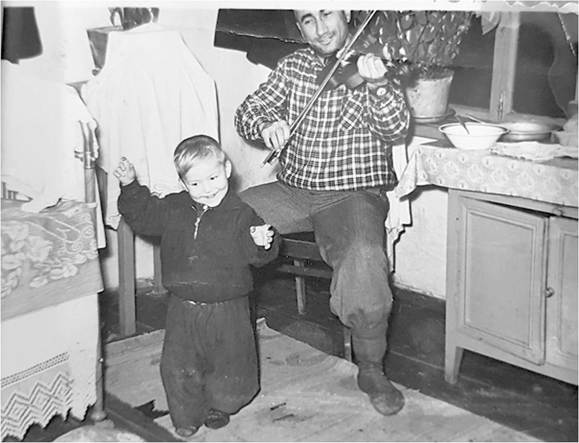
Fig. 2-5: Father is playing on the violin while his son is dancing Crimean Tatar traditional dance Haytarma. Uzbekistan, the 1950s. Photo by Mustafa Tomak. Courtesy of Nizami Ibraimov archive.
During the 19th century, hundreds of thousands of Crimean Tatars had even emigrated to the neighboring Ottoman Empire. The imperial Russian government had itself encouraged the impoverished Crimean Tatars to leave viewing them as politically unreliable and seeking to turn the peninsula into a settler colony. The 1944 deportations thus cannot be fully understood without reference to earlier bouts of chauvinistic Russian state-policy directed against the Crimean Tatars.14 The Soviet clearances not only represented a continuation of these earlier imperial policies, but also removed almost all of the societal structures and assets that had allowed the Crimean Tatars to grow and thrive as a distinctive group.
Moreover, the Soviet authorities had also succeeded in forging a cultural image of the Crimean Tatars as “traitors” and even sought to dehumanize them. After the evictions, the Crimean Autonomous Socialist Soviet Republic was transformed into a region. Crimean Tatar names were replaced, and their mosques were destroyed; Crimea lost all traces of its indigenous people and became literally Russified in the aftermath of the deportations as the authorities repopulated the peninsula with Russian and Ukrainian settlers.The deportation of 1944 was supposed to completely remove the Crimean Tatars as a discernable nationality from the demographic map of the world, disrupting their traditional way of life, social structure and cultural institutes. The children of the exiled Crimean Tatars also lost the right to receive an education in their native language. The deportees were themselves expected to assimilate into the cultural milieu of Uzbekistan among the majority Uzbek population. Even Western observers of the time were predicting that the Crimean Tatars would, through assimilation, eventually disappear from history. According to Robert Conquest, these deported peoples became “un- nations”.15 By calling them “Tatars” as opposed to their true name - Crimean Tatars - the state wiped out the very memory of their presence in Crimea while challenging their indigenous rights and sense of distinctive identity. The removal of the “Crimean” designation also opened the way for assimilation among other groups of “Tatars” and serve to erase all the traces of their presence on the peninsula. Thus the “Crimean Tatars” officially ceased to exist, being instead denoted as “citizens of Tatar nationality formerly living in Crimea.” Moreover, their removal as “Crimean Tatars” from the official state censuses and renaming to simply “Tatars” also constituted a settler colonial policy aimed at transforming their homeland’s indigenous population.16
A Point of no Return?
In 1956, a decree issued by the Presidium of the Supreme Council of the USSR released the Crimean Tatars from the special settlements.
However, it remained forbidden for them to resettle in the Crimean region. Despite removing the special settlement restrictions, the Soviet government still considered them guilty of treason; Crimean Tatars were given the right to freely travel and settle across the territory of the Soviet Union, but not the Crimean Peninsula. A memo prepared and issued by the Communist Party's Central Committee in 1956 further argued that Crimean Tatars didn't need to return to Crimea in order to enjoy their rights as Soviet citizens.17 Thus, unlike other punished peoples, the Crimean Tatars remained deprived of the right to a restored autonomy as well as an opportunity to return to their homeland. Reflecting on the decree, the historian Chantal Lemercier-Quelguejay argued that “In the circumstances, the Crimean Tatars are doomed to be assimilated by the peoples among whom they are now living. Thus, a people with a long glorious and tragic past will disappear finally from history.”18The history of the deportation and return of the Crimean Tatars is unique, as they did not receive the right to return and renew their autonomy in 1956, like most “punished peoples”. At the same time, they escaped the fate of other unrehabilitated groups: they did not invent a new homeland, as the Soviet Germans had done when they had been deported from the Volga region, Ukraine, and Crimea. Unlike groups such as the Soviet Koreans, who admit that they have become Russified, Crimean Tatars did not remain scattered all over the former Soviet republics. Instead, despite the ban, they sought to return to their homeland during the Soviet era. According to Greta Uehling, “we still lack a very clear understanding of the ways in which forced migrants in the former Soviet Union conceptualize their attachments to place, and the implications of these conceptualizations for the debate concerning people, place, and identity.”19 This raises the question: How did Crimean Tatars managed to return home?
It would be impossible to talk about Crimean Tatars' return without mentioning their connection to the lost homeland. Analysis of memories of deportation suggests that the traumatic loss of the homeland strengthened the exiles' sense of connection to it, with the idea of a return becoming a defining element of Crimean Tatar identity after 1944. Initially, Crimea was perceived as being their lost paradise or promised land. Those Crimean Tatars born in exile learned about the deportations and their lost homeland, primarily within the family circle. Thus, the extended Crimean Tatar families also became communities of memory in which memory and knowledge of the lost homeland and deportation were preserved, reproduced, and spread.
The emergence of this cultural longing to return was also influenced by the image of Crimea as a desirable place to live, as well as return to. Narratives of second generation exiles present an image of Crimea that was created for them by their parents: a fairy-tale homeland, where life flows harmoniously. The desire to return was rooted in this sense of harmony. From their exile, older generations of Crimean Tatars had constructed an image of a lost homeland as a place with incredible landscapes and plentiful resources.
The idea of returning as a process that would inevitably take place in the future, despite all the historical obstructions, was also formed in exile. For example, one of my interviewee, Ediye, as a child heard from her father that he would definitely bring his family home.20 This image of Crimea also manifested as a call to leave everything and return to the homeland illegally. Such an aspiration to return also carried a sense of biological imperative through with Crimean Tatars came to understood themselves as an essential part of the homeland with their exile having severely ruptured this connection. Uehling mentions that some members of the second generation had even espoused a metaphysical theory that the molecules of the Crimean-grown fruits their parents had eaten eventually became a part of their bodies.21 Thus, the notion of returning itself must be considered as an idea or ideology arising among the deported Crimean Tatars under the influence of hopes, dreams, or fantasies about relating to their homeland.
Return
After 1956, a Crimean Tatar national movement emerged with the goal of demanding state-organized mass return to Crimea and the restoration of the CrimeanAutonomous Soviet Socialist Republic as a vehicle for national autonomy. The national movement was itself engaged in nonviolent resistance with almost the entire community participating. As a result of large-scale petition campaign, a new decree was issued on September 5th, 1967, according to which the collective charges against the Crimean Tatars were dropped. However, as it later transpired another resolution was also issued on the same day, according to which the Crimean Tatars were still forbidden from returning to their homeland.22 It was ultimately this decree that provoked a process of reverse exodus with about 10.000 Crimean Tatars returning to their homeland between 1967 and 1978. Thousands undertook a journey into uncertainty together with elders who dreamed of dying in their native land, and children who had never seen Crimea, but had accepted the dream of it from their parents.
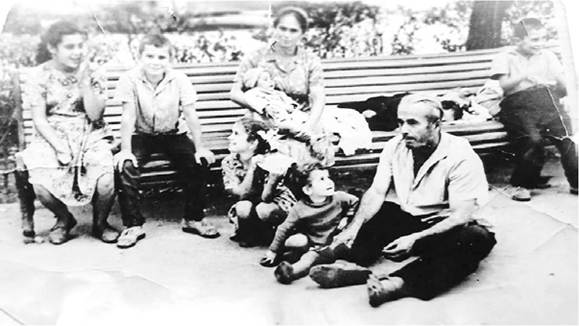
The returnees would first arrive into Simferopol, the administrative center of the Crimean oblast, and immediately seek to claim their right to live in the homeland. The parks and squares of the city were promptly occupied by groups of protesting Crimean Tatars who were waiting for an appointment with the local authorities in order to get some form of legal clarification. As they were not permitted to book hotel rooms, the streets of Simferopol subsequently became their temporary home. The human rights activist Petro Grigorenko, who came to Crimea in the summer of 1968, later wrote in his memoirs that the train station, airport, and city squares were filled with Crimean Tatars who “besieged” the Soviet and local party authorities. Grigorenko drew particular attention to the fact that Crimean Tatar families, many with small children in their arms, typically found themselves being forced to sleep on open ground in various public spaces.23
Fig. 2-6: The Karabashfamily in centralpark of Simferopol, 1968. From the family archive.
This strategy of return, which I term “through the front door”, represented a form of direct action that lasted approximately a year. During this period, only 111 Crimean Tatars received a permit allowing them to relocate back to the peninsula. For others, however, it soon became apparent that they were not welcome in Crimea.
An additional resolution was issued on September 5,1967, stating that the Crimean Tatars would be permitted to live anywhere within the Soviet Union, but only “in accordance with current legislation on the employment and passport regime”. In practice, this meant that newcomers needed to register for a residence permit, for which they were required to have a job. However, without registration they could not apply for employment in the area they wished to live. This vicious circle had been deliberately created in order to prevent the Crimean Tatars from returning to their homeland. Nevertheless, many sought to circumvent this by heading to the smaller villages in the northern steppe region of Crimea, where they had a better chance of receiving a permit from the local authorities, or at least remaining unnoticed.24
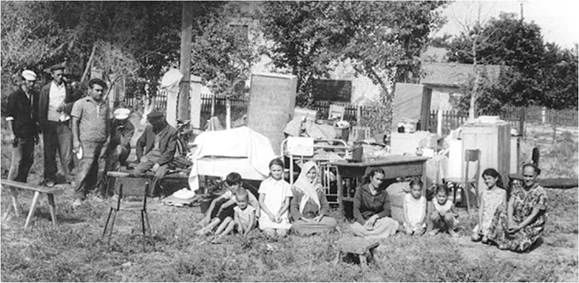
In addition to creating obstacles for obtaining a residence permit, which was also required in order to purchase property, the authorities resorted to forced evictions. Police raids against Crimean Tatars were mostly conducted in the middle of the night, with officers forcing open doors and windows and dragging the residents, including women and children, to waiting vans, beating and tying the men's hands and feet. Once again, there was no opportunity to collect personal belongings and valuables were usually stolen by the police officers. Indeed, an evicted family could even find themselves be left at an empty railway station in the middle of the steppe without money. Such forced removals served as a form of re-traumatization, reminding older members of the deportations of 1944, and received the name “repeated deportation”.25
Fig. 2-7: Forced eviction from Crimea, the 1970s. From Gulnara Bekirova’s archive.
Nevertheless, this new wave of evictions from Crimea did not stop the Crimean Tatars from seeking to return again, with some families being forcibly removed three or more times. One of my informants, Abdripi, re-
members that on returning to the Crimea in 1969, his family was forcibly evicted from peninsula in less than a month. Having collected a sufficient amount of money, they made a second attempt to return in 1975, during which his father was again accused of violating the passport regime and ordered to leave. He instead hid himself in the family home's closet every time the local policeman came to check.26 However, not all those Crimean Tatars evicted from the peninsula succeeded in their efforts to return. As a result of such evictions, many began to form diaspora communities on the territory of the neighboring Kherson and Krasnodar regions. These new areas where evicted Crimean Tatars settled subsequently became places of transit or spaces in between, situated between exile and homeland.
Concluding this practice of return did not guarantee registration or protection against eviction, however, some Crimean Tatars did manage to purchase a house, register themselves, and find employment. Between 1967 and 1978, about 10.000 Crimean Tatars returned to their homeland in this way.27
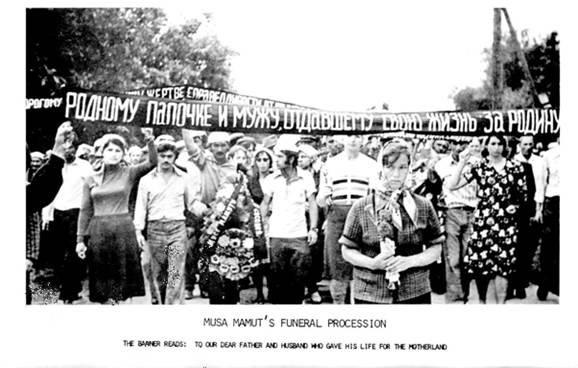
The growing number of returnees provoked a strong reaction from the Soviet authorities. In 1978, the “Resolution of the Council of Ministers of the USSR” legalized forced evictions from Crimea, seeking to ensure that everything occurred“according to the law”. The resolution forbade the sale ofhouses to Crimean Tatars, imposing sanctions on homeowners. Moreover, while those Crimean Tatars who had been forcibly evicted were previously able to return to their properties, this became impossible after 1978 as houses purchased by Crimean Tatars were demolished following the owners' removal. The adopted resolution was aimed only at Crimean Tatars.28 This act suspended the return process for almost a decade. Such aggravation of the situation in Crimea also led to increased political persecution of Crimean Tatars and even led to several high-profile suicides, among which was the self-immolation of Musa Mamut in 1978.
Fig. 2-8: Musa Mamutfuneral. From the book ReshatDzhemilev, ed., Zhivoyfakel: Samosozhzhenie Musy Mamuta (New York: Fond Krym, 1986).
With the start of perestroika, Crimean Tatars' migration back to Crimea resumed in 1987. This process was expedited by several events that took place in 1989 forcing former deportees to flee Uzbekistan for Crimea en masse. Notably among these was the Fergana Massacre, in which Uzbek nationalist mobs attacked the local Meskhetian Turkish community, themselves historic deportees from Georgia. Alongside the Meskhetian Turks, the Crimean Tatars who lived near the epicenter of the conflict became refugees. Elvira, one of my informants, recalls that in 1989 there was a feeling that Crimean Tatars would become the next target for nationalist violence.29
At the end of 1989, two documents were adopted, which met the requirements of the Crimean Tatars, albeit only partially. On November 14th, the Supreme Council of the USSR declared its intention to restore the rights of repressed peoples by law, approving the summary of the state commission on the problems of Crimean Tatars on the 28th. The document recognized the right of the Crimean Tatar people to return to their historical homeland and restore national integrity. Thus, the central government legitimized their right to return, prompting the start of a mass repatriation process.
Fig. 2-9: “Homeland or Death”. Crimea, 1990. Photo by Valeriy Miloserdov.
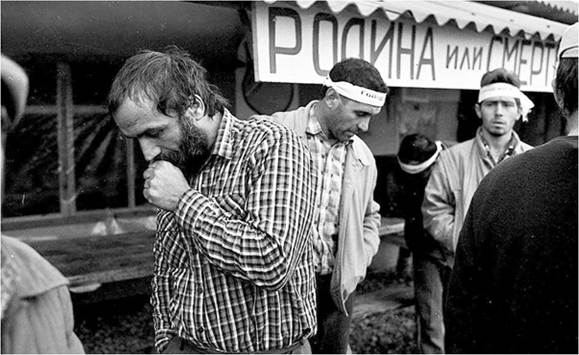
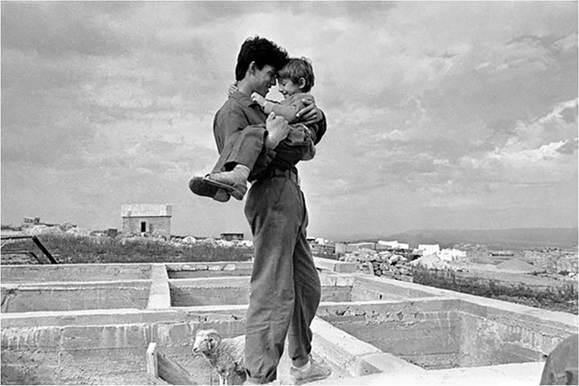
Return entails an emplacement process, which means inventing or reinventing homeland because of the impossibility of returning to the past. A bitter taste of a promised land and everyday struggle for their rights made the Crimean Tatars face new challenges. During their absence Crimea was totally russified in every sense. After the collapse of the Soviet Union Russia preserved its influence on the peninsula. Upon repatriating to their native land, Crimean Tatars was involved in a struggle for their political rights and land. Local elites, former party nomenclature, maintained existing hierarchies in Crimea. As such, Crimean Tatars lacked the resources and institutions for restoration of their sovereignty. Unsatisfied claims of indigenous people, to a certain extent, was a cause of Russian occupation of Crimea in 2014.
Fig. 2-10: “Here will be our home, son!”. Crimea, 1991. Photo by RifatYakupov.
Conclusion
The deportation of the Crimean Tatars represented the culmination of a colonial policydirectedtowards indigenous people of Crimea. CrimeanTatarswere expected to assimilate into Uzbekistani society and disappear as a nation. Instead, they not only preserved their connection to the homeland while in exile but forged a modern form of Crimean Tatar identity. The long-term intention to return to Crimea endured, despite the ban. Thus, the Crimean Tatars national movement was anti-colonial by its very nature. The process of reverse migration by Crimean Tatars should thus be seen as a complex system intertwined with strategies for maintaining ties with Crimea from exile, different practices of return, and the emplacement process. Upon arriving back in their native land, Crimean Tatars found themselves in the position of being a colonized indigenous people in a settler colony, having returned to an area now dominated by Russian culture and a Russian-speaking population.
Notes
1 Rorry Finnin, “Why Crimea Is the Key to Peace in Ukraine,” Politico, January 13, 2023, https://www.politico.com/news/magazine/2023/01/13/ peace-ukraine-crimea-putin-00077746?fbclid=IwAR0tNIjTAuYM7OyTT g_ellplnqGGxroS4k_qlBqfW7pZcdgUbb5wwj-cmCU
2 Refat Kurtiev, ed., Deportatsiia krymskikh tatar 18 Maia 1944 goda. Kak eto bylo. Vospominaniia deportirovannykh. Vol. 2 (Simferopol: Odzhak, 2005), p. 151.
3 Ibid., p. 72.
4 Gulnara Bekirova, Piv stolittia oporu: Krymski Tatary vid vyhnannia do povernennia (1941-1991 roky). Narys politychnot istorn (Kyiv: Krytyka, 2017), p. 101.
5 Aleksandr Yakovlev, ed., Stalinskie deportatsii, 1928-1953 (Moscow: Materik, 2005), p. 563.
6 J. Otto Pohl, “The deportation of the Crimean Tatars in the context of settler colonialism,” UluslararasiSuglarve Tarih 16 (2015), p. 57.
7 Brian Glyn Williams, The Crimean Tatars. From Soviet Genocide to Putin's Conquest (Oxford: Oxford University Press, 2016), p. 107.
8 Yakovlev, Stalinskie deportatsii, p. 497.
9 Williams, The Crimean Tatars, p. 94.
10 Kurtiev, Deportatsiia krymskikh tatar, Vol. 1, p. 67.
11 Williams, The Crimean Tatars, p. 97.
12 Robert Conquest, The Nation Killers: The Soviet Deportation of Nationalities (London: Macmillan, 1970); Mustafa Edige Kirimal, “Complete Destruction of National Group as Groups: The Crimean Turks,” in Genocide in the USSR: Studies in Group Destruction, eds. Nikolai Deker and Andrei Lebed (NewYork: Scarecrow Press, 1958); Norman M. Naimark, Stalin's Genocides (Princeton: Princeton University Press, 2010).
13 Terry Martin, “The Origins of Soviet Ethnic Cleansing,” The Journal of Modern History 70:4 (1998): 813-61; Brian Glyn Williams, “Hidden Ethnocide in the Soviet Muslim Borderlands: The Ethnic Cleansing of the Crimean Tatars,” Journal of Genocide Research 4/3 (2002): 357-73; J. Otto Pohl, “Soviet Apartheid: Stalin's Ethnic Deportations, Special Settlement Restrictions, and the LaborArmy: The Case of the Ethnic Germans in the USSR,” Human Rights Review 13 (2012): 205-24.
14 Pohl, “The deportation,” p. 57.
15 Conquest, The Nation Killers, p. 67.
16 Maksym Sviezhentsev, and Martin-Oleksandr Kisly, “Race in Time and Space: Racial Politics Towards Crimean Tatars in Exile, Through and After Return (1944-1991),” Krytyka, June 2021, https://krytyka.com/en/articles/ racial-politics-towards-crimean-tatars.
17 Nikolai Bugay, ed., Prinuditeknoepereselenie krymskikh tatar:put’ k reabilitat- sii (materialy i dokumenty) (Moscow: Akvarius, 2015), pp. 64-66.
18 Lemercier Quelquejay, “The Tatars of the Crimea, A Retrospective Summary,” CentralAsiaReview 16:1 (1968), p. 25.
19 Greta Uehling, “Thinking about place, home, and belonging among Stalin's forced migrants: A comparative analysis of Crimean Tatars and Meskhetian Turks,” in Tom Trier (ed.) Meskhetian Turks at a crossroads: Integration, repatriation, or resettlement? (London: Global Book Marketing, 2007), p. 610.
20 Ediye M., 1963. Interviewed by the author, 12 August 2015.
21 Greta Lynn Uehling, Beyond Memory: The Crimean Tatars’ Deportation and Return (NewYork: Palgrave Macmillan, 2004), p. 115.
22 Bekirova, Piv stolittya oporu, pp. 197-203.
23 Petro Grigorenko, Vpodpolye mozhno vstretit tolko krys (New York: Detinets, 1981), p. 635.
24 Martin-Oleksandr Kisly, Crimean Tatars’ return to the homeland in 1956-1989 (PhD diss., NationalUniversityofKyiv-MohylaAcademy, 2021), p. 121.
25 Ibid., p. 127.
26 Abdripi S., 1962. Interviewed by the author, 2 August 2015.
27 Oleg Bazhan, ed., Krymski tatary, 1944-1994: Statti, documenty, svidchennia (Kyiv: Ridnii krai, 1995), pp. 240-241
28 Bekirova, Piv stolittya oporu, p. 241.
29 ElviraA., 1962. Interviewedbytheauthor, 9 January 2014.
Selected Bibliography
Bekirova, Gulnara. Pivstolittia oporu: Krymski Tatary vid vyhnannia do povernennia (1941-1991 roki). Naryspolitichnoiistorii (Kyiv: Krytyka, 2017).
Fisher, Alan W. The Crimean Tatars (Stanford: Hoover Institution Press, 1978).
Jobst, KerstinSusanne. GeschichtederKrim. IphigenieundPutinaufTauris (Berlin, Boston: De Gruyter Oldenbourg, 2020).
Kisly, Martin-Oleksandr. “Post-Traumatic Generation: ChildhoodofDeported Crimean Tatars in Uzbekistan.” International Crimes and History 16 (2015): 71-93.
O'Neill, Kelly. Claiming Crimea: A History of Catherine the Great’s Southern Empire (New Haven: Yale University Press, 2017).
Pohl, J. Otto. “The deportation of the Crimean Tatars in the context of settler colonialism.” International Crimes and History 16 (2015): 45-69.
Sviezhentsev, Maksym, and Martin-Oleksandr Kisly. “Race in Time and Space: Racial Politics Towards Crimean Tatars in Exile, Through and After Return (1944-1991),” Krytyka, 2021, https://krytyka.com/en/articles/racial-politics- towards-crimean-tatars.
Uehling, Greta Lynn. Beyond Memory: The Crimean Tatars’ Deportation and Return (New York: Palgrave Macmillan, 2004).
Williams, Brian Glyn. The Crimean Tatars. From Soviet Genocide to Putin's Conquest (Oxford: Oxford University Press, 2016).
III.