Divided Loyalties
The texts surveyed earlier in this chapter raise some under-researched questions. In the first place, they suggest that Jews who joined the party in substantial numbers in 1919-21 divided their loyalties between Russian and Ukrainian cadres.
The policy of indigenization, which included both Yiddishization and Ukrainization, was probably supported by many Jewish party members. Some, like Ivan Kulyk and Volodymyr Koriak (Bliumfeld), became committed Ukrainizers, while former members of the Bund, such as Moisei Ravich-Cherkasskii and Moisei Rafes, developed a line that allowed the revolution to be seen as progressively drawing together different elements and overcoming national particularisms in the construction of a Ukrainian state and society.The composition of party and state organs reflected the weight of national groups in the urban population, something made clear in a study produced in 1928, which gives the population breakdown for the main cities of Soviet Ukraine in the early twenties in Table 1.1
The table shows that until 1926, in the main urban centers Jews were the second largest population after the Russians, and that a demographic shift toward Ukrainians occurred in that year.14 This would explain the overall proportion of Jews in the working class and their greater
Table 1.1 Population in thousands of cities in Ukraine, according to the census of 17 December 1926.
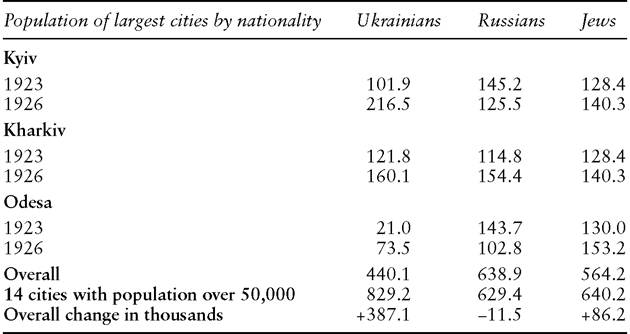
Source: From Khomenko, A. 1928, “Do nationalno-kulturnoi kharaketrystyky liudnosty Radianskoi Ukrainy (za perepysom 17 hrudnia 1926 roku)” Chervonyi shliakh 7: 194.
representation in the party during the first post-revolutionary years.15 However, this does not answer several questions concerning attitudes in the Jewish population toward the Soviet Ukrainian republic and its policies.
Was, for example, the presence of Jews in the party and Cheka the result of a conscious policy, or of contingent circumstances? How did the participation of Jews in the party, state administration, and security services affect Soviet Ukraine’s early development? What, for example, was their attitude toward the Ukrainization policy? As the preceding analysis of party history writing indicates, it would be a mistake to search for easy generalizations.Anti-Ukrainian attitudes within the secret police have been widely confirmed. For example, the head of the Ukrainian NKVD in Vinnytsia oblast I. Korablov in 1941 affirmed that Aleksandr Uspenskyi, who in 1938 headed the NKVD in Ukraine, used to repeat the phrases “75-80% of Ukrainians are bourgeois nationalists” and “all Poles and Germans who live in the Ukrainian SSR are spies and saboteurs” (Podkur 2009, 16). Such an attitude, as the first Bolshevik histories show, had roots in the CP(B)U's early formation. Although the view has been expressed that in the early twenties, some Jewish leaders in the CP(B)U hindered Ukrainization, it was in fact the appointment of Lazar Kaganovich as general secretary of the Central Committee of the CP(B)U that accelerated the policy’s implementation. Kaganovich was a Jew from Ukraine who learned literary Ukrainian and forced others among the leading Jewish cadre of the CP(B)U to do the same (Maistrenko 1985, 222). In Mais- trenko’s view, precisely because of his Jewish background, Kaganovich was able to make a noticeable change in the Ukrainization drive. As the commissar for education in 1924-27, he severely criticized Zinovev for stating that Ukrainization was “water on the mill of Petliurites” (X zizd 1928, 125).
How did party members of various backgrounds view indigenization? As the texts and figures presented in this chapter suggest, most Ukrainians supported the move to expand the use of Ukrainian (and Yiddish) languages, and to develop Ukrainian (and Jewish) institutions.
Some Jewish and Russian members also supported these policies. Others, however, especially those who were Russified (in the sense that they only spoke Russian and considered themselves culturally Russian), remained suspicious of attempts to create Yiddish, Jewish, or Ukrainian institutions. They saw subversive work by nationalists or Zionists behind moves to create autonomous cultural organizations.16The crucial turning point occurred in the mid-1920s when Ukrainians became predominant in the cities, and approached 50% of the party membership. This exerted pressure on both the state administration and party to do more than pay lip service to Ukrainization and to promote Ukrainian cadres. At this point, a push-back occurred in the form of charges that the new Ukrainian recruits were non-proletarian or “nationalist.” A compromise was reached at that time, which allowed a range of Ukrainian and Jewish institutions to develop their work. However, when Stalin took control of the party in the late 1920s, the compromise was abandoned, the charge of nationalism began to carry great venom, and led to violent consequences. This charge had been leveled from the first days of revolution, when it had been repeatedly employed to purge Ukrainian cadres, but in the thirties, it became part of a major campaign that led to the arrest of both Ukrainians and Jews in the party, administration and secret police.
Notes
1. The Russian Social Democratic Labor Party (RSDLP) was formed in 1898, but split in 1903 into Bolshevik and Menshevik wings; from 1912, the Bolshevik faction was officially known as the Russian Social Democratic Labor Party (Bolshevik). In 1918, it changed its name to the All-Russian Communist Party (Bolshevik), which is usually shortened to RCP(B). The Bolsheviks banned the Mensheviks in 1921.
2. For an overview of the Ukrainian working class on the eve of the revolution, see Krawchenko (1983, 39-45).
3. The Kyiv Oblast Committee, which in 1918 during Denikin’s occupation was the party’s only organizing center in Ukraine, reported “few contacts with local places, few contacts with the revolutionary movement,” and admitted that it was “insufficiently aware of the situation locally” (see “KP(b)U za Denikinshchyny” 1930, 223).
One of the main reasons given was that most party workers were Jews, which made activity under Denikin’s antisemitic rule “almost impossible.” A report from the Kyiv Oblast Committee on 29 September 1919 said: “our work stopped for an entire week, since it wasRepressed Memory 23 impossible for a Jew to show himself on the streets, and Jewish quarters, our meeting places, were under constant threat. Contact with the provinces cannot be established, since in the oblast committee there are no responsible workers who are not Jews, who could be sent to make contact” (ibid.). The same document pointed out that the Borotbists have “stronger contact with the masses than we do and the revolutionary movement is under their influence in far more places than under ours” (ibid., 224). The report also cited examples of communist groups going over to the Borotbists.
4. It gives the CP(B)U membership figures for 1922. Out of 54,818 members, 4,647 had come from Russian and Jewish parties. The Ukrainian parties, namely the Borotbists and the Ukrainian Communist Party (UKP, which had come out of the Ukrainian Social Democratic Party), contributed only 118 and 34 members, respectively. The breakdown of the CP(B)U's total membership in 1923 was 51,236; 27,490 (53.6%) were Russians, 11,920 (23.3%) Ukrainians, 6981 (13.6%) Jewish, 1,241 (2.6%) Polish, and 3,604 (7.1%) were of other backgrounds.
5. It was reported that 3% of party members joined before 1917, 10.8% in 1917, 13.1% in 1918, 28% in 1919, 33.5% in 1920, and 11.6% in 1921-22.
6. Purges of “nationalists” continued in 1928-30 (ostensibly for passivity, or for constituting a class or alien element), and in 1933. According to Dmy- tryshyn, practically all the vacancies created were filled by non-Ukrainian personnel, chiefly from Central Russia. As a result, the overall membership in the CP(B)U continued to increase (Dmytryshyn 1956, 145, 246).
7. Dashkevych calculated that only 7% of the CP(B)U was Ukrainian in 1918, and that the figure jumped to 19% in 1920, mainly because of the Borotbist intake.
When the left Social Democrats (creators of the UCP) were allowed in, the figure rose to 37%. “In order to diminish the influence of former members of this party, from 1925 a faster intake of Ukrainians was announced. In 1926, the percentage of Ukrainians in the party was 47%, in 1927 52%, in 1930 53%, in 1933 61%” (Dashkevych 1990, 57-58). However, most of the nomenklatura, or hierarchy, remained non-Ukrainian. In 1927, only 35% of members of the CC were Ukrainians. In 1930, out of around 2,500 nomenklatura people, only 43% were Ukrainians. Among secretaries of regional (okruzhnykh) committees, 55% were Ukrainians, an increase from the figure of 46% in 1927, but in 1933 it fell to 52%. Dashkevych concludes: “Ukrainians never had a real advantage in the decisive organs” (ibid., 58).8. According to his figures, on 1 January 1924, there were 57,016 party members, of whom 33.3% were Ukrainians, 45.1% Russians, and 14.0% Jews. On 1 January 1925, there were 101,852 members, of whom 37% were Ukrainians, 43.5% Russians and 11.9% Jews. On 1 January 1926, out of 151,939 party members, 43.9% were Ukrainians, 37% Russia and 11.4% Jews (ibid., 14).
9. In 1923, Ukrainians had constituted 31.9%, Russians 41.1%, Jews 21.0%, and others 6.1%. In 1924, Ukrainians constituted 34.3%, Russians 43.4%, Jews 14.4%, and others 7.9%. In 1925, Ukrainians were 35.9%, Russians 39.6%, Jews 13.7%, and others 7.8%. In 1926, Ukrainians were 48.8%, Russians 31.0%, Jews 12.3%, and others 7.9% (Zatonskyi 1927, 25).
10. Zinovev’s Istoriia rossiiskoi kommunisticheskoi partii (bolshevikov) (History of the Bolshevik Party) was published in 1923. It was translated into English as History of the Bolshevik Party: A Popular Outline (1924; rpt. London: New Park Publications, 1973).
11. For the early waves of arrests that swept Ukraine, see Bertelsen and Shkan- drij (2014).
12. 1917 god na Kievshchine, 321; quoted in Agurskyi, 84.
13. Yavorskyi’s Korotka istoriia Ukrainy (Short History of Ukraine) was attacked in “Dyskusiia” (1930): 267-326 and 3 (1930): 176-237.
Ravich-Cherkaskii was attacked in Skryp (1930).14. For a discussion of the urban population’s national composition at this time, see Krawchenko (1983), 47-56.
15. A higher proportion of Jews in the party could also be observed across the border in interwar Poland. Most members of the party in the villages were Ukrainians, and most in the towns were Jews. In Lutsk in 1933, for example, records indicate that all members of the party and its youth organization were Jews. See Snyder (2010), 82.
16. For the arrests of Zionists, see Bertelsen (2011).
References
1917 god na Kievshchine. 1919. N.p.: Vyd. Istpartu DVU.
Agurskyi, S[olomon]. 1930. “levreiske robitnytstvo v zhovtnevii revoliutsii (Kon- trrevoliutsiina robota Bundu).” Litopys revoliutsii 1: 78-101.
Bertelsen, Olga. 2011. “New Archival Documentation on Soviet Jewish Policy in Interwar Ukraine. Part One: GPU Repression of Zionist Parties and Groups in the 1920s.” On the Jewish Street 1: 37-112; “Part Two: GPU Repression of Jews and Jewish Groups in 1937-1940.” On the Jewish Street 2: 165-206.
Bertelsen, Olga and Myroslav Shkandrij. 2014. “The Secret Police and the Campaign against Galicians in Soviet Ukraine, 1929-34.” Nationalities Papers: The Journal of Nationalism and Ethnicity 42.1: 37-62.
Dashkevych, Ia. R. 1990. “Ukrainizatsiia, prychyny i naslidky.” Slovo i chas 8: 55-64.
Dmytryshyn, Basil. 1956. Moscow and the Ukraine, 1918-1953: A Study of Russian Bolshevik Nationality Policy. New York: Bookman Associates.
“Dyskusiia z pryvodu skhemy Istorii Ukrainy M. Iavorskoho.” 1930. Litopys revoliutsii 2: 267-326 and 3: 176-237.
Iefimenko, Hennadii. 2001. Natsionalno-kulturna polityka VKP(B) shchodo Radianskoi Ukrainy (1932-1938). Kyiv: Natsionalna Akademiia Nauk Ukrainy, Instytut Istorii Ukrainy.
Khomenko, A. 1928. “Do nationalno-kulturnoi kharaketrystyky liudnosty Radi- anskoi Ukrainy (za perepysom 17 hrudnia 1926 roku).” Chervonyi shliakh 7: 179-196.
“KP(b)U za Denikinshchyny (Materiialu y dokumenty).” 1930. Litopys revoliutsii 1: 221-241.
Krawchenko, Bohdan. 1983. Social Change and National Consciousness in TwentiethCentury Ukraine. Houndmills and London: Macmillan.
Maistrenko, Ivan. 1985. Istoriia moho pokolinnia. Spohady uchasnyka revoliut- siinykh podii v Ukraini. Edmonton: Canadian Institute of Ukrainian Studies, University of Alberta.
Mazlakh, Serhii and Vasyl’ Shakhrai. 1970. On the Current Situation in Ukraine. Ann Arbor: Michigan University Press. (Original: Do khvyli. Saratov, 1919).
Podkur, Roman. 2009. “ Reaktsiia spivrobitnykiv orhaniv derzhavnoi bezpeky URSR na prypynennia ‘velykoho teroru’ (lystopad 1938-1939 rr.).” Z arkhiviv VUChK-GPU-NKVD-KGB 2: 136-167.
Popov, M[ykola] M. 1930. Narys istorii Komunistychnoi partii (Bilshovykiv) Ukrainy. 4 ed. Kharkiv: Proletarii.
Popov, N[ikolai] N. 1927. Oktiabrskaia revoliutsiia i natsionalnyi vopros. Moscow and Leningrad: Gosudarstvennoe izdatelstvo.
Rafes, M[oisei] G. 1920. Dva goda revoliutsii na Ukraine. Moscow: n.p.
--------. 1923. Ocherki po istorii “Bunda”. Moscow: Moskovskii rabochii.
Ravich-Cherkasskii, M[oisei]. 1923. Istoriia Kommunisticheskoi Partii (b-ov) Ukrainy. Kharkiv: Gosudarstvennoe izdatelstvo Ukrainy, 1923.
Skryp[nyk], M[ykola]. 1930. “Do spravy ukrainizatsii.” Litopys Revoliutsii 1: xiii-xii.
Snyder, Timothy. 2010. “The Life and Death of Western Volhynian Jewry, 19211945.” In The Shoah in Ukraine: History, Testimony, Memorialization, edited by Ray Brandon and Wendy Lower, 77-113. Bloomington and Indianapolis: Indiana University Press.
X zizd KP(b)U. 20-29 lystopada 1927 r. Stenog. Zvit. 1928. Kharkiv: n.p.
Zatonskyi, V[olodymyr]. 1927. “Materiialy do ukrainskoho natsionalnoho pytannia.” Bilshovyk Ukrainy 6: 14.