Grain, Coal, and Gas. Ukraine's Economy since the Eighteenth Century
Boris Belge
The port of Odesa is undoubtedly one of the flashpoints for Russia’s war of aggression against Ukraine. Already after the annexation of Crimea and the establishing of Russian control over the Kerch Strait, commercial shipping became virtually impossible for Ukrainian merchant enterprises.
Nevertheless, after entering a full-scale war, Russia effectively blockaded the port and cut it off its sea routes in the spring and summer of 2022.In contrast to the 19th century, grain exports from Odesa are less important for Europe and predominantly feed many African and Asian countries such as China, Egypt, Turkey, Iran, Pakistan, and Bangladesh. Perhaps these new routes, distant from more Western countries, have made the importance of Odesa’s grain exports to the world economy less visible in the present.1 It was not until the Russian war of aggression against Ukraine that the significance of Odesa and its port in global food distribution became abundantly clear - a place that Odesa had won due to far-sighted decisions and the development of transnational links in the early 1800s and regained with considerable determination after Ukrainian independence.2
What applies to the port of Odesa also applies to the wider economy of Ukraine - it has a troubling imperial and Soviet past and a contested present. The history of Ukraine’s economy examines its evolution, including structures, institutions, and processes, and the relationships between economic and noneconomic factors such as politics, culture, and demography. This chapter will illuminate some key areas of Ukraine’s economic history from the 18th century up to the 2022 Russian military invasion from a birds-eye perspective.
I will give an insight into Ukraine’s multifaceted history by concentrating on three commodities, or resources, that encapsulate much of Ukraine’s economy: wheat, coal, and natural gas primarily used for burning.
As a country incredibly rich in raw materials and fertile soil, Ukraine’s economy has been oriented around food and energy for centuries. It is no exaggeration to say that Ukraine fueled the Russian Empire, the Soviet Union, and several parts of the modern world.The story of wheat, coal, and gas also helps answer the following questions: who sets the course of the Ukrainian economy - local, regional, national, imperial, or global actors? When did Ukraine experience economic autonomy, and how high was its interdependence within imperial or global economic geographies? Which financial goals were followed and what were the models? In this contribution, I intend to use economic history as a lens into the political, social, and cultural phenomena of Ukraine's history in the 19th and 20th centuries. A better understanding of Ukraine's economy helps to gauge the imperial and Soviet legacies within present-day Ukraine, both as a burden and an opportunity.
Ukrainian history is largely the history of a region that did not merge into a legal national entity. The question of when exactly, and how, Ukrainian history began is widely disputed.3 From the perspective of economics, a nationstate is needed as a container to facilitate a national economy, and things tend to get messy in the Ukrainian case. Although Ukraine lacked legal sovereignty, in many respects, it was still a distinct economic region separated from the so-called Russian “Motherland”. In the following chapter, I will use the established approach for circumventing this problem by focusing on the area that is today's territory of Ukraine - Left and Right Bank Ukraine, Southern Ukraine, and Crimea - territories that had previously been divided between the Habsburg, Ottoman, and Russian Empires.
Imperialism and Economy
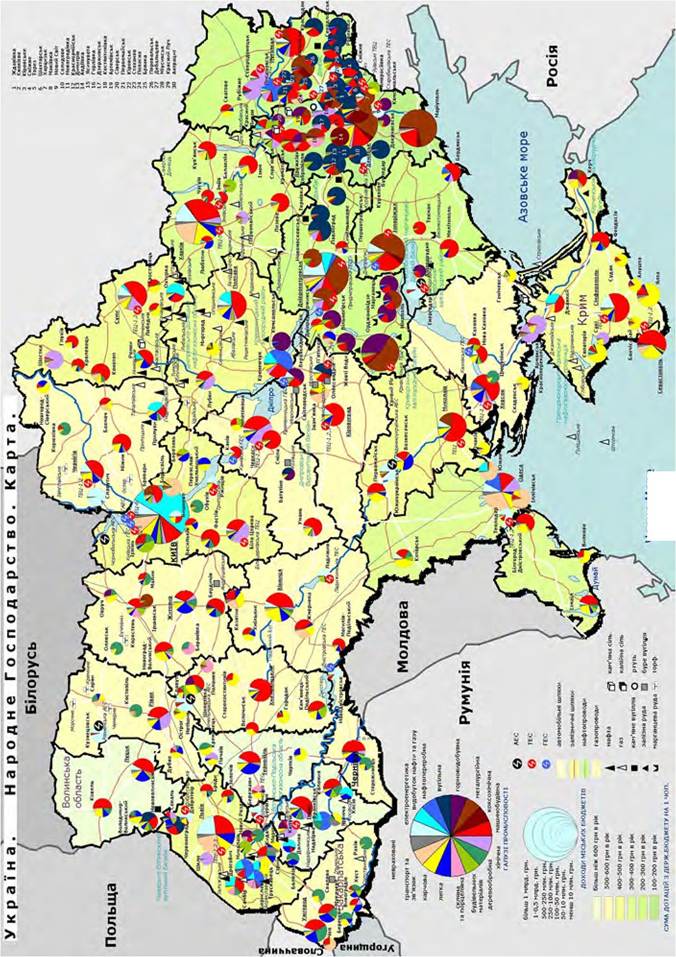
The following map (Fig. 1—1) shows the main industrial products for every region of Ukraine in 2006. While the numbers might have changed, it is still helpful for providing a general overview of Ukraine's key industrial centers.
What immediately catches the eye is the fact that most mining and metallurgical production is concentrated in the country's south-east. The center of all this is the Donets Coal basin (better known as Donbas), a mining area comparable to the German Ruhrgebiet, which also fueled the country's industrialization (and militarization).Fig. 1-1: Ukrainian Economy, 2006. Wikipedia Commons.
Чорне Mope
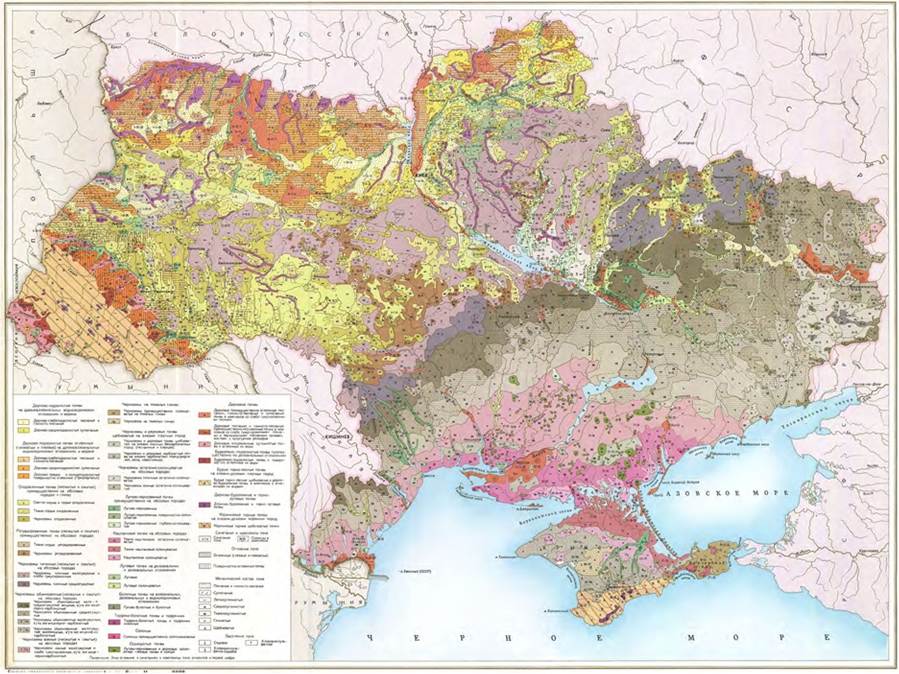
Fig. i—z: Soil Map of Ukraine. Source: General Directorate OfSurveying and Cartography of the ScmetMinistry, GUGK, SSSR, 1977. Dcrwnloadedfrom the European Soil Data Centre (ESDAC).
The second map (Fig. 1-2) gives an impression of the different types of Ukrainian soil. Attention needs to be drawn to the grey and pink areas where the so-called “chernozem” (black soil) and “castanozem” (brown earth) are located. Chernozem is fertile soil rich in humus and, therefore, most appropriate for cultivating grain. As a consequence, Ukraine was, and remains, one of the biggest international producers of wheat and rye.4
Both maps highlight Ukraine’s extraordinary wealth of resources. This alone is not enough for an economy to flourish, however. Resources must be developed, mined, cultivated, and introduced into economic cycles. The fundamental question about this process is not only how these processes took place but also for whose profit. The answer to the latter question reveals the nature of the area’s historical power structures, of which this chapter explores one, in particular. Scholars have previously considered whether Ukraine could be described as Russia’s colony, a topic that has caused heated debates.5 This uneasiness is mainly rooted in understanding colonialism as a cultural operation, forcing hegemonic representations of a ruling elite onto local populations.6 A point of concern is, for example, the applicability of cultural terms such as “racism” within the Russian context.
However, it is important to note that colonialism emergence as an analytical concept was initially defined in economic terms, being understood as “the process of control of supplies of raw materials, mineral resources and markets in underdeveloped and precapitalist regions.”7 Much of the literature since being published has also tended to distinguish between different types of colonialism. When taking a closer look at Ukraine’s history, three forms of colonialism are especially applicable: exploitation colonialism, settler colonialism, and internal colonialism. These three types are not mutually exclusive but instead provide different perspectives on the complex process of colonization.Exploitation colonialism is focused on the extraction (and exploitation) of resources or labor force for the benefit of the imperial metropole. The dominant form of colonial presence in the colonized territories is thus the trading post and colonial centers in which a small group of colonists constitute the political, economic and administrative elite. The early colonization of Northern America and Africa are a paradigmatic example for this type of colonization. It is also applicable to the colonization of Siberia in the 17th and 18th centuries.
Settler colonialism is “a distinct type of colonialism that functions through the replacement of indigenous populations with an invasive settler society that, over time, develops a distinctive identity and sovereignty”.8 This large- scale immigration of settlers is often driven by religious, political, or economic motives. However, it also differs from other forms of colonialism in that settlers frequently become a permanent social presence, perpetuating forms of living, domination, and economies that endure beyond the end of formal colonial rule.9 In Ukraine, this process can be observed beyond the second half of the 19th century, when the settlement of Southern Ukraine ended and the territories of “Little Russia” and “New Russia” were incorporated into the Russian Imperial framework.
Finally, internal colonialism is a widely used term that differentiates Russia’s colonial experience from the British (or French, or Portuguese) example. Legally, the colonized territories are already part of the state and not discriminated against by the center. Still, the structural power between these areas of the state is unevenly distributed, especially when it comes to the exploitation of resources.
As I will demonstrate in this chapter, Ukraine witnessed all three types of colonialism. Moreover, over the past decades, scholarly understanding of colonialism has also widened considerably, bringing social, political, and cultural factors into the equation. Culturally inspired historiography, however, has increasingly turned a blind eye to economics, focusing on people and cultural signs. In this context, the exploitation model of colonization differs from these approaches in that it places resources at the center of attention. Bringing these material factors back into the analysis and returning to an economic narrative of Ukraine’s history inside the imperial framework of the Russian Empire, the Soviet Union, and even the 1990s can therefore offer new insights. I will do so by elaborating upon three different arguments. First, I will assess the history of the grain trade in Ukraine and what this tells us about Ukraine as a cornerstone in Russia’s imperial framework. I will then consider how the Donbas served as the coal mine of the Russian Empire and the steel plant of the Soviet Union, but St. Petersburg and Moscow's rule over Ukraine did not mean colonial exploitation of the latter entirely. Instead, Ukraine’s East became an industrial center by itself. Finally, I will discuss how the construction of the main Russian gas pipeline through Ukraine undisputedly tied Ukraine’s economy to Russia’s, a problem that became virulent in the 1990s and 2000s when both states acquired independence and began to drift apart politically.
Grain
The cultivation of grain andUkrainian national identity are inextricably linked.
In fact, the country’s flag is said to present a blue sky over a golden wheat field. In the history of Ukraine, grain served three functions: it was a foreign trade commodity, a geopolitical weapon, and the main source of food. I will explore these different functions in turn.The territories of Ukraine have always been used to cultivate grain. In Ukraine, peasants grew rye in the north and wheat in the south (with some small portions of oat and hops). Today, sunflowers have also come to share a large proportion of Ukraine’s agricultural fields. Russia claimed Ukraine’s wheat early on. In the time of Tsar Peter I, Left-Bank Ukrainian merchants were forbidden from dealing directly with their Western counterparts since the state tried to monopolize trade. In the middle of the 18th century, LeftBank Ukraine was itself integrated into the Russian market.10
Catherine II’s conquest campaigns from the 1770s to the 1790s were also driven by the desire to get better access to the Black Sea and provide Russia with the ability to ship larger quantities of grain.11 In 1794, the Tsarina’s troops conquered the Turkish city of Khadzhibey, leading her to announce the founding of a new imperial Russia city at this century-old place of settlement. Odesa would soon become Russia’s biggest port for grain export.12 Short transportation routes to export corridors quickly fueled the rapid expansion of Ukraine’s agriculture with the hinterland of these Russian-ruled Black Sea ports, then called “New Russia” or Novorossiya, developing into the breadbasket of Europe.
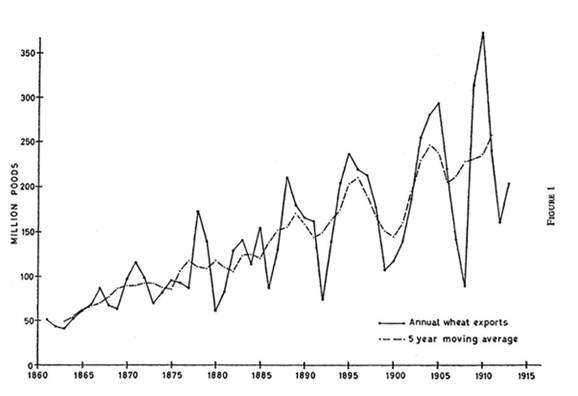
In the 19th century, as the population of Ukraine and the wider Russian Empire continued to grow and European-led globalization started to accelerate, capitalist logic began to influence grain cultivation. To Russia's economic planners it was evident that they had to exploit Ukraine’s soils as much as possible since grain promised an export surplus that the Empire could then leverage in order to join the international gold standard. This was a monetary system in which the standard economic unit of account was based on a fixed quantity of gold - making money convertible, serving as basis for the international monetary system from the 1870s to the early 1920s, and effectively until the 1970s. Membership in the club of gold standard states also increased its attractiveness to foreign debtors.13 The plan to join was concocted by the Imperial Finance Minister Sergei Ju. Witte. This plan worked: Russia’s trade balance profited from exporting ever more grain up until the 1900s (Fig. 1-3).
Fig. 1-3: “Wheat Exports of the Russian Empire (including Ukraine), 1861-1913”,
Source: Falkus, M.E., Russia and the International Wheat Trade, 1861-1814,
New Series, Vol. 33, No. 132 (Nov., 1966), p. 417.
Grain was not only a commodity, however. During the Soviet period, it also came to be regarded as a weapon for social engineering; in the 1930s, Joseph Stalin and his entourage had grain firmly in their sights when ordering the forced collectivization of farmland. Ukraine, one of the agricultural hotspots of the Soviet Union, was hit to a catastrophic extent by this assault on local peasants, ushering in what came to be known as the “Holodomor”, highlighting the genocidal consequences behind Stalin's intent to break the Ukrainian peasantry through brute force.14 While the US Congress and the German Bundestag (among other parliamentary bodies) later acknowledged the Holodomor as a genocidal crime, scholars still discuss to what extent Stalin had waged war against the peasantry in general, or specifically against Ukrainians. Without question, economic rationale had played a role: the Holodomor could not have happened without Stalin's plan to boost the heavy industrialization of the country and the inevitable demands this created for workers and food, and the simultaneously forced collectivization of the countryside.
This relates to the third point: grain is, first and foremost, a food stuff. Large armies need food as much as weapons - the present war is no exception and supplying food is an essential task for the state. There were mainly two reasons for the lack of grain in the 19th and 20th centuries: famines and wars. While bad harvests stemmed from natural causes, such as drought, sandstorms, or heavy rain, the resulting famines were often the cause of political decisions.15 In principle, Russia rarely suffered from harvesting too little grain and would have been able to provide for its population through improved redistributing across the empire and access to grain stores. This, however, seldom happened. Conflict also tended to exacerbate the scarcity of food, with the grain fields of Ukraine serving as a battleground in both world wars. The main reasons for the first Russian Revolution in 1905 and the February Revolution of 1917 (for which Ukraine was a major theater) were not cultural or political in nature, but stemmed from economic conditions, specifically high bread prices and widespread starvation under the impression of two wars (the Russo-Japanese War of 1905 and World War I).
Throughout the first half of the 20th century, Stalinism and the Second World War deprived Soviet Ukraine’s recovery as a producer of grain. During the ColdWar era, Stalin’s successor Nikita Khrushchev implemented some concessions that allowed local peasants to conduct independent small-scale agriculture. As a result, the peasantry was incorporated into the Soviet welfare state. However, the deficiencies of collectivized agriculture soon became apparent, and by the 1970s, the Soviet Union had become a net importer of grain.16 The heavy legacy of the Soviet era continued to affect Ukraine’s agricultural sector, with the kolkhoz (collective farming) system remaining in place until 2000. By the end of the 1990s, agricultural production had dropped to just 50 per cent of its 1989 level. Since 2000, there has been a slow recovery in the agricultural sector. In 2008 and 2009, the country once again ranked as the sixth largest grain producer in the world.17 However, the lingering effects of the Soviet era are still felt today, as Ukraine continues to grapple with the challenges of transitioning from a collectivized agricultural system to a more modern, market-based approach.
The story of grain is as much about internal politics as it is about Ukraine’s entanglements with Russia, Europe, and the wider world. Still, Russia’s hunger for grain - both rye for domestic use and wheat as a trade commodity - turned Ukraine effectively into a grain-supplying “colony”, dominated by the imperial center. This led to another problem: asymmetrical trade relations and resulting dependencies. Since Ukraine’s economy was set to achieve Russia’s agricultural surplus, Ukrainians could not always choose between several development opportunities freely.
Coal
While the story of grain could easily fit into a colonial narrative for Ukrainian history, the story of coal, being in some ways, like grain, a fuel supply, is much more complicated. In fact, the beginning of coal mining in the South-Eastern Ukrainian region of Donbas in the 1870s marked a fundamental shift in its economy. Ukraine now started to develop into a major European industrial region rather than being “only” an agricultural supplier of grain for the Russian and wider European economy. Prior to the rise of oil, coal was the dominant energy source, with the Donbas providing about 70 per cent of that consumed in the Russian Empire.18
After the Russian Civil War, industrial production in the Soviet Union had fallen to one-tenth compared to the pre-war level. It was Ukraine's coal that would fuel the recovery of the Soviet economy. Already in 1926, the Ukrainian coal industry had returned to 95 per cent of the pre-war level. With Stalin's decision to force the country's industrialization, Ukraine became even more important to the Soviet economy of the 1920s and 1930s. Without Ukraine's coal and iron, the Union would not have been able to produce the amount of steel projected for the first five-year plan. Indeed, from 1932 to 1933, the industrial region of Donbas-Dnipropetrovs'k-Kryvyi Rih produced 70 per cent of hard coal and 70 per cent of iron for the entire Soviet Union. From a global perspective, the numbers are equally impressive. In 1937, Soviet Ukraine was the third- biggest producer of iron and fourth biggest for coal in the world. In the first two decades of Soviet rule, southern Ukraine became an industrial region, and the number of workers quadrupled in only a few years. During this time, urbanization in South-Eastern Ukraine also increased, leading to significant population growth in cities like Stalino (Donetsk) and Zaporizhzhia. Between 1926 and 1939, the populations of these cities grew from around 105.000 to 462.000 in Stalino and from 56.000 to 289.000 in Zaporizhzhia.19
In Marxist (and thus Bolshevik) ideology, industrial workers represented the core of revolutionary movements. In the early 1900s, strikes by mineworkers in Southern Ukraine challenged the authorities and led to revolts during the 1905 Revolution. The history of coal challenges the narrative of Ukraine being a colony of Russia. While being politically ruled by Moscow, Southern Ukraine was portrayed as the beating heart of Russian industrialization, as a famous poster from 1921 showcased (Fig. 1-4).
Fig. 1-4: “Donbass serdtse Rossii.” The New York Public Library Digital Collections. 1921.
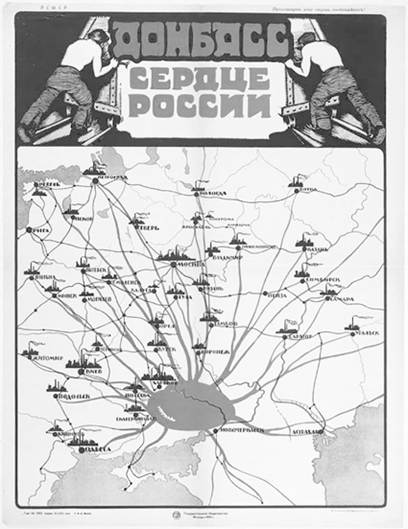
Donbas was not an exploited periphery but developed into a full-fledged economic center for the rest of the Empire. This gave the region and its people some leverage, influence, and attention. Southern Ukraine became the place “where the steel was tempered”, to paraphrase Alexander Ostrovsky’s famous novel, in the late Russian Empire and the first decades of the Soviet Union. This was made possible by large investments from foreign investors and protectionist policies that ensured Ukrainian coal stayed in the country. The Donbas’ development into a center of heavy industry also transformed the wider region with workers from all over the Russian Empire and Soviet Union migrating to south-eastern Ukraine.20 What emerged was not the “russification” of the region but, instead, the development of a specific regional identity, filled with pride as being the “heart of Russia” (Rossiia), and fueling the economy of the Soviet Union.
This central economic position of Donbas was challenged in the early 1930s when Stalin's prized megaproject, the new city of Magnitogorsk, shifted the Soviet Union's economic geography towards, and beyond, the Ural Mountains. However, Donbas (and with it, Ukraine) remained an industrial center of the Soviet Union - continuing to exert a socio-economic gravitational force over those Russians who came to work and live there. In the last Soviet Census of 1989, 45 per cent of the population of Donbas reported their ethnicity as Russian.21 This high percentage distinguished this region from other parts of independent Ukraine, with the Donbas emerging as a regional bastion of the proRussian former Ukrainian president ViktorYanukovych and the oligarch Rinat Akhmetov, the wealthiest man in Ukraine and known as financier and unofficial leader of the Party of the Regions.
Natural Gas
Long before the annexation of Crimea and the start of its war of aggression against Ukraine, Russia had already waged a certain type of war throughout the 2000s that saw a series of“gas wars” between both countries.22 During this decade, Russia weaponized its gas pipelines running to and through Ukraine to exert influence over the country's political landscape, setting the price of gas in conflict with the transit fees being demanded by Ukraine. As part of the postSoviet economic space, Ukraine had benefitted from reductions in gas prices and fees paid by the Russian Federation for flow rights. This advantage turned into a big disadvantage when the Ukrainian leadership lost favor with Russia, and the Kremlin started to use gas pricing and delivery for blackmailing. The contemporary picture of Ukraine as a transit country for natural gas overshadows the fact that it had previously possessed its own natural deposits. After the Second World War, Soviet Ukraine was one of the main gas producers within Comecon, the Eastern counterpart to the then European Economic Community. Most of the gas consumed in Poland, for example, came from Ukraine. Indeed, during the 1950s, the Ukrainian gas fields amounted to almost half of total Soviet gas production. Two decades later, the yield from Shebelinka, Ukraine’s biggest gas field in Kharkiv oblast, peaked at 68.7 million rubles in 1975. This was 23.8 per cent of the Soviet production volume.
In the late 1960s, West Germany reached out to the Soviet Union to satisfy its own economic hunger for natural gas, exacerbated by multiple crises in the oil market. Given the growing demand for gas, the Soviet Union could only meet these requests if it could develop the vast gas fields of western Siberia. However, under Leonid Brezhnev, the country lacked the necessary funds, prompting it to reach out to potential partners on the other side of the Iron Curtain. While the United States and Japan refused to respond to Brezhnev’s appeal, the Soviet Union and West Germany instead embarked on a new path of collaboration: the “gas for pipes” deal. This provided the Soviet Union with loans and necessary materials (around 1.2 million tons) for building the new pipelines - under the condition that it would deliver 3 billion cubic meters in natural gas to Germany on an annual basis.23
Representing the biggest deal between the Soviet Union and Germany since the Third Reich’s invasion, the agreement itself was celebrated as a significant cornerstone of German Entspannungspolitik, easing tensions across the blocs and (in an admittedly rather teleological perspective) leading to the fall of the Berlin Wall and the end of the Cold War. This specific deal is also at the root of later economic entanglements between Germany, the Soviet Union, and its legal successor state, the Russian Federation. The idee fixe of making peace by making business was as strong as it proved to be ultimately flawed. One of these deficiencies was that it overlooked the tremendous costs forced upon Ukraine. As early as the Winter of 1973-74, the Soviet Union experienced its own shortage in gas supply, but still insisted on meeting its delivery obligations with Western partners. To fulfill these obligations, Moscow simply rechanneled natural gas initially designated for Soviet Ukraine to West Germany, causing a major disruption to the former’s gas supply. Factories were closed, and households could not be heated. Jeronim Perovic pointedly observes that “in the Soviet Union, the country with the world’s largest proven fossil natural gas reserves, its own citizens were freezing.”24
This early example shows that depriving Ukraine of its gas supply is not a post-Soviet phenomenon, but a development deeply rooted in the German- Russian gas business. However, the tension between Russia and Ukraine intensified after 1990. Overnight, Ukraine became a transit country and a large importer. Utilizing the country’s economic dependence and debt to Russia, exerting pressure on this newly independent nation providing a means of consolidating regional control. When Russia reduced its gas delivery (again) in 1993 and 1994, a major energy crisis broke out. Consequently, the early 2000s were marked by ongoing negotiations between Russian and Ukrainian officials over the latter's debt towards Gazprom, with the matter only being resolved shortly before the outbreak of the Orange Revolution of 2004.
During the late 2000s, Russia and Ukraine engaged in ongoing discussions regarding the gas pipelines that linked their economies. However, it is notable that from 2005 onwards, there was a significant decrease in the import of gas from Russia to Ukraine, with the European Union beginning to play an increasingly larger role in the energy relationship between the two countries. This shift in the energy dynamic between Russia and Ukraine highlights the complex nature of the issue, but it is also important to consider the deteriorating relationship between the two countries. Russia, specifically, has attempted to bypass Ukraine with the building of the North Stream pipelines, which were designed to transport gas directly to Germany, effectively cutting out Ukraine and depriving it of transit fees. Thus, the colonial situation in the case of gas represented a sequence of resource exploitation, followed by control and dominance over energy supply: the Soviet Union drained the Ukrainian gas fields in the 1960s and 1970s, advertently or inadvertently forcing Ukraine to become dependent on Russia for gas imports.
Conclusion and Afterthoughts
Russia was a unique type of imperial state. Deprived of access to overseas territories, Russian imperialism took a different shape to that of the British or French. Andreas Kappeler was among the first to point to the peculiarities of the widely asymmetrical and complex political, social, cultural, and economic fabric of the Russian Empire.25 The blurriness between the “center” and the periphery stands out as one of the key features. The case ofUkraine, as well as that of the other Western “provinces” of the Empire, underlines this argument. This should, however, not distract us from the clear and direct power relations that benefited some while harming many.
In conclusion, examining Ukraine's economic history helps us to understand the flow of goods within and outside of this important economic space. It allows us to draw borders between regions and take a closer look at the spatial ordering ofUkraine and its relations with other countries and regions. Moreover, it is also important to consider the role of resources, soil, economics, politics, and culture in shaping these borders. Ukraine was both a colony and a core part of an empire, and this Janus-faced integration had a significant impact on its socioeconomic development. Willard Sunderland pointed out that “Russia’s ‘internal expansion’ (the intensification of settlement and the reorganization of society) and ‘external expansion’ (colonial conquest and immigration) proceeded together”26 leading to its ambivalent relationship with other European economies and its disentanglement from Russian dominance. This shared past with Russia continues to influence Ukraine’s economy today.
Notes
1 Boris Belge, “Odessa unddas Getreide,” GeschichtederGegenwart, 20.07.2022. https://geschichtedergegenwart.ch/odessa-und-das-getreide/, Accessed on 10 January 2023.
2 Patricia Herlihy, Odessa: A History, 1794-1914 (Cambridge, Mass.: Harvard University Press, 1986); Evrydiki Sifneos, Imperial Odessa: People, Spaces, Identities (Leiden, Boston: Brill, 2018).
3 Andreas Kappeler, Kleine Geschichte der Ukraine (Munchen: C.H. Beck, 2014), pp. 7-10.
4 Darra Goldstein, The Kingdom of Rye: A BriefHistory of Russian Food (Oakland: University of California Press, 2022); Robert E. Jones, Bread Upon the Waters: The St. Petersburg Grain Trade and the Russian Economy, 1703-1811 (Pittsburgh, Pa: University of Pittsburgh Press, 2013); Scott Reynolds Nelson, Oceans of GrainHow American WheatRemade the World (NewYork: Basic Books, 2022); John LeDonne, “Geopolitics, Logistics, and Grain. Russia's Ambitions in the Black Sea Basin, 1737-1834,” International History Review 28 (2006): 1-41.
5 Oleksii Sokyrko, “From Private Property to Feudalism,” The Ukrainian Week 22 August 2013 (https://ukrainianweek.com/History/87585); Stephen Ve- lychenko, “The Issue of Russian Colonialism in Ukrainian Thought: Dependency Identity and Development,” Ab Imperio 1 (2002): 323-67; Aleksandr Etkind, Internal Colonization. Russia’s Imperial Experience (Cambridge: Polity, 2011).
6 Margaret Kohn, and Kavita Reddy. “Colonialism,” in Edward N. Zalta (ed.) TheStanfordEncyclopediaofPhilosophy (Stanford: StanfordUniversity Press, 2022). https://plato.stanford.edu/archives/sum2022/entries/colonialis m/; Jurgen Osterhammel, Colonialism: A Theoretical Overview (Princeton: Markus Wiener Publishers, 2005).
7 M. Abdel-Fadil, “Colonialism,” in Matias Vernengo, Esteban Perez Caldentey, Barkley J. Rosser Jr. (eds.) The New Palgrave Dictionary of Economics (London: Palgrave Macmillan UK, 1987), p. 2.
8 Adam Barker, and Emma Battell Lowman, “Settler Colonialism,” in Global Social Theory. https://globalsocialtheory.org/concepts/settler-colonialism /. Accessed on 26 April 2023.
9 Ibid; Olivia Irena Durand, “‘New Russia' and the Legacies of Settler Colonialism in Southern Ukraine,” JournalofAppliedHistory 4:1-2 (2022): 58-75.
10 Kappeler, Kleine Geschichte der Ukraine, p. 99.
11 Kelly O'Neill, Claiming CrimeaiAHistory of Catherine the Great’s Southern Empire (New Haven, London: Yale University Press, 2017); Patricia Herlihy, Russian Grain and Mediterranean Markets, 1774-1861 (Philadelphia: University of Pennsylvania, 1963); BarryGoodwin, and Thomas Grennes. “Tsarist Russia and the World Wheat Market,” Explorations in Economic History 35:1 (1998): 405-30; David Moon, “In the Russians' Steppes: The Introduction of Russian Wheat on the Great Plains of the United States of America,” Journal of Global History 3:2 (2008): 203-25; Martin Buhler, Von Netzwerken zu Mdrkten: Die Entstehung einesglobalen Getreidemarktes (Frankfurt: Campus, 2018).
12 Lewis Siegelbaum, “The Odessa Grain Trade: A Case Study in Urban Growth and Development in Tsarist Russia,” Journal of European Economic History 9:1 (1980): 113-51; Patricia Herlihy, Odessa Recollected: The Port and the People (Boston, MA: Academic Studies Press, 2019).
13 Gregory, Paul R. Before Command: An Economic History of Russia from Emancipation to the First Five-Year (Princeton: Princeton University Press, 2014), pp. 55-81.
14 Anne Applebaum, Red Famine: Stalin's War on Ukraine (New York: Doubleday, 2017); Andrea Graziosi, “The Soviet 1931-1933 Famines and the Ukrainian Holodomor: Is a New Interpretation Possible, and What Would Its Consequences Be?” Harvard Ukrainian Studies 27:1/4 (2004): 97-115; Guido Hausmann, and Tanja Penter. 'Tnstrumentalisiert, verdrangt, ignoriert: Der Holodomor im Bewusstsein der Deutschen,” Osteuropa 70:3-4 (2020): 193-214.
15 Nikolai M. Dronin, Climate Dependence and Food Problems in Russia, 1900-1990: The Interaction of Climate and Agricultural Policy and Their Effect on Food Problems (Budapest: Central European University Press, 2008); Alfred Eisfeld, Guido Hausmann, and Dietmar Neutatz (eds.) Hungers- note in Russland und in der Sowjetunion 1891-1947: Regionale, ethnische und konfessionelle Aspekte (Essen: Klartext, 2017).
16 Manfred Hildermeier. Die Sowjetunion: 1917-1991 (Berlin; Oldenbourg Wis- senschaftsverlag, 2014); ManfredHildermeier. DieruckstdndigeGrofimacht: Russland undderWesten (Munchen: C.H. Beck, 2022).
17 Kappeler, Kleine Geschichte der Ukraine, p. 316.
18 Ibid. p. 127.
19 Ibid. p. 198.
20 Hiroaki Kuromiya, Freedom and Terror in the Donbas: A Ukrainian-Russian Borderland, 1870s-1990s (Cambridge, Mass.: Cambridge University Press, 2003); Theodore H. Friedgut, Iuzovka and Revolution (Princeton: Princeton University Press, 1989).
21 Don Harrison Doyle (ed.). Secession as an International Phenomenon: From America’s Civil Warto Contemporary SeparatistMovements (Athens: University of Georgia Press, 2010), pp. 286-287.
22 Thane Gustafson, The Bridge. Natural Gas in a Redivided Europe (Cambridge, Mass.: Harvard University Press, 2020).
23 Simon Pirani, and Anne Emmert. “Am Tropf: Die Ukraine, Russland und das Erdgas,” Osteuropa 60:2/4 (2010): 237-55.
24 Jeronim Perovic. Rohstoffmacht Russland: Eine globale Energiegeschichte (Wien Koln: BohlauVerlag, 2022).
25 Andreas Kappeler, Ungleiche Bruder: Russen und Ukrainer vom Mittelalter bis zur Gegenwart (Munchen: C.H. Beck, 2017); Andreas Kappeler, Zenon E. Kohut, Frank E. Sysyn, and Mark von Hagen (eds.) Culture, Nation and Identity: The Ukrainian-Russian Encounter (1600-1945) (Toronto: Canadian Institute of Ukrainian Studies Press, 2003); Andreas Kappeler, The Russian Empire: A Multiethnic History. Translated by Alfred Clayton (Abingdon: Routledge, 2013).
26 Willard Sunderland, Taming the Wild Field: Colonization and Empire on the Russian Steppe (Ithaca: Cornell University Press, 2004), p. 5.
Selected Bibliography
Balabushevych, T. A., Baran, V. D., Baran, V. K. (eds.) Ekonomichna istoriia
UkraIny. Istorychno-ekonomichne doslidzhennia, u 2 t. (Kyiv: Nika-Tsentr, 2011).
Dean, James. “Ukraine: Europe's Forgotten Economy,” Challenge 43:6 (2000): 93-108.
Etkind, Aleksandr. Internal Colonization. Russia’s Imperial Experience (Cambridge: Polity, 2011).
Goldstein, Darra. The Kingdom of Rye: A BriefHistory of Russian Food (Oakland: University of California Press, 2022).
Havrylyshyn Oleh (ed.) The Political Economy of Independent Ukraine: Slow Starts, False Starts, and a Last Chance? (London: Palgrave Macmillan, 2017).
Herlihy, Patricia. Odessa Recollected: The Port and the People (Boston, Mass.: Academic Studies Press, 2019).
Koropeckyj, I. S. Ukrainian Economic History: Interpretive Essays (Cambridge, Mass.: HarvardUniversity Press, 1994).
Kuromiya, Hiroaki. Freedom and Terror in the Donbas: A Ukrainian-Russian Borderland, 1870s-1990s (Cambridge: Cambridge University Press, 2003).
O'Neill, Kelly. Claiming Crimea: A History of Catherine the Great’s Southern Empire (New Haven: Yale University Press, 2017).
Siegelbaum, Lewis. “The Odessa Grain Trade: A Case Study in Urban Growth and Development in Tsarist Russia,” Journal of European Economic History 9:1 (1980):113-51.
II.