IDEOLOGY AND MYTH: SOVIET NATIONALITIES POLICY
Given our model of the Soviet communications system as set forth in Chapter 1, we can assume that if an issue is more or less openly debated in official channels over an extended period, then the central Party leadership either considers the matter unimportant, or the leadership is itself divided on the issue, since under these conditions both sides of the debate are ’’legitimate" until an official consensus is proclaimed.
As we have adequate reason to believe that the nationalities question is not unimportant to the Soviet leadership, the existence of clearly drawn - and only thinly veiled - debate indicates that the leadership is divided over the substance of nationalities policy and the theories that underlie it.Soviet nationalities policy is the arena of both open and veiled struggle between the proponents of greater centralization of political power and greater uniformity of culture on the one hand, and proponents of wider political, economic and cultural autonomy for nationalities on the other. While the Soviet media refer to nationalities policy in the singular, and imply that it is the fixed and immobile patrimony of the October Revolution, it is in fact neither monolithic nor unchanging; there is no solid consensus among elites as to what the "policy" is or should be, except at the rarefied level of ideals and platitudes: equality, mutual respect, and some form of "drawing together" in the more or less remote future. Below this level, Soviet nationalities policy is characterized by an ambiguity that both reflects and facilitates the efforts of diverse groups within the society to mold official ideology so that group interests can prevail while the overall stability of the system - upon which the same group interests also depend - will be minimally threatened.
Fluctuations in Soviet nationalities policy - ranging from oppression and Russification at one extreme·to compromise, accommodation and deferral of regime goals on the other - are thus responses to demands from republican cultural and political elites.
What is fundamentally at question, therefore, are the CPSU's mechanisms of adaptation, on the one hand, and processes of interest aggregation and articulation under conditions of severely restricted communications, on the other.The flexible instrument of Soviet nationalities policy must serve both functions: the ideology is the tie that divides as well as binds. Given that ideology derives from the political myth, and that governmental legitimacy in the Soviet Union rests on the ideology, then, reinterpretation or reformulation of specific elements of the myth, and invocation of key elements of the myth, or successful injection of elements of other myths into the ideology, serve to legitimate demands and initiatives on the part of particular interests, and actions or inactions on the part of central or republican authorities. Soviet nationalities policy, therefore, is the resultant of efforts on the part of national elites to reshape the ideology so as to preserve cultural identity or republican political autonomy; on the part of central authorities, it is the resultant.of similar efforts to limit such demands to a level at which they do not threaten all-Union interests or Russian interests, to accommodate (symbolically or substantially) demands that cannot be limited or suppressed, and to try to reshape demands - all without violating a vaguely defined but irreducible core of socialist ideology, and preserving above all the leading role of the Communist Party. We refer to nationalities policy as the resultant of these conflicting pressures to emphasize that the policy that emerges may not be what anyone or any group particularly wanted; in vector geometry, a "resultant" is the sum of a number of vectors, but it rarely coincides with any particular vector that produces it.
We are concerned in this chapter with the evolution of official nationalities policy since the death of Stalin, from the viewpoint of mythic inputs: overt efforts to reshape or to interpret the official ideology so as to legitimize particular interests.
This is an incremental process, and takes place almost entirely within legitimate channels of communication; we are not concerned in this chapter with opposition nor with samvydav channels, which represent a more focused effort to replace the official myth with another, rather than to reshape the interpretation of ideology in order to make it more amenable to the national myth. We admit that the distinction is arbitrary, but submit that it is logical in terms of our theoretical focus on how symbols become a medium of interest articulation under conditions of restricted communication.We have attempted in this chapter to emphasize wherever possible Ukrainian input into official nationalities policy. The discussion that follows, however, relates to official nationalities policy as it concerns all of the Union Republics. Ukrainian cultural and political elites must define the Ukraine's relationship to the center and to the USSR as a whole within the ideological framework of all-Union nationalities policy. Much of the content of this chapter thus has general applicability to all-Union nationality problems and policies.
In order to proceed, it will be necessary to make a distinction, though again an arbitrary one, between "ideology in flux" and the "official" ideological position. It will be convenient and not unreasonable to take as the official position of the Party at a given time those versions of nationalities policy that are crystallized in the Resolutions of CPSU Congresses. Three Congresses in the period under study - the 20th (1956), 22nd (1962) and 24th (1971) - stand out as marking major reformulations of official nationalities policy.
The organization of the argument in this chapter is evolutionary: an attempt is made to lend chronological coherence to our topical concerns. We will focus attention on three major areas of theoretical contention in the development of nationalities policy:
1. The nature of the "nation" and the pace of the realization of the "merger" of nations, and the proper dialectical interaction between the processes of "flowering" and "drawing together."
2.
The nature of Soviet federalism as it concerns the legal, cultural and political rights of the Union Republics, and the fate of these in the course of "building communism."3. The pace and character of ethnic and linguistic assimilation.
THE MYTH OF PROLETARIAN INTERNATIONALISM
The framework for the overt ideological expression of the myth of proletarian internationalism is the writings of Marx, Engels, Lenin and Stalin. The central premise of the classical Marxist theory of the nation is that it is decidedly a historical phenomenon. In the classical Marxist conception, nations are formed only when the inhabitants of one territory, speaking one language, are also united by economic bonds. Internal economic ties and a means of communication weld the various parts of a people into a nation.
The classical Marxist conception recognized that nations differ from one another and from other groups and communities in their intangible characteristics, or "psychological makeup." The Marxist approach to national character differs from that of the integral nationalist myth, however, in that, while the conditions under which people live together from generation to generation do manifest themselves in a distinctive culture, such a character is not biologically rooted, has nothing to do with the "landscape" or soil, and does not, in any idealistic sense, represent the fixed "essence" of a nation. In short, the "psychological makeup" of a nation is also historically conditioned.
"Leninist nationality policy" emerged out of the writings of Lenin and Stalin, and out of the tactical requirements of the Bolshevik revolution, to become one of the prime legitimating symbols of Soviet rule in the former Tsarist empire. Leninist nationality policy, as the original Leninist component of the myth of proletarian internationalism, can be summarized as encompassing the following five principles:
1. All nations and languages are equal.
2. Since nationalism is a bourgeois ideology, and the proletariat has no nation, the proletarian party cannot be divided on national grounds.
3. The right of nations to secede (the "right of national self-determination") is to be upheld, but secession must be in line with the interests of the proletariat, as defined by the party.
4. Even in a socialist state, concessions may have to be made to national consciousness; the policy in such cases must be to promote cultures "national in form, but socialist in content."
5. Under full communism, national distinctions will disappear, and nations will merge.
While Leninist nationality policy is a myth, or, more precisely, an element of a larger myth, it also functions as a complex symbol with a highly ambiguous content. It is one of the prime symbols in the clash between the regime and its challengers. Central authorities in Moscow urging internationalism and seeking to legitimate specific policies, republican political and economic elites striving for decisonal autonomy, and republican cultural elites critical of Russification and demanding the right of national cultural expression, all are able to base their claims on Leninist nationality policy, because of its ambiguity, and because of the force of the figure of Lenin as a legitimizing symbol.
In fact, Lenin's primary concern was less with the reconciliation of nationalism with Marxism than with the accomplishment and institutionalization of Soviet power throughout the former Tsarist empire. Lenin was preoccupied with the consolidation of power, and for him, nationalism was a force to be harnessed in the service of the revolution, and dealt with later. Lenin thus left a legacy of ambiguity and ambivalence on national issues that was later to be pressed into service by ideologues and spokesmen on both sides of the nationalities question, but by none with so great success as by the spokesment of a deeper myth, the fundamental myth underlying proletarian internationalism: the myth of Russian primacy.
In the Soviet conventional wisdom, two deviations have stood in the way of the implementation of Leninist nationality policy: Great Russian chauvinism, and bourgeois nationalism. Russian chauvinism represented the ethnocentric attitudes of Russian communists insensitive to minority national customs, languages and autonomy. Bourgeois nationalism referred to excessive aspirations for autonomy on the part of non-Russian cadres, and local hostility to Russian domination. Over time, bourgeois nationalism came to be regarded as the greater sin, and by the late 1930s, the term Great Russian chauvinism had all but disappeared from official discussions of nationalities policy.
Stalin's de facto preference for Russification was evident even at the height of the policy of "Ukrainization" in the Ukraine. When Oleksandr Shums'kyi, Ukrainian Commissar of Education, complained to Stalin that Russian assimilationist pressures were dominant, and that only intervention from Moscow would alleviate the situation - replacing Russian and Russified Ukrainian cadres with Ukrainians committed to Ukrainian ways - Stalin’s response was less than salutary for Ukrainization: conceding that Russifying tendencies must be opposed, he nonetheless insisted that neither could Ukrainization be rushed. Not only were there insufficient Ukrainian cadres to replace Russian and Russified leaders, but the interests of Russian minorities in the Ukraine had to be protected, too. Further, Ukrainization was not to be permitted to play into the hands of the nationalists by pursuing it too vigorously. In any event, the Ukrainians were instructed that they were not to reject Russian influences outright; Russia provided a revolutionary example that the minority nationalities should emulate.^
By 1933-34, the policy of favoring the appointment of ethnic Ukrainians preferentially to leadership posts had given way to the promotion of "tried and tested people
2
educated in the BOlshevik spirit." This spelled the end of Ukrainization; pressure on urban Jews and Russians to adopt Ukrainian ways came to an end, and indeed, with those Ukrainians who had pressed vocally for localism coming increasingly under suspicion of "bourgeois nationalism," there came to be a premium on knowledge of Russian among Ukrainians.3
The old prejudice of the Tsarist regime that Ukrainian was a vulgar peasant dialect, inferior to Russian, again began to be publicly articulated. In 1938, a requirement was adopted that the Russian language be taught throughout the Ukrainian school system. Where previously writers and artists had been encouraged to use and develop the Ukrainian language and to exploit Ukrainian folk themes, after 1938 the pressure increased on Ukrainians to avoid such "nationalist" themes, and to write in Russian.
J.V. Stalin, Socheneniia (Moscow: Izdatel’stvo "Politicheskoi Liter- atury," 1949-1953), Vol. VIII, pp. 149-50.
2...
Visti Ukrains fkoho Tsentraifnoho Vykonavs 'koho Komiteta (Kiev), January 17, 1933.
3..
P.P. Postyshev and S.V. Kossior, Soviet Ukraine Today (Moscow: Foreign Languages Publishing House, 1934), pp. 50-56.
The policy of Russification of the Ukraine continued after World War II, and for the remainder of Stalin's regime. The myth of Russian primacy began to receive public articulation after the war. Stalin was convinced of Ukrainian disloyalty during the war. The Ukraine had borne the brunt of the Nazi attack and occupation, and the Ukraine was cut off from Soviet control and support. During this time, there was a resurgence of Ukrainian nationalism, and the organization of armed groups to fight the Soviet regime, despite the indifference and even contempt of the Nazi occupiers. Armed anti-Soviet insurrection on the part of the OUN and UPA was not decisively quashed until 1950, and OUN cells were still being uncov-
4 ered in the 1960s.
5
Stalin's May, 1945 toast to the Russian people evoked a latent but quite firmly entrenched myth of Russian responsibility for the Soviet family of nations, buttressed by a not altogether unfounded myth of Russian sacrifices for the sake of the Union. Russians were conscious that the revolutionary movement of the 19th century was a Russian movement, and that the genius of Soviet Marxism is Russian Marxism. The Revolution itself was "Russian," and the Civil War had been fought and won largely by Russian Bolsheviks. It had been Russians who carried socialism, culture and modernization to the backwaters of the Tsarist empire. In the aftermath of a bloody war against the fascists, along with the perception of lack of support from the "nationalist" borderlands, there was ample sentiment to be tapped by Stalin's toast. The myth that the Revolution and the Soviet Union were a Russian patrimony unquestionably always existed just below the surface of Leninist nationality policy; Stalin's encouragement of Russian nationalism during the war and his attitude exemplified in
4
See Chapter 5, below.
^Pravda, May 25, 1945. See translation in Robert V. Daniels, ed., A Documentary History of Communisiri (New York: Vintage, 1962), p. 138. in his toast, brought it to the surface.
It is worth emphasizing that there is a deeper historical dimension to the identification of the USSR with Russia. The Tsarist imperial philosophy conceived of the empire as "Rossiyskaia." Richard Pipes notes that the Russian empire somewhat followed the French colonial pattern: in contrast to the British, the French extended the full rights of French citizenship to their colonies, hoping thereby to assimilate them.^ The analogy is apt: the entrenched belief that Algeria was somehow "French" came out of this pattern of colonialism, and Russian identification with the former colonies of the Tsars undoubtedly did also.
Crystallization of the myth of Russian patrimony of the former Tsarist empire began almost at once, with the rewriting of history. The theme of Russian primacy early became more or less incorporated into Marxist-Leninist ideology through the doctrine of "friendship of peoples" (druzhba narodov). The "friendship of peoples" doctrine is a remarkable example of mythmaking through anachronism: the projection of the concerns of the present into the distant past.
The friendship of peoples myth projects the "friendship" of the future Soviet "family of nations" far into the past, and emphasizes that the resistance of the borderlands to Russian colonization was resistance not to Russians per ser but to Tsarism. The myth maintains that the minority peoples of the empire in fact welcomed the Russian colo-
7 nizers as brothers in the revolutionary struggle.
The myth of the friendship of peoples was crucial in legitimizing the myth of Russian primacy, because it contradicts and belies the Russian colonial domination of minority nationalities. With this as background, we can ^Richard Pipes, ’’Introduction: The Nationality Problem,” in Zev Katz, Rosemarie Rogers and Frederic Harned, eds., Handbook of Major Soviet Nationaities (New York: The Free Press, 1975), p. 2.
?0n the "friendship of peoples" myth, see Lowell Tillett, The Great Friendship (Chapel Hill: University of North Carolina Press, 1969). formulate the myth of Russian primacy as follows:
1. The Soviet Union is a Russian enterprise. The basis of this is that the former Tsarist empire belonged to Russia, and because Russians took the initiative in forming and defending the Soviet Union.
2. The prerogative of rule thus belongs to Russians, and to Russified members of other ethnic groups.
3. Russian culture and the Russian language are not only superior, but are inviolable.
4. The new culture and language that will coalesce as the eventual result of drawing together and merging (sblizhenie and sliianie) of nations of the USSR will be Russian language and Russian culture.
The myth of Russian primacy serves to give a specific content to the myth of proletarian internationalism: that Russian culture is to be central to the "socialist content" of national cultures. As early as 1946, in an article condemning the "away from Moscow" slogan of Mykola Khvylovyi (1893-1933), it was made explicit that Ukrainian culture could not develop separately from Russian culture: that Russian culture is superior to, and is to be the model for, national cultures.
We should clarify that the myth of Russian primacy is distinct from Russian nationalism - both the neo-Slavophil- ism of Solzhenitsyn and the integral nationalism of Veche
9.
and Slovo natsii. It is clear that a myth of national identity based on blood is incongruous with the merger of nations through intermarriage, migration and assimilation, which is the goal of Soviet nationalities policy, and an integral part of the myth of proletarian internationalism. Nicholas DeWitt has suggested that as early as the mid- 19303, the official Soviet concept of nationality had
Q
Bolshevik, XXI, No. 22(November, 1946), pp. 1-8. Quoted in Yaroslav Bilinsky, The Second Soviet Republic (New Brunswick: Rutgers University Press, 1964), pp. 410-11.
9
See, for example, Dmitry Pospielevsky, ’’The Resurgence of Russian Nationalism in Samizdat,” Survey, XIX, No. 1(Winter, 1973), pp. 51-74. changed from one of "root nationality" based on ethnic descent to one of "self-declared nationality."^
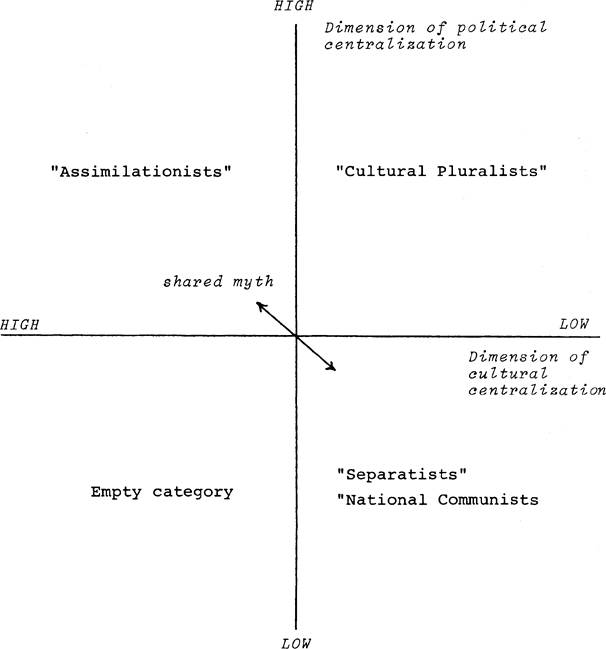
In the period of comparative liberalization that followed the death of Stalin, the meaning of the term "nation", the determinants of ethnic identity, and the pace of "drawing together" became the foci of debate between "cultural pluralists" and "assimilationists," in an effort to modify the myth of proletarian internationalism in the direction of lesser and greater, respectively, de-nationalization through government policy. It is to the specific content, the mythical premises, and the reasoning and techniques of argumentation of this debate that we now turn our attention.
THE MYTH OF PROLETARIAN INTERNATIONALISM
IN FLUX, 1956-1972
The events immediately following Stalin's death in 1953 at first seemed auspicious for Ukrainian autonomy. On June 13, 1953, CPUk 1st Secretary L.G. Mel'nikov, an ethnic Russian, was dismissed for appointing Russified East Ukrainians to high positions in the West Ukraine. His dismissal was accompanied by calls to emphasize the training and development of local cadres to develop programs in "locally meaningful ways.He was replaced by Kirichenko, the first ethnic Ukrainian to hold the top Party post in the Ukraine. Khrushchev, who had been Ukrainian Party boss from 1938 to 1949, turned to his former regional Party organization for support in his own succession struggle, and also as a source of loyal supporters for leadership positions throughout the Soviet Union.
For the first time in the Soviet period, the Ukrainians
^Nicholas DeWitt, Education and Professional Employment in the USSR
(Washington, D.C: National Science Foundation, 1961), p. 354.
^Pravda Ukrainy, June 13, 1953, p. 1.
were designated as "junior partners" of the Russians. The "junior" aspect of the partnership was emphasized, since the Russians remained the "principal bearers of the great revolutionary ideas of freedom and progress." But, as the Ukrainians, along with the Belorussians, were part of the "great Slavic family," they, as distinct from the other national minorities, were to be regarded as co-leaders in. 12
the Russian enterprise.
While no doubt reassuring to the Ukrainians, particularly in its contrast to Stalin’s ill-concealed contempt, it has been suggested that the partnership theme also served to remind the Ukrainians that, as partners, they were also
13 equally responsible for Soviet programs, and, close as they are to the Russians in language and culture, slated for intensive Russification.
The high point in the post-Stalin liberalization of nationalities policy came with the 20th Party Congress in February, 1956. Among the crimes for which Khrushchev castigated Stalin was that of "rude violations of the basic Leninist principles of the nationality policy of the Soviet 14
state." Khrushchev referred in this context to the mass deportations of minorities suspected of collaboration with
12
Pravda, May 30, 1954. Bilinsky reports that as early as 1948, Molotov reported to the Jubilee Session of the Ukrainian Supreme Soviet that the Ukrainians were the first to have entered the road to socialism after the Russians, but this theme remained subdued until 1954; Bilinsky, op. cit., p. 19. For informed Western discussions of the hierarchy of Soviet Republics, also see John A. Armstrong, "The Ethnic Scene in the Soviet Union: The View of the Dictatorship," in Erich Goldhagen, ed., Ethnic Minorities in the Soviet Union (New York: Praeger, 1968), and Vernon V. Aspaturian, "Nationality Inputs in Soviet Foreign Policy: The USSR as an Arrested Universal State," in Aspaturian, ed., Process and Power in Soviet Foreign Policy (Boston: Little, Brown and Co., 1971).
13
Robert S. Sullivant, "The Ukrainians," Problems of Communism, XVI, No. 5(September-October, 1967), p. 53.
14
See "Khrushchev’s Secret Speech," in Dan N. Jacobs, ed., The New Communist Manifesto and Related Documents, 3rd edition (New York: Harper and Row, 1965), pp. 147-48. the Germans, and to Stalin’s alleged desire to deport the Ukrainians to Siberia, too, but for their numbers. The inronic tone of this portion of the speech clearly implied that Stalin’s suspicions of nationalist plots in the borderlands were an illusion, and this must have gone far in relegitimizing, and even stimulating, stepped up demands for greater rights to cultural expression and political autonomy.
A few months following the Congress, Lenin’s ’’Testament," containing documents suppressed in the USSR since 1923, was published, and included an article that, while it had long been known in the West, became the entering wedge of a new theme in the mythical aspects of Soviet nationalities policy. In the article, Lenin criticized Stalin’s plan to incorporate the Union Republics as provinces of the Russian Republic, and urged tact in dealing with minority nationalities; in particular, he warned against the suppression of non-Russian languages.15
As a direct result of the 20th Party Congress and the publication of the "Testament," a myth of an egalitarian and benevolent Lenin was fostered, and greater emphasis was placed on his respect for national cultures - a consideration that had been quite openly tactical in nature - than a dispassionate reading of Lenin would seem to justify. In the wake of de-Stalinization, it was the benevolent Lenin that became the symbol of the legitimacy of the post-Stalin order as far as nationalities policy was concerned.
Symbolic concessions to national sensitivities, not to mention the reforms of 1955-1957,15 inevitably raised the
15V.I. Lenin, "On the Question of Nationalities, or ’Autonomization,”’ Kornmunist, No. 9(1956), pp. 22-26. English translation in National Liberation^ Socialism and Imperialism: Selected Writings of V.I. Lenin (New York: International Publishers, 1968), pp. 165-71.
^Federal powers in the fields of finance, planning, judicial administration and light industry management were transferred to the Republics, among other decentralization measures. See E.G. Bloembergen, "The Union Republics: How Much Autonomy?" Problems of Communism, XVI, No. 5(September-October, 1967), pp. 27-35.
expectations of national political and cultural elites for further concessions. These were not forthcoming. Khrushchev, his power secure, began in 1959 a trend toward administrative recentralization, accompanied by removal of some of the more outspoken national leaders, and renewed attacks on the survivals of "bourgeois nationalism."
The Third. Party Program
In official nationalities policy and theory, the effort to repair the breaches in the myth of proletarian internationalism caused by the succession crisis began in August, 1958, with an authoritative article by the Tadzhik scholar B. Gafurov. Gafurov's article in effect announced the forthcoming reversal of the regime's nationalities policy as it had been defined by the 20th Party Congress. In counterpoint to the recent emphasis on the "flowering" or "flourishing" (rastsvet} of national cultures, Gafurov reintroduced the concepts of "drawing together" (sbtizhenie) and "merger" or "fusion" (sliianie) of the Soviet nations, which, in the liberal euphoria of the succession, had almost disappeared from the media.
Obstacles to the attainment of unity remained for Gafurov "nationalist prejudices" and "national narrow-mindedness," and in particular, "the tendency to marshal cadres of different nationalities,"17 reluctance to fulfill plans for inter-republican deliveries, and in general, emphasis on the locality at the expense of the Union as a whole. Repeating familiar themes, Gafurov finds in the field of ideology that nationalist survivals are manifested most
often in:
... idealization of the historical past, in an uncritical attitude toward various national movements, in forgetting the principle of partiinost' in elucidating questions of culture, literature, the arts.18
Gafurov does not fail to include Russian chauvinism as an obstacle to unity:
... we should keep in mind V.I. Lenin's advice that it is above all Russians who should combat Great Russian chauvinism, and representatives of a given nationality who must struggle against local nationalism.19
Yaroslav Bilinsky, however, commenting on the same passage from this article, urges that the apparent fairness of this passage is qualified by the fact that few Russians criticize Russian chauvinism, and the tenor of the passage suggests that "the struggle against Russian nationalism is not to be taken seriously, while the struggle against non-Rus- 20 sian nationalism is."
Finally, Gafurov addressed the question of when unity will finally be achieved:
The fusion of nations is an altogether complex and lengthy process. For its achievement, not only the victory of socialism throughout the world is necessary, but also the transition from the first, lower phase of communist formation - socialism - to its second and higher phase - communism. H
18Ibid., p. 28.
IQ
Ibid., p. 23.
20
Bilinsky, The Second Soviet Republic, p. 23.
21
Gafurov, p. 16.
What is remarkable is that, whether Gafurov’s theses were in the nature of a ballon d'essai from higher sources or his own independent initiative, they were enshrined, point for point, in the 3rd Program of the CPSU, adopted at the 22nd Party Congress in October-November, 1961.
The section of the Party Program dealing with nationality policy begins:
Under socialism the nations flourish 22 and their sovereignty grows stronger.
Thus, the concept of rastsvet - at least during the period of socialism - was instituted as an integral part of official nationalities policy: nations were to be allowed to flourish. But,
Full scale communist construction constitutes a new stage in the development of national relations in the USSR, in which the nations will draw still closer together until full unity is achieved. The building of the material and technological basis of communism leads to still greater unity of the Soviet peoples.23
Khrushchev specifically endorsed this section of the new
Program in his second major speech to the 22nd Party Con- 24
gress on October 17, 1961.
The concepts of rastsvet, sblizhenie and sliianie were not new in Soviet ideological polemics. The terms had been
22
’’The Program of the Communist Party of the Soviet Union,” Pravda and Izvestiia, November 2, 1961, pp. 2-9. Translation in Charlotte Saikow- sky and Leo Gruliow, eds., Current Soviet Policies, IV (New York and London: Columbia University Press, 1962), p. 26.
23
Ibid., p. 26.
24
N.S. Khrushchev, "On the Program of the Communist Party of the Soviet Union," Pravda and Izvestiia, October 19, 1961, pp. 1-10. Translation in Current Soviet Policies, IV, pp. 103-104. Note that these early documents refer to the Soviet peoples - in the plural - a usage that had changed by the 24th Congress. used by Lenin and Stalin, and the thesis that sliianie would come only with the achievement of communism had been adum-
25 brated in Lenin's pre-revolutionary writings. Sliianie had not been perceived as much more than a symbolic threat so long as its realization remained in the distant future. Neither Gafurov's reintroduction of the terminology, nor its enshrinement in the Party Program, would have created significant controversy had it not been for another, in fact the main, theme of the Program: that the CPSU and the Soviet Union were in fact now entering the period of transition to communism, and the transition was to be completed, not in the dim and irrelevant future, but, Khrushchev assured the 22nd Congress, by the year 1980:
We base ourselves on strictly scientific estimates, which indicate that we shall, in the main, have built a communist society within twenty years.26
The implication was clear to everyone concerned with nationality problems. Khrushchev, in asserting that the myth of proletarian internationalism was to be transformed into reality, inaugurated a debate of immediate perceived practical significance over what the substance of the myth actually was. That the regime seemed to conceive it in extreme assimilationist terms was hinted in the Program: the ominous assertion that "the boundaries between the Union Republics of the USSR are increasingly losing their former
. 27
former significance...." suggested the coming end of
25.
See, e.g., "Critical Remarks on the National Question," National Liberation^ Socialism and Imperialism, p. 27.
2 6
current Soviet Policiesj IV, p. 89.
27
Ibid., p. 26. Their "former significance," of course, following Lenin, was the tactical necessity of respecting national sensitivities. As federalism became less significant, so, clearly, would national rights and autonomy in all areas, and the program of fusion seemed explicitly to exclude the Russians from its effects.
federalism.
The Party Program offered no explicit rules on how it was to be implemented, but later debate on the provisions of the proposed new constitution suggest that the abolition of the Union Republics was being given serious consideration.
It seems clear in retrospect that the reversal in official nationalities policy following Khrushchev's consolidation of power was prompted in large part by quite practical considerations. Khrushchev's decentralization of industrial and agricultural management in 1957 left the nonRussian republics in a position of unaccustomed strength. Judging from the numerous press articles denouncing "localism," "nepotism," "preferential treatment," and the like between 1958 and 1962, it appears that the republican elites made heavy use of their new powers in matters of
2 8 cadre selection.
As the 1961 Party Program's theses were to the point but skeletal, offering no explicit guidance on how it was to be implemented, the Program gave rise to a spate of academic and publicistic writing on the subject of nationalities policy over the following decade, activity which, taken altogether and in retrospect, can be characterized as a more or less esoteric "debate" over which of the two myths will guide the interpretation of official nationalities policy.
The participants in this debate were academics and ideological spokesmen; top Party officials rarely took public part, except to affirm resolutions and theses of the Party. The channels of the debate were the official press, the academic press, and Party journals; since all these channels of communication are subject to censorship, the representatives of extreme views were excluded from open participation, and sought other, illegal, channels {samizdat).
28
See, e.g., I. Kravtsev, "Sblizhenie i rastsvet sotsialisticheskikh natsiei," Pravda Ukrainy, January 20, 1962, pp. 3-4. Brezhnev also believed the sovnarkhozy encouraged localism: Pravda^ September 30, 1965.
The operative rule is that views and polemics, if their proponents expect publication, must not contradict the skel- eltal official policy of the Party as it is enshrined in its theses and resolutions. The task, therefore, and the key to effective articulation of interests, is not to propose bold new themes, but to demonstrate that one or another specific policy proposal follows logically from, or is in some way legitimated by, that much of policy that has become "official."
The fundamental issue at stake in this debate was, of course, the continued existence of Union Republics organized along national lines, with as much a measure of political and cultural autonomy and national characteristics - most especially language - as possible, versus the protection of Russian dominance, and its extension, through cultural and linguistic assimilation and political centralization of decision-making. Although certainly many people in the USSR think of these issues and discuss them privately in terms as stark as this, the issue cannot be publicly discussed in the forthright way we have formulated them here, nor can the myths that underlie them be articulated. It is the ambiguity inherent in the official version of nationalities policy that is manipulated in an effort to shape a future policy that will legitimate either increased centralization and Russification, or increased national autonomy.
There are three principal tactics peculiar to this form of ideology-shaping:
1. The most important of these is the evocation of the symbolic authority· of Lenin. The potency of the Lenin symbol cannot be overstressed. So long as the regime is not its own legitimation, it must rely on symbols external to itself, and Lenin is the most important of these. The ambiguity of Lenin’s legacy provides the proponents of interests with a legitimating symbol for their demands, too. If a sufficiently convincing argument can be made that a policy direction is consistent with "what Lenin actually intended," the proponents of that policy will have gone far in legitimating it. Very rarely does anyone assert (and then only at the highest levels) that what Lenin said fifty years ago may in fact be irrelevant to the country's problems today.
2. The effort to extrapolate from accepted ideological premises to conclusions that favor one or another policy preference is another device. In this case, we have in mind academic debates over esoteric themes such as what constitutes a "nation," in which the practical implications of resolution of theoretical questions are veiled but real.
3. A third device involves theoretical arguments built around the "dialectic." This device is most often used to maintain the ambiguity of official policy, to stalemate discussion, or to camouflage blatant lapses of logic.
The Concept of the Nation
The common element in all Marxist treatments of the nation {natsiia) is that it is not a racial or a tribal community, but the product of a definite historical epoch, that of rising capitalism. Nationalities (natsionaI 'nosti*) and peoples (narody}, on the other hand, have their origins in precapitalist industrial relations. Engels spoke of the "fusion" or "merger" {sliianie) of tribes and clans - as a result of the appearance of private property, classes, trade, etc. - into "peoples," more or less stable ethnographic and historical formations, with their own cultures and written languages. A people or nationality is not merely an alliance of tribes, but a merger of them, in which they become fused and lose their individuality and their local governments, their' territories merged under a single 29
government.
Lenin, following Engels, stressed the historical nature
29.
Engels, Origin of the Family, Private Property and the State,
pp. 118, 125. of the nation, and capitalism as its economic basis. But in criticizing the historian Mikhailovsky, who had held national ties to be a generalization of clan ties, Lenin argued that only the modern period of Russian history - since the 17th century - is marked by true fusion of the formerly disunited Russian provinces, lands and municipalities into a single whole. More importantly, Lenin urged, this fusion was not the result of continuation and generalization of clan ties, but rather it was called forth by "growing exchange among the provinces... the concentration of small local markets into one all-Russian market.
The importance of the historical-materialist and economic theory of the origins of nations to the myth of proletarian internationalism cannot be overstated. If clans and tribes can, on the basis of economic integration, be "merged" into single nations with the arrival of capitalism, then further economic integration under socialism can be expected to lead to the further merger of nations into larger units with, it is implicit, single, centralized governments. The awkward formula of national self-determination can then be considered as appropriate only for capitalist states, and the corollary to national selfdetermination, "national communism," as a wholly unscientific deviation.
Until the period shortly following the adoption of the 1961 Party Program, Stalin's definition of the nation, with its four factors (common language, territory, economy and psychological makeup) remained unquestioned. In addition, for Stalin, "merger," while inevitable, is explicitly reserved for the dim future, the present being a time of "flowering" of the national cultures that had been oppressed under Tsarism. Stalin's explicit rejection of immediate
30
V.I. Lenin, Sochineniia (Moscow), Vol. I, pp. 137-38.
31J.V. Stalin, The National Question and Leninism (Moscow: Foreign Languages Publishing House, 1950), p. 23. merger, and his insistence on the indispensability of his four defining characteristics, particularly "psychological makeup," make his theory of the nation and its development (as distinct from his practice) rather more consistent with the cultural pluralist view than with the assimilationist view.
With the promulgation of the Party Program, and at the height of officially encouraged criticism of Stalin, his definition of the nation was open to modification. The assimilationist thrust in the definition of the nation was to reduce to a minimum the number of defining characteristics of nationhood, and in particular, to minimize the significance of the psychological aspects of national identity and to emphasize the role of "objective factors," - particularly economic and territorial ones. For assimi- lationists, "national self-consciousness" may exist, but only as a carry-over from pre-socialist nationhood; the self-declared concept of nationality is preferred over the concept of "root" nationality, based on ethnic descent. For assimilationists, any attempt to assert the stability of the psychological makeup of the people of a given nation is to treat the nation as a "naturalistic" community, rather than a "historical" one.
The arguments of the cultural pluralists consistently assign high importance to the psychological aspects of nationhood. M.S. Dzhunusov, among the most prolific and respected of the cultural pluralist nationality specialists, argued fervently, for example, at a conference on Problems of the Drawing Together of Socialist Nations held in Luhans’k (Lugansk) in January, 1966, that the study of nationality problems requires analysis of psychological
32 phenomena "more than does any other subject."
Cultural pluralists tend to project the existence of nations farther back into the past than is strictly 32.
"Konferentsiia po voprosam internatsionalizma,” Pravda Ukravny, January 25, 1966. For a report on the substance of the conference, see Narodna tvorohist ta etnohrafiia, No. 3(May-June, 1966), pp. 103-105. orthodox and, of course, much farther into the future, and they tend to deal somewhat more openly with tensions between nations both before and after the revolution. Predictably, it is only cultural pluralist writers who mention the dangers of Russian chauvinism. The cultural pluralists, as indeed they must, concede the necessity and desirability of integration, but with a marked emphasis on genuine equality. As Gray Hodnett notes, in the case of some writers, it is this emphasis on genuine internationalism that distinguishes the cultural pluralist position from a
33
form of crypto-nationalism.
Like the assimilationists, the cultural pluralists appeal to the symbolic authority of Lenin, but more so in criticisn of Russification than in defense of the existence of nations in their own right, for, as we have seen, while Lenin urged respect for the rights of national minorities as a tactical measure, he,was unequivocal in his contempt for nationalism per se, and clearly argued that nations will ultimately merge under socialism.
Merger^ the Nation^ and Federalism
Disagreement over policies of denationalization and the delimitation of the prerogatives of Union Republics is often cast in the form of theoretical debates over the pace of the realization of merger. A variety of variations on the themes of sblizhenie 3 rastsvet, and sliianie have emerged, which are indicative of the positions individuals take on these issues.
33
Gray Hodnett, "What's in a Nation?" Problems of Communism, XVI, No. 5(September-October, 1967), p. 8.
34
Dzyuba, for example, makes the error of confusing Lenin's tactical emphasis on respecting the feelings of nationalities with a rejection of merger. See Internationalism or Russification? (New York: Monad Press, 1968), pp. 42-43.
The process of sbtizhenie - "drawing together" or "rapprochement" - of the various nations is to be the result of the building of a Union-wide economic, political and cultural unit. In its ideal form, the process of sbtizhenie is envisaged to mean that each culture will be influenced by the others, with the ultimate end-point being the amalgamation of the best of all cultures in a new, single international culture.
Because of the dominance of Russians, however, the term stiianie - "merger" - has come to mean, operatively, assimilation into Russian culture. There is, in fact, little empirical evidence that, where one culture is dominant, any such process as stiianie is ideally intended to describe actually occurs. The experience of minority and immigrant groups in America suggests that the dominant culture does not "blend" with diverse minority cultures to produce a new one combining the best features of all. Rather, the pattern appears to be complete assimilation into the dominant culture, or maintenance of ethnic ways behind a superficial "acculturation," or, if the dominant culture permits it,
35 cultural pluralism.
The theme of merger was clearly dominant in the period between the 22nd and 24th CPSU Congresses. The academics and publicists who most adamantly argued that merger was around the corner were those who also argued against the psychological interpretation of nationhood and for the abandonment of federal arrangements in the proposed new constitution.36
After the fall of Khrushchev, the merger theme fell into the background. This was not due to a victory of the cultural pluralists, for the theme re-emerged in the 1970s.
35
That the American experience is not entirely lost on the Soviet Union was shown in a review of Glazer and Moynihan’s Beyond the Metting Pot by Sh. Bogina in Sovetskaia etnografiia, No. 1(1966), pp. 184-87. See English translation in Soviet Sociology (Summer, 1967), pp. 56-60.
36
Hodnett, op. cit.
But uncertainty regarding Brezhnev’s position on the subject, reinforced by his reticence on nationalities policy prior to the 24th Congress and the 50th Anniversary celebrations, surely was cause for caution.
A collective of scholars in L'viv (L'vov) seized upon the temporary hiatus to carry the polemic with the opponents of national statehood one step further: not only, they asserted, must merger await the achievement of communism, but a further condition for the merger of nations under
37 communism will be the final "withering away of the state." This was a reckless assertion, if only because the "withering away of the state" has long been rejected by the CPSU even as a myth, but the thesis was attacked on its own grounds in a review in Komunist Ukrainy. The reviewer pointed out that Lenin had argued in his "Summary of a Dis- 38
cussion on Self-Determination" that it is the accelerated convergence and merger of nations which will itself result 39
in the disappearance of the state.
The immediate device by which the issue could be temporarily shelved without either side withdrawing from its position was the "dialectic." In Soviet polemics, the dialectic is often used as a device for either escaping the logical conclusions of an argument carried too far, or, when policy disputes are being discussed in doctrinal terms, of recognizing a stalemate and ending public discussion.
The proposition that merger is a dialectical process - i.e., that both "flowering" and "drawing together" take place simultaneously - was first explicitly discussed in
^Torzhestvo Lenzns’kykh pryntsypiv proletars'koho znternatsiorializmu (L’viv: ’’Kamenar,” 1971), p. 96.
38V.I. Lenin, Sochineniia, Vol. XXII, p. 302.
39
H. Emelianenko, "Lenins’ky pryntsypy proletars'koho internatsiona- lizmu," Komunist Ukrainy, No. 11(1971), p. 92. In addition to the fact that merger will result in a single state structure, the Soviet leadership, for good and obvious reasons, do not like to discuss the ’’withering away of the state.”
1962 by M.S. Dzhunusov. That either process occurs, of course, has been said many times, but Dzhunusov's article was significant for suggesting that they occur simultaneously, and for pointing out the implications of this for 40 the pace of merger - that it will be slower.
Official acknowledgement that the merger theme was no longer operative came in 1969:
Under the leadership of the Communist Party the multinational Soviet nation firmly proceeds toward communism. Each Soviet nation and nationality brings its own weighty contribution.... In the process of creation of communism, they reach many-sided flowering and ever-closer drawing together. In all spheres of material and spiritual life of the Soviet people there are multiple lines common to all nations. However, the drawing together of Soviet nations and their internationalist unity should not be regarded as their merger. The removal of all national differences is a long process, which cannot be achieved except long after the victory of communism in the world and its firm establishment.41
This excerpt from an otherwise routine article is notable on several accounts. Besides lending the Party's authority to the equal weight of flowering and drawing together, and returning to the pre-1961 position that merger is remote, it offers "internationalist unity" as a midway point along the path of drawing together, short of merger. The use of the word "unity" (edinstvoj in describing the Soviet Union is certainly not new, but its elevation to the status of a category, or stage of development, is new, and, as we shall discuss more fully below, is a Brezhnev contribution.
40
Istorzza SSSR, No. 3(1962), p. 43. Cited by Hodnett, p. 11.
41
"Torzhestvo Leninskoi natsional'noi politiki," (editorial), Komnunist,
No. 13(1969), p. 10.
Even more remarkable is the reference to the Soviet Union as a "nation" {natsiia). It is accepted usage in the Soviet media and academic writings to refer to the Soviet "state" (gosudarstvo) r "country" (strana), Fatherland (Otohizna), motherland (rodina), and "people" (narod), but a reference to the Soviet "nation" is rare. We have been unable to locate another instance of this usage.
If the Soviet Union were to be considered a "nation" by any of the definitions discussed, it would mean that merger had already been achieved. Since the Party has endorsed the view that merger will only follow the world-wide vic- 42
tory of communism, it is logical that the Party must also reject the concept of the Soviet Union as a "nation." The effort, apparently of assimilationists, to label the Soviet Union explicitly as a "nation" seems easily to have been defeated.
If we can assume that high-level disagreement over federalism is what stalled the long-delayed new constitution (adopted in 1977), and there is evidence that this is the • 43
case, it seems clear that there must be high-level sympathy with the demands of pro-federalist academics. It is worth noting that none of the Union Republic 1st Secretaries came to Brezhnev's support when, at the 50th anniversary celebrations in 1972, he proposed that work on the new constitution be terminated early and submitted to an "allpeople's referendum," and while Brezhnev's remarks on the [48] [49] [50] [51] [52] [53] [54] [55] [56] [57] [58] [59] [60] [61] new constitution were printed, the printed version omitted 4 4 his reference to an "all-people’s referendum." In place of the apparently defeated Soviet "nation," there emerged after the 24th Party Congress the formula of the "New Historical Community of People - the Soviet People" {Novaia istoricheskaia obshchnost’ liudei - sovet- skii narod). Like many formulas raised to ideological status by the Party, this is not new, the full phrase 45 having been used by some writers in the early 1960s. It did not become ubiquitous, however, until Brezhnev, in his report to the 24th Congress, elevated it to the status of a developmental plateau: A new historical human community - the Soviet people - has emerged in our country during the years of socialist construction. 6 In one sense, the announcement of the achievement of a new plateau brought a sense of relief: it signified, in fact, that there was to be no dramatic change. The same ambiguity of the formula, however, like that of the 1961 Party Program, gave rise to conflicting interpretations based on concrete institutional and group policy goals. 44 The discrepancy in the live version of Brezhnev’s speech (Radio Moscow, December 21, 1972), and the published version {Pravda, December 22, 1972), was brought to my attention by Christian Duevel, Radio Liberty Central Research Service, Munich, West Germany. 45 The phrase "historic community of people," but without "Soviet narod,' was first used by Khrushchev at the 22nd Party Congress; see Current Soviet Policies IV, p. 84. The term "Soviet narod" itself first appeared in the resolutions of the 18th Congress and Statutes of the VKP(b); see KPRS v rezolutsiiakh z*izdiv3 konferentsiy i plenvmiv TsK (Kiev, 1954), Vol. 3, p. 360. The expression "Soviet Ziudi," also meaning "people" but without the organic connotation, was used in the first days of the revolution; Lenin's first use of the term is reported to have been in March, 1919, in his "Appeal to the Red Army," Sochinen- iia, XXIX, p. 213. See V.M. Honchareva, "Radians’kyi narod - nova istorichna spil'nist’ liudei," FiZosofs'kja dumka, No. 2(1972), 36-45. [62] It became another ambiguous symbol to be filled with mythic content. To some degree, however, the semantic space of the word 47 narod in the Russian and Ukrainian languages is restricted. Unlike the term liudi, also meaning "people" but in the discrete sense of a group of individual persons, narod carries a distinct spiritual and organic connotation; the semantic distinction is similar, if not identical, to that between Vo Ik and Leute in German. Narod thus implies an organic tie among people over and above that of mere citizenship. In addition, when used outside the "populist" context, the word carries a symbolic connotation of empire inherited from Tsar Nicholas I's ideology of "Official Nationality," in which narodnost ' was one of the three pillars of the regime. As used in the 19th century, especially by the Slavophiles, the term had a romantic frame of reference that derived from German Idealism. While there was, to be sure, conflict among government ideologists at the time over the "nationalistic" versus the "dynastic" interpretation of narodnost ', there is no doubt that in the popular mind and in the intellectual mind, the term carried with it a connotation of the supreme metaphysical, even mystical, importance of the Russian people and Russian messianism, and it certainly served as an ideological justification for Tsarist 48 policies of Russification. The word narod, therefore, at least in part is a symbol of the myth of Russian primacy, carrying a heavy load of historical significance; hence, the importance of Brezhnev's having raised the formula "Soviet narod" to the status of an ideological shibboleth. ^Although the Ukrainian word is narid, Ukrainian writers writing in Ukrainian use the Russian word narod. 48 See Nicholas Riasanovsky, Nicholas I and Official Nationality in Russia^ 1825-1855 (Berkeley: University of California Press, 1969), p. 124. For assimilationists, the "new historical community" formula was conceived as a compromise, or watered down, version of the more desirable "Soviet nation." If, as we have seen earlier, for Marxists the nation is a "historical community," it does not take much dialectical imagination to make a logical inversion and conclude that a "historical community" is a sort of "nation." Evidence that this perception exists can be found in the attempts of assimila- tionist writers to identify the terms nctrod and natsiia. V.I. Kozlov has done the most effective job of this type of semantic-symbolic manipulation, and it is therefore worth quoting him at length: In the Russian language in the first half of the 19th century, the word nation (natsiia) had predominantly a political meaning, but it yielded that meaning to the word "people" (narod) and came to be used for the most part in the ethnic sense. The same thing occurred with the derived word nationality (natsional 'nost '), although in the 20th century the meaning of the latter has been greatly expanded.... In particular, there has been a drawing together of the term natsional 'nost ' with the term narod, (the term Sovet natsional' nostei, for example, now means the same as Sovet narodov). The term natsional 'nost', however, in distinction to narod, is never used in the meaning of "race" (plemia). At the present time, in our literature, the term natsional 'nost ' is most often used to designate ethnic (national) membership... the term in foreign languages closest to our own is "ethnic nationality."49 So far, while Kozlov has equated natsional 'nost' with narod, his views do not as yet represent a significant departure; Kozlov, a sociologist, is merely describing current usage. The identification comes later. On page 57, V.I. Kozlov, Dinamika ohislennosti narodov: metodologiia issledovaniia i osnovnye faktory (Moscow: "Nauka,” 1969), p. 20n. Kozlov equates the term "ethnic community" (etnzcheskaza obshchnost’) with narod. Then: ... in an ethnic community (etnzcheskaza obshchnost ') as already noted above, while usually related indirectly to economics, not one of its basic features - self awareness, language, territory, etc. - fails, as a rule, to undergo substantial changes during the transition from one mode of production to another. Therefore, if we assume that the type of ethnic community is determined all and for the most part by a social-economic formation, then we may characterize the peculiarities of every type basically as merely those same characteristics which are typical of the given formation, i.e., specific industrial relations or social class composition. The terms plemza, narodnost’^ and natszza are in that case altogether superfluous, since it is more correct to call them all similar "types" of ethnic communities: narod of primitive society, narod of slave society, and so forth; in the final analysis, they look no more strange than the currently used terms "capitalist nation" and "socialist nation." In the process of proposing simplified sociological terminology, Kozlov has identified narod with ethnic com munity, and defined capitalist sub-sets of that category. On to define a narod·. and socialist nations as this basis, he is prepared an ethnic community, made up on a definite people (narod), or is a social organism territory of a group of people who already have or are in some measure evolving various links in a community of language, common features of culture and everyday life, peculiarities of psychic disposition, and, if these are differentiated racially, then considerable cross-breeding among them.51 5®Ibzd., p. 58. SlIbzd., p. 57. It will be noted that Kozlov's definition of a narod is in all respects identical to Stalin's definition of a nation. The same is true of his definition of an ethnic community, previously identified with narod·. The basic characteristics of an ethnic community are: self-awareness and selfidentification, language, territory, peculiarities of culture, a definite form of social-territorial organization or a distinctly expressed striving to create such an organization.52 The interpretation of the "new historical community" concept as one that equates narod with natsiia and all which that entails has been challenged head-on by cul- 53 tural pluralist academics. Brezhnev himself has more or less explicitly rejected the notion that narod is equivalent to "nation." In a speech at the presentation of the Order of the Friendship of Peoples to Kazakhstan, he said: In speaking about the new historic community of people, we certainly do not mean that national differences are disappearing in our country, or all the more, that a merging of nations has occurred. Similarly, in his report to the 24th Congress of the CPSU, at which he advanced the "historic community" thesis, 52 Ibid., p. 57. Kozlov researched and wrote at least two years before the 24 Congress at which Brezhnev elevated the ’’Soviet narod" to ideological status. The explanation, of course, is that Brezhnev himself hardly originated the idea; he borrowed, from among academic disputants, the ideas that served him. 53 See, for example, I.P. Tsamerian, Teoretzoheskte problemy obrazovaniia I razvztiia sovetskogo mnogonatszonal’nogo gosudarstva (Moscow: "Nauka,” 1973). See review by E. Tadevosian in Izvestiza, January 23, 1974, p. 3. 54 Quoted by Tadevosian, op. O'Lt. Brezhnev made it clear that the "drawing together" and "flowering" of the socialist nations - referring to "nations" in the plural - were still to be considered as coexisting tendencies.55 Bearing in mind the criterion that high-level pronouncements of this type represent "official" ideology, it seems clear that the Party does not regard the Soviet narod concept as favoring the proposals of the assimilationist school. At the very least, it was clear at the time of the 24th Congress that there was no "Soviet nation" in the official view, and that flowering and drawing together were of equal importance. For assimilationists, simply calling the Soviet Union a "nation" is not an end in itself: this is a device for ascribing the attributes of a nation to the Soviet Union, so as to legitimate further policies of denationalization and centralization. With the idea of a "Soviet nation" defeated, the crux of the debate turned on defining the characteristics of the "Soviet narod," The assimilationist strategy has been simply to define them as those of a nation, without calling it that. The remarks of Rogachev and Sverdlin, among the foremost representatives of the assimilationist school, are typical: The new historic community - the Soviet people - is a community of a higher order than a nation. It resembles a nation by many essential features: community of economy, territory, culture, psychology, consciousness of belonging to the Soviet people, the presence of an all-Union language of international discourse, etc. S^Radians’ka Ukraina, March 31, 1971. English translation in Digest of the Soviet Ukrainian Press, May, 1971, p. 16. 56p.M. Rogachev and M.A. Sverdlin, "SSSR - otechestvo mnogonatsional’- nogo sovetskogo naroda,” Fitosofskie nauki, No. 2(1973), p. 10. Cultural pluralists, in addition to explicitly denying the equation of narod and nation, place greater emphasis on the multinational (mnogonatsional ’naia) character of the "new historical community," which is not surprising. But when discussing the characteristics of the Soviet narod, they place primary emphasis on the class nature of the community. To a certain degree, this is an alternative to the crypto-ethnic interpretation placed on it by the assim- ilationists. But it is also a response to another symbol raised to ideological status by Brezhnev at the 24th Congress: that of "unity" (edinstvo). The full symbolic sig- ficance of the "unity" theme did not become apparent until the celebration of the 50th anniversary of the formation of the USSR in 1972, but its significance was evidently apparent to some scholars before then. Unity, like the other terms discussed here, is not new to ideological discourse. Its import in Brezhnev's speech derived in part from the frequency of usage, but primarily from the qualifiers he used. Before 1971, it was common to speak of the "unshakeable" {neterpimoe) unity of the nations of the USSR, a usage directed at foreign commentators who, in the Soviet polemical view, were trying to exploit the disunity they saw - i.e., minority nationalism. Brezhnev spoke repeatedly, however, of the "monolithic" unity of the peoples of the USSR.57 "Monolithic" has quite a different connotation. Whereas "unshakeable" refers to resistance to an external force, "monolithic" implies an internal cohesion, and is directed at internal threats to unity. The thrust of the efforts of cultural pluralists to define "unity" in class terms is to give it a demotic, or civil, connotation, rather than an ethnic or organic one. Ukrainian cultural pluralist scholars figured very prominently in the effort to classify "unity" and the 57 Radians fka Ukraina, March 31, 1971, pp. 2-8. English translation in Digest of the Soviet Ukrainian Press, May, 1971, p. 16. Soviet narod in class rather than ethnic terms. Exemplary of this theoretical thrust are the remarks of V.M. Hon- chareva: We know that the term narod is used in two meanings: 1) as a synonym for the term "nation" (for example, in such expressions as the "Russian nation," the "French nation," the "Ukrainian nation," etc. 2) in its own meaning to designate the "working people." Obviously, the category "Soviet narod" is not used in the same sense as Russian narod or French narod. This term describes the unity of the working people of the Soviet Union without regard to their national affiliation. The category "Soviet narod" signifies not so much the uniformity of language or ethnic composition, as the unity of USSR workers regardless of their differences in lifestyle, mentality, culture, and so forth. That is, it is a unity of an international type. ° Whereas assimilationist writers can cite numerous passages from Lenin in support of either the ultimate or the immediate merger of nations, we have seen that this option is not open to cultural pluralists, who are forced to rely on Lenin’s tactical calls for respect for national feelings. Through a careful exegesis of Lenin's pre-war writings, however, Honchareva attempts to imply that Lenin regarded merger to mean a merger of.class interests only, rather than of ethnic characteristics: ... V.I. Lenin preferred the idea of a merger of the working classes of all nations over the abstract slogan calling for the merger of nations. 9 V.M. Honchareva, "Radians’kyi narod - nova istorichna spil'nist’ liudei," Fidosofs'ka dumka, No. 2(1972), pp. 36-45. Note the juxtaposition of the Ukraine with Russia and France, in effect equating their status. 59, Ibzd. Honchareva's citation of Lenin to this effect in fact is a passage dealing with Lenin's well-known preference for international proletarian unity over alliances betwen bourgeois states. The fallacy in Honchareva's appeal to the symbolic authority of Lenin is a confusion in levels of analysis. Writing apparently with the same aim in mind, but approaching the question from the standpoint of republican versus Union sovereignty, V.M. Terlets'kyi, the former 61 Chief Editor of Komunzst Ukrazny, writes: Socialist democracy provides for and tangibly ensures the equality of nationalities in Soviet society.... In the USSR, the Union state does not exist above and beyond the republican states. It is a form of Union of the republics, a means for jointly realizing Union rule - they act as one through Union organs in accordance with the USSR constitution, as well as 62 through their republican organs.... Were it only so! Terlets'kyi is arguing here that the USSR is not a federation at all, but a confederation in which the Union derives its powers from the constituent republics, rather than vice-versa - a view that is patently false in the Soviet case, as well as a velleity. 60у.1. Lenin, Soehznenzza, Vol. XX, pp. 19, 378; Vol. XVI, p. 146. ^■^Valentyn Μ. Terlets'kyi, Chief Editor of Komunzst Ukrazny since 1969, disappeared without explanation from the editorial board of the journal with the November, 1972 issue, closely following the ouster of Petro Shelest. Under Terlets'kyi, the journal had adopted a relatively progressive line, and on some occasions had published articles critical of Brezhnev's centralist policies. V.F. Sorenko, Terlets'kyi's replacement, is thought to have served as an ideological official in Dnepropetrovsk ca. 1969. For a discussion of these and related issues, see Christian Duevel, "A Brezhnev Protege as Chief Editor of Komunzst UkraznyV' Radio Liberty Research Paper 343/72, November 29, 1972. Radians 'ka Ukrazna, May 30, 1971, pp. 3-4. Terlets’kyi’s style, as does that of many liberal publicists, exemplifies the technique of attributing the views of domestic ideological opponents to the common Cold War enemy: Therefore, the various attempts of anticommunist ideologies, including those of Ukrainian bourgeois nationalists, to slander the Union state consisting of all the nations of our homeland and to portray the Soviet Ukraine, as well as other Soviet republics, as having no rights, are in vain.63 The important thing to note is that Terlets'kyi's criticism here is directed as much at individuals such as Sverd- lin and Rogachev, as to foreign anti-communists. The technique is similar in principle to that of airing and discussing proscribed views and interpretations under the guise of criticizing bourgeois ideology. Cultural pluralist writers who place stress on a "class" rather than an ethnic interpretation of the "new historic community of people" rely on this technique frequently. Thus, the cultural pluralist writer S. Kovalev, after explaining at great length the class nature of the Soviet narod, assures his readers that there can be no American "people" comparable to the Soviet narod because of the conflict of economic 64 classes in America. The esoteric reasoning is that, if the reason that the Americans have not achieved a narocZ-like community is because of class conflict, then the reason that the Soviet community ds a narod is because of class unity. Thus, both "unity" and the "Soviet narod" are placed outside an assimilationist framework: the characteristics of a narod that the author wishes to legitimate - namely, ethnic and cultural diversity - are excluded from the 63Ibid. 64 S. Kovalev, ’’Radians’kyi narod - nova istorychna spil’nist’,” Sdl's'kd vdstd, July 21, 1971, p. 2 criteria for differentiating the two systems. As we have pointed out, cultural pluralists, while they frequently appeal to the authority of Lenin, more often appeal to the Marxist "classics." The author just cited and others, for example, quote liberally from Marx and Engels' The German Ideology, for much is made in that work of the illusory community of peoples that characterizes capitalist societies. To argue that there can be no genuine community of peoples where unemployment reigns, billionaires rule, and class antagonism in general is rife is to juxtapose as an ideal society the myth of a Soviet Union where these problems do not exist, rather than to juxtapose the Soviet Union to a society where these problems are attributed to the maintenance of cultural and linguistic problems. The thrust of this strand of cultural pluralist argument is that merger, if it is ideologically necessary, need not involve the dissolution of cultural and linguistic externals in order to achieve the type of social justice that the myth envisages. In his lengthy speech on the occasion of the 50th anniversary of the USSR in December, 1972, Brezhnev explicitly endorsed the dialectical interpretation that flowering and drawing together proceed apace as equal tendencies: The further drawing together of the nations and peoples of our country is an objective process. The Party is against speeding it up artificially; there is no need for that, this process is dictated by the entire course of our Soviet life. At the same time, the Party considers inadmissable any attempts to restrain the process of drawing together of the nations, to create hindrances to it under one pretext or another or artificially to consolidate national isolation, for that would run counter to the general direction of development of our society, to the internationalist ideals and ideology of communism, and to the interests of communist construction. * Two things are clear in this authoritative statement. The first is that the Party will not undertake aggressive denationalization of the type advocated by the more vociferous assimilationists, nor will the Party relax is hostility to national particularism. Secondly, the thrust of the pronouncement is that the Party endorses drawing together, even though it does not anticipate "speeding it up artificially." It is not so much a centrist position as a status quo position, although the brunt of it is against those who advocate aggressive implementation of sblizhenie, rather than against those who plead for moderation. Pravda, in October and December, 1972 began explicitly insisting in its editorials that the two trends of the contentious dialectic were of equal rank.^ Ivan I. Bodiul, Moldavian Party 1st Secretary, nonetheless amended the formula in his speech at the 50th anniversary celebrations, referring to "the path of unflinching drawing together, which has now become the leading tendency in the twin processes of national relations." We may speculate that Brezhnev foresees that the best path to retirement with honor lies in maintaining a centrist position in nationalities policy, particularly in relation to the doctrinal questions we have discussed. Certainly, his contribution to the polemic has been in the direction of moderation: the introduction of the "new historic community" concept to replace the assimilationist "Soviet nation" idea, and the elevation of "unity" to the status of of an ideological category, to replace the contentious and abrasive sliianie. Unity and its derivative formulations (such as "full unity" - polnoe edinstvo), while ambiguous and giving rise to debate in their own right, have a more softened, less overtly assimilationist connotation, than ^Pravda, December 22, 1972. 66See, for example, Pravda, October 12, 1972, p. 1. ^7Pravda, December 23, 1972. does sliian'ie r which is associated in the minds of the minority nationalities with denationalization and Russification. By introducing a number of new terms and concepts, Brezhnev has been able to ameliorate the intensity of the nationalities problem in purely symbolic terms, without changing the substance of policy. In spite of the stale- matihg of discussion and the bridling of the assimilation- ists, there has been little change in policy; indeed, during the period since the 24th Party Congress, Brezhnev has effectively curbed the autonomist tendencies of the Ukrainian party under Shelest, and the most outspoken nationalist dissidents in the Ukraine have, since 1972, been all but silenced. CONCLUSIONS The crisis of legitimacy in Soviet nationalities policy lies in a certain lack of uniformity, or inconsistency, in the adaptation of ideology to the mythic structure of the society: the ideology simply does not properly address ethnic processes in the Soviet Union. To illustrate this, we can divide the various alternative interpretations of the national question along the dimensions of commitment to the integrity of the Soviet Union (the vertical axis, representing degrees of political centralization, with a highly centralized "Soviet nation" at one extreme, and outright separatism at the other), and the dimension of assimilation (the horizontal axis, "flowering" of cultures and languages at one extreme, merger at the other). What this simple graph illustrates is the disjunction between myths and ideology. The mythic structure does not divide conveniently in the way that ideologically expressed demands do. The most salient dimension from the viewpoint of the regime is the vertical axis, as can be judged from the fact that the regime has arrested and imprisoned those who adopt positions below the horizontal axis. The debate between assimilationists and cultural pluralists, however, is legitimate, and takes place entirely in legitimate channels of communication. Because what these positions have in common is high commitment to the integrity of the Soviet Union, this can be interpreted as the irreducible core of the myth of proletarian internationalism: the territory of the Soviet Union must remain a political entity governed from Moscow. The political myth on which the nationalists - below the horizontal axis - base their demands is the myth of national self-determination: that a nation is legitimately governed only by itself. This is not parallel to the regime's definition of what constitutes a legitimate ideological position, however, for - as the graph is intended to show - this is the same myth that underlies the arguments of the assimilationists. In arguing for a single Soviet nationality - whether achieved through Russification or genuine "merger" - they implicitly endorse the same myth as do the nationalists, albeit a radically different method of transforming the myth into political reality. In terms of concrete policy proposals and demands for respect for national cultures and languages, the cultural pluralists are a moderate midpoint between the assimilationists and the nationalists. But in terms of the mythic basis of the legitimacy of the state, it is the assimilationists and the nationalists who are united; the cultural pluralists seek a demotic, rather than an organic, basis of cohesion: a genuinely multinational and multicultural federation based on elass unity. Where the assimilationists and the nationalists divide, therefore, is not over the mythic basis for the legitimacy of a state (any state), but over the specific myth of proletarian internationalism: that the former Tsarist empire must in one form or another remain a state, and governed from Moscow. This disjuncture - the simultaneous existence and legitimacy of two opposing political myths, and conversely, the casting of opposed political demands based on a single myth - perpetuates conflict over the form of the continued existence of the Soviet state, simultaneously with conflict over whether the Soviet state has a right to exist at all.