Khmel'nuts'kui and the Revolution of 1648
Bohdan Khmel'nyts'kyi is the central figure in Ukrainian history during the seventeenth century. Some have also considered him the most important leader in modern Ukrainian history.
First of all, it was during his tenure of less than a decade as hetman (1648-1657) that the Cossacks, and with them half of Ukraine’s territory, changed their allegiance from Poland to Muscovy. This proved to be the beginning of a process that was to result in the further acquisition by Muscovy of Ukrainian territory from Poland until the final disappearance of the Commonwealth from the map of Europe at the end of the eighteenth century. Even more important for Ukrainian history was the fact that Khmel'nyts'kyi succeeded in bringing most Ukrainian lands under his control and in ruling the territory as if it were an independent state. His Cossack state consequently provided an inexhaustible source of inspiration for future generations of Ukrainians, many of whom strove to restore what they considered to have been an independent Ukraine under Khmel'nyts'kyi.A pivotal figure in the history of eastern Europe during the seventeenth century, Bohdan Khmel'nyts'kyi has been viewed in radically different ways. Not surprisingly, traditional Polish historiography considered Khmel'nyts'kyi the leader of a destructive uprising that seriously undermined and eventually destroyed the Polish state, while Russian historiography has viewed him as a leader who successfully led the Orthodox ‘Little Russians’ into the fold of a united Russian state. Ukrainian writers see Khmel'nyts'kyi as an outstanding leader who successfully restored the idea of national independence that had lain dormant since Kievan times. Although some Ukrainians may criticize him for his sociopolitical and diplomatic failures, especially his decision to submit to Muscovy, all agree that his rule was a crucial turning point in Ukrainian historical development.
Jewish historians of eastern Europe view Khmel'nyts'kyi as the instigator of the first genocidal catastrophe in the modern history of the Jews. They point out that not only was the vibrant Jewish community in Ukraine largely decimated, but this early ‘holocaust’ brought about the inner-directed and mystic emphasis which marked the subsequent development of eastern Europe’s Ashkenazi Jews. Finally, Soviet Marxist writers, both Russian and Ukrainian, tended to stress the popular revolutionary aspect of the Khmel'nyts'kyi years. Beginning in the 1930s, they placed the Cossack leader into that small but politically significant pantheon of acceptable pre-Soviet national heroes, especially because he was so instrumental in setting out along a course which led to the ‘reunification’ of the brotherly Ukrainian and Russian peoples. Thus, for some, Bohdan Khmel'nyts'kyi has been a hero, either qualified or of the highest order, while by others he is seen as a villain or even the devil incarnate. Who was this man, whose career is still the subject of historical debate and contemporary political polemic?Khmel'nyts'kyi’s early career
Bohdan Zinovii Khmel'nyts'kyi was born about 1595. His actual birthplace has not been determined with certainty, although many believe it was his father’s estate at Subotiv, near Chyhyryn, not far from the Dnieper River and about forty-three miles (seventy kilometers) south of the frontier town and Cossack center at Cher- kasy. The boy’s father, Mykhailo, was a registered Cossack of gentry origin, probably from Belarus, who had served in Galicia (in the town of Zhovkva) on the staff of the renowned early seventeenth-century Polish general Hetman Stanislaw Z61- kiewski. Subsequently, Mykhailo Khmel'nyts'kyi was invited by the district starosta at Chyhyryn to serve in that town, where he soon became vice-starosta and settled on an estate in nearby Subotiv, where his son Bohdan was later born.
In the absence of an Orthodox school in the relatively near city of Kiev (one was not opened there until 1615), Bohdan was sent to a Jesuit school in Galicia (at Jaroslaw).
After completing his education, he served with his father and the Cossacks who fought with Hetman Zolkiewski in the latter’s abortive campaign against the Turks in 1620. Both Zolkiewski and Mykhailo Khmel'nyts'kyi were killed at the Battle of Cecora/Tsetsora Fields, near Ia§i in Moldavia, while the young Bohdan was captured and sent to Constantinople. For the next two years, until his mother forwarded enough money to redeem him, Bohdan studied Turkish and became thoroughly acquainted with Ottoman and Crimean politics as well as with the difficulties faced by the Greek Orthodox church in the sultan’s capital. After his return home in 1622, Khmel'nyts'kyi served with the registered Cossacks in his native region of Chyhyryn.At this time, during the 1620s and 1630s, Khmel'nyts'kyi was known to favor an increase in the number of registered Cossacks and an extension of their privileges, and he was even suspected of having participated in the Ostrianyn rebellion of 1638. Acting on that suspicion, the Polish authorities demoted him from colonel to captain (sotnyk) and allowed him to serve in that position as head of the Chyhyryn Cossacks. During the relatively peaceful years after 1638, Khmel'nyts'kyi turned his attention to his estate near Chyhyryn, where he seemed destined to spend the rest of his life as a typical registered Cossack whose primary object was to enhance the status of his group so that it might eventually be accepted as on a par with the nobility (gentry) in the rest of Polish-Lithuanian society. But the steppe zone in which Khmel'nyts'kyi, like his father before him, lived was undergoing rapid colonization and change, and without the appropriate documents the Khmel'nyts'kyi family’s claims to noble status meant little to aggressive magnates who had a tradition of appropriating lands from the gentry, whether or not they were of proven noble status. Accordingly, Khmel'nyts'kyi’s social status remained uncertain, and he was forced to seek a modicum of security by rendering military service to the king or by engaging in economic activity in an effort to increase at least his material wealth.
The uncertainty of his own position was responsible for Khmel'nyts'kyi’s favoring changes on behalf of the registered Cossacks, whose status had declined after the abortive revolts of 1637-1638. He was particularly encouraged by King Wladyslaw TV’s plans in 1646 to organize a new crusade against the Ottomans. Courted for their military potential, the Cossacks saw the king’s plans as offering a way of improving their own situation. In fact, Khmel'nyts'kyi was one of a four- member Cossack delegation summoned to Warsaw in 1646 to negotiate with the king. So much the greater, then, was his disappointment when the Polish nobility succeeded in thwarting Wladyslaw’s effort. Nonetheless, the Cossack delegation supposedly received a secret charter from the king, which promised to restore those privileges the Cossacks had enjoyed before 1638. Khmel'nyts'kyi was anxious to obtain a copy of this charter for himself.
The first few months of 1647 witnessed a series of events that was to mark a turning point in Khmel'nyts'kyi’s life. Because of his importance as a historical figure, it is not surprising that many legends have grown up around him, in particular about this crucial period in his life. The more colorful of these legends, drawn from several later sources, make up what the historian Mykhailo Hrushevs'kyi has dubbed the ‘Khmel'nyts'kyi affair.’ The so-called affair refers to a ‘struggle over a woman’ named Matrona/Helena, in whom Khmel'nyts'kyi - himself married with a family - supposedly had an amorous interest. Eventually, Helena married Khmel'nyts'kyi’s local rival, the Polish vice-starosta of Chyhyryn, Daniel Czaplinski. Just before Czaplinski won the hand of Helena, he raided Khmel'nyts'kyi’s estate at Subotiv, appropriated its movable property, and at some point flogged the Cossack leader’s son, who as a result of his injuries died soon after. The violence and terror undoubtedly contributed to the untimely death of Khmel'nyts'kyi’s wife sometime in 1647.
Khmel'nyts'kyi was a business rival of Czaplinski’s superior, the Chyhyryn star- osta, Aleksander Koniecpolski, who for his part felt that the Cossack leader was encroaching on his liquor monopoly. In response to the raid on his estate, Khmel'nyts'kyi sought justice in the local court but was unsuccessful. He then journeyed to Warsaw and put his case before the Polish Senate. There, too, he received no satisfaction. While in the capital, he even turned to King Wladyslaw, who, though he sympathized with Khmel'nyts'kyi, admitted that he was powerless to intervene in Poland’s szlachta-controlled legal and administrative system.
Kheml’nyts’kyi’s appeals to the royal court and Senate in Warsaw served to alienate his enemies further, and after returning home in late 1647 he was promptly arrested on Koniecpolski’s orders. Helped by friends, Khmel'nyts'kyi managed to escape and, with nowhere else to turn, decided to follow in the footsteps of hundreds of discontented registered Cossacks and lower gentry before
him. In January 1648, he fled to the Zaporozhian Sich and its Cossack host, who lived in relative safety beyond the reach of the Polish authorities.
These basic facts were later embellished by several authors in such a way that the long-standing political, social, and economic friction between Poles and Cossacks was made to seem less important as motivating Khmel'nyts'kyi’s actions than his supposed rivalry with a minor local Polish official over the love of a woman. In the end, however, it was not a personal quarrel over ‘Helena of the steppes,’ but the ever-present social, religious, and national tensions in seventeenth-century Ukraine that set the stage for a series of events which would result in profound changes in both Ukrainian and Polish society.
The revolution of 1648
While the Zaporozhians may have been subdued after the failure of the revolts in 1637 and 1638, they were not eliminated.
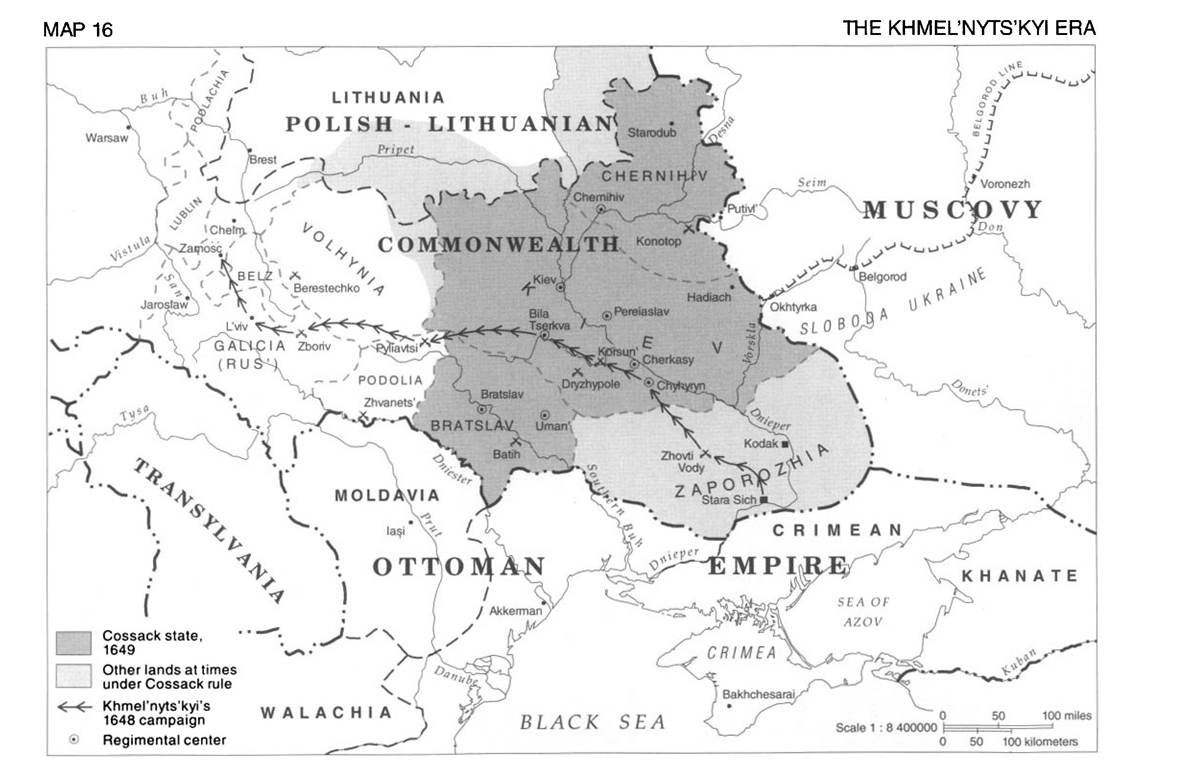
Now it seemed that the right leader - one who they heard was even trusted by the king - had arrived in Zaporozhia in the person of Bohdan Khmel'nyts'kyi. Khmel'nyts'kyi immediately set out to allay the traditional attitude of suspicion on the part of the Zaporozhians toward the ‘gentrified’ registered Cossacks, and before the end of January 1648 he was elected hetman. The new hetman anticipated conflict with the Poles and, drawing on his experience with the Ottoman world, concluded an alliance with the Crimean Tatars. Although Poland’s governing circles were divided on how to handle this new Cossack threat, the view of the supreme military commander, Crown Hetman Mikolaj Potocki, prevailed. Joined by his son Stefan (stationed at the Kodak fortress) and the army of another Polish commander, and confident in their military superiority, Potocki undertook a preemptive attack against the Zaporozhian Sich. But to their surprise the Polish forces were intercepted en route and defeated by a joint Zaporozhian-Tatar army under Khmel'nyts'kyi at the Battle of Zhovti Vody on 5-6 May. In the course of the battle, Stefan Potocki was captured by the Tatars (he later died of his wounds), and the registered Cossacks on the Polish side deserted to Khmel'nyts'kyi. With this expanded Cossack- Tatar force, Khmel'nyts'kyi was able to pursue the Poles and defeat them in a second battle, at Korsun', on 15-16 May, in which both Polish commanders were captured. To make matters worse for the Poles, King Wladyslaw died on 16 May, the day of their defeat at Korsun'.Upon hearing the news of the Cossack victories, discontented elements throughout the Kiev palatinate were inspired to revolt. Peasants drove out or killed their Polish landlords and Jewish estate managers; Orthodox clergy called for vengeance against Roman Catholic and Uniate priests; and townspeople plotted against the wealthy urban elements. Thus, by the summer of 1648, two of Poland’s leading commanders had been captured, its large eastern army had been defeated, its Ukrainian peasant population was in revolt, and its king was dead. Moreover, Poland’s traditional enemies - the Zaporozhian Cossacks and the Tatars - were flushed with victory and there seemed no defense against them. Undoubtedly, the Ukrainian peasant masses and the vast majority of the unregistered Zaporozhian Cossacks were ready to rid themselves of Polish rule once and for all. But was Bohdan Khmel'nyts'kyi ready?
Khmel'nyts'kyi’s way of life, like that of other relatively comfortable registered Cossacks, was the way of life of an aspiring country gentryman. While he had been personally wronged by local rivals, his initial goal was simply to obtain justice. If justice could not be obtained through legal channels, then a military victory against the Polish army might force the authorities to act favorably on his behalf. Even after Khmel'nys'kyi had defeated Poland’s eastern army twice, it is likely that he would have welcomed the possibility of remaining a subject of the king of Poland if he had been assured of personal legal redress and the restoration to his fellow registered Cossacks of the privileges they had enjoyed before the abortive revolt of 1637-1638. It was too late to go back, however, whether he wanted to do so or not. Khmel'nyts'kyi’s actions, motivated by personal resentment, set in motion a sequence of events over which he did not have complete control. He had to ride the waves or be submerged.
At first, Khmel'nyts'kyi tried to resist the Cossack-peasant uprising, which after doing away with the local Polish nobility would, he surmised, probably turn on the Rus' gentry and registered Cossacks as well. He hoped to find support among Poles for his desire to control what he considered the excesses of the revolution. In June 1648, pretending not to know of the king’s death, Khmel'nyts'kyi stopped his army at Bila Tserkva, just southwest of Kiev, and sent an emissary to Warsaw demanding that the traditional Cossack privileges be restored; that the number of registered Cossacks be increased to 12,000; that the Cossacks be paid for their services of the last five years; and that the Orthodox church be treated justly, in particular by having the churches and monasteries still held by the Uniates restored to it. In return, the hetman pledged his loyalty to the king.
The Polish Diet was overjoyed with Khmel'nyts'kyi’s modest demands and agreed to have them considered by the new king, whom they were still in the process of choosing. Khmel'nyts'kyi then returned to his estate near Chyhyryn and in early 1649 even managed to marry Matrona/Helena, after her short-lived marriage to Czaplinski was annulled. It seemed that Khmel'nyts'kyi was on the verge of obtaining all he had wanted.
Events were not to leave him in peace, however. Other Cossack leaders, like the popular Maksym Kryvonis and Danylo Nechai, led the peasant masses and unregistered Cossacks in new revolts which heaped further destruction on Roman Catholic Poles, Uniate Ukrainians, and Jews throughout the Kiev palatinate. These revolts had a particularly devastating impact, in both the short and the long term, on the Jews (see chapter 27). The number of Jewish victims during the period from 1648 to 1652 has been estimated at from the tens to the hundreds of thousands, and no exact number is ever likely to be known. Whatever the exact number, or whoever was responsible - the peasants, the Zaporozhian Cossacks and their independent-minded leaders like Kryvonis and Nechai, or the Crimean Tatars, who sold captured Jews in the Ottoman slave markets - it is Khmel'nyts'kyi who is held to blame in Jewish sources to the present day. The widely used Encyclopedia Judaica describes him with borrowings from Jewish