Preface
This is a history of Ukraine, of the people who inhabit today s north-central region where Ukraine was born, with its distinct language, culture, and social traditions. Here was the medieval civilization of Rus with its capital at Kyiv, which stretched from the great Pripet Marsh down along the Dnipro (Dnieper) River and its tributaries, ending at the great cataracts or “porohy,” the threshold between settled Slavic communities and those of the nomads that roamed the great east European steppe.
Referred to redundantly at times as “Dnieper Ukrainef here in the great metropolis of Kyiv was the cradle of modern east European civilization, as great princes of Kyiv built the city-states of today s Russia, Belarus, and what now form the western provinces of Ukraine (the medieval principality of Galicia) which include the Carpathian mountains.These were the branch-plants of the Rurik dynasty from the mercantile republic of Novgorod, which established the great trade route from Scandinavia to Constantinople, the capital of the Eastern Roman Empire. In the wake of the devastating Mongol invasion of 1240, the “kraina”—the frontier between the Slavic Christian lands and the steppe of the Muslim Mongol Horde—emerged as the home of the Cossacks, the creators of a unique culture that became Ukraine. The Cossack movement of Ukraine was the second stage in the history of Kyiv-Rus, as following its destruction armed frontiersmen began to venture into the steppe to reap a rich harvest from hunting and gathering. The freedom of the steppe brought a democratic and individualistic lifestyle with an anti-feudal, antistate ideology defended by the lance and sabre.
Today Ukraine consists of disparate regions, each with its own traditional language, religion, and culture, but it is the Cossack regions that gave birth to Ukrainian culture, and language.
By 1900, however, Ukrainian national identity had spread to neighboring territories, particularly to Galicia in the Austro-Hungarian Empire, where many educated Rusins (aRutheniansw)1 tended to refer to themselves as “Ukrainian,” although there was little in common between Galicia and Ukraine. Following World War I we see in Galicia (“Western Ukraine”) the growth of a myth supported by the so-called Organization ofUkrainian Nationalists (OUN) whereby lands populated by “ethnic Ukrainians” were split between the Russian and Austro-Hungarian empires. The myth has been perpetuated by several authors ofUkrainian history who fail to explain how it was possible to split something which had never been together.2A myth demonstrating an even greater disregard for the historical record lies in Russian historiography, which beginning in the 19th century went hand-in-hand with Russian imperialistic ideology. Projecting 19th century circumstances onto history, Ukraine (“Little Russia”) and Belarus became Simplyparts of Russia. Ignoring the fact that “Russia” was born only in 1722, Russian historians have consistently referred to the medieval civilization that emerged in today s Ukrainian lands as “Kievan Russia.”3 According to this view (which has been adopted by many Western historians) Slavic east Europe consisted of a united and common “Russian land” where the split was caused in part by the collapse of the Kiev state. Thus the first key period “was the original co-existence of the ancestors of today s Ukrainians and Russians as the Rus.”4 Again, there could not have been a split in a common entity which never existed. In actual fact the exact opposite was the case—a continual state ofwarfare between the city states of Kyiv-Rus and Novgorod on the one hand, and those of the north-east on the other.
The blatant perversion of history persisted into Soviet times and targeted other societies as well. Following Stalins expulsion of the entire Tatar population from the Crimean Peninsula in 1944, it was claimed in a major two-volume Moscow publication that the Crimea has been Russian land from ancient times.
Therefore, there was no conquest of a sovereign land but a reunification and a reestablishment of the rights of the Russian people to their own land.5 Such untruths continue to fuel Russian nationalist propaganda to this day.This book begins in the distant past and ends with the enslavement of the Ukrainian people in the second half of the 18th and first half of the 19 th century. As revealed by recent archaeology, the great steppe of Ukraine and southern Russia was the birthplace of the patriarchal warlike Aryan tribes, which conquered Europe and much of Asia and in the process introduced the bronze and the iron ages. These nomads have had a lasting
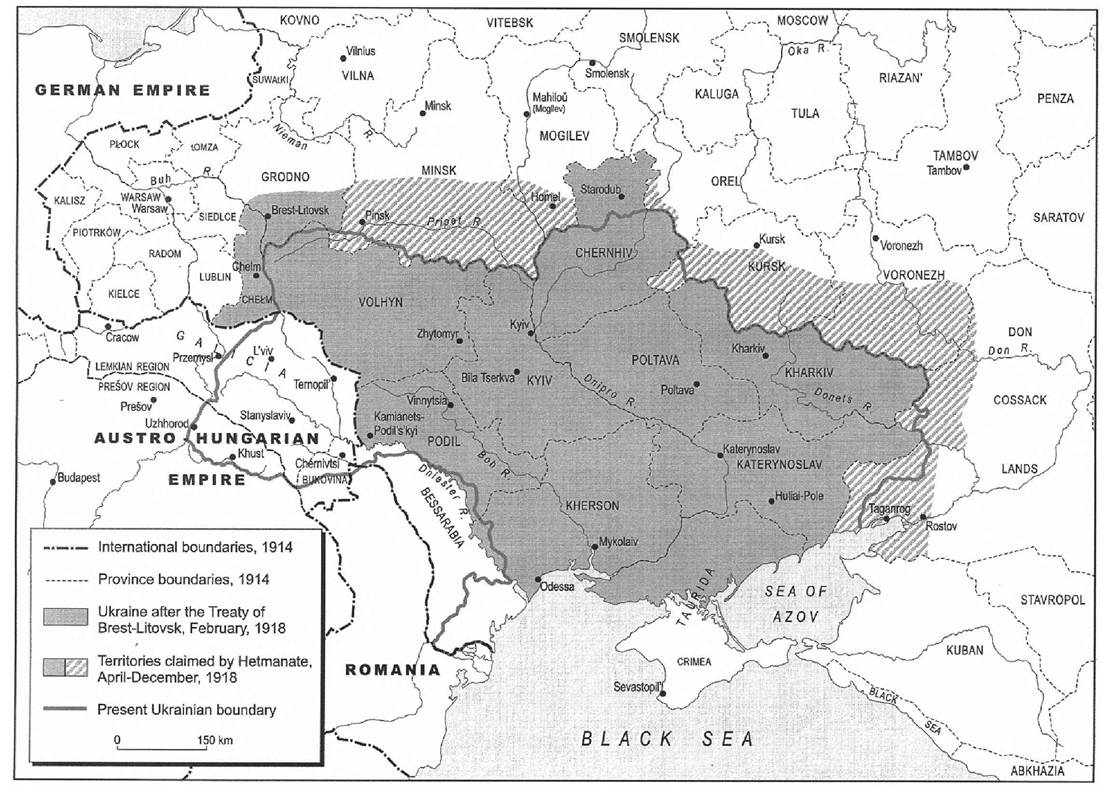
Ukraine following the declaration of independence, 1918.
effect on the Ukrainian people and their history. We also consider the early Slavs, their manufacturing “emporia” and the fur trade, which gave rise to the future city-states. Often ignored by historians, the Slavs were the last barbarian tribes to invade the Roman Empire following the first religious wars between the Arian Christian Goths and Vandals, and the Roman Orthodox Church.6
Next the text traces the beginning and development of the Kyiv-Rus civilization and its neighboring Greek Orthodox city- states. The period also marks the beginning of the Papal Crusades and the continuing religious warfare, which had a profound impact on European history. Destroyed by the Mongols, Rus fell to the pagan Lithuanian tribal princes while Galicia was absorbed by the Polish Roman Catholic monarchy, and by the beginning of the 15th century all vestiges of Kyiv-Rus had disappeared, left with a scattered population in the forests, wetlands, and the steppe. Following the defeat of the Germanic Crusader Knights in the great battle of Tannenberg in 1410, the Roman Catholic kingdom of Poland-Lithuania became the dominant power in eastern and central Europe.
Now begins the second period or stage in the history of what had been Kyiv-Rus, as in the 15th century armed frontiersmen start to venture into the steppe in search of the rich harvest that could be obtained from hunting and gathering. The steppe was a dangerous place frequented by marauding Tatar- Mongols in search of booty, and soon blockhouses and forts began to spring up manned by determined armed men known as Cossacks. In Chapter 10 we perceive the early Cossack democratic individualistic lifestyle and anti-state ideology that marked a parting of the ways with traditions of princely Kyiv- Rus and its great noble families, which began to adopt Roman Catholicism to become Polish noblemen. Another characteristic feature of Cossack society was the freedom enjoyed by women and a veneration of children which can be seen in the image of “Did Moroz” or Old Man Frost, who traveled in his sled during the dark days of Christmas to deliver presents to
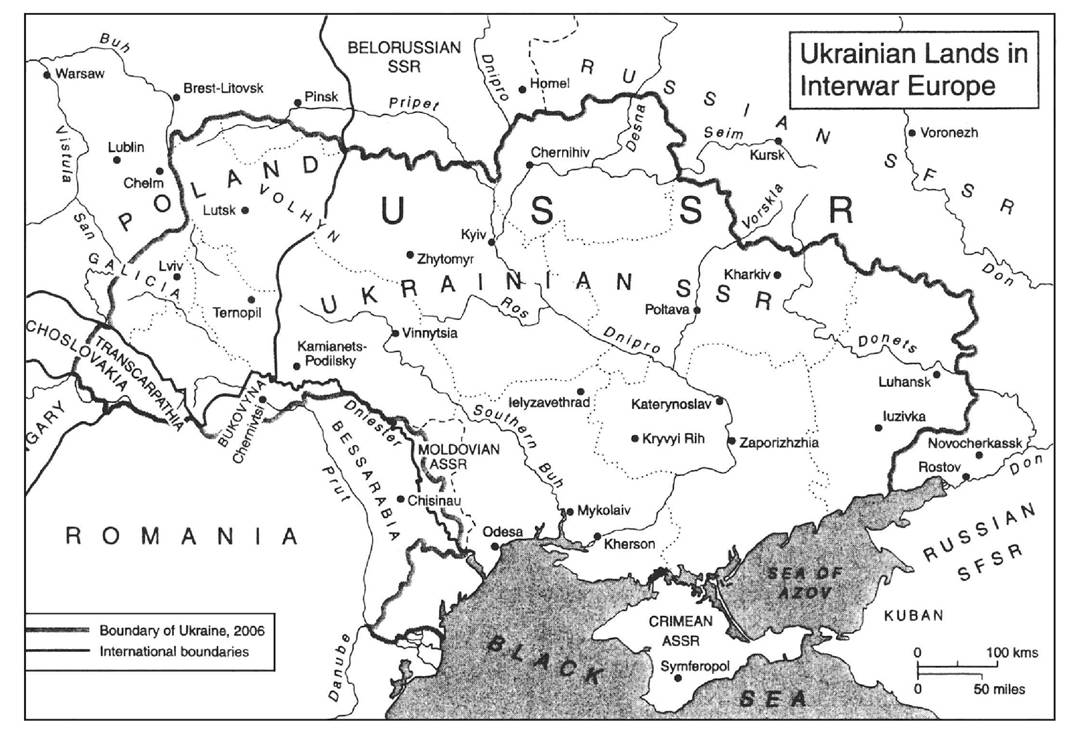
The interwar Ukrainian territory as part of the U.S.S.R. following the Polish-Soviet war of 1920-21.
children. Cossacks serving in the Baltic region most certainly carried on the practice incognito, giving rise to the fable of “Santa Claus.”
Chapters 11 and 12 describe the growth of the Cossack movement in north-central Ukraine and its spread across the eastern steppe to the Don River. As Ukraine fell under the rule of the Catholic nobility, with the cruel serfdom and religious persecution of Greek Orthodox and Protestant churches, Cossack and serf uprisings sprang up in Ukraine and Muscovy culminating in the great Ukrainian revolution of 1648 as described in chapters 12,13, and 14. Led by Cossacks, the enslaved serfs rose up in a bloody revolt. The mutual massacres were accompanied and followed by years of warfare during which under the brilliant strategist Hetman (Commander) Bohdan Khmelnitsky Cossack regiments inflicted crushing defeats on invading Polish-Lithuanian armies.
Entire Europe watched as a population of barely one million established an independent and free “Ukraina terra Cossacorum.” There was also no “union” with Muscovyin spite ofRussian claims, but on the contrary, in 1659 an invading Muscovite army of 100,000 strong—the best the Tsar had—was annihilated in the battle of Konotop in northeastern Ukraine by an inferior Cossack army supported by a Crimean force.Moscowlay open but the anticipated Ukrainian-Crimean invasion never came, as Cossack unity disintegrated into disagreement and civil war. Polish, Muscovite, and Ottoman armies invaded to support a particular faction as Cossacks turned on themselves in a violent rupture of unity, which would never be restored. By the Treaty of Andrusovo, signed in 1667 by the Polish king and the Moscow tsar, it was agreed to partition Ukraine along the Dnipro River, as the Sultan of Turkey sent his Janissaries to occupy the southwestern steppe. Following much fighting, the outnumbered Cossackregiments of the western right-bank provinces were defeated by a Polish invasion and serfdom reestablished by the great magnates. On the left-bank territories by the end of the 17 th century the Cossack hetman was under the authority of the Tsar, but on condition that Ukraine maintain its autonomous status under a Cossack administration, and Muscovite serfdom was not to be allowed.
In 1700 the Great Northern War broke out as the Don Cossacks erupted in a great revolt against Muscovite oppression, supported by serfs and most of the local population. The Hetman of the left-bank, Ivan Mazepa, joined Charles XII in return for Swedish recognition of Ukrainian independence, as the young king entered Ukrainian territory in 1708 in search of supplies and a rest for his men. With Cossack regiments once again hopelessly divided, and unable to get support from the Don Cossacks, Charles XII and Mazepa were defeated in the great battle of Poltava and forced to seek refuge with the Turkish Sultan as outlined in chapter 15.
More fighting with Peter I followed and with Mazepa s death the newly elected Hetman Pilip Orlyk led Cossackregiments into Ukraine, SupportedbyPolish forces. It was Orlykwho drafted not only the first Ukrainian constitution, but also the first document which spelled out the separation of the legislative, executive, and judicial powers of a state, decades before it was proposed in Western Europe or North America.The last chapter outlines the post-Peter I period up to the second half of the 18th century. Following the tsar s death, leftbank Ukraine enjoyed a period of restored autonomy under Hetman Kirilo Rozumovsky while the right-bank provinces slipped deeper into serfdom and violent revolt. With Empress Catherine II on the Russian throne, serfdom was also introduced in left-bank Ukraine as Cossack autonomy was suppressed and Ukraine incorporated into a uniform Russian state. In 1768 the Zaporozhian Cossacks had refused the Crimean Khans offer of an anti-Russian alliance, a decision they would come to regret. In the same year the Turkish Sultan declared war on Russia in which Ukrainian Cossacks played a key role in the Russian victories with the capture of the entire Black Sea coast and the Crimean Peninsula. With peace the Cossacks were no longer needed, and the free Zaporozhian territory was a bad example for Russian totalitarianism. They also owned the richest agricultural land in Europe, as well as extensive mineral deposits. In a surprise move, with the powerful Zaporozhian army still dispersed the Sich stronghold was surrounded by a large force and with a garrison of only 3,000 Cossacks it had little choice but to surrender.
In left-bank Ukraine, autonomy and Cossack status was also abolished and Russian-style serfdom imposed in the villages. The new order of despotism was accompanied by the destruction of the village educational system as printing presses were removed from monasteries, and Ukraine sank into illiteracy and oppression where it remained for the next century and a half. By the early 19th century Ukrainian writers such as M. Hohol (N. Gogol) were publishing in Russian to secure a literate audience, although Gogols father could still publish in Ukrainian. All things Ukrainian were destroyed or appropriated to become “Russian,” and eleven years after Gogols death in 1863 it was declared that a “Little Russian (Ukrainian) language has not, does not, and cannot exist.”7 The printed word in Ukrainian was outlawed and men of letters, such as the great poet Taras Shevchenko, were exiled to Sibera. Imperial universities began to rewrite history as the Ukrainian people were denied their past and Ukraine sank into obscurity.
More on the topic Preface:
- PREFACE
- PREFACE
- PREFACE TO THE SECOND EDITION
- Preface
- Preface to the Second Edition
- Preface
- PREFACE
- Preface
- Preface
- PREFACE