Selfhood and Statehood in Interwar Ukraine: Inventing the “New Man”
Oksana Klymenko and Roman Liubavskyi
In the 1920s and 1930s, authoritarian and totalitarian regimes were established in various European countries. The creation of a “New Man”, and methods of total control over all spheres of his life, were central characteristics and necessary conditions for their existence.
In the Soviet Union, the New Man's formation was closely intertwined with various projects in the economic sector, such as industrialization, as well as in the social, cultural, and educational spheres via campaigns like Ukrainization or the eradication of illiteracy. According to the Soviet authorities, all these campaigns were aimed at creating a “new ideal world” and a New Soviet Man. Soviet propaganda, which was represented through posters, newspapers, radio, cinema, and other popular mediums, had a significant impact on the New Man's formation.The “New Man” was a term used by the Soviet authorities to characterize the image of a “real Soviet man”, who believed in the idea of revolution, was ready to sacrifice his life for it, actively participated in socialist construction, and obtained education in his free time. In the USSR, there were attempts to explain this term from an ideological point of view. Soviet ideologists of the 1920s and 1930s, particularly Leon Trotsky and AnatoIy Lunacharsky, wrote about the New Man in their works.1
The Soviet project of creating the New Man through education was com- pIex. It was not onIy about changing the sociaI and economic conditions of people's lives, but also about changing their habits and lifestyles. To implement these plans, many ideological projects were introduced focusing on the reconstruction of physical spaces, changes to everyday habits, and the mastery of a new model of speaking and remembering. This chapter will consider these processes using severaI historicaI exampIes incIuding sociaIist city construction, the introduction of new socialist rituals, and new remembrance practices.
Spaces
According to Michel de Certeau, creating a rationally organized space, freed from physical, mental, and political threats to its existence, was one of the prerequisites for implementing utopian urban projects.2 The construction of socialist cities next to outstanding industrial facilities during the first five-year plan, such as the KharkivTractor Plant (KhTP, or DniproHES), can be consid- eredone of the most radical projects within New Man education. Indeed, soviet architects were unanimous in their opinion that creating a fundamentally new living space was necessary. However, there was no universal point of reference or detailed view as to how this space would be created; during the 1920s and 1930s, much of this became centred on discussions held between the so-called "urbanists” and ”desurbanists”. For their part, the Bolsheviks viewed socialist cities as an open field for social experimentation with several projects for creating new cities and towns being developed in the Ukrainian Socialist Soviet Republic during this period.3
Let us consider the socialist city of “New Kharkiv” both as an idea and its construction's implementation. Today, the town space is the centre of the Industrial (1934-2016 Ordzhonikidzevskyi) district of Kharkiv, located on the northeastern outskirts of the city with its construction having begun in 1930. It is also known that German and American engineers and architects took part in developing many of these exemplary socialist cities across the USSR, such as Magnitogorsk and Novokuznetsk. However, the study of the State Institute for Urban Design “Dipromisto” documentation makes it possible to establish that, in this case, design work for New Kharkiv was carried out by domestic architects under the guidance of P. Aloshyn.4 In the explanatory note to the master plan of the city around KhTP, it was noted that it would not have any housing shortages, unsanitary conditions or any of the other shortcomings characteristic of “old” cities.5 The developers believed that to achieve this, it was necessary to abandon the established principles of urban development and create new housing and socio-cultural living conditions.6 According to the designers' plan, all KhTP employees would receive apartments in new “housing complexes”.
Each complex consisted of a set of buildings and premises necessary to ensure the complete “socialization of the individual needs service.” According to the project, 36 “housing complexes” were to comprise eight to ten buildings, in which 2548 people would live. These also included a school, a club, a canteen, a kindergarten, and a nursery. It was also planned for the houses to be interconnected by special corridors-bridges at the second-floor level so that residents could visit any of their complex's facilities without having to go outside.7 The idea of freeing women from the kitchen was especially key to implementing the desired layout of these apartments. The authors of the project noted that one of the shortcomings of the “old” Kharkiv was the social enslavement of women in the household. According to the general design of the city, there were no kitchens in the apartments, with workers having to instead eat in public canteens.8 The program's authors for planning and building up the new city also provided exceptional conditions for cultural recreation among KhTP workers, which were unavailable for employees of enterprises located in Kharkiv.9 Each residential complex provided a special hall for cultural and educational events and public meetings. The project also included the creation of an administrative and cultural set, which included an administration building, a theatre, houses of culture, labor, physical culture and sports, cinema and press houses, two hotels, museums, swimming pools, a park of culture, and a football stadium. According to the project, this large number of objects was planned to be erected within ten years.10Fig. 2-2: A prospective plan ofthe apartment block for Traktorobud 3. 1930. TsDAML Ukrainy. F.8, op. 1, spr. 261.
Reprinted with permission.
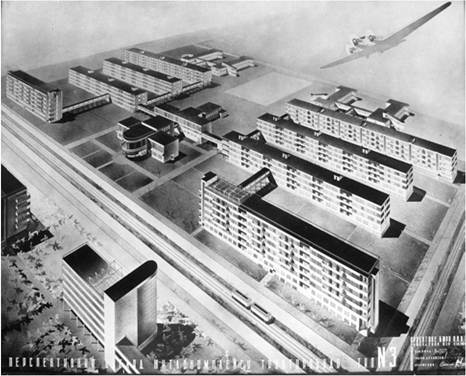
The project's authors also planned to have all residents of“New Kharkiv” living in multistorey communal buildings.
While its construction plan proposed the creation of 288 houses however, only 50 had been built by 1939.11 Consequently, most KhTP workers did not receive a separate apartment in the 1930s while the area's ongoing housing crisis began to ease only in the mid-1950s. Housing itself consisted of two varieties: one-room apartments for singles and two-room apartments for workers with families. The premises were quite spacious, with high ceilings of 2.9 metres and bathrooms and toilets. However, the construction project's omissions were promptly discovered by those moving in. The KhTP's deputy director Stukota promptly reported to the All-Russian Tractor Association (VATO) that the designers' calculations had turned out to be incorrect: there were more rooms for singles than necessary and not enough apartments for families. As a result, the management of the plant decided to accommodate the families of several employees in rooms designed for only one person.12 The functional purpose of apartments for singles thus changed, with this problem being repeatedly raised in the pages of the periodical press as KhTP workers' correspondents sent letters to newspaper editorial offices. Thus, the brigadier of the first Komsomol battalion Radkevych sought to inform the public of the challenges faced when seeking to provide the numerous “shock workers” with suitable housing. In a letter to one of the major Soviet periodicals, published in 1932, he claimed that the administration paid attention to him only when it was necessary to fulfil the plan but did not consider his requests to improve living conditions; the author himself lived in the same room with seven other workers and slept on a wooden trestle bed.13 Therefore, the sanitary and technical qualities of the apartments were reduced due to the excessive number of residents.It should be noted that these particular workers came from the countryside and gradually acclimatized to urban living conditions, adapting the space within the new apartments to the suit needs of the everyday peasant life to which they had been accustomed.
It is worth recalling the case of the plant director, P. Svystun, who reportedly saw a piglet being kept in the bathroom of one of the apartments. In another, the owner had built a stove and chopped wood right on the parquet.14 Under such conditions, the Bolsheviks' idea for a radical socialist restructuring of life proved impossible to realize as the Soviet authorities failed to change the everyday habits of workers through the specific architectural solutions. Not only did these complex residents not live up to the expectations of the Bolsheviks, they simply adapted many of their “old” everyday practices to better suit their new living space.Practices
Introducing new revolutionary rituals into everyday life was an essential component of the Soviet policy for forming a New Man. Nevertheless, Party leaders and local cultural workers understood that it would be challenging to displace the various ritualized features of traditional Ukrainian life; for this, it was necessary to offer socialist alternatives such as “red christenings” (oktiabryny), or “red weddings”. Such measures merit closer study since they represented a critical communication channel between the Soviet government and society. Let us consider these demonstration events, initiated by the leaders of workers' clubs or conscious “Soviet” people, as a cultural product offered to ordinary citizens. One of these events was reflected in the pages of the regional press. On May 11,1925, the October holidays (oktiabryny) appeared as a significant event in the life of the staff of the Second State Confectionery Factory.15 It is clear that when covering this event, journalists somewhat exaggerated October's importance. However, given the fact that the Soviet authorities advertised the ideas of a new way of life as a cultural trend, such an occasion really could have generated great interest, although the work correspondents reported that participants did not understand the purpose for holding these celebrations.16 “Red christenings” can be considered a specific form of Soviet public entertainment culture, which was also presented to the citizenry by the authorities.
According to correspondents, a large number of working people gathered to watch the ceremony, culminating in the act of filling out a questionnaire for the baby. This action was public, and questions and answers were read aloud to the accompaniment of an orchestra specially invited to attend. Interestingly, in addition to biographical data (name and surname), the questionnaire also required the parents to provide information regarding their social origins and the child's future speciality, which was “chosen” and recorded. The couple then received gifts from the factory committee and the Leninist Communist League of Youth of Ukraine members.17 “Oktiabryny” were another such event, through which the Soviet authorities sought to demonstrate their presence in the social space. The ceremony was filled with semantic codes, the cyphers of which were known to every member of the Soviet society. The first steps of the child's socialization took place in the factory, which testified to the marginalized status of the church within official discourse. The procedure's publicity highlighted, for all those who had gathered, the importance of collectivism as a form of organizing everyday practices. The orchestra, Komsomol guests, and the awarding of parents with prizes reproduced the atmosphere of a solemn holiday.There is no evidence of how often such events were held. However, analysing these examples makes it possible to understand how the authorities used workers' clubs to demonstrate new social values and spread them through everyday practices. A demonstrative “red wedding”, for example, took place on January 15,1924, in the club for food industry workers. The next day, the city newspaper drew readers' attention to the fact that the ceremony had been held at a club, not a church.18 Therefore, the authorities attempted to demonstrate the existence of an alternative to sustainable traditions and provided examples of new social relations that were to become role models. Press correspondents portrayed the newlyweds as model citizens who had abandoned established norms and married in a new revolutionary ritual, the wedding itself evoked a solemn meeting of the cultural commission, at which the question of marriage was regarded. The club's management made a welcoming speech, telling the audience about this new way of life's essence and social significance. The newlyweds, who were themselves members of the trade union of food industry workers, were married and pledged to join the ranks of the Communist Youth Union.
Fig. 2-3: Workers club of Shestopark Theatre. New Year’s Eve, 1924. Kharkiv Historical Museum. Reprinted with permission.
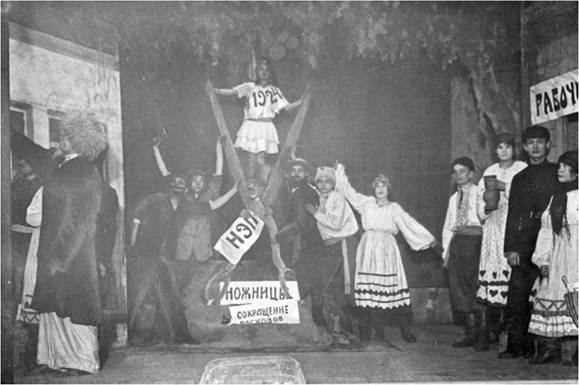
The Soviet authorities tried to use workers' clubs to demonstrate to workers how the foundations of this new socialist order would be established by introducing them into people's daily lives. Such ideas for this new way of life were put into practice through ceremonial events and public presentations as an ideological product that the authorities offered to “use” in the hope of re-educating society.
Memory
The 1920s and 1930s were a period when various campaigns were introduced across the USSR in order to educate the New Man and establish control over him, including his memory and understanding of the past. Soviet ideologists used memory to form a “new person”, which was characterized by a new identity and language, as well as an appropriate attitude towards the state, the team, and workplace.
Soviet commemorative practices in the interwar period were greatly influenced by propaganda, as well as by specially created commissions that were engaged in writing Soviet history: The Commission for the Study of the October Revolution History and the History of the Communist Party, or “Istpart” which was established in the 1920s, and the Commission on the History of the Factories and Plants, abbreviated as the “HFP Commission”, founded in the 1930s. Both commissions had a similar structure comprising a central commission in Moscow with branches in each republican as well as local commissions and even ones overseeing individual factories. These commissions included party leaders, historians, and the HFP Commission also employed its own writers, its leading ideologist being the proletarian author Maxim Gorky. In order to write a “correct” version of history, these commissions turned to the collection of memoirs authored by those who had participated in revolutionary events as well as workers.
Both commissions, when collecting these memories, used similar techniques. Istpart collected and recorded memories by organizing so-called “memory evenings” and sending letters of request to members of the Soviet public who had participated in revolutionary events encouraging them to write memoirs and complete questionnaires. Moreover, using these memories, Ist- part created the “correct” version of Soviet history based on the class principle, with the October Revolution serving as an important event. In the 1930s, the focus of attention within the politics of memory shifted from the issue of revolution to socialist construction, as the drive toward industrialization was proclaimed and became the Soviet Union's main priority.
Methods for collecting and fixing the memories of socialist construction continued with the traditions initiated by Istpart. These involved holding “memory evenings”, individual conversations, and workers writing their memoirs in response to requests from editorial boards. However, there was a significant difference which meant that the workers' memoirs collected by the HFP Commission were to be a primary source for recording the origins of new industrial buildings rather than simply being used as evidence to confirm the Bolshevikversion of history. Furthermore, from the beginning of the five- year plans, propaganda actively disseminated information about workers' achievements and records in factories and plants.
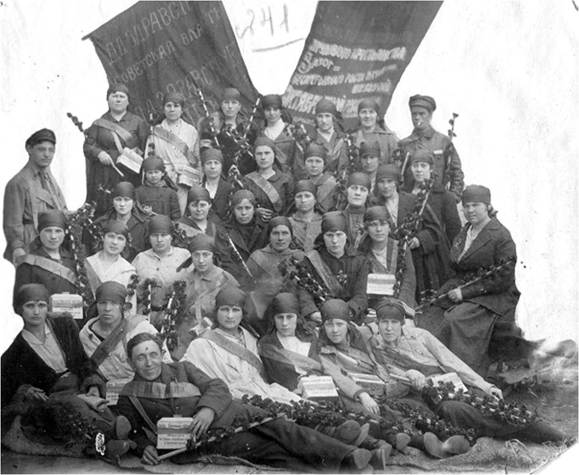
Fig. 2-4: Workers from the Kholodnohirs’kyi raion on 1 May 1923. Kharkiv Historical Museum. Reprinted with permission.
In addition, it was not only the commissions’ influence that was an essential aspect of the formation of the New Man’s memory but also the ways in which the authors of these memories, in particular workers, learned to present themselves and narrate their pasts in the “right” way. A key example is the collected autobiographies of the workers of the DniproHES. This appeal to DniproHES is not accidental; after all, Soviet propaganda considered the plant to be a symbol of the first and second five-year plans and one of the most outstanding examples of industrialization in both Ukraine and the wider Soviet Union. Situated near the city of Zaporizhzhia in southeast Ukraine, the construction of the Dnipro Hydroelectric Station lasted from 1927 to 1939 and received its name from its location on the Dnipro, the longest river in Ukraine. The official opening took place in 1932 though some of the facilities had still not been completed by then.
The Commission, engaged in writing the history of DniproHES from 1933 to 1934, paid great attention to the collection of workers’ autobiographies and memoirs, sending out personal requests for them to write about themselves and their participation in the construction of this hydroelectric power station. These requests generally concerned those who had moved to another place of work after the power station’s completion. Since it was necessary to obtain information only in written form, only forepersons and engineers, rather than the ordinary laborers, were engaged in this process. This was justified by the assumption that those who held the highest positions were educated, unlike much of the regular labor force who remained illiterate, despite the literacy campaign of the 1920s. In addition, all of the authors were male, not female, explained by the fact that men, rather than women, still occupied most leadership positions in Soviet society. Although, as a result of emancipation, some women’s brigades were formed, and several well-known female shock workers were employed at DniproHES. As evidenced by the Commission’s documents on the history of DniproHES (stored in the State Archive of Zaporizhzhia region), women did not write autobiographies or memoirs. However, many still provided oral testimonies detailing the various roles they had played in the plant's construction.
However, it should be clarified that only those who had started working at DniproHES during the 1920s had to submit a biography. Still, in the 1930s, the Commission collected autobiographies of those who had already worked at other sites. In such away, the concept of“new Soviet people” was implemented - even the people’s past had to correspond to the ideological frame. A worker seeking a position at DniproHES was required to provide an autobiography, which included information about their origins, family, education, and previous places of employment. A special commission was created to verify the information provided in this document and to write relevant requests to the workplaces, where the potential employee claimed to have previously worked.
Such attention to autobiographical information stemmed from the fact that certain social groups were not permitted to work at Soviet industrial facilities. These included “kulaks”, priests, and everyone who had belonged to the privileged classes under the previous Tsarist regime, as well as those who participated in the Ukrainian national movement from 1917 to 1921. Soviet propaganda proclaimed that these groups should not be allowed to work at plants and factories because their activities would be aimed at undermining socialist construction. As Sheila Fitzpatrick notes, “Class was a major component of the Soviet identity and the autobiographical picture”.19
This process of submitting one's autobiography and the attention focused on the workers' pasts was a common practice in all Soviet factories and plants during this early period. Moreover, people were searching for the ideal depiction of their past, influenced by propaganda and observations of what was happening with social groups that could not integrate into Soviet society. Sometimes they constructed their autobiographies subconsciously, copying the propaganda messages they heard. This sometimes led to them incorporating certain cliches ad hoc, for example, in order to hide one's “wrong” origin and received their desired job. In this regard, an autobiography might serve a kind of ticket to a brighter future. Olena Stiazhkina clarified some of the ways that ordinary people used to construct their past in the autobiographies, such as seeking to present the “right” origin by placing an emphasis on childhood poverty.20
Let us analyse two examples of autobiography from this period. The first was written by Arsenii Zhukov, “the head of the railway transport operation of the right and left banks”.21 The editors personally addressed him with a request to provide his memoirs: “In accordance with your request, now I am reporting my autobiography and outstanding moments of the DniproHES construction”.22 His memoirs have been preserved both in the original version (handwritten) and typewritten, of which there are two printed versions.23 The texts contain a familiar list of questions such as origin, training, work, and rewards. It is mentioned that he was born into a peasant family but, due to their poverty, when he was three or four years of age he was taken in by another family for educational reasons. It is unknown whether this was the real reason. For instance, it is written that he was unable to remember how much land they had owned, but it is noted that they had had two horses.24 Considering the second remark, the emphasis on poverty may be somewhat exaggerated since the presence of the indicated number of livestock at the beginning of the 20th century points to what would have represented a reasonably average level of wealth for a peasant family.
The primary attention in the autobiography is given to the description of the DniproHES construction, however, with the author himself seemingly becoming less and less important in his own life story. Indeed, he increasingly appears not even as part of the labor team but as merely an anonymous piece in a mass of people and machines, the details of his personal life and family having been squeezed into the framework of an ideologically necessary plot. Analysing Soviet biographies, Stiazhkina notes that “People wrote their stories, of course, with the goal in mind. First of all, they searched for and wrote a ‘correct biography', that is, demonstrating the naivety of class consciousness, true social origin, professional training and individual qualities”.25
Writing memoirs about the DniproHES construction also served as a tool for teaching a worker to speak of himself primarily as part of a team, not an individual. This idea finds confirmation in autobiography of one Veselago, an engineer from Yaroslavl who also sent his memoirs, dated January 24,1934, to the DniproHES editorial office:
The work at DniproHES was so imbued with a collective idea, everyone was so inspired by teamwork that it is Challengingfor me to single out my role in the common cause. If I take credit for anything, it is the ability to be critical of American technology, the ability to choose what we need, to combine it with Soviet methods of work and to unite the team of workers on the left bank into a friendly family moving towards a common goal. Without suppressing the initiative, but without violating the one-person principle.26
The author's attention to the equipment is not incidental since he had previously gone on a business trip to the United States in 1928, in order to study American construction equipment.27 However, he described his trip quite dryly and entirely without emotion. Veselago focused only on technology, and there were no impressions or judgments about what he had seen in the country that very much belonged to the capitalist world. The author wrote on the subject of this trip as carefully as possible, despite the editorial board members' interest in it. The latter's confirmation is found in the highlighted passages about the journey in one of the variants of the memoir's text.28 The fact that he was chosen for the trip may indicate his recognized qualifications and, at the same time, his reliability. However, there are some doubts about the latter. At the beginning of his autobiography, he indicates his parents' own occupation as merely being “employees”, which was also a kind of cliche and veiled the exact type of work. He had seemingly completed his higher education during the October Revolution, graduating in May 1917 from the Leningrad Institute of Communications Engineers - which indicates the Soviet name for the institute. In addition, he remained non-partisan in 1934.29 His testimony about military service is also quite cautious, “I was not in military service, I did not serve in any armies”30, although he would have been 24 years old in 1917. On the one hand, it was a standard phrase that should be written in an autobiography alongside not having any criminal convictions, which he also notes. Conversely, his statement on military service can also be regarded as a signal that in 1917 he had not supported the Bolsheviks' political enemies.
Research into these autobiographies reveals that workers were expected to learn the rules of correct self-presentation as part of a team and within the context of the industrialization campaign. Jochen Hellbeck emphasizes that Soviet workers' self-talk was constantly integrated into the context of nationwide campaigns.31 However, collected by the Commission for writing Dnipro- HES history autobiographies had the genre of memories. The authors did not just retell their past but had to give the details of their work at DniproHES. As a result, the authors' personalities tended to exist at the periphery while discussion of large-scale construction occupied the central part of their narratives.
We can state that publicity and collectivism, as the New Soviet Man's virtues, were formed as much by the authorities as well as via slogans and popular campaigns, and became embedded in people's daily lives. The authorities tried to present the Soviet project of a New Man as attractive to society in the 1920s and 1930s. They encouraged the introduction of new rites, such as the October (oktiabryny) and red weddings, and turned them into a performance, the participants of which received gifts. Utopian ideas for creating a new society therefore became part of everyday Soviet life.
The industrialization and the modernization of society raised the problem of mass resettlement of workers near to their respective enterprises. The so-called “socialist cities” were designed to solve this problem with open spaces, those who lived in these places would supposedly to contribute to assimilating socialist ideals. In order for everyone to eat in the dining room, for example, apartments were designed without kitchens, thus, the private occurrence of a family meal became impossible. Newly constructed socialist cities, such as New Kharkiv, were symbolically opposed to the old ones with the press emphasizing the rationality of their urban space in terms of the absence of a city centre, or a large number of green spaces.
Self-awareness is the main characteristic of a man. The upbringing of the new Soviet person also assumed the assimilation of new (self-)representation practices. Analysis of autobiographies and memoirs shows that people imitated this political canon in their own texts, searching for an ideologically correct version of their biography. The creation of several similar texts thus contributed to one's self-awareness as a Soviet person.
Notes
1 L. D. Trotskii, Pokoleniie Oktiabriairechiistatii (Moscow: Molodaia gvardiia, 1924), p. 260; A. V. Lunacharskii, Vospitaniie novogo cheloveka (Leningrad: Priboi, 1928), p. 48.
2 M. De Serto, “Po gorodu peshkom,” Communitas 5 (2002), p. 82.
3 V. H. Tkachenko, “Budivnytstvo ‘Velykoho Zaporizhzhia' v 20-30-ti roky XX stolittia” Naukovi pratsi istorychnoho fakul’tetu ZDU 16 (2003), pp. 221-225; M. Alf'orov“Polityka urbanizatsii Skhidnoi Ukrainy u 1920-1939 roky,” Skhid 1 (2010), p. 77.
4 Tsentral'nyi derzhavnyi arkhiv-muzei literatury i mystetstva Ukrainy (thereafter: TsDAMLM), F. 8, op. 1, spr. 265, ark. 4.
5 Tsentral'nyi derzhavnyi arkhiv vyshchykh orhaniv vlady ta upravlinnia Ukrainy (thereafter: TsDAVO), F. 5, op. 3, spr. 1877, ark. 2.
6 TsDAMLM, F. 8, op. 1, spr. 261, ark. 63.
7 TsDAMLM, F. 8, op. 1, spr. 261, ark. 2.
8 TsDAVO, F. 5, op. 3, spr. 1877, ark. 64.
9 TsDAMLM, F. 8, op. 1, spr. 261, ark. 2.
10 TsDAMLM, F. 8, Op. 1, Spr. 261, Ark. 3.
11 V. Plotnikov, “Pobutove budivnytstvo Kharkivs'koho traktornoho zavodu”, ArkhitekturaradianskoiUkrainy 5 (1939), p. 15.
12 Rosiiskii gossudarstvennyi arkhiv ekonomiki (RGAE), D. 7620, Op. 1, d. 390, l. 4.
13 RGAE, D. 7620, Op. 1, d. 89,1.15.
14 Iu. L'vov, Sled nazemle (Moscow: Politizdat, 1966), pp. 25-27, 53.
15 “A zachem ego krestit'?”, Kharkovskii proletarii, 1925,11 May, p. 3.
16 Ibid.
17 Ibid.
18 “Ne v tserkve, a v klube (proletarskaia svad'ba)”, Proletarii, 1924,16 January, p.2.
19 Sh. Fitzpatrick, Sryvaite maski! Identichnosti i samozvanstvo v Rossii XX veka (Moscow: ROSSPEN, 2011), p. 110.
20 O. V. Stiazhkina, “‘Pravyl'na biohrafiia' peresichnoι' liudyny 1920-kh rokiv: sposoby konstruiuvannia mynuloho (na materialakh Donbasu)” Novi storinky istorit Donbasu: Zb. statei / hol. red. Z.H. Lykholobova. - Donetsk: DonNU, 2008. - Kn. 15-16, pp. 204-224.
21 Derzhavnyi arkhiv Zaporiz'koι' oblasti (DAZO), F. 995, Op. 28, Spr. 37, Ark. 124-zv.
22 DAZO, F. 995, Op. 28, Spr. 37, Ark. 124.
23 DAZO, F. 995, Op. 28, Spr. 37, Ark. 124-125-zv.
24 DAZO, F. 995, Op. 28, Spr. 37, Ark. 124.
25 Stiazhkina, “Pravylna biohrafiia”, p. 206.
26 DAZO, F. 995, Op. 28, Spr. 37, Ark. 148.
27 DAZO. F. 995. Op. 28. Spr. 44. Ark. 11.
28 DAZO. F. 995. Op. 28. Spr. 44. Ark. 11.
29 DAZO. F. 995. Op. 28. Spr. 37. Ark. 144.
30 DAZO. F. 995. Op. 28. Spr. 37. Ark. 144.
31 Hellbeck, “Working, Struggling, Becoming”, p. 350.
Selected Bibliography
Fitzpatrick, Sheila. TearOffthe Masks! Identity and Imposture in Twentieth-Century Russia (Princeton: Princeton University Press, 2005).
Halfin, Igal. Red Autobiographies: Initiating the Bolshevik Self, Donald W Treadgold Studies on Russia, EastEurope, and CentralAsia (Seattle: Herbert J. Ellison Center for Russian, East European, and Central Asian Studies, University of Washington, 2011).
Hellbeck, Jochen. “Working, Struggling, Becoming: Stalin-EraAutobiograph- ical Texts,” Russian Review 3 (2001): 340-359.
Hellbeck, Jochen. Revolution on My Mind: Writing a Diary under Stalin (Cambridge, Mass.: HarvardUniversity Press, 2009).
Kenez, Peter. The Birth of the Propaganda State: Soviet Methods of Mass Mobilization, 1917-1929 (Cambridge: Cambridge University Press, 1985).
Stiazhkina, Olena, Liudynavradianskiiprovintsiuosvoiennia (vid)movy (Donetsk: DonNU, 2013).
Liubavskyi, Roman, Povsyakdenne zhyttia robitnykiv Kharkova v 1920-ti - na
pochatku 1930-kh rokiv (Kharkiv: Rarytety Ukrainy, 2016).