Society in Turbulent Times: The Impact of War on Ukraine
Anna Chebotarova
On February 24, 2022, Russia launched a full-scale multi-front invasion of Ukraine. This date marks the beginning of a new phase in a protracted Russian-Ukrainian military conflict that has been raging with varying intensity since 2014.
The strength and effectiveness of the Ukrainians’ military fightback came as a surprise to many politicians and analysts. Before the fullscale invasion, many predicted the Ukrainian army’s rapid collapse from the technically and numerically dominant adversary. The societal resilience and resistance to the Russian attack have been unprecedented, particularly in the eastern and southern parts of Ukraine. A wave of peaceful protests has since swept through the newly occupied, predominantly Russian-speaking regions. Hundreds of residents in the cities of Kherson, Henichesk, and Melitopol rallied with Ukrainian flags against the invasion, often in the presence of Russian tanks and soldiers. Indeed, military and societal responses to the 2022 Russian attack were much more potent than in Crimea and Donbas eight years prior.Whereas earlier sociological research has labelled the Ukrainian identity as “ambivalent”,1 the surveys in the war-time period have provided solid empirical evidence of tectonic shifts in Ukrainian self-perceptions and geopolitical orientations. Comparing the situation in the early and recent months of the Russian-Ukrainian War, Serhii Kudelia2 explains Ukraine’s weakness in 2014 as a function of four primary deficiencies: lack of political legitimacy, defensive capacity, societal cohesion, and support from the international community. Over the next eight years, as the author shows, the situation in Ukraine has improved significantly in all four dimensions.
In this short essay, I will outline what effects the ongoing war - both protracted military conflict since 2014 and the full-scale Russian invasion in 2022 - has so far had on Ukrainian society and public opinion.
The empirical data comes from three waves of surveys on Ukrainian regionalism, conducted by the University of St. Gallen from 2013 to 2017 (N=6000)3 and an Info Sapiens survey (N=1000) commissioned by the international research project VALREF4 only months after the full-scale Russian invasion in April 2022. Additionally, I will use the data from several other opinion surveys conducted in Ukraine before and after the beginning of the Russian-Ukrainian war.Ukrainian Ambivalence
Ukraine's post-Soviet history began with the unified democratic choice of its people. In a December 1991 referendum, 90.3 per cent approved the Act of declaration ofUkrainian independence, with a clear majority across all the oblasts (administrative regions). Since then, Ukraine has faced multiple challenges. Implementing market reforms on the ruins of the former Soviet planned economy was complicated by efforts to build new state structures and accommodate the diversity of ethnolinguistic, religious, and cultural groups into a viable and coherent national community. Institutional weakness, a conflictual political system, and chaotic privatization of state-owned assets resulted in the formation of oligarchic clans that originated from the Soviet nomenklatura. Very quickly, corruption and inequality became significant structural issues. One of the questions that perplexed researchers concerned the mechanisms behind enduring political pluralism in Ukraine, as opposed to post-Soviet Russia and Belarus, which were rapidly falling into authoritarianism. LucanAhmadWay5 offered - for instance - an impactful concept of “pluralism by default” to explain the peculiarities of Ukraine's political system in the first decades of independence. As the author argued, such pluralism emerged from state and party weakness and the contradictory nature of Ukraine's nation-building projects. Therefore, political competition endured not because political leaders were especially democratic or because institutions or societal actors were particularly strong but because the government was too fragmented and the state too weak to monopolize political control.6
For a long time, the tension between Soviet-nostalgic and new Ukrainian nation-building projects yielded a balancing act in Ukrainian politics and society.
The notion of “ambivalence” denotes a state of having polarized emotions about the same object (emotional ambivalence) or expressing mutually exclusive ideas (intellectual ambivalence) and decisions (volitional ambivalence). In the Ukrainian case, this concept was consistently developed by sociologist Eugene Golovakha,7 who demonstrated that social ambivalence, essentially a parallel orientation towards mutually exclusive values and ideas, has been a characteristic feature of Ukrainian society in the first decades of independence. One of the examples could be simultaneous popular support for market economy and socialism, the celebration of both Soviet and new Ukrainian national holidays, or parallel orientations towards both Russiaandthe EuropeanUnion. According to Golovakha, ambivalent consciousness plays the role of a “doubleedged sword” for society in transition. On the one hand, it shields individuals from the psychological trauma of radical social changes and protects a community from dramatic clashes. On the other hand, ambivalent consciousness, as an unstable balance of two opposing cultures, cannot last long without destructive social and psychological consequences.The ambivalences and contradictions in Ukrainian society were usually regarded as firmly divided by region and language. Such attitudes and orientations have indeed differed across Ukraine, particularly along the East-West axis.8 However, the fueling of these differences had become politically and socially toxic by 2004 when competition in Ukraine's presidential elections came to revolve around regional cleavages. By the outbreak of the Orange Revolution in November of that year, Ukrainian ambivalence had evolved into an antagonistic phase, primarily because of its instrumentalization for political gains.
The Flickering War
The Euromaidan and the subsequent annexation of Crimea became a turning point in the history of independent Ukraine. In March 2014, right after the annexation of the Crimean Peninsula, Russia-backed separatist protests arose in the Donetsk and Luhansk oblasts of Ukraine (Donbas region) and across Southern and Eastern Ukraine.
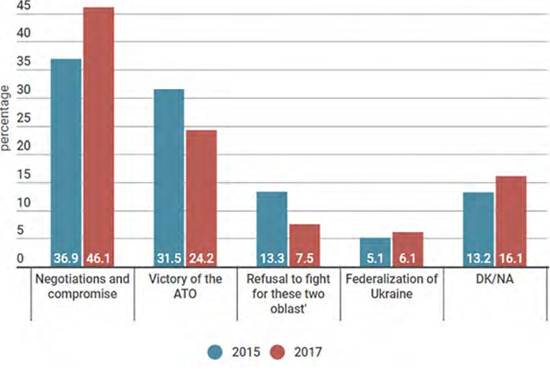
Proclaiming the Donetsk and Luhansk People's Republics (the so-called DNR and LNR), armed groups seized government buildings. These events subsequently fueled the Russian-Ukrainian military conflict, which has smoldered - with various degrees of intensity - until the full-scale invasion in 2022. It is estimated that during this protracted phase, approximately 14 000 people were killed, among whom 3400 were civilians.9 Even in periods of relative calm following the Minsk II peace settlement, around a dozen Ukrainian soldiers were still being killed every month. As of late 2021, the overall number of people displaced internally (IDPs) was approaching one million. Moreover, those who became IDPs preferred to settle in the eastern part of the country - in Ukraine-controlled parts of Donbas and the adjacent regions - not far from the homes they were forced to abandon and the loved ones left behind.10Nevertheless, before 2022, wider Ukrainian society had slowly learned to live with this low-key war, while coverage of the fizzling conflict gradually faded in the international media. Generally, societal preference towards conflict resolution followed peaceful negotiations and compromise scenarios (Fig. 3—1), yet 25 to 30 per cent of Ukrainians supported the idea of fighting until the total victory of the Ukrainian army counter-offensive Anti-Terrorist Operation (ATO).
Fig. 3-1: Distribution of desirable solutions for the Donbas Conflict (“Ukrainian Regionalism” Survey, University of St. Gallen, 2015-2017)
Desirable solutions for Donbas conflict
50
The attitudes towards the Minsk II agreement, signed back in 2015, diverged across Ukrainian society. While 42 per cent favored its implementation, 32 per cent agreed that Ukraine should follow the agreement only if the other sides do so, with 15 per cent opposing the idea altogether. There was a reasonable apprehension that Russia would use the Minsk agreements to infiltrate and strengthen its influence on Ukraine's domestic and foreign policy, endangering Ukraine's sovereignty.11
Since 2014, the non-government-controlled areas of Donetsk and Luhansk oblast and Crimea have been a “blind spot” for Ukrainian sociologists.
Owing to various safety protocols and methodological considerations, the surveys were commonly conducted only in the regions and areas controlled by the Ukrainian state.12 At the same time, some scholars have carried out quantitative and qualitative research in the non-government-controlled areas (NGCAs). Despite methodological challenges, one tendency in such surveys is apparent: the longer people lived on the territories outside Ukrainian political control, the deeper the value, geopolitical and attitudinal gap with the rest of Ukraine became. Thus, as the 2017 ZOiS survey showed,13 the majority of inhabitants of Ukrainian-controlled Donbas (65 per cent) firmly opted for the reintegration of NGCAs into the respective oblast, while most of the respondents in the so-called DNR and LNR supported special autonomy for the “republics” - either within Ukraine (35 per cent) or even Russia (33.1 per cent).14 The differences with the rest of Ukraine became even more striking. According to a May 2017 survey, only 18.2 per cent of DNR and LNR residents supported the idea of Ukraine joining the European Union, while this share in government-controlled Ukraine reached 53 per cent. Since its arrival in March 2020, the COVID-19 pandemic has only exacerbated the rupturing of this delicate fabric of social ties, as the level and possibilities of direct contact between occupied and non-occupied territories have decreased dramatically. The crossing through the “checkpoint” with Crimea or the “contact line” separating the conflict-affected people residing in the government-controlled areas (GCAs) and the NGCAs of Eastern Ukraine has been severely limited. This has prevented hundreds of thousands of people from accessing essential services and maintaining connections with the other side.For Ukraine at large, different tendencies have been prevalent. As several scholars note, political changes unleashed by the Euromaidan victory and Russia's aggression in 2014 have replaced societal ambivalence and confrontation with the consolidation of Ukrainian national identity.
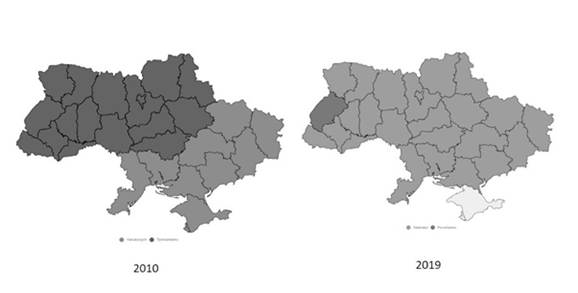
The Maidan, the annexation of Crimea and the beginning of the war in Donbas led to a patriotic mobilization and a substantial shift in Ukrainian politics. A significant part of the electorate with pro-Russian sympathies was left out of political participation, which led to the homogenization of the Ukrainian political and cultural field.The regional polarization that characterized the preceding decade has almost disappeared from the electoral map. In post-Euromaidan presidential elections, the winning candidates (Petro Poroshenko in 2014 and Volodymyr Zelensky in 2019) received majority support almost in all oblasts across the country (Fig.3-2).
Fig. 3-2: The Results of 2nd ballot OfPresidential elections in Ukraine by winning candidate per oblast (2010; 2019)
Thus, while the social distance towards Crimea and the NGCAs of Donbas has been growing, the protracted military conflict has increased cohesion and unity in government-controlled Ukraine. Many scholars have described this new sense of Ukrainian nationalism as becoming predominantly civic - being more tolerant and inclusive toward citizens from various ethnolinguis- tic and religious background.15 Others brought attention to cultural trends of Ukraine becoming “more Ukrainian”,16 the othering of Russophone Ukrainians, the polarizing discourses in post-Euromaidan society, and new mechanisms of “civic” exclusion.17
Fig. 3-3: The dynamics of feeling proud for being a Ukrainian citizen, 2002-2020, Ukrainian Society: Sociological Monitoring Survey.18
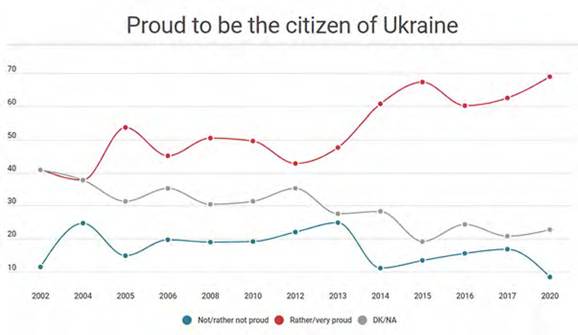
The share of respondents who did not feel proud to be citizens of Ukraine has decreased three times during the first phase of the Russian-Ukrainian War - from almost 25 per cent in 2013 to 8.4 per cent in 2020 (fig.3-3). One might also notice three “spikes” in the rising curve of pride in being Ukrainian citizens - 2005 (after the Orange Revolution), 2014-15 (following the Euromaidan and the beginning of the Russian-Ukrainian conflict) and 2020 (following Volodymyr Zelensky’s victory in the 2019 Presidential elections). Even though societal attitudes towards the Orange Revolution and the Euromaidan varied significantly across different regions, both events have ignited faith in the power of joint actions and more positive future perspectives of Ukraine. Indeed, Zelensky’s landslide victory marked a moment of overwhelming societal optimism (albeit short-lived). The 2019-20 opinion polls show that for the first time in a decade, the share of respondents satisfied with their lives exceeded the percentage of those dissatisfied (40 per cent to 36 per cent). In their recent book, The Zelensky Effect, Olha Onuch and Henry Hale explore the sources and mechanisms behind the popularity of a politician that reflected and expressed “the hopes and frustration of Ukraine’s first ‘Independence generation’ as well as [...] civic duty, the importance of Ukraine’s diversity, and the common quotidian experiences that bound Ukrainians together”.19
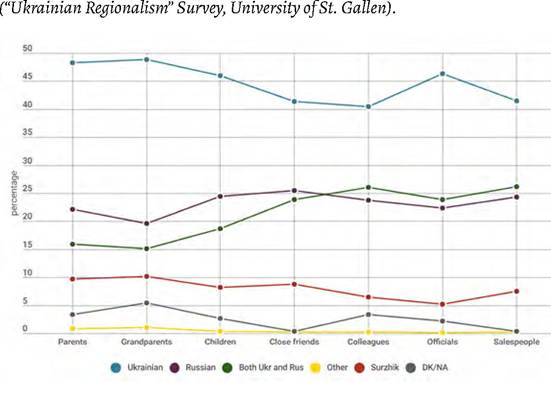
The growing confrontation motivated many Russophone Ukrainians to redefine their national belonging as Ukrainian. Yet this tendency could already be observed among Russian speakers before the war. As the “Ukrainian Regionalism” survey shows, already in 2013,82.9 per cent of respondents declared they were Ukrainians (this share was higher than 60 per cent in all oblasts except Crimea). Prior to the Euromaidan and the war, 59 per cent of Russian speakers and 89 per cent of bilinguals identified as Ukrainians, while in 2017, these numbers were already 66 per cent and 92 per cent, respectively. As of 2017, over 60 per cent said their native language is Ukrainian, while the share of declared Russian speakers has decreased (from 21.2% in 2013 to 11.4% in 2017). At the same time, using Ukrainian and Russian in communication with various social groups took different constellations, with the growing popularity of Ukrainian in both personal and professional realms (Fig. 3-4).
Fig. 3-4: Predominant language of communication with various groups, 2017
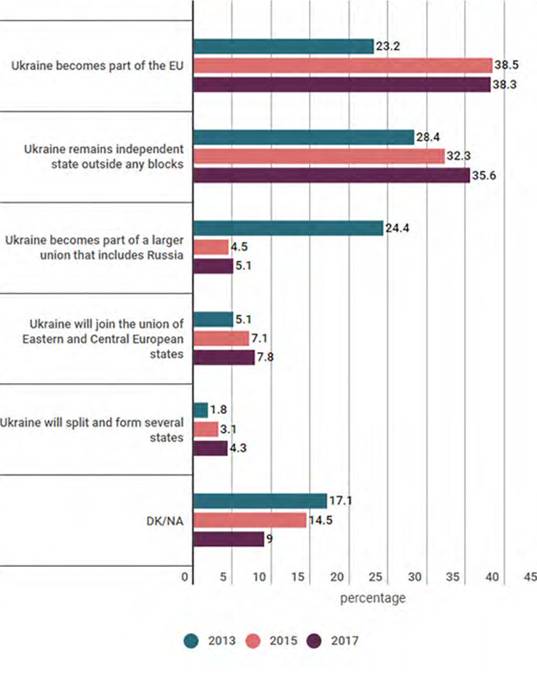
The outbreak of the Russo-Ukrainian War caused a tectonic shift in Ukrainian ambivalence towards the country's geopolitical choice. If earlier opinions were divided between the desire to join the EU and the alliance with Russia, after 2014, this fork became the opposition between EU membership
Anna Chebotarova: Society in Turbulent Times: The Impact of War on Ukraine 307
and retaining a non-aligned neutral status. Between 2013 and 2017, support among Ukrainians to join the EU nearly doubled - while support to join a union that includes Russia decreased by five times.
Fig. 3-5: Preferable geopolitical choice, 2013-2017, Ukrainian Regionalism Survey
Desirable geopolitical scenario for future
Until recently, the perspectives of accession to NATO remained a regionally divisive question. While the overall support has grown from 18 per cent in 2013 to 45.1 per cent in 2017, it was still significantly lower in south-eastern Ukraine, particularly among Russian speakers and the representatives of the older generation. Only after the full-scale invasion did the support for joining NATO soar to an unprecedented 83 per cent across Ukraine.
Nation-Building to the Sound of Sirens
Surveys conducted before the full-scale Russian invasion revealed that only 19 per cent of Ukrainians estimated its likelihood as high20. Yet, when it did happen, Ukrainians reacted with remarkable cohesion and solidarity. According to the VALREF survey conducted in April 2022, 70 per cent of respondents claimed they were prepared to take up arms to defend Ukraine, while 94 per cent reported either being ready to help the Ukrainian army or already engaging in supportive activities (such as financial donations or volunteering). The volunteer movement and grassroots networks, developed over the years of confrontation in Donbas, have been activated with renewed vigor. In the first weeks of the war, people in the newly occupied territories showed their attachment to Ukraine by organizing demonstrations with Ukrainian flags, which were then brutally dispersed by the Russian military. For the first time, the share of people who thought that things in the country were going in the right direction was five times higher than those who held the opposite view (76 per cent to 15 per cent in March), remaining as high as 82 per cent in December 2022. Finally, support for President Zelensky has tripled, reaching an unprecedented 93 per cent.21
Such cohesion is not unique, and we may witness the classical “rally- round-the-flag” effect (a concept introduced by political scientist John Mueller in 1970). This phenomenon is typically characterized by a sharp increase in patriotism and public support for national leaders during war or security crises. The durability of such consensus for almost a year at the time of writing makes the Ukrainian case quite remarkable. Thus, since May 2022, the percentage of respondents who deny the possibility of Ukraine's territorial concessions has only grown (from 82 per cent to 85 in December 2022), even if it may prolong the war.22
The war has already taken an enormous toll on Ukraine, causing a demographic crisis and the displacement of millions of Ukrainians internally and abroad. It has also led to significant economic problems as millions lost their jobs and were forced to flee their homes. According to a report from the World Bank, in 2022, Ukraine experienced a tenfold increase in poverty due to war.23 The number of military and civilian casualties has not yet been precisely calculated but is estimated in the tens of thousands. The wailing of air raid sirens has become a constant soundtrack of Ukrainian daily life as Russia continues its brutal attacks on critical energy infrastructure to demoralize the civilian population. At the same time, the overwhelming majority continue to believe in an eventual Ukrainian victory (over 90 per cent as of August 2022) and brighter perspectives for the country's post-war future.24 This unifying aspiration became a coping strategy - an emotional “anesthesia” that helps Ukrainians resist and endure exceptionally difficult circumstances. For the majority of respondents (55 per cent), Ukraine's victory would mean expelling Russian troops from the entire territory and restoring the country's pre-war borders (as of 2014).25 The success of such a scenario would inevitably pose the challenges of reintegration and transitional justice in regions that have been under Russian influence and control since 2014.
Even though the war currently remains ongoing, and the outcome is unknown, February 24,2022, marked a new tragic milestone in Ukrainian nationbuilding and its radical separation from the “Russian world.” The Russian invasion's brutality, which includes the destruction of residential areas and genocidal mass violence against civilians, is only likely to expedite this separation. The full-scale invasion further strengthened anti-Russian tendencies in Ukrainian identity politics. Along with limiting access to Russian media and social networks, introducing language quotas and measures aimed at separating the Ukrainian Orthodox Church from the Moscow Patriarchate, the politics of spatial and cultural “derussification” has been gaining momentum in Ukraine. The drive to distance the country from the aggressor state is widely supported in the society under attack. However, the internal tensions around the Russo- phone Ukrainian culture and the “language question” among Ukraine's Russian speakers will likely pose a challenge to the long-term resilience and cohesion of a society traumatized by war.
Conclusion
Since the proclamation of independence, Ukrainian society has evolved from ambivalence through internal confrontation to growing social unity and solidarity. The latter trend was significantly accelerated by the external threat from Russia since 2014, which left Crimea and part of Donbas out of Ukrainian political control. Popular identification with the Ukrainian state and the growing salience of Ukrainian identity has been a persistent phenomenon exacerbated by the war. The sense of national pride that waxed and waned with every new revolution has now become a clear unifying trend in a defiant society.
Ultimately, the brutality of Russian aggression has caused Ukrainians to redefine their national identity on three main pillars: the rejection of the “Russian world”, belief in an impeding victory of Ukraine and a brighter postwar future, as well as aspirations to integrate with the West. Societal unity in the face of aggression has been unprecedented and persistent, but internal cleavages may re-emerge as Ukrainians feel the growing human and economic costs of war. Prolonged violent conflict makes keeping the balance between protecting national security and defending democratic values a challenging task. Moreover, given the importance of restoring the territorial integrity of Ukraine within its pre-war borders, strategies for reintegrating Crimea and Donbas have yet to be developed, as the experience of occupation had an alienating effect on these regions.
Notes
1 Ievhen Holovakha, “Osoblyvosti politychnoι' svidomosti: Ambivalentnist' suspil'stva ta osoblyvosti,” Politolohichni Chytannia 1 (1992): 24-39
2 Serhiy Kudelia, “The Ukrainian State under Russian Aggression,” Current History 121:837(2022):251-57, https://doi.org/10.1525/curh.2022.121.837-2 51.
3 “Ukrainian Regionalism Surveys: Methodology,” accessed December 31, 2022, https://www.uaregio.org/en/surveys/methodology/.
4 “National Values and Political Reforms in Post-Maidan Ukraine - Department of Literature, Area Studies and European Languages,” accessed December 31, 2022, https://www.hf.uio.no/ilos/english/research/projects/v alref/index.html.
5 Lucan Way, Pluralism by Default: Weak Autocrats and the Rise of Competitive Politics (Baltimore: John Hopkins University Press, 2015).
6 Way, Pluralism by Default, p. 5.
7 Holovakha, “Osoblyvosti politychnoι' svidomosti”
8 Ulrich Schmid and Oksana Myshlovska (eds.), Regionalism WithoutRegions: Reconceptualizing Ukraine’s Heterogeneity, Leipzig Studies on the History and Culture of East Central Europe, vol. 5 (Budapest; New York: Central European University Press, 2019).
9 “Conflict-Related Civilian Casualties in Ukraine” (UN Human Rights Monitoring Mission in Ukraine, January 27, 2022), https://ukraine.un.o rg/sites/default/files/2022-02/Conflict-related%20civilian%20casualties %20as%20of%2031%20December%202021%20%28rev%2027%20January %202022%29%20corr%20ENj0.pdf.
10 “Internal Displacement Monitoring Center: Country Profile Ukraine,” IDMC, accessed December 31, 2022, https://www.internal-displacement.org/countries/ukraine.
11 Duncan Allan, “The Minsk Conundrum: Western Policy and Russia's War in Eastern Ukraine,” Chatham House-InternationalAffairs Think Tank (blog), May 20, 2020, https://www.chathamhouse.org/2020/05/minsk-conundr um-western-policy-and-russias-war-eastern-ukraine-0/minsk-2-agree ment.
12 Olexiy Haran, Maksym Yakovlyev, and Maria Zolkina, “Identity, War, and Peace: PublicAttitudes in the Ukraine-Controlled Donbas,” Eurasian Geography and Economics 60:6 (2019): 684-708, https://doi.org/10.1080/1538721 6.2019.1667845.
13 Gwendolyn Sasse, “The Donbas - Two parts, or still one?,” accessed December 31, 2022, https://www.zois-berlin.de/publikationen/the-donbas- two-parts-or-still-one.
14 Ibid.
15 O. V. Haran, and Maksym Yakovlyev (eds.), Constructing a Political Nation: Changes in the Attitudes of Ukrainians during the War in the Donbas, Second edition (first English-language edition) December 2017; first edition March 2017 (in Ukrainian) (Kyiv: Stylos Publishing, 2017); Volodymyr Ku- lyk, “National Identity in Ukraine: Impact of Euromaidan and the War,” Europe-Asia Studies 68:4 (2016): 588-608, https://doi.org/10.1080/0966813 6.2016.1174980; Grigore Pop-Eleches, “Revolutions in Ukraine: Shaping Civic Rather Than Ethnic Identities,” PONARS Eurasia (blog), February 22, 2018, https://www.ponarseurasia.org/revolutions-in-ukraine-sha ping-civic-rather-than-ethnic-identities/; Nadiia Bureiko and Teodor Lucian Moga, “The Ukrainian-Russian Linguistic Dyad and Its Impact on National Identity in Ukraine,” Europe-Asia Studies 71:1 (2019): 137-55, ht tps://doi.org/10.1080/09668136.2018.1549653.
16 Dominique Arel, “How Ukraine Has Become More Ukrainian,” Post-Soviet Affairs 34:2-3 (2018): 186-89, https://doi.org/10.1080/1060586X.2018.1445 460.
17 Oleg Zhuravlev and Volodymyr Ishchenko, “Exclusiveness of Civic Nationalism: Euromaidan Eventful Nationalism in Ukraine,” Post-Soviet Affairs 36:3 (2020): 226-45, https://doi.org/10.1080/1060586X.2020.17534 60.
18 Valerii Vorona and Mykola Shul’ha (eds.), "UkraInske suspil’stvo: monito- rynh sotsial’nykh zmin,”30 RokivNezalezhnosti 22:8 (2021).
19 Olga Onuch and Henry Hale, The Zelensky Effect (London: C Hurst & Co publishers ltd., 2022).
20 “Dynamika otsinky viis’kovol zahrozy (16-17 liutoho 2022),” accessed January 2, 2023, http://ratinggroup.ua/research/ukraine/dinamika_ocenki_ voennoy_ugrozy_16-17_fevralya_2022_g.html.
21 “Sociological Group ‘Rating’,” accessed January 3, 2023, https://ratinggro up.ua/en/.
22 Anton Hrushets’kyi, “Dynamika hotovnosti do terytorial’nykh postupok dlia iaknaishvydshoho zavershennia viiny: rezultaty telefonnoho opytu- vannia, provedenoho 4-27 hrudnia 2022 roku,” accessed January 2, 2023, https://kiis.com.ua/?lang=ukr&cat=reports&id=1167&page=1.
23 Andrea Shalal, “World Bank Says Ukraine Has Tenfold Increase in Poverty Due to War,” Reuters, October 15, 2022, sec. Europe, https://www.reuters. com/world/europe/world-bank-says-ukraine-has-tenfold-increase-pov erty-due-war-2022-10-15/.
24 “Den’ Nezalezhnosti UkraIny: shcho obiednuie ukraintsiv i yak my bachymo peremohu na shostomu misiatsi viiny,” accessed January 3, 2023, https://dif.org.ua/article/den-nezalezhnosti-ukraini-shcho-obedn ue-ukraintsiv-i-yak-mi-bachimo-peremogu-na-shostomu-misyatsi-viy ni.
25 “Den' Nezalezhnosti UkraIny.”
Selected Bibliography
DAnieri, Paul J. Ukraine and Russia: From Civilized Divorce to Uncivil War (Cambridge: Cambridge University Press, 2020).
Haran,, O. V., and Maksym Yakovlyev (eds.) Constructing a Political Nation: Changes in the Attitudes of Ukrainians during the Warin the Donbas. December 2017.
Kulyk, Volodymyr. “National Identity in Ukraine: Impact of Euromaidan and the War,” Europe-Asia Studies 68:4 (2016): 588-608.
Kuznetsova, Irina, and Oksana Mikheieva. “Forced Displacement from Ukraine's War-Torn Territories: Intersectionality and Power Geometry,” Nationalities Papers 48:4 (2020): 690-706.
Minakov, Mikhail, Heorhij Kasjanov, and Matthew Rojansky (eds.) From “The Ukraine” to Ukraine:A Contemporary History, 1991-2021 (Stuttgart: ibidem Verlag, 2021).
Onuch, Olga, and Henry Hale. The Zelensky Effect (London: C Hurst & Co publishers ltd., 2022).
Schmid, Ulrich, and Oksana Myshlovska (eds.) Regionalism without Regions: Reconceptualizing Ukraine’s Heterogeneity. Leipzig Studies on the History and Culture of East Central Europe, vol. 5. (Budapest; NewYork: Central European University Press, 2019).
Way, Lucan. Pluralism by Default: Weak Autocrats and the Rise ofCompetitive Politics (Baltimore: John Hopkins University Press, 2015).
Wilson, Andrew. Ukraine Crisis: WhatItMeansforthe West (New Haven: Yale University Press, 2014).