38 Soviet Ukraine: Economic Transformation and the Great Famine
The new Soviet society derived its legitimization from the Communist ideology formulated by the nineteenth-century German socialist philosopher, Karl Marx, and adopted for implementation in the former Russian Empire by the early twentieth-century Bolshevik leader, Vladimir Lenin.
It was through economic transformation that Marxist-Leninist ideologists promised to create a classless and egalitarian Communist society, first in Soviet Russia and its allied republics within the former tsarist empire, and then throughout the rest of the world.
38.1 A starving family in Soviet Ukraine during the famine of 1921
Wherever the Bolsheviks extended their rule, they tried to create immediately a classless, Communist state. The Bolshevik-led government nationalized (appropriated without compensation) all industries, transportation and power facilities, artisan workshops, and shops. It also nationalized privately-owned land, although the large estates were not broken up but preserved in the form of state-owned farms and collectives. To assure a food supply, the government introduced forced grain requisitions. Even money was prohibited and barter relations introduced instead. This radical approach to economic transformation was known as “war communism.” Its results were catastrophic, and Russia’s economic life, already severely undermined by World War I and the Civil War, was brought to a virtual standstill. Worse still for the rural population was the outbreak of famine in 1921 that was to last for two more years and to claim in Soviet Ukraine alone the lives of 1.5 to 2 million people.
Forced with economic collapse, in March 1921 Lenin decided to make a “strategic retreat” in the revolution. Consequently, the Soviet government introduced its New Economic Policy (NEP) with the goal to restore economic productivity.
Under the NEP forced grain requisitions were replaced by a tax in kind, and peasants were allowed to dispose of their surplus produce, which gave rise soon to a thriving local agricultural market economy and trade. Small-scale industries and shops were allowed to be privatized. As a result of these changes, by the mid-1920s the Soviet economy as a whole reached production levels that had existed in the Russian Empire on the eve of World War I.
38.2 A thriving country market in Soviet Ukraine during the NEP years after 1923.
In Soviet Ukraine the NEP did not really take hold until after 1923, when the tax in kind was replaced by a virtual free market in the agricultural sector. By 1927 the gross national product of Soviet Ukraine had finally reached prewar levels. Such relative economic prosperity in agriculture was soon to come to an end, however.
The New Economic Policy was never meant to be other than a temporary measure. Once the economy was stabilized, Soviet society could “move forward.” In 1928 the NEP was replaced by a command economy introduced at the initiative of the head of All-Union Communist party, Iosif Stalin. The entire Soviet Union was to be treated as a single economic unit with all decisions made in Moscow under the direction of the State Planning Commission (Gosplan, established in 1927). Henceforth, economic life was based on the concept of the Five-Year Plan, according to which production goals and schedules were set for all aspects of industry and agriculture. The main goal of the First Five-Year Plan (1928-1932) was rapid industrialization. To pay for it, the government once again nationalized small industries and shops that had been permitted under the NEP, and to assure a steady food supply for industrial workers it decided on full-scale collectivization of the land.

38.3 Blast furnaces at a metallurgical factory at Stalino (today Donets’k), 1924.
Soviet Ukraine’s lower Dnieper urban triangle (Dnipropetrovs’k—Kryvyi Rih—Zaporizhzhia) and the Donbas-Donets’ Basin industrial region just to the east (see Map 36) together formed one of the two areas in the Soviet Union that were singled out for large-scale state investment. Soviet Ukraine’s First Five-Year Plan, with its emphasis on heavy industry, was followed by the Second Five-Year Plan (1933-1937), and the Third Five-Year Plan (1938-1941), during which the technological reconstruction of industry and transportation and the collectivization of agriculture were to be completed, and certain industries (chemical and machine building) were to be given special attention. Among the first steps was to create the necessary infrastructure for heavy industry, in particular the completion of the massive Dnieper Hydroelectric Station (begun in 1927), the construction of several regional power stations, and the extension of railroad lines in the lower Dnieper industrial triangle and the Donbas-Donets’ Basin industrial region (see Map 36). As a result of the new command economy, Soviet Ukraine’s industrial output increased from 3.4 to 5.5 times in the course of the first two Five-Year Plans (1928-1937).
Nationalizing or reconstructing industries and mobilizing urban workers (who were often given preferential treatment in salaries and social programs) was the relatively easy part of Stalin’s economic transformation of Soviet society. Much more challenging was the agricultural sector, whose success was dependent on the participation of often uncooperative peasant workers and on the need for favorable yet unpredictable weather conditions. Since the government’s emphasis was on heavy industrial development, the needs of the urban work force took precedence over those of the peasant agriculturists. Collectivization of the land was therefore considered the best way to guarantee a steady food supply to the cities.
Voluntary collectivization had existed since the outset of Soviet rule, but it had not taken hold.
Consequently, by October 1928, only 3.4 percent of farms (representing 3.8 percent of arable land) had been collectivized in the Soviet Ukraine. The First Five-Year Plan initially called for 12 percent, and then 25 percent of land to be collectivized. This seemed too modest, however, so that in 1929 the All-Union Communist party called for the implementation of a policy of forced collectivization. As a result, by the end of the First Five-Year Plan (1932), 70 percent of Soviet Ukraine’s farms had been collectivized and, three years into the Second Five-Year Plan (1935), the figure reached 91 percent (representing 98 percent of arable land).
38.4 Determined workers in 1925 proudly display a Russian-language banner that reads: State Factory in Stalino—We Are Ready to Start Up the No. 5 Blast Furnace.
Such statistics and the term forced collectivization tell us little about the cost in human lives that were the result of Soviet policies. In effect, to achieve its goals, Stalin’s regime launched a war against its own peasantry. The first step was directed against well-to-do peasants, the so-called kulaks (Ukrainian: kurkuli), who were considered most opposed to collectivization. In January 1930 the All-Union Communist party ordered “the liquidation of the kulaks as a class.” Within two months, an estimated quarter-million kulaks with their families were deported from the Soviet Ukraine to the central and eastern regions of the Soviet Union. During the forced transports to these remote and inhospitable regions, thousands died along the way or soon after arrival.

38.5 A family declared to be kulaks forced from their home in the Stalino region, 1930.
With dekulakization completed, the Soviet government turned to the collective farms themselves, where peasants and even administrators opposed the ever-increasing crop quotas demanded by “The Plan.” Urban workers loyal to the Communist party (the so-called 25,000-ers) were dispatched with troops to carry out forced requisitioning.
At the same time another million peasant workers were deported to the east in 1931 and 1932.Dekulakization and forced grain requisitioning had a devastating impact on the harvest which dropped steadily in 1931 and 1932. Famine broke out in several areas of Soviet Ukraine and in neighboring areas (the lower Don, Kuban’, and sub-Caucasus region) during 1932. By the winter and spring of 1933 widespread starvation raged throughout most of the countryside. Estimates for 1933 alone range from 4.5 to 5 million deaths, and as many as ten million deaths during the rest of the decade are attributed to what became known as the Great Famine. Since the Soviet government at the time—and for the next half century —denied that a famine ever took place, there is no certainty as to the number of fatalities. Indirect evidence is available, however, by calculating demographic trends based on previous and subsequent population censuses. Between 1930 and 1937 the number of inhabitants in Soviet Ukraine actually declined from 31.2 million to 28.4 million, as opposed to 34.1 million, the figure it should have had based on normal demographic growth. Similarly, the number of ethnic Ukrainians should have risen between 1926 and 1937 from 23.2 million to 26.9 million, but instead decreased to 22.2 million. The statistical data that is today available to researchers also reveal that the largest decline in the Soviet Ukraine’s population occurred from 1931 through 1934, when the republic suffered a net loss of 4.1 million persons. As Map 38 graphically reveals, not only most of Soviet Ukraine but also the largely ethnic Ukrainian-inhabited lands immediately to the east in Soviet Russia (the lower Don valley, the Kuban’ region, and the Subcaucasus region) lost more than 20 percent of their population as a result of forced deportation and famine in the years 1929-1933.

38.6 Communist activists confiscating household belongings of a family declared to be kulaks, Podolia region, 1929.
MAP 38 THE GREAT FAMINE

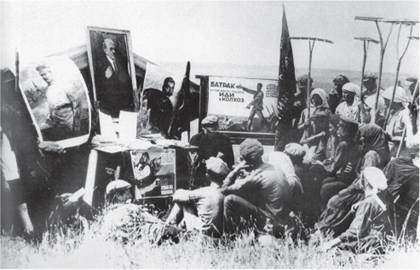
38.7 Under the watchful eyes of the “great” Soviet leaders, Trotskii (not yet exiled), Lenin, and Stalin, a political “meeting” in the fields of Soviet Ukraine tries to assure villagers they did well to join the collective farm (kolhosp).

38.8 Threshing grain on collective farms (this one near Zinov’ivs’k) still depended on primitive machinery and intensive manual labor as late as 1935.
Some writers have described the Great Famine as a “Ukrainian Holocaust,” that is, genocide perpetrated specifically against the Ukrainian people. This is certainly true if one understands Ukrainian in the territorial sense. After all, Soviet policy and death by famine did not make distinctions regarding the alleged or actual nationality of its victims. Germans, Mennonites, Greeks, Poles, Bulgarians, Moldavians, and Tatars were among the kulaks deported, and these peoples were also among those left behind who later died from starvation and faminerelated diseases. The decade of the 1930s coincided as well with political persecution and the dismantling of cultural institutions, publications, and schools that served the interests of Soviet Ukraine’s minority peoples. Between 1935 and 1939 the various nationality districts and village soviets (see Map 37) were either abolished or reorganized, with the result that they lost their national character. Especially hard hit were the institutions and cultural activists (Communist and non-Communist) among Jews, Poles, Germans, Greeks, Bulgarians, and Crimean Tatars. Aside from the closing of schools, cultural institutions, and publications, the Communist party Ievsektsiia concerned with Jews was abolished as early as 1930; large numbers of Poles were deported from western border areas to other parts of Soviet Ukraine and Soviet Central Asia; arrests, deportations, and executions were directed against suspected German “fascists” and Polish “counter-revolutionaries”; and the programs of Hellenization among Greeks and Tatarization among Crimean Tatars were brought to an end.

38.9 Pavel Postyshev, Stanislav Kosior, and Lazar Kaganovich, the three leading officials sent by the Soviet leader Iosif Stalin (third from the left) to carry out forced collectivization and enforce the government’s “Plan” in Soviet Ukraine.
Ethnic Ukrainians in particular were victims of the Stalinist drive for economic and political conformity. Paradoxically, the years that encompassed the First Five-Year Plan also coincided with continuing achievements in the policy of Ukrainianization. By 1930-1931, for example, 80 percent of all books and 90 percent of all newspapers appeared in Ukrainian, and 88 percent of all students in the republic were enrolled with Ukrainian as the language of instruction. Yet at the same time trials against Ukrainian intellectuals (including many who returned from exile) became common after 1930, followed by large-scale purges of the Communist party (Bolshevik) of Ukraine—268,000 members were removed from party ranks between 1933 and 1938. The accusations against both non-party and party members often contained references to “Ukrainian bourgeois nationalism.” This was understood to mean that favoring Ukrainian cultural and scholarly activity as well as a distinctive economic or political path for Soviet Ukraine was tantamount to being an anti-Soviet Ukrainian bourgeois nationalist. In effect, by the end of interwar period in 1939, the political and economic integration of the Soviet Ukraine within the Soviet Union as a whole was complete and the experiment with Ukrainianization (like the earlier NEP) had come to an end.

38.10 Among the first of the Soviet Union’s major political trials was one held in Soviet Ukraine’s capital of Kharkiv, 1930, against a fictitious anti-Soviet organization, the Union for Liberation of Ukraine; most of the 45 defendants, Ukrainian intellectuals and church leaders, were imprisoned.
The other important element of traditional Ukrainian life, the Orthodox Church, was also largely undermined during the interwar years. From the outset of Soviet rule the Bolsheviks were opposed to Christianity and all other religions in general; instead they adopted atheism as the ideal spiritual and moral guide for Communist society. The largest and most important religious institution in Soviet Ukraine was the Russian Orthodox Church under the Patriarch of Moscow (whose office had been restored in 1918). During the Ukrainian revolutionary era, however, some priests and bishops hoped to create a jurisdictionally independent Ukrainian institution. Their hopes were realized when, in 1920, the Ukrainian Autocephalous Orthodox Church was established, to be headed one year later by Metropolitan Vasyl’ Lypkivs’kyi. Initially, the Soviet government supported the Ukrainian Autocephalists as a means of counteracting and undermining the more influential Russian Orthodox Church in Ukraine under the Moscow Patriarchate. But when the government decided to step up its campaign against “Ukrainian bourgeois nationalism,” it implicated the Ukrainian Authocephalous Orthodox Church in the 1930 trial against counterrevolutionary organizations. One year later the church was forced to disband. Many of its priests and hierarchs were subsequently arrested and its churches destroyed or used for other purposes. The same kind of persecution was leveled against the Moscow patriarchal church in Ukraine throughout the entire interwar years, although it was at least allowed to exist as a legal entity.

38.11 Destruction of the St. Nicholas Church in Kharkiv, 1929, on orders from the Soviet authorities.

38.12 Vasyl’ Lypkivs’kyi (1864-1938), priest, co-founder, and from 1921 to 1927 metropolitan of the Ukrainian Autocephalous Orthodox Church.