36 Soviet Ukraine in the Interwar Years
The administrative structure of Soviet Ukraine changed several times during the interwar years. Initially, the nine tsarist provinces (gubernii) remained in place. Then, between 1923 and 1925, the old provinces were abolished and the whole territory of Soviet Ukraine was divided into fifty-three regions (okruhy), which in turn were subdivided into districts (raiony, which replaced the volosti of the tsarist era).
Also within the boundaries of Soviet Ukraine was the Moldavian Autonomous Soviet Socialist Republic located just east of the Dniester River which formed an international border with Romania.The Soviet Union refused to recognize Romania’s acquisition of the former tsarist province of Bessarabia west of the Dniester River. As a direct challenge to Romania the Soviets formed the Moldavian A.S.S.R. as the first step toward the eventual re-acquisition of all of Moldavia—that is, Bessarabia. Aside from creating an autonomous “Moldavian” state with its administrative center at the town of Balta, Soviet ideologists began to argue that the Moldavians were not ethnically or linguistically Romanians—as they considered themselves—but rather a distinct Moldavian or Moldovan (to use the current terminology) “nationality.” Somewhat later, the Soviet Union added to Soviet Ukraine other territories which were inhabited by Romanians. As a result, Soviet Ukraine (and present-day Ukraine) came to include within its borders inhabitants of similar but juridically “distinct” nationalities: Moldavians and Romanians.
During the second half of the 1920s the borders of the Soviet Ukraine were altered on several occasions. The biggest change came in 1925, when the far eastern okruhs of Shakhty and Taganrog (a total of 10,900 square miles or 28,000 square kilometers) were transferred to Soviet Russia. Then, between 1925 and 1928 eight small territorial adjustments, all in favor of Soviet Ukraine, were carried out near the town of Putyvl and other points along the republic’s northern border with Soviet Russia (compare Maps 35 and 36).
In 1931-1932, the internal administrative structure of the Soviet Ukraine was changed once again. The regions (okruhy) were abolished and replaced by larger oblasts named after their administrative centers. Initially, there were five oblasts, then seven (as indicated on Map 36—Kiev, Chernihiv, Kharkiv, Vinnytsia, Odessa, Dnipropetrovs’k, and Stalino), and by 1939 thirteen. Ever since the Bolshevik Revolution of November 1917, the political structure of Soviet society was based on councils (soviets) of workers, peasants’, and soldiers’ deputies, later simply named soviets of worker’s deputies. Therefore, the Soviet Union as a whole and every national republic, autonomous republic, okruh or oblast, city, town, and village, had their own soviets. Soviet Ukraine’s highest legislative body was a unicameral parliament first known as the Congress of Soviets of Workers’, Peasants’, and Soldiers’ Deputies, then simply as the Supreme Soviet (Verkhovna Rada).
MAP 36 SOVIET UKRAINE, 1932

The Soviet system was also based on the principle—or, more aptly, the dogma—that the state represented the interests of industrial and agricultural workers and that it was to be governed by a revolutionary elite, the Communist party. Therefore, it was in the interests of the state to assure that the councils (soviets) which administered the various levels of the republic’s administrative structure were filled with ideologically reliable Communist party members.

36.1 Mykola Skrypnyk (1872-1933), Bolshevik revolutionary and from 1917 leading figure in the Soviet Ukrainian government and Communist party (Bolshevik) of Ukraine, from 1927 to 1933 commissar (minister) of education.
In 1918, when the Bolsheviks made their first attempt to secure power in Dnieper Ukraine, the Communist party (Bolshevik) of Ukraine (CP(b)U) had a mere five thousand members.
The following year, the party’s ranks began to increase, by 1922 reaching fifty-six thousand members. There remained, nevertheless, a problem regarding the social and ethnic composition of the party. At the outset its ranks were drawn from the industrialized proletariat, especially in the Donbas in eastern Ukraine, so that members were primarily Russians and Jews. The CP(b)U had not yet made inroads into the largely ethnic Ukrainian-inhabited rural countryside. Hence, while the majority of the population of Soviet Ukraine was ethnic Ukrainian (80 percent), in 1922 that group made up only 23 percent of the party membership. To correct this imbalance and to increase party membership overall, the CP(b)U was instructed to implement general policies set in Moscow by the All-Union Communist party (Bolshevik), headed from 1922 by Iosif Stalin.
36.2 Oleksandr Shums’kyi (1890-1946), Ukrainian revolutionary and national-Communist leader, from 1924 to 1927 commissar (minister) of education and a main proponent of Ukrainianization policies.
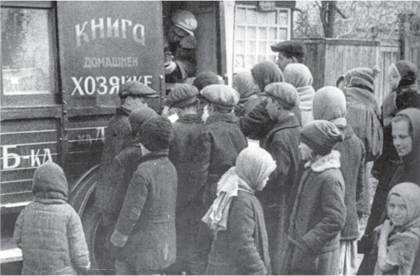
36.3 Availability of books was of crucial importance for bringing Soviet Marxist ideology to the populace; here a mobile library brings books to villagers in Soviet Ukraine, 1929.
Stalin especially favored a policy known as “indigenization” (korenizatsiia); that is, “rooting” the party by bringing into its ranks members from the indigenous population in each of the republics. If successful, the policy of indigenization would assure control of the countryside through “home grown” Communist party cadres. In fact, the proportion of ethnic Ukrainians in the CP(b)U did increase dramatically, from 37 percent in 1925 to 60 percent in 1933. During that same period, ethnic Ukrainian membership in the Communist Youth League (Komsomol), the training ground for future party members, increased from 59 to 72 percent.

36.4 Mykola Khvyl’ovyi (1893-1933), writer, publicist, and proponent of a Ukrainian literary revival that would no longer be dependent on Russian models.
A corollary to indigenization was the policy called Ukrainianization, in which emphasis was given to promoting the Ukrainian language in the government administration, in education, and in public and cultural life in general. The leadership within the Communist party (Bolshevik) of Ukraine actually had mixed views on the value of Ukrainianization. This was the result of the on-going division within the CP(b)U hierarchy between the “inde-pendentists” and “internationalists,” with the former favoring Ukrainianization and the later opposed. Throughout the interwar years, as the leadership in the CP(b)U changed—not to mention the changing views of the all-Union Communist party in Mos-cow—so too did the fate of the Ukrainianization policy. From 1923 through 1927 the all-Union party leader Stalin was sympathetic to Ukrainianization as a part of the indigenization policy, so that local Ukrainian party leaders (Mykola Skrypnyk, Oleksandr Shums’kyi, and Hryhorii Hryn’ko) were basically left alone to promote the Ukrainian language and culture.

36.5 Avant-garde design for book covers by leading authors during the height of Ukrainianization: Mylola Khvyl’ovyi, Pavlo Tychyna, Iurii Ianovs’kyi, and Ivan Dniprovs’kyi.
It was in the educational system that the most significant advances were achieved. A decree issued in 1923 by Soviet Ukraine’s Ministry of Education mandated that wherever ethnic Ukrainians were in the majority instruction in schools must be in Ukrainian. The guidelines in this and other decrees applied to adult literacy schools as well as to elementary and secondary schools. Within a few years, as high as 81 percent of all adult literacy schools (1925) and 82 percent of all elementary schools (1928) used Ukrainian as the language of instruction.
Analogously, if in 1922 less than 1 percent of secondary schools used Ukrainian, by 1929 that figure had raisen to 66 percent. University-level education was slower in adopting Ukrainian as the language of instruction (only 42 percent of classes by 1928), although all university-level and professional school students were required to study subjects in Ukrainian history, language, literature, and economic geography. There were also marked achievements in the Ukrainian publishing industry and in the development of literature, theater, painting, music, and cinema, whose practitioners tried to produce traditional and avant-garde forms that would be distinctively Ukrainian. Even some of the leading Communists and non-Communist intellectuals from the emigration and the neighboring countries like Poland (among them the former Central Rada president and distinguished historian Mykhailo S. Hrushevs’kyi) accepted invitations to return home and take up positions in Soviet Ukrainian scholarly and cultural institutions.
36.6 Les Kurbas (1887-1942), from 1922 to 1933 director of the avant-garde and experimental Berezil’ Theater in Kiev and Kharkiv.
In short, by the end of the 1920s Soviet Ukraine was well on its way to becoming a Ukrainian state in content as well as in name. While the process of Ukrainianization was to continue and reach its apogee in the early 1930s, its ultimate fate was to be profoundly affected by the economic transformation of Soviet society, a process set in motion by Iosif Stalin in 1928.

36.7 Oleksandr Dovzhenko (1894-1956), film director and founder of Ukrainian cinematography, internationally best known for his silent film, Zemlia (The Earth, 1930), about the collectivization of agriculture in Ukraine.