The Administrative and Socioeconomic Structure of Ukrainian Lands in the Austrian Empire, 1849-1914
Following the revolutionary era that began in March 1848 and ended decisively in August 1849 with the defeat of the Hungarians, Austria entered a period of neoabsolutism during which the imperial administration in Vienna attempted to undo the achievements of the 1848 revolution and to restore the absolute power of the emperor.
During the next two decades, from 1849 to 1868, there were several attempts at restructuring the Austrian Empire. Each new attempt was a direct result of the interplay of external and internal forces, namely, international developments and pressure from the empire’s many nationalities, in particular the Magyars. The process unfolded in three distinct phases: the first, 1849 to 1859, marked a neo-absolutist phase, with government exclusively under the control of Vienna; the second, i860 to 1866, was a time of constitutional experiment; finally, the third, 1867 to 1868, witnessed the creation of the Austro-Hungarian dual monarchy, the structure which prevailed until the very demise of the Habsburg Empire in 1918. Each phase had a direct effect on the administrative structure of Galicia, Bukovina, and Transcarpathia, and therefore on the Ukrainians living there.Administrative structure
During the revolutionary era, the Kremsier parliament was disbanded in March 1849, and its constitutional proposals scrapped. Even the more centralized constitution decreed the same month by the emperor was never put into effect, and it was eventually annulled, on 31 December 1851. With the return of neoabsolutism, there was no thought of an Austrian parliament. Instead, Vienna ruled the empire directly from the imperial court and, in some areas, including Galicia and Hungary, through martial law administered by the imperial army. Martial law in Galicia lasted until 1854, after which an imperial civil administration was set up, headed by a viceroy (German: Statthalter, Polish: namiestnik', Ukrainian: namistnyk) who was appointed by and responsible only to the emperor.
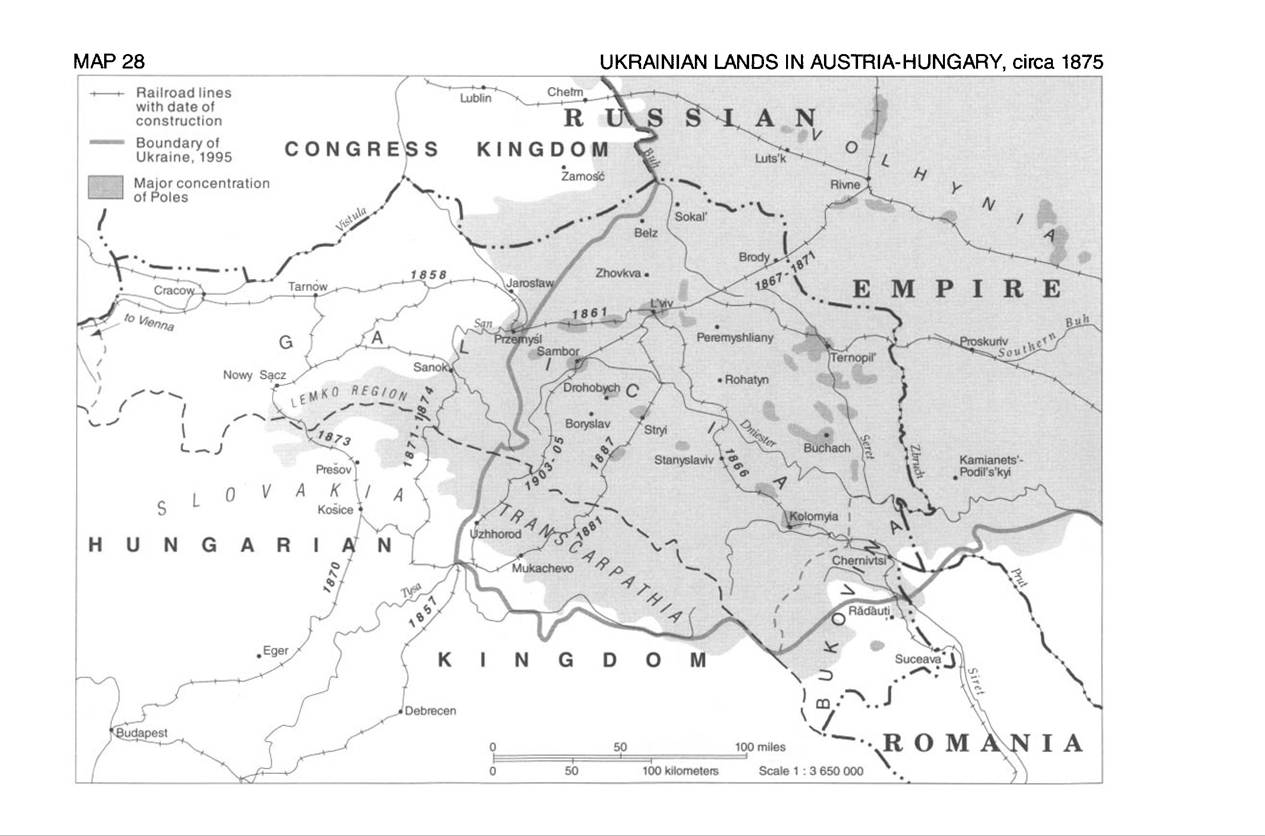
The whole province was also administratively reorganized. In 1867, the nineteen regions (Kreise) were replaced by seventy-four and, later, eighty-three districts (Bezirke/powiaty/povity), each with its own sheriff (starosta) in charge of the district administration. Besides the districts, there were also two self-governing cities, L'viv and Cracow.The status of Bukovina remained uncertain. While the imperial constitution of 4 March 1849 proposed that Bukovina be a separate province, that constitution never went into effect. As a result, it was not until 1854 that Bukovina’s full administrative separation from Galicia occurred. In i860, however, that move was rescinded and Bukovina once more became part of Galicia. As for Transcarpathia, it, like the rest of Hungary, was under martial law, although one of the military districts was centered in Uzhhorod, and part of the Transcarpathian population thus effectively united under the nominal rule of its local leader, Adol'f Dobrians'kyi. The Uzhhorod, or ‘Ruthenian,’ District lasted only five months, however, and after its dissolution in March 1850 the Transcarpathians had no separate administrative status. Their homeland continued to be divided into several Hungarian counties (Hungarian: megye·, Ukrainian: komitaty or zhupy), each headed by a Magyar official.
In Galicia, the first viceroy to function under the new centralized system of Austrian rule was the Polish count Agenor Goluchowski. Goiuchowski was a wealthy landowning magnate from Galicia and a confidant of Emperor Franz Joseph and his immediate entourage. Goluchowski also represented what initially was a small group of Polish leaders who felt that the future of the Polish cause did not lie in revolutionary activity, but rather in organic cultural and economic work with the broader mass of the Polish population and in cooperation with the three imperial states that ruled Polish territory. Goluchowski was convinced that Austria offered the best political future for Poles.
Accordingly, he was more than willing to cooperate with the Habsburgs, provided that Vienna recognized all of Galicia as a Polish land and that it granted complete cultural if not political autonomy to the Poles living there.A dominant figure throughout this whole period, Goluchowski served as Galician viceroy three times between 1849 and 1875 and as Austrian imperial minister of internal affairs between 1859 and 1861. The emperor needed a reliable administrator, and he trusted Goluchowski. Goluchowski knew this, and, taking advantage of Vienna’s weakness at certain times, he was able to advance the Polish cause and transform Galicia into an area in which Poles monopolized the upper echelons of the administration, the educational system, and economic life - a state of affairs that was to last at least until the outbreak of World War I in 1914. During the period of imperial administrative rule before 1859, Goluchowski successfully foiled Vienna’s inclination to divide Galicia into two provinces, a division which would effectively have meant a Polish and a Ukrainian province. He also succeeded in having many German officials removed, in having Polish replace German in secondary schools (gymnasia), and in restricting the further spread of Ukrainian schools. He even tried to introduce the Latin alphabet for Ukrainian publications in 1859, although this effort failed after strenuous protests by Ukrainian leaders.
International developments and Austria’s internal politics
The year 1859 was a crucial turning point for Austria, since it lost a war with
France and the growing Italian nation-state of Sardinia-Piedmont. This loss underlined Austria’s internal weaknesses, and plans were made to restructure the empire. It was evident that centralized rule from Vienna had failed. Influenced by Count Goluchowski, who was now imperial minister of internal affairs, the Austrian government proposed a new solution in February 1861.
This marked the dawn of the era of constitutionalism and representative government in Austrian history. Each of the Austrian provinces received its own diet (German: Landtag·, Polish: sejm; Ukrainian: soim), and a central parliament (Reichsrat) with representatives from all the provinces was established in the imperial capital of Vienna. The year 1861 also saw the reinstatement of Bukovina as a separate province, a status it retained until the demise of the empire. Thus, with the dawn of Austrian constitutionalism, the Ukrainians of Galicia and Bukovina became active members in the political process at both the provincial and the imperial level.The next important turning point in Austrian history came in 1866. In that year, neighboring Prussia, under the dynamic leadership of Chancellor Otto von Bismarck, defeated Austria in a war that lasted no more than six weeks. With this victory, Prussia eliminated Habsburg influence over the Germanic lands in central Europe. Five years later, in 1871, Bismarck united the smaller German states under the leadership of Prussia to form the German Empire. Austria’s defeat by Prussia in 1866 was attributed to the failure of the Hungarians to cooperate in the war effort. Consequently, Vienna was once again forced by external events to try to resolve the Hungarian problem as well as to respond to the continuing demands of the empire’s other nationalities.
The result was a compromise reached with the Hungarians in May 1867 and known as the Ausgleich. According to the Ausgleich, the Hungarian Kingdom was left to govern itself except in foreign affairs, some economic matters (currency, tariffs), and the military, all of which were to be the common concern of the whole empire. As for the other ‘kingdoms and lands represented in the parliament’ - the official if rather awkward name for the Austrian, or non-Hungarian, territories - a revised constitution was promulgated in December 1867. This document guaranteed individual citizens equality before the law; freedom of the press, speech, and assembly; and protection of the interests of the various nationalities, including equal rights for all languages in local use in schools, administration, and public life.
With the implementation of the Ausgleich in 1868, the Austrian Empire was transformed into the so-called Habsburg Dual Monarchy, or Austria- Hungary.Meanwhile, Count Goluchowski was back in office as viceroy in Galicia following Austria’s defeat by Prussia in 1866. Again, Vienna wanted his support, and again he was willing to give it so long as Polish interests in Galicia were served. While the Ausgleich may have resolved one problem in the empire, it inevitably prompted demands from other nationalities. After all, if Hungary could gain selfrule, why should not the ‘Polish’ Kingdom of Galicia and Lodomeria or, for that matter, the ‘Czech’ Kingdom of Bohemia-Moravia gain it too? The Poles put forth their program in the so-called Galician Resolution of 1868, which demanded wide-ranging political autonomy for the province, including legislative power for
Austria’s Parliamentary Structure
When Galicia’s diet was established in 1861, it had 150 seats. After 1901, that number was raised to 161, and after 1911, to 228. The Bukovinian diet had 31 seats for most of the period until 1911, and thereafter it had 63. Deputies to the provincial diets were elected according to the curia system, which allotted to four social strata a specific number of deputies. Among the deputies in Galicia in 1861 were 44 elected by the great landowners, 3 elected by the chambers of commerce, 23 elected by the cities, and 80 elected by small towns and rural communes. Provincial diets also included several ex officio members. In Galicia after 1875, they included seven bishops (3 Roman Catholic, 3 Greek Catholic, 1 Armenian); two university rectors and, after 1900, the president of the Polish Academy of Sciences; and the rector of the polytechnical school in L'viv. Finally, each diet was presided over by a marshal and vice-marshal appointed by the emperor. The diets had limited authority and were basically concerned with local agricultural and, later, industrial development, hygiene, and elementary and secondary schools.
Until 1873, the diets also elected deputies to the newly established central parliament (Reichsrat) in Vienna.Austria’s central parliament also came into being in 1861. It consisted of two houses: a House of Lords (Hemnhaus), made up of members appointed by the emperor; and the more important House of Deputies (XbgeordnetenhausY Until 1873, the members of the House of Deputies were elected by the provincial diets; then, by voters according to the curia system; and finally, after 1907, by universal male suffrage. The number of deputies in the Austrian parliament steadily increased, from 203 in 1861 to 516 in 1907.
The heritage of Viceroy Goluchowski’s rule in Galicia was strongly felt in the new administrative structure. Although Ukrainians made up close to half the province’s population, by the demise of the empire in 1918 they had never elected more than one-third of the deputies in the Galician diet. (Their largest representations were 66 of 228 deputies in 1914, and 49 of 150 deputies in 1861.) In Bukovina, where Ukrainians also made up close to half the province’s population, they had no deputies at all in the provincial diet until 1890. Thereafter, their largest number was 17 of 63 deputies in 1911.
In the Austrian parliament’s House of Deputies, Ukrainians had at most only one-quarter of the seats allotted to Galicia (their largest representation was 27 of 106 seats in 1907). Moreover, from Goluchowski’s third term in 1871-1875 until the outbreak of World War 1 in 1914, all subsequent Galician viceroys were Poles, all the marshals in the Galician diet were Poles, and all the district sheriffs were Poles.
the local diet, a separate supreme court, and responsibility on the part of the viceroy to the diet. Vienna was not prepared to go so far, fearing - and rightly so - that meeting these demands would encourage similar demands by other nationalities and lead to the disintegration of the empire. If Goluchowski was to continue to support Vienna, however, he needed something to appease the supporters of the Galician Resolution. Accordingly, the Austrian government agreed to permit several administrative changes in the province. Polish became the language of internal administration, secondary schools, and L'viv University; and the Provincial School Board, which theoretically was subordinate to the Galician diet, became an independent body and instrument of further polonization within the educational system. Also, in 1871 the Ministry of Galician Affairs was created in Vienna to represent the interests of the province directly with the imperial government. From the ministry’s establishment in 1871 until the empire’s demise in 1918, all ministers of Galician affairs were Poles.
Hence, while it is true that Ukrainians participated in the political system and were guaranteed certain legal rights with respect to the promotion of their national culture, the realities of Austrian political life, on both the domestic and the international front, forced the central government in Vienna to depend on the leading stratum in Galicia, which was made up almost exclusively of Poles. In effect, the Ukrainians became a minority in Galicia, forced to struggle for any advance in their national life, more often than not in the face of intransigent Polish opposition. This state of affairs, which lasted until 1918, is perhaps best summed up by the late Ukrainian-Canadian scholar Ivan L. Rudnytsky:
The dominant position of the Poles was bolstered by the social privileges of the landed nobility and the upper middle class. Conversely, for the Ukrainians the struggle for national and social emancipation was one and the same. In addition to the clash between the social interest of the two nationalities there was an invidious conflict on the psychological plane. The outlook of the Polish intelligentsia and middle class was largely derived from the gentry tradition. The origins of the Ukrainian intelligentsia were plebeian; every educated Ukrainian was only one or two generations removed from either a parsonage or a peasant hut. Thus even those Polish and Ukrainian groups whose formal education and living conditions were similar displayed divergent social mentalities. Both communities viewed the present conflict as if it were similar to the great seventeenth-century wars between the Polish aristocracy and the Ukrainian Cossacks.1
Social structure and economic developments
In the first half of the nineteenth century, Galicia was an underdeveloped agrarian region whose raw materials were exploited by the more industrialized provinces in the western part of the Habsburg Empire. This characterization is true also for the second half of the nineteenth century. Some industrialization took place during the very last decades of the century, however, and changed Galicia’s economy somewhat from one dependent exclusively on agriculture.
The size of Galicia’s population increased substantially during the second half
The Problem oe Statistics
During the second half of the nineteenth century, several European countries began to undertake censuses every ten years. These censuses produced a wide variety of statistical data. Among the most controversial questions, in particular in multinational Austria-Hungary and the Russian Empire, were those concerning national identity. Actually, the question asked by both Austria- Hungary and Russia concerned native language (‘mother tongue,’ ‘language of daily use'), but the answers to the question were generally used by contemporary political activists - and are still used by scholars today - to describe the national composition of these states. Not surprisingly, spokespersons for each nationality were interested in arriving at the highest figure possible for their groups in order to justify demands for greater political representation, more schools, and social and cultural services that might otherwise go to another national group.
The census question about language was useful if one wanted to know about languages spoken. Difficulties arose, however, when language data was used as a basis for arriving at national affiliation. Eor instance, the Austrian statistics on language for Galicia in 1910 were the following:
| Polish | 4,672,000 | 58.5% |
| Ukrainian | 3,208,000 | 40.2% |
| German | 90,000 | 1.1% |
| Other | 10,000 | 0.1% |
When these figures are used to describe the number of Poles or Ukrainians in Galicia - as they frequently have been used - serious discrepancies present themselves. Eor instance, there turn out to be no Jews, even though we know from the statistics on religion that there were 872,000 Jews recorded in Galicia in 1910. The same statistics tell us that the vast majority of Jews (808,000) gave Polish as their language, thereby inflating the number of‘Poles,’ and that a smaller number of Jews gave German (26,000) or Ukrainian (22,000) as their language, thereby increasing the number of these nationalities, if only slightly. Similarly, 235,000 Greek Catholics recorded their spoken language as Polish, even though a significant portion were probably of Ukrainian ethnicity. Table 33.1 attempts to correct these discrepancies by using statistics on both language and religion to gauge the approximate numerical size of Galicia’s nationalities.
The operative word is approximate. This is because all statistics, especially those relating to national identity in multinational states, must be treated with great caution. One should never assume that numbers are wholly accurate; at best, what they provide is an estimate.
TABLE 33.1
Nationality composition of Galicia, 1910
| Number | Percentage | |
| Poles | 3,627,000 | 45.4 |
| Ukrainians | 3,422,000 | 42.9 |
| Jews | 872,000 | 10.9 |
| Germans | 65,000 | 0.8 |
| Others | 10,000 | 0.0 |
| TOTAL | 7,996,000 | 100.0 |
of the nineteenth century, from 4.9 million inhabitants in 1849 to 7.9 million in 1910. The numerical relationship between the province’s two leading groups - Poles and Ukrainians - also changed, although not to the degree suggested by Austrian governmental statistics, which used spoken daily language as the criterion for national identity. Table 33.1 provides a more realistic estimate, based on a combination of statistics on language and on religion. These revised statistics suggest that between 1849 and 1910 the percentage of Poles in Galicia remained the same, while that of Ukrainians declined slightly, from 47 to 43 percent. The decline in the percentage of Ukrainians was even greater in eastern Galicia, from 71 to 62 percent. The reasons for this proportional change were (1) an increase in Polish colonization from western to eastern Galicia, and (2) the large-scale emigration of Ukrainians abroad beginning in the 1880s.
Despite the enormous growth in Galicia’s population, its socioeconomic status did not change substantially. Although the population of the provincial capital, L'viv, quadrupled in size during the second half of the nineteenth century, in 1910 it was still a relatively small city of only 207,000 inhabitants, over 80 percent of whom were Poles or Jews. The next-largest cities in eastern Galicia were Prze- mysl and Kolomyia, with fewer than 40,000 inhabitants each, and Ternopil' and Stanyslaviv (today Ivano-Frankivs'k) with fewer than 30,000. As is clear from these figures, the vast majority of Galicia’s population remained rural.
In fact, more than three-fifths of the province’s inhabitants were engaged in agricultural pursuits. Although the serfs were legally freed from bondage in 1848, in a sense they remained economic serfs. There were several reasons for this. The right of the peasants to use the gentry-owned woods and pastures (the traditional servitude) was revoked with the emancipation, and now the peasants had to pay for the privilege. Their only source of income was their plots of land, but these were too small to provide a sufficient income. The peasants were forced to borrow and before long experienced chronic indebtedness. This state of affairs was only made worse as landholdings were repeatedly subdivided among offspring. In 1859, 66 percent of those who made up Galicia’s agricultural sector fell into the category of small-sized landowners (owning less than 14 acres [5.7 hectares]), and another 25 percent were middle-sized landowners (owning up to 28 acres [11.5 hectares]). In subsequent years, the average size of a peasant holding steadily decreased, from 12 acres (5 hectares) in 1859, to 7 acres (3 hectares) in 1880, and
Administrative and Socioeconomic Structure, 1849-1914 425 finally to 6 acres (2.5 hectares) in 1900. There was a slight increase in the total amount of arable land available, but it proved insufficient to offset the increasing demographic growth. There were some areas of Galicia, such as the former Podo- lia in the province’s far southeastern corner, where the economic status of the peasantry stabilized and improved during the last decades of the nineteenth century. Throughout most of the province, however, the peasants seemed to be caught in an inescapable cycle of indebtedness, land subdivision, and rapid demographic growth.
The difficult economic situation gave rise to frequent peasant strikes, especially at the beginning of the twentieth century. Many peasants also sought relief by emigrating abroad. Beginning in the 1880s, Galician peasants sought their fortunes in the New World, where they settled in the alien industrialized environment of the northeastern United States. By the turn of the century, emigrants were also departing for Canada and Brazil, although in these countries they settled primarily in agricultural regions that provided for a way of life more similar to the one they had had at home. Between 1881 and 1912, an estimated 430,000 Ukrainians left Galicia and Bukovina, and another 170,000 left Transcarpathia. Emigration grew to such proportions that both the Austrian and the Hungarian authorities, fearing the complete depopulation of certain areas, tried - although with little success - to control the exodus.
The only real way to stop emigration was to improve the Galician economy. Although the general Austrian principle of treating Galicia as a source of raw materials for the empire’s western provinces as well as a market for the latter’s industrial goods had not changed, the beginnings of industrialization were embarked upon. In the 1880s in particular, industrial development was encouraged by the dynamic marshall of the Galician diet, Mikolaj Zyblikiewicz. Railroad construction had already begun in the 1860s, and by 1914 Galicia, together with Bukovina and Transcarpathia, had a rather well developed network totaling 2,294 miles (3,700 kilometers). As in other parts of east-central Europe, however, the coming of the railroad at least initially had a negative effect on local economies. Hence, in 1861, when L'viv was connected via Cracow to Vienna, a larger supply of goods from the western industrialized regions than before was dumped on the Galician market. Provincial administrators tried to overcome such economic imbalances, and among other measures they encouraged the development of a credit and banking system for Galicia. Investors were solicited not only from Vienna, but from abroad, especially from France, England, the United States, and Canada. Emigrants also began to send money home, which helped to increase the amount of investment capital in the province. By 1900, foreign investments in Galicia amounted to 1.3 billion crowns, at a time when the province’s entire budget was only 20.5 million crowns.
As a result of these developments, a modest industrial growth took place in Galicia. By 1902, there were 335 plants (with at least twenty workers each), employing 26,000 workers; by 1910, these figures had increased to 448 plants, with 36,000 workers. The workers were employed in food processing (34 percent), lumber and wood processing (20 percent), clothes manufacturing (16 percent), mineral - mainly oil - extraction (15 percent), and machine building and metal-
The Ukrainian Diaspora
Migration is nothing new to the peoples of Ukraine. In the sixteenth century, Ukrainians discontented with Poland’s economic and cultural policies emigrated eastward to Muscovy. In the early eighteenth century, the first political emigration, associated with the Cossack hetman Pylyp Orlyk, fled westward from Muscovite rule. At the beginning of the nineteenth century, individuals from Transcarpathia who sought better careers than they could pursue at home emigrated to the Russian Empire. A few decades later, Ukrainian cultural activists led by Mykhailo Drahomanov were forced by political persecution to emigrate from the Russian Empire to western Europe.
The massive emigration, from mostly western Ukrainian lands, of the 1880s was different from all previous emigrations both quantitatively and qualitatively. 'Those who left Ukrainian lands in this newest emigration, which was to number about 600,000 by 1914, established distinct community structures in the United States and then Canada. These structures still exist over a century later.
The American and Canadian experience also served another important function with regard to national development. Most East Slavic emigrants from Galicia and Bukovina had little or no sense of a national identity when they left home. It was only in the United States and Canada, where they were surrounded by peoples from all over Europe and the world, that they embarked on their own nationality-building process, learning about their Ukrainian identity and passing it on to their children and grandchildren. A somewhat different path was followed by immigrants from Transcarpathia (including those from what is today northeastern Slovakia). While they too had had a weak sense of national identity, by the 1890s they had split from their Galician and Bukovinian fellows and developed, particularly in the United States, a distinct Carpatho-Rusyn community, which exists to this day.
The Ukrainian nationality-building process in North America was initially carried out by secular organizations, the oldest and still the largest of which is the Ukrainian National Association (Ukrafns'kyi Narodnyi Soiuz), established in 1894 in Jersey City, New Jersey, across the river from New York City. This and similar organizations not only functioned as insurance companies to protect immigrant workers who might be struck by illness or injury', but also promoted Ukrainian culture and national awareness through the organization of cultural events and the publication of Ukrainian-language newspapers, annual almanacs (ialendari), and books.
Among the most important Ukrainian institutions in North America were the churches. Although concerned with saving souls, it was not long before the churches in North America began to serve the same function as in the western Ukrainian homeland, particularly Galicia. That is, the churches and their parish priests became as interested in preserving the Ukrainian language and fostering a Ukrainian identity as they were in sustaining purely religious activity. The earliest Ukrainian churches were almost all Greek Catholic. This is because as many as 80 percent of the pre-World War I immigrants came from Galicia and Transcarpathia, where Greek Catholicism was the predominant religion until 1918.
Quite apart from the Orthodoxy brought by the few Bukovinian immigrants, the 1890s witnessed the beginning of an Orthodox movement in the United States, which over the next three decades attracted tens of thousands of Greek Catholics. These Orthodox converts almost all joined the Russian Orthodox church, as members of which they gave up or never developed a Ukrainian identity. Ukrainian Orthodoxy per se did not really take hold in North America until the 1920s, when new immigrants fleeing Soviet rule in Dnieper Ukraine re-created the Ukrainian Autocephalous Orthodox church. In fact, the Ukrainian emigration, particularly in North America, was to function for most of the twentieth century as the only environment in which certain Ukrainian churches could survive, especially after the Soviet Union’s ban against the Autocephalous Orthodox church in 1930 and against the Greek Catholic church in 1946.
An integral part of the Ukrainian nationality-building process in North America was an ongoing interest in the European homeland. That interest, moreover, was not simply a passive, informational one. Ukrainian immigrants and their descendants hoped to influence economic and, in particular, political developments in Ukraine. Ukrainian immigrants as well as Transcarpathia's Carpatho-Rusyn immigrants in North America were especially active in lobbying the United States and Canadian governments and in supplying economic assistance to various political factions in the course of the Ukrainian revolution and the realignment of borders following World War I. During the interwar years, the immigrants turned their attention to the shortcomings of Polish rule in Galicia, and they tried to bring the world’s attention to the 1921 and 1933 famines in Soviet Ukraine. On the eve of and during World War II, they protested against the Hungarian occupation of Carpatho-Ukraine and the Soviet annexation of eastern Galicia. When the Soviet Union and the United States became wartime allies, the anti-Soviet views of most Ukrainian immigrants were no longer appreciated by the American and Canadian governments. But with the coming of the Cold W'ar era, the immigrants were successful in bringing thousands of displaced persons (DPs) - many of whom had fought the Soviets - to North America. Then, for nearly four decades, until the demise of the Soviet Union, they undertook a virtual unending public relations campaign against the ‘Soviet occupation of Ukraine.’ Finally, with the beginning of the Gorbachev reform era in 1985, the Ukrainian diaspora was mobilized to help victims of the Chornobyl' nuclear disaster and to assist the democratization process led by movements like Rukh.
The large-scale Ukrainian emigration to North America that had characterized the decades before World War I was not to be repeated. There were several reasons for this: United States government restrictions against southern and eastern European immigration implemented in 1924; the negative impact of the world economic depression of the 1930s; and the strict controls against emigration imposed by Soviet authorities on territories under their control.
Aside from the masses of emigrants who left their homeland primarily for economic reasons, the twentieth century also saw a steady stream of Ukrainian political and religious leaders who sought refuge abroad, cither in North America or, more often, nearer home, in east-central and western Europe. Among the numerous exiles were refugees from tsarist, Soviet, and Polish rule, including Viacheslav Lypyns'kyi and Dmytro Dontsov before World War I; Mykhailo Hrushevs'kyi, Symon Petliura, Volodymyr Vynnychenko, Pavlo Skoropads'kyi, Dmytro Doroshenko, Nestor Makhno, levhen Petrushevych, and levhen Konovalets' during the interwar years; Andrii Mel'nyk, Stepan Bandera, Mstyslav Skrypnyk, Ivan Kedryn-Rudnyts'kyi, George Shevelov, and Volodymyr Kubiiovych during World War II; and losyf Slipyi, Valentyn Moroz, Leonid Pliushch, and losyp Terelia during the last decades of Soviet rule.
Particularly because of the high profile of these and numerous other political, religious, and cultural figures, the Soviet government maintained continual surveillance of the Ukrainian emigration wherever it was located, whether from listening posts at home or through the widely spread Soviet espionage networks abroad. The reason was simple: at a time when the Soviet regime was denying the validity of certain aspects of Ukrainian culture, outlawing Ukrainian churches and religious orders, suppressing information about certain historical events, and banning movements that promoted the idea of independent Ukrainian statehood, all these elements were being kept alive and well among Ukrainian immigrants and their descendants in the diaspora.
The diaspora fulfilled its role as a preserver of Ukrainian culture and national consciousness through the creation in western Europe and North America of several educational and scholarly institutions, such as the interwar Ukrainian Free University, begun in Vienna and later continued in Prague and Munich, and, from the post-World War II years, the Shevchenko Scientific Society and Ukrainian Academy of Sciences in New York City; the St Josaphat Catholic University in Rome; the Ukrainian encyclopedia project in Sarcelles, outside Paris; the Ukrainian Studies Program at Harvard University in Cambridge, Massachusetts; the Canadian Institute of Ukrainian Studies at the University of Alberta in Edmonton, Canada; and the Chair of Ukrainian Studies and English-language Encyclopedia of Ukraine project at the University of Toronto, Canada. In short, the Ukrainian diaspora, despite numerous internal conflicts, maintained for posterity all those elements of the Ukrainian cultural patrimony that were being suppressed in the Ukrainian homeland.
Administrative and Socioeconomic Structure, 1849-1914 429 working (10 percent). The most remarkable growth was in the oil industry, following the discovery in the 1870s of fields in eastern Galicia near Drohobych and Boryslav. Financed and operated by Austrian, French, and English companies, oil production increased eightyfold between 1875 and 1910. In fact, by the outbreak of World War I in 1914, eastern Galicia accounted for almost four percent of the world’s oil production. Conversely, Galicia’s small iron ore and coal production decreased by almost 50 percent between 1858 and 1889.
In the end, despite some industrial development, Galicia remained an economically underdeveloped agrarian society under Austrian rule. To an even greater degree, so did the other Ukrainian-inhabited regions of the Austro- Hungarian Empire, Bukovina and Transcarpathia: in those regions, there were virtually no industries prior to World War I.
Other peoples in eastern Galicia and Bukovina
Most of the administrative, commercial, and industrial development in late nineteenth-century Galicia was directed not by Ukrainians, but rather by Poles and Jews. The Poles’ numbers continued to increase, not only west of the San River, but also in the eastern, ‘Ukrainian,’ half. The reason for the rather dramatic increase was a steady migration of Poles from western to eastern Galicia. They settled in agricultural communities in the midst of Ukrainians as well as in towns and cities, especially L'viv. By 1890, one-third of all Poles living in eastern Galicia had immigrated from west of the San. By 1910, there was a total of 890,000 Poles in eastern Galicia. In terms of socioeconomic composition, 68 percent were peasants; 16 percent were engaged in industry; 8.5 percent were engaged in trade and transport; and 7.5 percent were engaged in administration, the professions, and service jobs.
Not only did the Poles dominate the administration and economic life of Galicia as a whole, they also transformed much of eastern Galicia, especially its cities, into oases of Polish culture. Accordingly, in relatively liberal Austria, L'viv (or Lwow, as it was known among Poles) became one of the leading centers of the Polish national revival among the lands carved out of the pre-partition Polish- Lithuanian Commonwealth. Besides a host of Polish newspapers, publishing houses, theaters, cultural societies, and schools, L'viv boasted its own Polishlanguage university, the Polish Historical Society, and a distinguished library and research center known as the Ossolineum. The city also became home to some of Poland’s leading historians (Oswald Balzer, Michal Bobrzynski), ethnographers (Waclaw Zaleski, Pauli Zegota), and writers (Jan Lam, Jan Zachariasiewicz), and from eastern Galicia came the leading author of Polish theatrical comedies, Count Aleksander Fredro (the maternal grandfather of the future Greek Catholic metropolitan, Andrei Sheptyts'kyi).
It is not surprising, therefore, that Poles in nineteenth-century Austria quite naturally considered L'viv - and, for that matter, all of Galicia - an integral part of the Polish patrimony. The idea that ‘things should remain as they always have been’ (naj bude, jak buwalo) was most adamantly promoted by a group of Polish
landowners from eastern Galicia known as the Podolians. These self-styled representatives of Galician autonomy were convinced that the future of the province would best be guaranteed if political as well as economic power - based on land, not on any experiments with industrialization - remained in the hands of the Polish nobility.
The other influential people in Galicia, the Jews, also continued to expand in size and economic influence during the second half of the nineteenth century. Whereas in 1849 there were 328,000 Jews, by 1910 their numbers had more than doubled, to 872,000, a figure that represented 11 percent of the total population of the province. Three-quarters of Galicia’s Jews (660,000) lived in the eastern half of the province, in both cities and small towns (76.2 percent) and the surrounding Ukrainian countryside. The number of Jews grew as a result of a high birthrate and flights from pogroms in the neighboring western provinces of the Russian Empire.
The Jews remained an important factor in the Galician economy. By 1910, 77 percent of the group were engaged in commerce, industry, and small handicrafts. With the beginnings of industrial development during the last decades of the nineteenth century, a few Jews were able to amass substantial wealth in Galician banking, oil, trade, industry, and even large-scale landowning. These achievements were exceptional, however. The vast majority, in part because of rapid demographic growth and the province’s relatively limited economic opportunities, remained poor. For these reasons, Galicia’s Jews, like its Ukrainians, began to emigrate en masse, first to neighboring Hungary (Transcarpathia and eastern Slovakia), then to the imperial capital of Vienna, and finally to the northeastern United States, where between 1881 and 1910, 237,000 Jewish Galitzianer (173,000 from eastern Galicia alone), as they were known, sought to improve their economic status.
Despite emigration, Galicia in the second half of the nineteenth century was the center of a vibrant Jewish political and cultural life. Jews had their own political parties and members in both the Galician diet and the imperial parliament in Vienna. They were particularly well represented on regional and urban councils. Although they initially cooperated with the Poles, by the beginning of the twentieth century many Jewish candidates were cooperating with the Ukrainians in order to counteract Polish political dominance.
While the vast majority of Galicia’s Jews remained Hasidic traditionalists who eschewed contact with the gentile world, the cultural elite favored assimilation. In a sense, the Jewish elite was similar to those Ukrainians who accepted the principle of multiple loyalties. For them, the choice was to be a German or a Pole of Jewish religious background. The Ukrainian option was less desirable, although in 1910 over 22,000 Jews declared that their native language was Ukrainian and therefore were classified as Ukrainian. Ukrainophile Jews were in the minority, however. As for the Germanophiles and Polonophiles, the latter group prevailed after the 1870s. Jewish Polonophiles attended Polish schools and adopted a Polish national identity.
In politics, some Jewish Polonophiles wholeheartedly embraced the Polish
Ukraine’s Other Diasporas
Since Ukraine was home to many different peoples, it generated other Ukrainian diasporas or, more precisely, diasporas from Ukraine. Numerically the most important was that of the Jews. Hundreds of thousands of Jews from Ukrainian lands in Austria-Hungary and the Russian Empire began emigrating to the northeastern cities of the United States at the same time as Ukrainians, between the 1880s and 1914. During those early decades, the Jews founded numerous organizations Uandsmanschaften) that brought together immigrants from specific communities. For instance, in the 1940s there were in the United States as many as 31 separate organizations of Jews from the city of Odessa alone, which were among the nearly 800 groups that formed an umbrella body known as the National Conference of Ukrainian Jewish Organizations. The National Conference was particularly active in trying to help the relatives of its members in Soviet Ukraine during World War II through the Jewish Council for Russian War Relief.
A few prominent Jews from Ukraine have been able to maintain contact with the culture of their geographic birthplace, which they invariably identify as ‘Russia.’ This has been particularly the case with musicians, such as Nathan Milstein, the world-renowned violinist from Odessa, and Vladimir Horowitz, the Kiev-trained piano virtuoso, who after six decades of living abroad was finally able to fulfill his dream during the late 1980s by returning home to perform in what he called ‘my Russia.’
Others had professions which enabled them to have ongoing direct relations with Ukraine, even during the years of Stalinist rule, when contacts with the West were severely restricted. Sol Hurok, for instance, was a New York impresario who for several decades after World War II brought to the West numerous performing ensembles from the former Soviet Union (including from Ukraine). Even more prominent was Armand Hammer, an American-born member of a family of successful entrepreneurs in pre-World War I southern Ukraine, who himself became a wealthy industrialist and art collector. In the 1920s, Hammer went to the Soviet Union and with Lenin’s personal blessing operated several industrial plants during the NEP period. After returning to the United States, he continued to invest heavily in the Soviet Union and during the Cold W’ar years was a spearhead for American business relations with the Communist world. Hammer was most proud of the fact that in 1986, sixty-five years after he had first gone to the Soviet Union, he was able to return following the nuclear disaster at Chornobyl' in order to help what he described as ‘the Russians.’
Another type of Jewish emigrant is represented by the German-language writers Manes Sperber (from eastern Galicia) and Paul Cclan (from northern Bukovina). Since the 1930s, both have enriched Austrian literature with works containing themes inspired by their birthplaces - small Jewish shtetlakh - in Ukraine.
These musicians, businesspeople, and writers arc the exception, however, with regard to their views of their ancestral homeland, whatever they may call it. Before 1914, most Jews emigrated from Ukraine because they were seeking to improve their economic situation, but their diaspora-born descendants have tended to remember the pogroms and other forms of persecution as the primary cause forcing their own ancestors, and by association all Jews, to seek refuge abroad. The view in the Jewish diaspora of the ancestral homeland in Ukraine and other parts of eastern Europe became clouded further by the massive destruction of entire families and communities during the World War II Holocaust. As a result, today the popular image of Ukraine and eastern Europe among people of Jewish heritage living in North America and other countries tends to be negative. Such an attitude has at times contributed to friction between Jewish and Ukrainian organizations and spokespersons on the rare occasions when the two diaspora communities have been brought together by political issues, such as emigration policy from the former Soviet Union or the prosecution of alleged war criminals, which in the 1970s and 1980s were of concern to the United States, Canadian, and Israeli governments.
The other significant diaspora from Ukraine is represented by people of East Slavic heritage - in many cases individuals born into Ukrainian-speaking families - who consider themselves Russian. Wherever these people have lived, they have retained the hierarchy of multiple loyalties that was commonly held throughout Ukraine during the nineteenth century. In other words, they are Russians, or Little Russians, from Ukraine.
Most of these Little Russians were part of the massive emigration from the Russian Empire that occurred after the Bolshevik Revolution and Russian Civil War (1917-1920). They created no specifically Little Russian organizations, but instead integrated fully with the rest of the Russian immigrant community, whether in central and western Europe or in North America. Several adapted easily and made distinguished careers in their new homelands, such as the aviation designer Igor Sikorsky, the biologist Theodosius Dobzhansky, the chemist George Kistiakowsky, and the historian Michael T. Florinsky in the United States, and the diplomat George Ignatieff in Canada. Others, like the Yale University historian George Vernadsky (the son of the first head of the Ukrainian Academy of Sciences) and the Orthodox priest and theologian Georges Florovsky, who taught for many years in Paris and at Harvard and Princeton universities, devoted much of their scholarship to developments in Ukraine. They invariably described it, however, as 'West Russia’ and therefore as an integral part of a single Russian civilization.
Often the Little Russian immigrants regarded and wrote nostalgically about Ukraine as their ‘Russian’ homeland, which might be occupied by the Bolsheviks but one day would be brought back into the fold of a ‘one and indivisible’ democratic Russia. There were also Little Russians less tolerant of and indeed openly hostile to the notion that Ukraine could ever become a sovereign state, denying even that Ukrainians existed as a distinct nationality. Such views were propagated in a spate of books and pamphlets that were popular in certain circles of the Russian immigration, with titles such as Le plus grand mensonge du XX siecle: L'Ukraine (The Greatest Lie of the Twentieth Century: Ukraine, 1939), by Vasilii Shul'gin, and Ukraine, a Russian I.and (1940), co-authored by Sergei Obolensky. During the Cold War, a time when Russian patriots abroad felt their entire heritage was being unjustly associated with Communism and the Soviet enemy, some reacted by criticizing American political leaders who, as they saw it, accepted the ‘propaganda of Ukrainian emigri specialists’ and recognized Ukraine as a legitimate if occupied national entity and a member of organizations like the Munich-based Anti-Bolshevik Bloc of Nations.
Little Russians have been particularly active in the various jurisdictions of the Russian Orthodox church that have flourished in western Europe and North America both before and after the Bolshevik Revolution. The first convert from the Greek Catholic church, later hailed as the ‘father of Orthodoxy in America’ for his work among immigrants in the northeastern United States from eastern Galicia and Transcarpathia, was St Aleksei (Alexis Toth) from the Rusyn/Ukrainian-inhabited PreSov Region in present-day northeastern Slovakia. During the interwar years, many Russian dmigrd clergy either were natives of Ukraine or had functioned there as hierarchs before the civil war forced them to leave. Among the latter group were Metropolitan Antonii (Aleksei Khrapovitskii, reigned 1920-1927), the head of the Synod Abroad, based at the time in Sremski Karlovci, Yugoslavia, and Metropolitan Evlogii (Vasilii Georgievskii, reigned 1921-1946), the head of the Exarchate for Western Europe, based in Paris, who was first under the Patriarchate of Moscow and later under Constantinople. Metropolitans Antonii and Evlogii were typical of other clerics from ‘Little Russia’ who denied that Ukrainians exist as a distinct people and who condemned as superfluous and uncanonical all efforts to create an Autocephalous Ukrainian Orthodox church. To this day, the Orthodox Church in America (formerly the Russian Orthodox Church in the United States) and the Russian Orthodox Church Abroad (the Synod, now based in New York City) are made up largely of clergy and faithful who themselves or whose parents came from Ukraine but who identify themselves as Russians.
A relatively newer diaspora from Ukraine comprises Poles from eastern Galicia and western Volhynia who were forced into exile between 1939 and 1946 after their homeland, which had been part of Poland before World War II, was forcibly annexed to the Soviet Union. Most of the nearly half-million Poles remaining at the close of World War II in what by then was Soviet Ukrainian territory were, according to an agreement with the Soviet Union, resettled in postwar Poland, especially in Silesia and other territories annexed from defeated Germany. The war also displaced thousands of Poles from Galicia and Volhynia to various parts of Europe and North America, where they were to remain permanently.
Among the Polish diaspora from Ukraine was a strong contingent from the city of L'viv. Immediately after the war, they established in London the L'viv Circle (Kolo Lwowian) to perpetuate through lectures and publications the memory of Polish Lwdw. Almost without exception, the Poles from L'viv and other eastern territories (kresy) resented the Ukrainians, who, they believed, usurped their Polish homeland with the aid of Soviet power. Such attitudes have from time to time caused friction between Poles and Ukrainians in the diaspora, especially when the subject of the UPA (Ukrainian Insurgent Army) is discussed in the Polish press and other publications abroad.
The Poles from Ukraine who found themselves in postwar Poland were for decades forbidden by the pro-Soviet Polish authorities to discuss publicly the fate of their homeland. Privately, however, the ‘easterners’ shared with other Poles their resentment against the Soviets and, by default, against Ukrainians, who, from their perspective, had taken possession of their Polish patrimony. The suppression of public memory about Galicia and Volhynia came to an end with the political changes brought about by Gorbachev in the mid-1980s. Since that time, Poland has experienced an outburst of interest in its former eastern lands. Numerous books, pamphlets, reprintings, and journals devoted to ‘Polish’ western Ukraine have appeared. L'viv, in particular, has been the focus of attention through publications, media reports, and the activity of over a dozen Friends of Lwow societies founded throughout Poland since 1989.
It seems that members of the Polish diaspora from Ukraine, as well as their descendants and sympathizers, are finally resigned to the reality that the international boundaries established in 1945 are not going to change. They hope, however, that by recognizing the newly independent Ukrainian state they will be able to contribute to the restoration of Polish monuments there and to encourage a positive reappraisal of the Polish contribution to the history and culture of western Ukraine.
national cause (Wilhelm Feldman), while others allied themselves with Polish and Ukrainian socialists whose primary interest was the transformation of Galicia’s socioeconomic system. Still another faction rejected any expectation that real improvement for Jews could ever be achieved in Galicia, or, for that matter, anywhere else in east-central and eastern Europe. These were the Zionists, who, from the time their first Galician organization was established in Przemysl in 1874, looked to only one avenue to Jewish salvation - emigration to Palestine. Given the reality of Ottoman rule, emigration to Palestine was not immediately possible, and before long some Galician Zionists had formulated the concept of selfemancipation through participation in local politics in order to improve the status of Jews while they still remained in Europe.
One of the aspects of self-emancipation was a new attitude toward the indigenous Yiddish culture of Jews in the Austro-Hungarian Empire as well as elsewhere in eastern Europe. Neighboring Bukovina, in particular Chernivtsi, was the home of the founder of Yiddish theater, Abraham Goldfaden, and the site of the first world congress of Yiddish language and culture. Organized by Nathan Birnbaum and other Zionist leaders, the Chernivtsi language congress, notwithstanding fierce opposition on the part of the supporters of Hebrew, set in motion a process whereby Yiddish was finally codified as a distinct literary language. Thus, the Jews of Galicia, most of whom lived in the eastern part of the province, during the last seventy-five years of Austrian rule engaged in a broad spectrum of political, socioeconomic, and cultural activity, sometimes in cooperation and at other times in competition with the Ukrainians and Poles among whom they lived.
Chernivtsi was also the main center for Bukovina’s Romanians. Although in 1900 they constituted only 14.3 percent of the city’s population, Chernivtsi (in Romanian, Cernauji) had by that time become the home of several Romanian schools, cultural organizations, newspapers, and political groups. Among the articulate portion of the Romanian population, the large landowners, led by the Austrian officials Eudoxiu Hurmuzaki and Alexandru Petrino, were quite content with centralized Habsburg rule. They were challenged, however, during the last two decades of the nineteenth century by a movement of intellectuals who in 1892 founded the Romanian National party. The party urged the implementation of greater autonomy for Bukovina and an improvement in the economic status of the province’s Romanian peasantry.
The oldest and most important cultural organization was the Society for Romanian Literature and Culture in Bukovina (Societatea pentru Literatura §i Cultura Romana in Bucovina), founded in Chernivtsi in 1863. Over the next half century, it published literary journals (Foaia, 1865-69; Aurora Romana, 1881-84), provided scholarships for Romanian gymnasium students, encouraged the creation of a Department of Romanian Language and Literature at the newly established University of Chernivtsi (1875), and, in 1897, opened a printing shop for all kinds of Romanian-language books, school texts, and newspapers. As well, the society continually pressed the Austrian government to extend Romanian-language education in Bukovina, with the result that by 1900, classes were taught in Romanian in 115 elementary schools, or 37 percent of all of such schools in the province.
During the last three decades of Habsburg rule, Romanian leaders were concerned primarily with two issues. The first was the growth of the local Ukrainian movement, which they feared was displacing them in their ‘own province.’ The other issue was Romanian irredentism from neighboring Romania. Moldavia and Walachia had united in 1858 and then, two decades later, as the Kingdom of Romania, had become independent of the Ottoman Empire. Irredentists saw that achievement as only the first step toward the eventual reunification of all ‘Romanian’ lands, including Transylvania from Hungary, Bessarabia from Russia, and Bukovina from Austria. Nonetheless, despite such irredentist calls from the south, the Romanians in Bukovina remained for the most part satisfied with the increasing cultural and administrative autonomy they enjoyed under Habsburg rule.