The End of Pastoral Economy
Uezd-Ievel harvest data are not available for the period 1846-54, but guberniia figures, provided in Table 7.1, tell the story. Orthodox state peasant harvests in 1848, including those of the Nogai, barely returned
TABLE 7.1
Harvests (in Chetverts) and output/seed ratios in Tavria guberniia, 1845-1861
| Year | Orthodox state peasants | Colonists | ||||
| Sown | Harvested | Yield | Sown | Harvested | Yield | |
| 1845 | 255,417 | 460,082 | 1.80 | 28,137 | 76,182 | 2.71 |
| 1846 | 231,419 | 1,528,900 | 6.61 | 25,602 | 310,973 | 12.15 |
| 1847 | 301,405 | 1,210,156 | 4.02 | 27,064 | 329,748 | 12.18 |
| 1848 | 308,779 | 313,628 | 1.02 | 29,027 | 60,962 | 2.10 |
| 1849 | 248,478 | 736,800 | 2.97 | 25,673 | 122,289 | 4.76 |
| 1850 | 260,465 | 440,649 | 1.69 | 28,767 | 107,556 | 3.74 |
| 1851 | 245,807 | 922,142 | 3.75 | 29,463 | 308,838 | 10.48 |
| 1852 | 273,165 | 2,261,932 | 8.28 | 34,990 | 374,020 | 10.69 |
| 1853 | 314,633 | 1,700,944 | 5.41 | 40,596 | 343,827 | 8.47 |
| 1854 | 282,077 | 1,086,430 | 3.85 | 41,587 | 364,827 | 8.77 |
| 1855 | — | — | — | — | — | — |
| 1856 | — | — | — | — | — | — |
| 1857 | 240,179 | 1,570,238 | 6.54 | 39,767 | 394,556 | 9.92 |
| 1858 | 354,725 | 1,646,376 | 4.64 | 37,811 | 393,644 | 10.41 |
| 1859 | 344,133 | 1,493,226 | 4.34 | 50,008 | 383,323 | 7.67 |
| 1860 | 322,053 | 1,574,925 | 4.89 | 60,569 | 382,618 | 6.32 |
| 1861 | 283,404 | 1,548,380 | 5.46 | 52,285 | 482,226 | 9.22 |
Source: 'Otchety tavricheskikh gubernatorov1, za 1843-61, f. 1281, op.
4-6; f. 1283, op. 1, (for 1854).
the seed planted. Colonist harvests, while better, were also desperately low. Livestock levels are provided in Chapter 6 (Table 6.6). In 1848 livestock holdings in Berdiansk and Melitopol uezds fell to just 0.82 animal units (AUs) per male soul, and Orthodox state peasants were particularly hard hit.
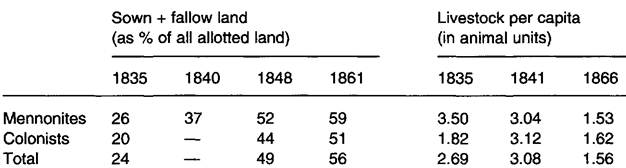
With wool prices already at an all-time low there was little impetus to reinvest in livestock, and so the Orthodox state peasants and Nogai did not replace their decimated herds. Colonists also increased the pace of transition to arable husbandry. The progression in colonist villages is shown in Table 7.2. By 1861 they were already pushing their ploughed fields beyond the flood plains and onto the steppe, placing more and more marginal land under crops. By 1889 colonists would be using about 70 per cent of their land as arable.
This process did not affect all villages equally, because later settlers received much worse land than the early ones. Already by 1835 the only land available for new villages was far up secondary streams in more
TABLE 7.2
Colonist transition to arable husbandry, 1837-1861
Sources: 'Tabellen iiber den Zustand der Molotschner Kolonisten,' 1835, PJBRMA, file 1138,1ob-37ob; 'Verzeichnis QberAussaat und Ernte im Molotschner Menonisten Bezirk in den Jahren 1828 bis 1848,’ 1849, PJBRMA, file 1308, 25-6; A. Klaus, Nashi Kolonii: Opyty і materialy po istorii і Statistike inostrannoi koionizatsii v rossii (St Petersburg: NusvaΓta, 1869), Appendix 3 and Appendix 7; Franz Isaak, Die Molotschner Mennonisten: Ein Beitrag zur Geschichte derselben (Halbstadt: Braun, 1908), 32; 'OtchetyTavricheskikh Gubernatorov... za 1861,’ 1862, RGIA, f. 1281, op. 6, d. 47; Detlef Brandes, Von den Zaren adoptiert: Die deutschen Kolonisten und die Balkansiedler in Neurussland und Bessarabien, 1751-1914 (Munich: R. Oldenbourg, 1993), 227, Table 29.
and more arid locations. A founding member of the village of Gnadenfeld, established on the Apanlee River in 1835, described how her family had ‘come to a barren steppe without any roads and paths. No tree, no bush, only tall, dry, bitter grass and prickly camel fodder grew on the dry, cracked ground... There were no wells, only an almost dry stream which provided water for man and beast... Those not near the stream found no water except at great depths. This proved to be bitter, salty water unsuitable for drinking, cooking, and washing. The entire village of Gnadenfeld had only three wells with suitable water. For almost fifty years the villagers hauled their drinking water from these wells.’1
For Orthodox state peasants, post-1848 developments followed the path already established in previous years. Prior to 1840 just six land repartitions had ever occurred in all of Tavria guberniia; there were nineteen repartitions in the 1840s and forty-four in the 1850s.2 Following the pattern described for Bolshoi Tokmak (in Chapter 6), arable land increased accordingly. By the 1880s roughly three-quarters of all peasant land was under crops. Common pastures disappeared altogether in some places, leaving peasants dependent on leased pastures and fodder crops to feed their draft animals.3