The Fourfold Structure
The development of modern Ukrainian social and political thought cannot be understood properly if it is visualized as a simple lineal progression. This error has often been made by Ukrainian writers who, by strongly identifying themselves with a particular trend or school of thought, have presented it as the mainstream, while denying the validity and legitimacy of the other trends in their nation’s intellectual history.
This bias is particularly evident in the way in which various authors have approached the history of the Ukrainian Revolution of 1917-21. For one group of writers, the one and only true expression of the will of the Ukrainian people was the Ukrainian People’s Republic, i.e., the regime represented successively by Mykhailo Hrushevsky, Volodymyr Vynnychenko, and Symon Petliura. According to another interpretation, however, a “real” Ukrainian state existed only during the Hetmanate of 1918, headed by Pavlo Skoropadsky. And there exists a third school for which the only legitimate spokesman of the Ukrainian toiling masses, the workers and peasants, was the government of the Ukrainian Soviet Republic. Each of the three schools tries to monopolize the history of the Ukrainian Revolution (at least in its positive and constructive aspects), while vociferously disparaging the rival trends. The inadequacy of these one-sided approaches is obvious: the history of the Ukrainian Revolution is the totality of the forces which in fact were active among the Ukrainian people during those years. This observation ought to be applied also in the broader context of the history of modern Ukrainian social and political thought.
The basic heuristic assumption of this paper is the following. The development of modern Ukrainian social thought is to be understood not as a single stream, but rather as a process containing several parallel and distinct, although correlated and interdependent, trends.
A conscientious researcher has the obligation, in spite of his personal preferences, not to favour exclusively one trend, but to try to comprehend them all, being aware of their positive contributions and their shortcomings and failures.The proposed approach can be illustrated by examples drawn from the history of other countries. Since the seventeenth century, English political thought has been dominated by the polarities of Cavalier and Roundhead, Tory and Whig, Conservative and Liberal, and finally Conservative and Labour. In German history of the eighteenth and nineteenth centuries we find the polarity of Catholic Austria and Protestant Prussia, each claiming to represent the “true” Germany. In nineteenth-century France the parallel trends were Legitimism, Orleanism, Bonapartism, Republicanism, and Socialism, none of which could be said to be more French than any other.
In modern Ukrainian social and political thought we can identify four basic trends: the democratic-populist, the conservative, the communist, and the integral-nationalist. The first two exclusively dominated the scene before World War I, while the last two emerged after the Revolution. These four trends can be categorized in two ways: first, populism and communism form the “left,” and conservatism and integral nationalism form the “right”; and second, there is a link between populism and conservatism in that both are pluralistic, while communism and integral nationalism share a totalitarian outlook, as the diagram below shows.
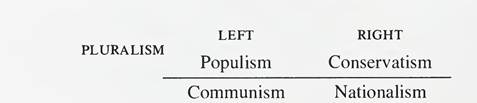
TOTALITARIANISM
The proposed fourfold division provides an “orientation map” to aid one through the maze of Ukrainian political movements and schools of social thought. The division, however, should be used flexibly, as each
of the four major trends contained—either in chronological sequence or contemporaneously—a number of parties, factions, and groups, and a variety of shades of opinion. Ukrainian political life has often been charged with a tendency toward excessive factionalism, but this was more pronounced in east-central than in western Ukraine, because the tsarist regime, at least prior to 1905, denied the Ukrainian people the opportunities for free civic self-expression which existed under the constitutional Austrian regime.
As a result, in Russian Ukraine political movements were driven underground, which reduced them to small, informal circles and splinter groups, frequently isolated from each other. This applies all the more to conditions under Soviet rule, where, even during the comparatively liberal 1920s, unorthodox political ideas could be expressed only in an allusive manner by using “Aesopian language” in poetry, fiction, literary criticism, and works of scholarship.The very fact that the Ukrainian people had been living in different states (the Russian and Austro-Hungarian Empires before World War I, and the USSR, Poland, Romania, and Czechoslovakia during the interwar period) led to the formation of political organizations on a sectional basis, determined by the specific conditions of each state. Nevertheless —and this point needs to be stressed—all four major trends of political thought were all-Ukrainian in their nature, encompassing, with varying degrees of intensity, all territorial sections. For instance, outstanding representatives of populist thought, Drahomanov and Hrushevsky, who were natives of east-central Ukraine, exercised a formative impact on the development of Galicia. There exists a mistaken opinion that integral nationalism was peculiar to western Ukrainian lands only. It is obvious that this trend, which crystallized in the 1920s and 1930s, could not penetrate Soviet Ukraine overtly. However, the chief ideologist of integral nationalism, Dmytro Dontsov, was an eastern Ukrainian emigre, and among the leading personalities of the movement we find several who were of eastern Ukrainian background.
As a final methodological observation, I confess that I do not subscribe to the Marxist theory which views political ideologies as direct reflections of economic class interests. It would be easy, for example, to ascribe conservatism to the landowning gentry, or communism to the industrial working class, but such an interpretation would amount to an oversimplification.
In Soviet polemical literature one often encounters the term “bourgeois nationalism,” but this is a form of abuse rather than a useful category. Ukrainian integral nationalism, in whatever way one wants to judge it, is not the ideological superstructure of a (largely nonexistent) national bourgeoisie. It is self-evident that social and political ideas do not develop out of thin air, but in a concrete social setting. However, the relationship between trends of thought, on the one hand, and social classes and economic interest groups, on the other, is highly complex; ideologies, although to some extent conditioned by the social environment, possess also an autonomous dynamic of their own. A key role in the formulation and development of political ideas was played in Ukraine, as in other modem East European nations, by the intelligentsia—a peculiar social stratum which transcends economic classes. Thus we find contradictory schools of political philosophy supported by intellectuals whose personal social background and living conditions were often quite similar.The paper will now proceed to an individual discussion of the four major trends noted above. The scope of this study allows us to characterize them only in briefest outline.