The Kievan System oe Political Succession
From the time of their very first appearance in eastern Europe, the Varangians treated the regions that came under their control as private property to be passed on to their offspring.
Although in theory priority was given to the eldest son, in practice brother fought against brother until the strongest won. Scholars have debated what the actual system of succession was or whether there was any system at all.Grand Prince Jaroslav the Wise tried to lessen familial antagonism by defining the order in which his successors should follow him. According to his testament, recorded in the Primary Chronicle, he assigned to each of his surviving sons in the order of their age (and therefore of their prestige) one or more of the Kievan Rus' lands as his patrimony. The most important were (1) Kiev and Novgorod, for the eldest son, Iziaslav, who became grand prince; (2) Chernihiv (together with Tmutorokan'), for Sviatoslav; (3) Pereiaslav and Rostov- Suzdal', for Vsevolod; (4) Smolensk, for Viacheslav; and (5) Volhynia, for Ihor. Not mentioned in laroslav’s testament were two other lands: Polatsk, which had been ruled by laroslav’s older brother (Iziaslav) and which continued to be ruled by his descendants; and Galicia, which was eventually ruled by the Ros- tyslav dynasty, that is, the descendants of laroslav’s grandson Rostyslav. In each of the lands or groups of lands, laroslav’s ‘sons and grandsons’ created local dynasties and power bases, while at the same time expecting to become grand prince when their turn came in the order of lateral succession.
Lateral succession meant that at the death of the grand prince, the Kievan scat did not go to the eldest son of the grand prince, but rather to his first brother according to the order of rank in the list of seven principalities. In theory, only after all the brothers from one generation had passed from the scene did the next generation have its turn, beginning with the eldest son of the original grand prince.
The principle of lateral or horizontal succession to the Kievan realm as a whole clashed, however, with the practice of vertical succession from father to son that was followed in each of the local principalities, where a prince more often than not strove both to retain his individual patrimony and to obtain the title of grand prince of Kiev.The confusion and conflict between the principles of lateral and of vertical succession prompted Grand Prince Volodymyr Monomakh to convene in 1097 a conference of princes at Liubech. The conference abandoned the complex principle of lateral succession and accepted the practice of vertical succession, essentially transforming Kievan Rus' into a federation of independent principalities. Yet even this agreement was soon challenged, since Monomakh himself, whose own patrimony was Pereiaslav, crossed dynastic lines and accepted in 1113 the grand princely throne of Kiev. In effect, he returned to the old ideal of establishing a single (Monomakh) dynasty, as most of the principalities of Kievan Rus' were ruled directly either by him or by his offspring. Upon the death of the charismatic Monomakh in 1125 and his eldest son in 1132, however, the absence of any strong grand prince saw Kievan Rus’ revert to a state of affairs in which brother fought brother and nephew fought uncle in a vain attempt to gain political and military superiority in an environment that continued to be without any orderly principle of political succession. By the era of disintegration beginning after 1132, whatever tenuous political unity still existed in Kievan Rus' was based on the fact that each of the realm’s component parts (the number of lands had increased from eight at the death of laroslav the Wise in 1054 to twelve in the twelfth century) was ruled by a descendant of one of the many branches of the family of laroslav the Wise.
Only much later, in the late fourteenth century, did the concept of a single Riuryk dynasty (the Riurykids or Riurykovyches) begin to be discussed.
The Riurykid concept was evolved by Muscovite chroniclers who were anxious to prove that the Muscovite branch of the family was descended in a direct line from Riuryk, the semi-legendary ninth-century ‘founder’ of the dynasty, through laroslav the W'ise, Volodymyr Monomakh, and the junior branch of the Monomakh dynasty, whose princes (lurii Dolgorukii and Andrei Bogoliub- skii) ruled what had become the Grand Duchy of Vladimir-Suzdal'. Eventually, that duchy was replaced by one of the younger cities on its territory, which became the new center of the Riuryk dynasty, Moscow. Despite this framework for explaining the transfer of political-dynastic power, it should be remembered that the concept of a Riuryk dynasty was never considered in Kievan times. The rulers of Kievan Rus' spoke of themselves simply as the sons, grandsons, and great-grandsons of the eleventh-century grand prince laroslav the Wise.of Kiev, to be followed after his death by the other sons in a defined order of succession. At the same time, each of the sons built up his own dynasty on the lands given to him as his patrimony.
Despite laroslav’s admonishment to his sons that they ‘love one another’ and ‘dwell in amity’ under the direction of the eldest, Grand Prince Iziaslav I (reigned 1054-1078), and despite his efforts at establishing a system of succession, conflicts arose among laroslav’s descendants almost immediately. Those conflicts were to rack the Kievan realm for nearly a half century. The situation was only made worse by the appearance of a new threat from the south, the Polovtsians, who had dominated the steppe since driving out the Pechenegs earlier in the century. Aware of the dissension among the Rus' princes (in which the nomads themselves were often allied with one Rus' prince against another), in 1061 the Polovtsians decided to attack Kiev directly. For nearly a decade, they were able to roam at will and to ravage the Kievan Rus' countryside, especially the border regions of Pereiaslav and southern Kiev principality.
Not only did the Polovtsian attacks ruin the agricultural base of the economy in the borderlands (whose population was either killed or deported as slaves), by the end of the eleventh century they had effectively cut off Kievan trade with Byzantium, both down the Dnieper River and the Don River via Bila Vezha and via Tmutorokan'. After 1094, Tmutorokan' and after 1117 Bila Vezha were permanently severed from the Rus' lands to the north. Both came under Polovtsian and Byzantine influence until destroyed by the Mongols in the thirteenth century.The conference of Liubech and Volodymyr Monomakh
The Polovtsian danger and the inconclusive results of the continuing inter- princely feuds prompted five of the Rus' princes to meet in 1097 at Liubech, a small town north of Kiev. There, at what came to be known as the conference of Liubech, the princes agreed to recognize the existing assignment of lands to their present rulers and offspring. In the words of the Primary Chronicle, each prince swore to ‘guard his own domain’ and not to cross over local dynastic lines, while together they were to ‘watch over the land of Rus” and defend it against the Polovtsians.2 They also agreed to hold future councils to decide on subsequent differences that might arise among them.
In the spirit of cooperation called for at Liubech, and under the leadership of the dynamic prince of Pereiaslav, Volodymyr Monomakh, the Rus' princes were able to defeat the Polovtsians on three occasions between 1103 and 1111. As a result of these victories, the Polovtsian threat was eliminated for the next half century. The Liubech example also served as a model for the resolution of inter- princely quarrels at similar conferences that were held from time to time.
Nevertheless, despite the best intentions, the order agreed to at Liubech, whereby each prince would remain within his own domains, was short-lived. In 1113, following the death of Grand Prince Sviatopolk II (reigned 1093-1113), the city assembly (viche) of Kiev decided to invite the hero of the wars against the Polovtsians, Volodymyr Monomakh of Pereiaslav, to rule over them.
At first he hesitated, for fear of disrupting the dynastic agreements reached at Liubech, which he himself had supported. But after riots broke out in Kiev that threatened the wealthy social strata, the monasteries, and the deceased ruler’s widow, Volodymyr Monomakh accepted the offer, and from 1113 until his death in 1125 he ruled as grand prince. After acquiring the title of grand prince, whose realm included the principalities of Kiev, Turah-Pinsk, and Novgorod, Monomakh still retained his original patrimony of Pereiaslav and through his offspring ruled in Smolensk and Rostov-Suzdal'. In effect, most of the principalities of Kievan Rus' were under the control of one ruler.Volodymyr Monomakh was the last of the three outstanding, charismatic rulers of Kievan Rus' during the era of consolidation. In an effort to strengthen his authority in the city of Kiev and throughout the Rus' realm, Monomakh did away with the practice of charging excessive interest rates and codified the Expanded Version of the Rus' Law of laroslav the Wise. Also, like laroslav the Wise, Monomakh extended his own family’s ties to western Europe (his wife was a daughter of the last independent Saxon king in England), and he improved relations with
Byzantium, which had worsened in recent decades. All these factors, combined with the peace on the Polovtsian steppe, contributed to make the reign of Volodymyr Monomakh one of the last periods of stability in Kievan Rus'.
Monomakh hoped to retain the unity of the Rus' realm by returning to the pre- laroslav system of succession, that is, by placing his eldest son on the throne of Kiev and his younger sons in other principalities. Initially, this approach worked. His successor, Mstyslav I (reigned 1125-1132), not only maintained order throughout Kievan Rus' but even increased the realm’s influence, especially in the Baltic region. After Mstyslav’s death in 1132, however, the reign of his brother laropolk II (reigned 1132-1139) was marked by a renewal of the internal strife that had already characterized certain periods of Kievan history.
The periods of decline in central authority, which during the era of consolidation generally had lasted only a few years between the long reigns of strong rulers like Volodymyr the Great, laroslav the Wise, and Volodymyr Monomakh, grew into decades, until they became the norm during the era of disintegration, which was to last from 1132 to 1240.The era of disintegration
A symbolic indication of political disintegration was the frequency with which the title of grand prince changed hands. For instance, whereas during the first two and a half centuries of Kievan Rus' (878-1132) there were fourteen grand princes, in the initial three decades of the era of disintegration (1132-1169) there were eighteen. The new era witnessed esssentially two trends: (1) the gradual decline of Kiev as a political and economic center, and (2) the diffusion of power to centers in other parts of the realm. This meant that as Kiev declined three new power centers began to take its place: Galicia-Volhynia in the southwest, Vladimir- Suzdal' in the northeast, and Novgorod in the far north.
In 1136, Novgorod revolted and became independent of the Kiev principality, to which it had previously belonged. Subsequently known as Lord Novgorod the Great, the independent city-republic directed its mercantile interest westward toward the Baltic Sea and northward toward the sparsely inhabited forest regions. On the other hand, Rostov (later, Vladimir-Suzdal') and Galicia-Volhynia participated actively in the struggle for control of Kiev and the grand princely title. Yet while each of the principalities had its own charismatic leader capable of attacking and controlling Kiev, those leaders were more interested in remaining within their own domains than residing in the weakened seat of the grand prince. In this regard, the activity of the grandson of Monomakh, Andrei Bogoliubskii, is often considered to epitomize the new era. As ruler of Vladimir-Suzdal', in 1169 he organized a coalition of Rus' princes, who marched on Kiev, captured the city, pillaged and burned many of its churches and monasteries, and killed many of its inhabitants. Indeed, warring Rus' princes had fought for control of Kiev before, but none had treated it as a foreign city in the way Andrei Bogoliubskii did. Although he assumed the title of grand prince, unlike most of his predecessors who had sought and gained the prize of Kiev, Bogoliubskii appointed vassals to
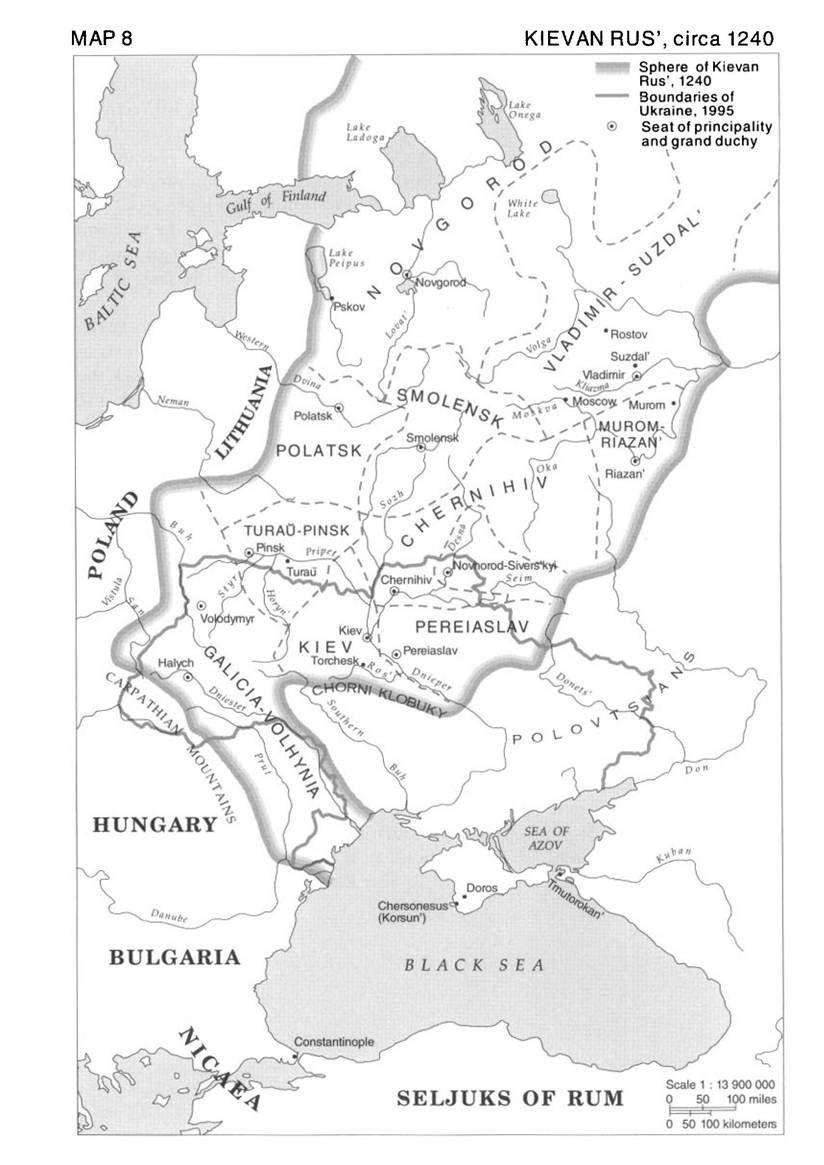
represent him, preferring instead to reside in his native principality of Vladimir- Suzdal' in the north.
Struggling for Kiev but ruling it from afar was repeated in the first half of the thirteenth century and became the pattern. For instance, Roman of Volhynia gained hegemony over the city in 1200 but remained in his Volhynian homeland. It was during his absence that in 1203 a combined force of lesser Kievan and Chernihiv princes, in alliance with the Polovtsians, attacked Kiev and plundered it so mercilessly that the chroniclers were prompted to report, ‘Such great evil had not been seen in the Rus' land since the Christianization of Kiev.’3 At the very end of the era of disintegration, Danylo of Galicia captured Kiev (1239-1240), but he too preferred to remain in his native principality, especially in the face of the Mongol threat to the region.
External invasions from the steppe hastened the disintegration of whatever the interprincely warfare had left of Kievan unity. Ever since their three defeats at the hands of Volodymyr Monomakh, the Polovtsians had not dared to attack the Rus'. In the 1160s, however, under their new dynamic leader Khan Konchak, the Polovtsians renewed their raids against the southern principalities, especially Pereiaslav, Chernihiv, and Novhorod-Sivers'kyi. Also from this period dates the 1185 expedition against the Polovtsians led by Prince Ihor of Chernihiv, who was immortalized in the literary work Slovo 0 polku Iharevi, or the Lay of Ihor’s Campaign. After the death of Khan Konchak in 1187, many of the Polovtsians moved farther west toward Bulgaria; those who remained in the steppes drew closer to the Rus', serving with them in their interprincely battles and becoming integral (by many marriages, as well as in other ways) in Kievan dynastic politics.
Yet even with the Polovtsian danger eliminated or neutralized, the steppe remained a potential source of danger unless a strong defense could be mounted by a unified Kievan realm. By the first half of the thirteenth century, however, this seemed no longer possible. The decline of the grand prince’s authority and the diffusion of political and economic power, especially toward three peripheral regions - Galicia-Volhynia, Vladimir-Suzdal', and Novgorod - had proceeded so far that any return to the era of Volodymyr Monomakh or laroslav the Wise seemed impossible. The full transformation of Kievan Rus' into a new alignment of political forces was not to occur until the appearance in 1237 of a new factor in eastern Europe - the Mongols. But before turning to the role of the Mongols in hastening the realignment of Rus' politics, it is necessary to examine socioeconomic and cultural developments in Kievan Rus' from its early years to the mid-thirteenth century.