The Limits of Planning: Central Policies and Regional Realities
Although the Russian state planned immigration to the Molochna region, once the settlers had arrived it had little control over their actions. Imperial Russia’s inability to effectively administer its periphery is legendary.
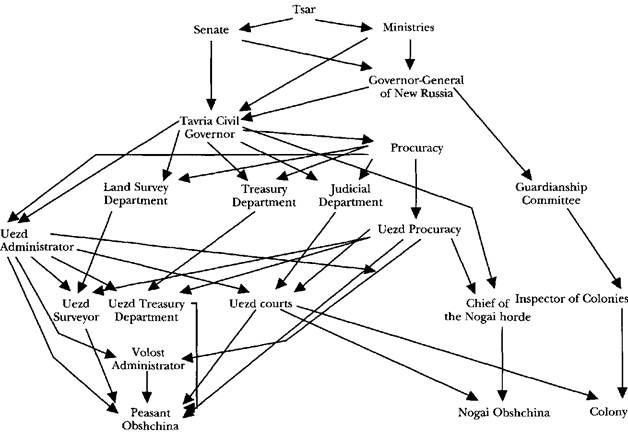
As historians Walter McKenzie Pinter and Don Karl RowneyFigure 2.1 Patterns of administrative authority in Molochna
explain it, ‘The most talented and best-trained men have served at the centre, but generally have had to depend on the least educated and least ambitious to execute their policies throughout the realm.’16 The problem was magnified in regions like Molochna, where settlers were almost exclusively state peasants. Regional administrators were normally drawn from the nobility, but because there were few resident nobles to fill offices in Tavria and other frontier guberniias, civil governors had no option but the ‘large-scale recruitment of nearly uneducated rural folk into the ranks of officialdom.’17
Even had local officials been competent, the complexities of the administrative system made effective administration impossible. The official system in Molochna is portrayed schematically in Figure 2.1. The bewildering web of overlapping jurisdictions and parallel, unintegrated channels of authority are expressed by arrows showing possible paths for the downward flow of orders. With authority so ill-defined it is little wonder that regional administration devolved into a gridlock of jurisdictional disputes and red tape.18 Although regional officials collected statistical data about settlers in Molochna, there is little evidence that the state even tried to directly administer Orthodox or sectarian state peasants. The sole exception to this general rule was the administration of foreign settlers, which is dealt with in detail in Chapter 5.
As for the Nogai Tatars, the state actively sought to change their agricultural practices, but its failure, detailed in Chapters 3 and 7, is the clearest evidence of the state’s inability to effectively administer the Molochna region.The lack of effective central control does not mean there were not significant, active local administrative organs in Molochna. Starting at the bottom, peasant contact with officialdom was mediated through the peasant obshchina. This body, composed of elected peasant elders (starosti), hundred-men (sotskie), fifty-men (pintidesiatskie), and ten-men (desiatskie), is often inaccurately described as a ‘commune’ owing to the redistributive function it sometimes filled.19 In Molochna, where obshchina land redistribution did not begin until the 1840s, the obshchina nevertheless existed and served as the official representative of Nogai, Orthodox, and sectarian peasants to higher authorities. It was also the official conduit for disseminating orders from above to peasants. Foreign settlers had a parallel institution, the Gemeinde, with mayors (Schultze) and ten-men (Zehnmdnner) serving similar functions.20 There is little evidence regarding the obshchina’s role in day-to-day peasant life in Molochna, but accounts of its function in other areas suggest it was a repository of ‘unwritten customary law’ and the ‘ensurer of tranquillity’ in the villages.21
The second rung in the administrative ladder was the volost, or for colonists, the Gebietsamt. Created by Tsar Paul I in 1797, the volost was an administrative unit intended to contain approximately 3,000 male souls.22 In Molochna, volosts were always ethnically homogeneous. The volost administration consisted of a head-man (volostnoi golσυa), a scribe (volostnoi pisar,), a village representative (seΓskii vybomyi), and one desiatskii for each ten households in the volost.23 The state charged these officials with publicizing new laws, encouraging church attendance, taking measures against epidemics and fire, ensuring maintenance of roads and bridges, and arbitrating minor disputes.
It also gave them authority over agricultural practices and grain reserves.24There was a large overlap between volost and obshchina authority, and the extent to which volost officials played an active role in local administration in Molochna is unclear. Unlike with the obshchina, there is almost no record of volost-level administrative activity in Molochna before the 1840s, although the Mennonite Gebietsamts were again a signal exception. The only significant examples of volost-level activities are harvest reports, and it is not clear whether these were actually assembled by volost officials or simply recorded as cumulative volostlevel totals in reports. Bolotenko writes that the volost was artificial and ineffectual, and nothing in the Molochna case refutes this.25 Certainly, volost administrative organs did not act as representatives of the peasants in the same way obshchinas did, for peasant petitions were almost always addressed by the obshchina directly to the tsar, the Senate, the governor general of New Russia, or the civil governor of the guberniia. By the same token, decrees from higher authorities to peasants bypassed volost authorities and directly addressed obshchinas.
At the uezd level there were, for the first time, sharp distinctions between the administration of Orthodox and sectarian state peasants, Nogai, and colonists. The regional administrator (zemskii ispravnik) was the most important regional official for Orthodox and sectarian state peasants. Nominated by the guberniia’s civil governor and officially appointed by the Russian Senate, he had enormous discretionary powers in matters ranging from taxation to law enforcement to approval of obshchina officials.26 Historian S. Frederick Starr describes zemskie ispravniki, with their four assistants (zasedateli), as a ‘motley and ill- trained band’ who were ‘often the only representatives of the autocracy with whom most rural folk had any direct contact.’27
The zemskii ispravnik’s authority did not extend to Nogai, who were instead administered by a ‘chief (nachaΓnik) appointed by the governor general of New Russia but subject to the authority of the civil governor of Tavria.
The civil governor arbitrated disputes, mainly pertaining to land, that arose periodically between the Melitopol zemskii ispravnik and the Nogai nachaΓnik.Colonists, too, were outside of the zemskii ispravnik’s jurisdiction, answering instead to an inspector of colonies appointed by the Guardianship Committee for Foreign Settlers in New Russia (hereafter the Guardianship Committee), which operated under the auspices of the governor general of New Russia.28 When disputes arose between the inspector of colonies and either the zemskii ispravnik or the Nogai nachal’nik they were theoretically subject to resolution by the governor general of New Russia, who was officially the superior of the civil governor of Tavria. In practice, however, the jurisdictions of the governor general and the civil governor were distinct, and Interjurisdictional disputes sometimes had to be settled by the Senate in St Petersburg.29
In addition to the obshchina, volost, and uezd administrative organs, a variety of other regional administrative bodies effected life in Molochna. Uezd-Ievel courts, land survey offices, treasury offices, and procuracies all played a part in running the region. However, as will be shown in later chapters, the most important decisions in Molochna were made by the settlers themselves.
The state’s policy towards the Molochna settlers was, first, one of paternal wardship, intended to ensure both their material and moral welfare. To this end it directed its most extensive administrative efforts at promoting agricultural self-sufficiency. The most substantial indication of state involvement in administration of the region comes from annual harvest reports collected at the village level and amalgamated into guberniia-wide reports for the Ministry of Internal Affairs in St Petersburg. These reveal that the state’s principal yardstick for measuring the well-being of settlers was grain production. The state assumed that the minimum annual consumption requirement per male soul was two chetverts of grain.
Where harvests fell below this, settlers were eligible for loans, either of grain or money to buy it. Where harvests rose above two chetverts, settlers had to contribute to grain reserves intended to alleviate shortages in future years.30The state’s first attempt to establish a systematic empire-wide grain reserve had come in 1767 when Catherine II ordered the construction in every village of a grain depot large enough to hold a one-year supply of grain for every member of the population.81 The decree said nothing of how this might be done, or indeed of what constituted a one-year supply. Not surprisingly little came of the initiative. In 1794 there were still no grain depots in Tavria oblast. In that year Catherine ordered the construction of five grain depots: in Simferopol, Karasubazar, Feodosiia, Evpatoriia1 and Perekop. At the same time she clarified the system of collecting grain, ordering each household to contribute one-eighth of a chetvert per year to a total of one and seven-eights chetverts.32 In 1799 Paul I ordered the construction of a grain depot in every peasant village of more than fifty households and the collection of one-sixteenth chetvert per male soul per year to a total of three chetverts of rye and three-eights of a chetvert of wheat per male soul.33 This shaped the basic outline of the grain reserve system for the empire until 1842 with the single exception that, by 1804, the reserve was decreased to two chetverts per male soul.34
After a nearly complete harvest failure in Tavria in 1821 the Senate, observing that earlier decrees had been ignored, reissued detailed instructions for the establishment of grain depots. It ordered the establishment of food-supply commissions in every guberniia and the conStruction of depots in every village. Alternatively, in poor agricultural regions it ordered the establishment of money reserves with which to buy grain when necessary.
The Senate reiterated the requirement that peasants contribute one-sixteenth of a chetvert of grain per male soul per year to a total of two chetverts per male soul, or alternatively make a cash payment of twenty-five kopecks per male soul per year to a figure to be determined by prices in individual regions.35These decrees were fundamentally flawed. At the rate of one-sixteenth of a chetvert per year the full reserve would have taken thirty- two years to accrue. Russia experienced significant harvest failures on eleven separate occasions between 1800 and 1850, an average of once every four and a half years, and the country never went more than eleven consecutive years without a failure.36 Moreover, at least in Tavria guberniia, peasants never came close to constructing the required number of depots. As late as 1843 there were still only sixty-three grain depots in the entire guberniia, and most grain was still stored in pits in the ground. Grain reserves in 1843 amounted to about a half chetvert per male soul, barely a quarter the amount required by the 1822 decree, despite the fact that the required contributions had been tripled in 1842.3’
Because local grain reserves were never adequate, when harvest failures occurred the state was forced either to lend peasants money to buy grain or to lend them grain from reserves in unaffected guberniias. In 1833 and 1834, when Russia experienced an empire-wide harvest failure, the state spent 8,475,172 paper rubles on grain for state peasants; 1,655,261 rubles of this went to Tavria guberniia alone.38 Although such loans were supposed to be repaid, in practice they could go unpaid for a very long time indeed. In 1858 Tavria state peasants had still not fully repaid cash loans from 1833 and 1834, nor had they repaid loans of grain received in 1839.39
Still, in 1821, 1833, 1834, 1839, and 1848 the state showed an impressive ability to deal with crop failures, and although there were shortages and hardships, large-scale famines were avoided. But the cost of emergency efforts, and the failure of state peasants to adopt more efficient farming methods to improve yields and reduce the need for emergency measures, were constant sources of frustration to the state. Indeed, there was real suspicion in St Petersburg that the grain reserve program was a disincentive to increased peasant grain production. ‘There is no doubt,’ an adviser reported to Minister of State Domains Kiselev in 1840, ‘that the ease with which the villages are issued loans, combined
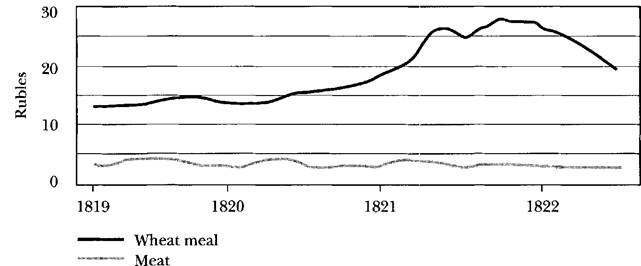
Figure 2.2 Meat (per pud) and wheat meal (per chetvert) prices in Molochna, 1819-1822
Source: GAKO, f 27, op. 1, d. 1837-47, 1899-1999, 2127-38, 2266-76.
with the feebleness of supervision over the issuance of grain, is the main reason for the inadequacy of personal reserves and the significant increase in peasant arrears in paying grain [into the depots].’40
Such a claim must not be taken too seriously. State aid ensured subsistence but hardly provided for ease, and it is doubtful whether the peasantry as a whole relied on subsidies so heavily that it consciously manipulated its grain production based on them. The claim may, however, have some credence for the Molochna region. It is striking that the state took no notice of either livestock or gardens when it assessed food reserves in Molochna. To be sure, during the 1821 harvest failure the Molochna region did not receive aid because the uezd nachal’nik took into account garden production, but this was the exception rather than the rule. In eight of the twenty-three years for which detailed grain production figures exist between 1803 and 1838 the state officially designated Molochna as a grain-deficit region and exempted it from contributions to grain depots. The problem with this evaluation is demonstrated in Figure 2.2, which shows meat and grain prices during the 1821 harvest failure. Despite soaring grain prices, meat prices remained virtually unchanged, belying the existence of a subsistence crisis. Had there been a true crisis, surely meat prices would also have risen. The state’s inability to recognize such regional peculiarities in its administrative policies meant there were large loopholes for Molochna peasants to exploit. After all, why produce grain surpluses for public reserves when meat and garden vegetables went untaxed?
Kiselev’s advisers identified a second disincentive to state peasant grain production in the laws that hindered state peasants from exporting or selling grain outside their own uezds. These laws, intended to ensure that the state controlled how much grain remained in each uezd, were aimed specifically at preventing state peasant food shortages.41 They were a clear example of the state’s policy of wardship, for they promoted subsistence at the expense of commercial incentives. The transportation and sale of grain, like every commodity in the empire, was the monopoly of members of Russia’s three merchant guilds. State peasants could sell grain at local markets, but only guild members could legally sell it in towns, and only members of the upper two guilds could transport it across uezd borders.42
In 1812 Alexander I issued two decrees that opened a legal avenue for state peasants to take part in trading activities by permitting them to purchase trading licences. To all intents and purposes these decrees granted state peasants equal status with guild members, although the legislation avoided the word ‘guild,’ referring instead to four different ‘groups’ (rodi) of peasant traders. The cost of licences, which had to be renewed annually, was very high, ranging from 2,500 rubles for a licence to trade internationally to 2 per cent of the value of the peasant’s capital for a licence to trade within towns and uezds.43 Members of the third merchant guild could not trade across uezd borders, and guberniia administrators naturally assumed similar restrictions would apply to the lower two categories of peasant licence-holders. Remarkably the Senate disagreed, ruling that peasants were not actually guild members, but rather holders of temporary permits. As long as licensed peasant traders obtained travel passes from uezd administrators through normal channels they could trade across uezd borders.44
Theoretically, then, it was possible for state peasants to trade in their own grain, but for most state peasants the cost of licences was prohibitive. This does not mean that state peasants did not trade in grain illegally. Laws, after all, are only as good as the state’s ability to enforce them. Alexander himself acknowledged that it was ‘well known that state peasants and serfs, sometimes in the name of merchants, and sometimes in the name of landlords, carry on various sorts of trade.’4’ He specifically intended the 1812 decrees to place controls on this practice. Still, for peasants in Molochna, who were isolated from markets anyway, such laws could only have been a further incentive to concentrate on subsistence agriculture and avoid the expenses related to either expanding their grain production or switching to commercial sheep-raising.