13 The Polish-Lithuanian Commonwealth after 1569
After 1569 all Ukrainian lands that had been part of the Grand Duchy of Lithuania found themselves within the Kingdom of Poland. That year marks the culmination of a process that had lasted nearly two centuries, during which Lithuania was being drawn into the political, social, and cultural orbit of Poland.
Lithuania’s integration with the rest of Poland was part of a gradual process that unfolded in two stages, each of which was characterized by a combination of internal political instability and external threats to the grand duchy.The first stage began in the 1380s as a result of civil strife between the sons of Lithuania’s joint rulers, Algirdas (r. 1345-1377) and Kestutis (r. 1345-1382). Following the death of these two grand dukes, their respective sons, Jogaila and Vytautas, embarked on a struggle to attain control of the grand duchy’s throne. Vytautas invited the Teutonic Knights to help him, while Jogaila called on the Knights’ enemy, Poland, to enter the fray. In the end, Jogaila accepted an invitation to be crowned the king of Poland in 1386, as Wladyslaw II Jagiello (r. 1386-1434), while Vytautas was left to govern as grand duke of Lithuania (r. 1401-1440). As part of his bargain to become king of Poland, Jogaila/Jagiello agreed to convert personally as well as make Roman Catholicism the official religion of Lithuania. Vytautas was eventually recognized as legitimate ruler of the grand duchy, which henceforth was linked in personal union with Poland.

13.1 Symbolic of Poland’s expansion eastward is the castle at Kamianets’ in Podolia, rebuilt in the 16th century.
MAP 13 THE POLISH-LITHUANIAN COMMONWEALTH, circa 1570

Even before Jogaila/Jagiello was crowned king of Poland, that country’s nobles (magnates and gentry) had wrested from various Polish kings a whole host of privileges.
Poland itself was divided into palatinates (wojewodztwa) and lands (ziemie), each headed by an official (palatine) appointed by the king. In the course of the fifteenth century, the palatinate system was set up in Galicia (Rus’), Podolia, and Belz, that is, in those parts of Ukraine ruled at the time by Poland. Each palatinate also had its own dietine (sejmik) headed by the royal palatine and comprised exclusively of members drawn from the local nobility. The dietines chose noble delegates to represent their respective palatinates in the kingdom’s national Diet (Sejm). Among the privileges held by Poland’s nobles were perpetual exemption from having to pay taxes and the exclusive right to hold offices in the various provinces (or palatinates) and the royal governorships of the country’s most important castles. King Jagiello had to agree to these existing contracts and also to promise to work for the recovery of “all Lithuanian and Rus’ lands that once belonged to Poland.” In other words, Poland was claiming for itself the territorial heritage of most of former Kievan Rus’ and certainly all its Belarusan and Ukrainian territories.Lithuania continued to function as an independent state, and in contrast to Poland it had a much more centralized governing system. Most of the Lithuanian nobility (with the exception of the hereditary lords-boyars) were subject to taxes and military service at the behest of the grand duke, who also controlled closely the duchy’s various officials and regional administrators. Polish influences, however, were gradually becoming more and more evident in Lithuania. For instance, the Polish palatinate administrative structure was gradually introduced into Lithuania’s Rus’-inhabited lands of Kiev (1471), Volhynia (1566), and Bratslav (1566). Lithuania’s official status as a Roman Catholic country also had an impact on the Rus’ inhabitants of Belarus and Ukraine, with the result that at certain periods the Orthodox were subject to legal and social discrimination.
Some responded by leaving Lithuania entirely and moving eastward to Orthodox Muscovite lands. The flight to the east of an increasing number of Rus’ nobility, clergy, townspeople, and even peasants from Belarus and Ukraine was particularly evident during the sixteenth century.
13.2 The act of Union at Lublin as depicted by the 19th-century Polish historical painter Jan Matejko.
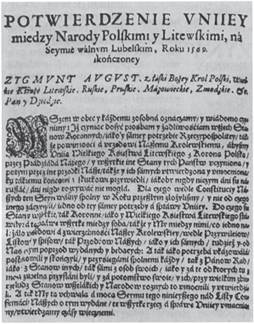
13.3 Text of the Union of Lublin that in 1569 created the Polish-Lithuanian Commonwealth.
It was the threat from Muscovy in the east that led to the second stage of Lithuania’s increasingly closer association with Poland. Among the “successor” states of former Kievan Rus’ was the principality of Vladimir-Suzdal’ (see Map 8), which by the fourteenth century had itself disintegrated into several independent states. In the course of the fifteenth century, the most dynamic of these states had become the Grand Duchy of Muscovy. Since 1326 the city of Moscow had been the residence of the Orthodox metropolitan of Kiev and all Rus’, and it was not long before Muscovite rulers began to claim they were as well the descendants of Riuryk, the alleged founder of Kievan Rus’. As members of the Riurykide dynasty Muscovy’s rulers also styled themselves the legitimate heirs of Kievan Rus’ and all its territory, most of which at the time was under Lithuanian rule. By the 1560s the ruler of what by then was the Tsardom of Muscovy, Ivan IV (“the Dread,” r. 1547-1584), had acquired several borderland strongholds from Lithuania (including Chernihiv, Novhorod-Sivers’kyi, Starodub, and Smolensk) as well as Polatsk, which opened the way to the grand duchy’s capital of Vilnius (see Map 12). In an effort to counter the Muscovite threat, the Lithuanians turned to the Polish king, Zygmunt II Augustus (r. 1548-1572).
Zygmunt not only helped the Lithuanians militarily, he also proposed a closer political relationship between Poland and Lithuania. In 1569 nobles from both sides met at the borderland town of Lublin to discuss the future relationship between the two countries. When negotiations became deadlocked over the question of whether Lithuania should be incorporated into Poland, King Zygmunt intervened. He unilaterally ordered the annexation to Poland of the contested borderland palatinate of Podlachia as well as Lithuania’s Ukrainian territories farther south. Ukraine’s Rus’ gentry especially welcomed the annexation, since they looked forward to attaining the privileges that went along with being members of the Polish nobility. For nearly two centuries Poland had ruled the largely Ukrainian-Rus’ inhabited palatinates of Galicia (Red Rus’), Belz, and Podolia; now, as a result of what became known as the Union of Lublin (1569), three new palatinates were added to the Polish kingdom: Kiev (comprising the former Rus’ principalities of Kiev and Pereiaslav), Volhynia, and Bratslav.
As a result of the Union of Lublin, Kiev, Volhynia, and Bratslav entered into Poland as distinct palatinates, each governed by its own noble-controlled dietine. Despite their administrative autonomy the three palatinates of Ukraine functioned at least initially as a unit. The nobility in all three felt that their relationship to Poland was based on the principle of voluntary union followed by negotiated settlements that assured them the traditional rights and privileges embodied in Lithuanian law. As for Poland and Lithuania as a whole, the Union of Lublin transformed their relationship into that of a common republic (Rzeczpospolita), or commonwealth. At the head of the commonwealth was a king elected jointly by both regions, which together were henceforth represented in a common Diet (Sejm) located in Warsaw.
The new Polish-Lithuanian Commonwealth was indeed stronger than its individual component parts and was able not only to deter further advances by Muscovy but also to expand its own borders farther eastward.
Among its acquisitions on Ukrainian territory was the city of Chernihiv and the surrounding area, which after 1619 formed the new Chernihiv palatinate. It is also from the late sixteenth and early seventeenth centuries that the very name Ukraine, heretofore a vague term meaning borderland in any part of eastern Europe, came to be related to a specific territory. In Polish sources from this period Ukraine (Polish: Ukrajina) referred specifically to the palatinates of Kiev, Bratslav, and Chernihiv. Together with the palatinates of Galicia (Rus’), Belz, Volhynia, and Podolia, most of the territory of present-day Ukraine (with the exception of Transcarpathia, Bukovina, the Black Sea littoral, and Crimea) was by the second quarter of the seventeenth century part of the Polish-Lithuanian Commonwealth.
13.4 The Polish fortress of Kodak/Kudak, completed in 1635, along the middle Dnieper River; map from 1652 by the fort’s designer, the French army engineer and architect in the service of Poland, Guillaume le Vasseur de Beauplan.
MAP 14 LANDHOLDING PATTERNS IN POLISH-RULED UKRAINE, 1569-1648
