The Scythians
Not all pastoral herders left the Pontic-Caspian steppes to attack the western lands and the great civilizations of the south. Others as recent excavations have shown headed east to the Caspian-Aral steppes of eastern Kazakhstan and southern Russia, to the foothills of the Urals to pursue herding and metallurgy.
By mid-3rd millennium вс the entire region to the east of the Caspian and surrounding the Aral Sea was home to the Aryan pastoralists, who continued to conquer the southern valleys of the great mountain ranges of Afghanistan, Pakistan, and northern IndiaJudging from Greekwriters, by about 1000 вс (and probably earlier) the Tauran lowlands of western Kazakhstan, Uzbekistan, and Turkmenistan were home to three related pastoral “nations,” speaking an Iranian language; the Sauro- matae, Scythians, and the powerful Massagetae who Herodatus states were like the Scythians. By this time, however, many Indo- European languages had diverged as was reported by Herodotus: “The Budini, a numerous and powerful nation, all have markedly blue-grey eyes and red hair, a pastoral people with their own language.”72No doubt responding to population pressure and a shortage of grazing land, the Massagetae turned on the Scythian tribes about 1000 вс and drove them west to the pastoral origins of the Aryans on the Pontic-Caspian steppes. The Mas- sagetae occupied the entire plain between the Oxus (Amu Darya) and Jaxartes (Syr Darya) rivers and were the first to demonstrate that pastoral herders could defeat large “civilized” imperial armies. In the first half of the 6th century вс the Persian King Cyrus Hystaspes defeated the Medes, the Assyrians, and subdued the GreekIonian city states of Asia Minor. This created the largest empire seen to date, stretching from Egypt to India. Following the conquest of Assyria, Cyrus turned his attention to the east towards the “numerous and warlike people” of the nomadic Massagetae, where he would meet his death.
Their king had died and the nomads were ruled by the widowed Queen Tamyris, and perceiving an Opportunityto increase his kingdom Cyrus proposed marriage to the Queen. The proposal was rejected (“the queen was well aware that he was wooing not herself but her dominions”) and, gathering a large force, the Persian Emperor advanced towards the Jaxartes (Herodotus refers to it as the Araxes) River.Apontoon bridge was quickly put up, but the advance Persian detachment that crossed into Massagetae territory was attacked and destroyed by Queen Tamyris’ son, Spargapises. Discovering the great stores of food and wine which the Persians had brought with them the Massagetae warriors settled down to a feast but during the night when all were asleep, the main Persian force crossed the river and massacred them. Spargapises was captured alive, but to redeem his honor he killed himself when his hands were untied. Now Queen Tamyris advanced with all her cavalry and infantry, and attacked the Persians. Herodotus provides a description of the battle, which took place around 530 вс:
The battle which followed I judge to have been more violent than any other fought between foreign nations. According to the information I have, the engagement began by the two armies coming to a halt within range of each other and exchanging shots with bows and arrows until their arrows were used up; after which there was a long period of close fighting with spears and daggers (swords?) neither side being willing to retreat. Finally, however, the Massagetae got the upper hand, the greater part of the Persian army was destroyed where it stood and Cyrus himself was killed. He had been on the throne for twenty-nine years.73
We don’t know whether the Persians had cavalry by this time, but undoubtedly the pastoralists’ Victorywas due in large part to theirs. It is the eastern tribes that introduced the next revolution in warfare—men mounted on horseback and fighting with lance, sword, and battle axe in tight formations, or alternatively from a distance with an improved version of the Hyksos invention; the short composite bow shooting arrows armed with three-sided heads.
It is not known precisely when mounted cavalry replaced the war chariot, but it must have taken place over a period of time to allow for the spread of larger horses which could support man and weapons. Mounted cavalry had an advantage over war chariots. It was more maneuverable, faster, and could concentrate a larger striking force within a given area, since a mounted archer or lancerdid not require a driver which would have been the case if he were fighting from a chariot.
We are told by Herodotus that after being expelled from CentralAsia by the Massagetae the Scythians attacked the Cimmerian nomad herders and drove them from the Pontic- Caspian steppes. This was a time, as Herodotus explains, that “All these (steppe tribes)... were continually encroaching upon one another’s territory.”74 The mobility of the nomad horsemen also took them to the Far East where many of their tombs have been discovered, such as at Pazyryk in the Altai Mountains dating to the 2nd century вс. An earlier tomb at Arzhan dating from the 8th century вс in Tuva measured 120 meters in diameter and probably represented a Scythian burial, with 70 chambers arranged as the spokes of a wheel, from the center outwards. At the Center were a male and female of well- preserved European appearance, dressed in furs and bearing elaborate decorations, with notable individuals lying to the south, west, and north of the royal couple. With them were buried 160 horses of rideable size with their harnesses, common Scythianweapons, and ornaments bearing the typical Scythian animal-style imagery.
The Scythians made a dramatic appearance in the Near East in the 7th century вс as they pursued the retreating Cimmerian tribes. Bypassing the Caucasus Mountains along the western shores of the Caspian Sea they attacked and defeated the powerful Medes and began to press the Assyrian Empire. The Medes were an Indo-European people who had conquered western Iran and as recorded by Herodotus: “The Medes were once universally known as Aryans, but they too changed their name...”75 following a series of battles the Assyrian ruler Esarhaddon reached an agreement with the Scythians, by which he was forced to marry his daughter to the Scythian King Por- tatua.
In spite of the marriage after marching on Egypt and receiving a heavy tribute from Pharaoh Psammetichus the Scythians continued to maintain their pastoral lifestyle and had no need of civilization, except for loot and booty and they were eventually expelled by a Mede betrayal.During the twenty-eight years of Scythian supremacy in Asia (Middle East), violence and neglect of law led to absolute chaos. Apart from tribute arbitrarily imposed and forcibly exacted, they behave like mere robbers, riding up and down the country and seizing people’s property. At last Cyaxares (ruler of the Median Empire) and the Medes invited the greater number of them (Scythian chiefs?) to a banquet, at which they made them drunk and murdered them, and in this way recovered their former power and dominion.76
Following the expulsion of the Scythians, in 612 вс Cyaxares turned against the Assyrians, captured their capitol at Nineveh and destroyed the Assyrian Empire.
The defeated Scythians returned to their steppe homeland in Ukraine where under Greek influence some Scythian tribes and those who were subject to them began to lead an agricultural life, growing grain, onions, leeks, lentils, and millet.77
The lighter wagons have four wheels but some have six, and they are fenced about with felt. They are built like houses, some with two divisions and some with three, and they are proof against rain, snow and wind. The wagons are drawn by two or three yokes ofhornless oxen; hornless because of the cold. The women and children live in these wagons while the men ride on horseback, and they are followed by what herds they have, oxen and horses.78
This mobility gave the Scythians ready access to most neighboring lands, and deprived of Asia Minor and the Near East they turned their attention westwards to central Europe. A mysterious culture of unknown origin had developed between the Elbe and Vistula rivers in Poland, the so-called Lusitanians, who lived in agricultural settlements from about 1200 вс.
Perhaps these were remnants of Old Europe which had survived the earlier Aryan onslaughts. At about 500 вс the Lusitanians fell victim to a Scythian force, never to reappear again. We can trace the invasion route by the destroyed Lusitanian strongholds and tall Scythian burial mounds. The attack may have triggered the series of migrations of Gaelic (Celtic) tribes from central Europe to the west and into Asia Minor, in the process to be the first to sack Rome in 390 вс.The strength of the Scythians lay in both light and heavy cavalry, the latter equipped with spears, javelins, axes, and short straight swords. Above all they introduced an innovation which would dominate much of warfare for the next millennia, the light mounted archer equipped with a short but powerful composite bow made of wood and reinforced with animal sinew and horn plates. Only about 80 centimeters in length, it received additional power from its re-curved shape and looped bone nock-ends, with the bowstring sitting in a groove notched in the bone. The arrow also stays on the string for a shorter period of time than with a long bow, which results in greater accuracy. Such bows are depicted on elaborate Scythian gold bowls found in graves in southern Ukraine but only the grips and nock-ends have survived decomposition. Basing himself on a later version (which could not have been very different from its predecessors), Ammianus Marcellinus wrote that “While the bows of all people are made of flexible branches, Scythian bows... resemble the crescent of the moon, with both ends inwards.”79
Such a bow was capable of accuracy at a considerable distance. An old Greek grave found at Olbia, a trading port on the Dnipro-Buh estuary of the Black Sea, bears an inscription to the effect that Anaxagoras, son of Dimagoras, shot an arrow 282 “orgyiai” or 521.6 meters.80 Although Anaxagoras was a Greek, he most Certainlyused a Scythian composite bow which was common in the region. Perhaps Anaxagoras had the benefit of a favorable wind, but even the rate of fire of a Scythian mounted archer was impressive—about 10-12 arrows per minute.
With bronze or the three-sided iron arrowheads the penetrating power of the short composite bow was probably greater than that of a traditional version with the speed of the horse contributing to the arrow s velocity. A few hundred Scythian mounted archers could unleash a deadly hail of arrows while remaining at a relatively safe distance. How a bow was used also made a difference. The short bow was drawn to the shoulder in the Hyksos manner which resulted in greater accuracy than the usual practice of drawing to the chest.The disruptive motion of the horse made shooting from horseback much more difficult. The skill and ability was instinctive, obtained by constant practice beginning at an early age when a Scythian boy (or girl) began to ride a horse. The trick was to release an arrow when the horse s four feet were in the air at full gallop. The penetrating power of a recursive bow can be judged by a much older, traditional version, the case of Otzi the Ice Man, who was found in 1991 still well preserved after spending more than 5,000 years buried in ice in the Italian Alps. A computed tomography (C.T.) scan revealed that Otzi was killed by an arrow with a small flinthead which had pierced his skin clothing, penetrated his shoulder blade and severed an artery, which was the immediate cause of death.
Scythian horsemen carried ox-hide lassoes to catch horses but which could also be used to snare an enemy in battle to be dispatched with a dagger or taken prisoner. The apparent unity of man and beast must have made a deep impression on those who had never witnessed a mounted rider, and no doubt the Greek legend of the mythical centaur—half man and half horse—originated with their first sightings of a mounted
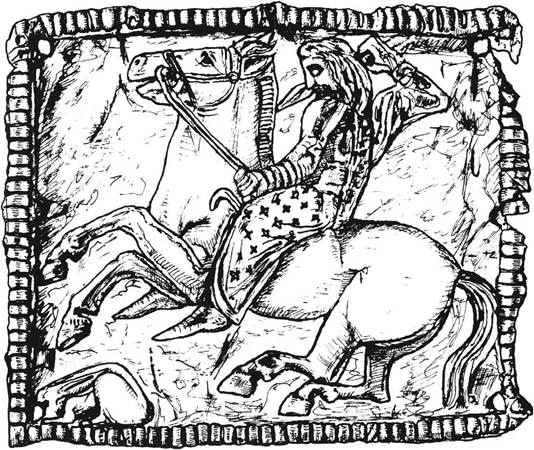
A Scythian nobleman on a hunt. From a gold plaque found in the Kul-Oba burial mound of southern Russia, 4th century вс.
warrior. Although bred for size, Scythian horses retained many characteristics of their wild ancestors such as speed, strength, and endurance, being able to thrive in the hard winter conditions of the Eurasian plan. Well-muscled, they had little fat for insulation and instead grew shaggy coats for protection against the cold and the elements. Other types of horses were also bred. A genetic mutation, which was particularly encouraged for mounted archery was a horse whose gait resembled that of a dog, which resulted in a smooth ride. Frozen remains of large horses were found in the Altai Mountains dating to about 300 вс, with remains of grain seed still in their stomachs. Evidently even nomads depended on agricultural produce, if not for themselves then at least for their prized steeds.
The mounted Scythian army would change over time, as it came in contact with their southern neighbors. The Greek historian Herodotus had recorded that every Scythian warrior was a mounted archer, but by 310 вс Diodorus Siculus writes that in a battle they fielded twice as many infantry formations as cavalry, which was fighting in disciplined ranks. By this time some Scythian tribes had settled to farm and begun to adopt Greek infantry methods, or the foot soldiers could have been Scythian allies. The core of the Scythian army continued to be its heavy cavalry, the Royal Scythians who fought in disciplined formations and able to maneuver rapidly by commands given by signal. Their remarkable horsemanship was greatly aided by appropriate clothing, such as trousers and boots. This gave each Scythian horseman an advantage when facing cavalry of the Greek, Persian and Roman civilizations who Usuallywore kiltlike tunics. Thus a bronze statue of the Roman EmperorMarcus Aurelius, for example, shows him as late as ad 165 mounted on horseback wearing a toga and sandals. It is not clear, however, whether the Scythians used rudimentary saddles or stirrups.
What were Scythian tactics and strategies like when confronting an opponent? A typical Scythian method of engagement would begin with small cavalry detachments to harass the enemy at chosen locations and to probe for a weak spot which could be exploited as the situation demanded. Releasing a continuous hail of arrows, a Scythian horseman himself was a moving target and difficult to hit by infantry archers. Should the enemy ranks break, the Scythian heavy cavalry would charge the disoriented enemy with swords, javelins, and spears. Battle axes and maces could also be used depending on the opponent s armament, and whether infantry or cavalry was being engaged. The entire strategy was based on mobility and improvisation, the basic objective being to disorient the enemy and upset his battle formations. Should his lines hold, the Scythian harassing units would pretend to take flight to lure the enemy cavalry into giving chase. The pursuing enemy would then be ambushed by hidden forces, surrounded, and cut to pieces.
The Scythians were also the first people to come to the attention of the Greeks and Persians with another innovation—
women warriors. Earlywritings by Ctesias, the physician to the Persian court of the Achaemenid dynasty mentions when describing the “Saka” or the Scythians, that “in general (Saka) women are courageous and help the men in the dangers of war.”81 Greek sources on the other hand, describe the women warriors as hostile to men. Hellanicus wrote in the 5th century вс that the women carried golden shields, silver axes, loved men but killed male infants. Evidence supports the presence of women warriors since many burial mounds excavated in southern Ukraine and southern Russia contained female skeletons with swords, spears, daggers, arrowheads and armor.82
A demonstration of the effectiveness of the Scythian host took place during a Bosphoran campaign. By about 500 вс the northeastern area of the Black Sea, from the eastern coast of the Crimean Peninsula to the north slopes of the Caucasus Mountains was under the control of a Greek-Scythian state, the so-called Bosphoran Kingdom. According to Diodorus Siculus who described the events which took place on Scythias eastern borders in the late 4th century вс, the Scythian Bosphoran King Paerisades* two heirs, Satyrus and Eumeles became locked in a conflict over the throne. The two armies, one led by Eumeles with 22,000 horse and 20,000 foot, and Satyrus, force consisting of Greek and Thracian mercenaries, 10,000 Scythian horse and 20,000 infantry, a total of 34,000 men, met on the Thatis (Kuban) River north of the Caucasus Mountains. At first the outnumbered Greeks and Thracians were pushed back with some losses. Then Satyrus led his Scythian heavy cavalry in a charge against the enemy’s center, smashed their cavalry and penetrating the second line of battle forced the enemy to disperse in flight. Wheeling his men around Satyrus then led a second charge into Eumeles, rear, again completely routing the enemy forces. In yet another conflict, when in 348 вс Alexander the Great s General Zapyrian invaded Scythia with an army of 30,000 men with the intention of taking the Greek city of Olbia (then allied with the Scythians), he was met by a Scythian force and defeated, not a common event for Alexander s generals. The details of the battle, however, are not known.
Another major campaign which earned the Scythians a reputation for invincibility was fought on the east European plains of which a full account is given by Herodotus. A century after their return to the Pontic steppes from the Middle East, the Scythians faced an invasion of their own lands. The enemy was the Great King of Persia, Darius I Hystaspes of the Achaemenid dynasty and son of the slain Emperor Cyrus, who ruled the largest empire known at the time. He now turned his attention to the Greek city states. With probably the largest army ever assembled in antiquity, Darius I crossed the Hellespont which divides Europe and Asia in 600 ships, and by the summer of 512 вс had reached the Danube. In order to secure his rear he decided to conquer Scythia, and crossing the Danube began to advance into their territory, with the announcement
29
that he was retaliating for their invasion of a century earlier. Abandoned by most of their neighbors and realizing the overwhelming strength of the enemy, the Scythians began to retreat into the Pontic steppes of southern Ukraine, destroying wells and springs and burning off the prairie grass in a scorched earth policy. Families and old people were sent north with the herds, leaving the young warriors to face the foe.
Led by three kings Idanthyrsus, Scopasis and Taxacis they lured Darius I and his men into an exhausting pursuit, harassing them all the while with mounted archers. The pursuit went on for some 5,000 kilometers, from the Danube River to the steppes north of the Caucasus Mountains. Frustrated by the lack of a decisive battle and finding himself in unusual circumstances Darius sent a messenger to Idanthyrsus;
Why on earth, my good sir, do you keep on running away? You have, surely, a choice of two alternatives: if you think yourself strong enough to oppose me, stand up and fight, instead of wandering all over the world in your efforts to escape me; or, if you admit that you are too weak, what is the good, even so, of running away? You should rather send earth and water to your master, as a sign of your submission, and come to a conference.
Idanthyrsus replied in these words:
Persian, I have never yet run from any man in fear; and I am not doing so now from you. There is, for me, nothing unusual in what I have been doing: it is precisely the sort of life I always lead, even in times of peace. If you want to know why I will not fight, I will tell you: in our country there are no towns and no cultivated land; fear of losing which, or seeing it ravaged, might indeed provoke us to hasty battle. If, however, you are determined upon bloodshed with the least possible delay, one thing there is for which we will fight—the tombs of our forefathers. Find those tombs, and try to wreck them, and you will soon know whether or not we are willing to stand up to you. Til then—unless for good reason—we shall continue to avoid a battle. This is my reply to your challenge; and as for you being my master, I acknowledge no master but Zeus from which I sprang, and Hestia the Scythian Queen. I will send you no gifts of earth and water, but others more suitable; and your claim to be my master is easily answered—be damned to you!83
Herodus uses the Greeknames “Zeus” and “Hestia” in place of the Scythian “Papaeus” and “Tabiti,” the mythical founders of the Scythian nation.
We are told that Darius I received the strange gifts of a mouse, a frog, a bird and five arrows, interpreting this as an unconditional surrender. They were offering their land (where a mouse lives), their water (where a frog lives), their horses (represented by the free bird) and were laying down their arms (the arrows) before him. Soon, however, he was told the true interpretation. “Unless you Persians turn into birds and fly up in the air, or into mice and burrow under ground, or into frogs and jump into the lakes, you will never get home again, but stay here in this country only to be shot by Scythian arrows.” Reinforced by some neighbors, the Scythians now stepped up their tactics
ofharassing and ambushing Persian isolated units and foraging parties. Their cavalry began to dominate the field, and seeing that he could not win Darius deserted his camp in the middle of the night, leaving the weak and wounded behind. By forced marches he reached the pontoon bridge over the Danube and crossed with his remaining forces to the south bank of the river, leaving a large number of dead on the steppe. Once again a Persian Emperor was defeated by nomad herders, and the Persians would never attempt another invasion.
A Scythian army could put into the field a fairly large proportion of its population, since all able-bodied adult males, including some single women, fought during a campaign.84 Scythian society and its entire social structure and value system was militaristic and geared for war, there being no distinction between warrior and civilian. Their skilled craftsmen, however, occupied a lower social standing than the warriors. Thucydides informs us, in the 4th century вс with what is probably an overestimate, that the Scythian army was larger than a 150,000 Thracian host (during an occasion), and that not a single people could resist the Scythians by themselves if the Scythians were “all of one will” The entire Scythian nation consisted of several tribes, each operating Independentlyunless ordered into a common campaign by a stronger dominant tribe, or by a pressing necessity. The total devotion of a Scythian warrior was towards warfare, where personal bravery was held in high esteem. An old biblical source (2 Maccabees 4:47) describes the Scythians with due apprehension:
Behold! A people comes from the north. They carry bows and short spears. They are most cruel and merciless. Their voices roar like the sea, they prance about on their horses, moving in unison like one man. They are an ancient people, coming from afar and no one knows their language.... They are always courageous and their quivers are like an open grave. Their people devour your crops and bread; they destroy your sons and daughters; and they consume your sheep and cows, your grapes and vineyards. And the cities on which you base your hopes, they destroy with the sword.85
The harshness of the Scythians is also revealed in the personal behavior and outlook of the warriors. Killing an enemy in battle was a great honor, followed by a beheading or a scalping of the dead foe. A warrior, we are told, drank the blood of the first enemy he killed, and brought all the heads to the king. Failing to do so would deprive him/her of the proportional share of the booty, and would earn disgrace amongst his/her peers. Skulls of the most renowned enemies were made into drinking cups, sometimes coated in gold on the inside, and scalps were used as decorations on horse harnesses. If many scalps were available, the hair would be sown into a cloak. A contemporary Ossetian legend from the Caucasus region of the Russian Federation recounts how the hero Sozryko killed the warrior Yelt- agan and scalped him. Returning to his “aul” (village), he summoned all the women and told them to sew him a coat from the scalps and moustaches of his enemies.86 Although the hero is a Sarmatian, their customs and language were similar to their Scythian relatives. Also, according to the Roman writer Lucian, the Scythian warriors had a tradition of forming lifelong blood brotherhoods. Their religion consisted of various deities, the most important being the protectors of hearth, fire, and the herds. Of great importance was the God of War, who brought good fortune in battle and who, according to Herodotus (Book 4), was worshipped by embedding a straight double-edged sword into a mound of brushwood or sand. Human or animal blood was then poured over the sword as a sacrifice, with the body being cut up and scattered on the ground around the sword.87 No shrine or temples were used in the ceremony, which could be performed by anyone under the open sky.
The reverence for the sword became common among other people in later periods, even reaching far-off Japan amongst the Samurai. The harsh treatment by the Scythians of their opponents was probably not too much out of line with the prevailing practices of the day but their social and personal relations were of a more positive nature. Once again, Herodotus who knew the Scythians well from his travels, describes them as being the most just of all people he had encountered. Outstanding in the art of war, they were also noble, brave and skilled in managing their economic affairs. He was particularly impressed by their devotion to those who were close to them such as relatives, (elected) chiefs, and above all blood brothers. He recounts a Scythian tale which probably served as a moral example and could very well have had a basis in fact. Two Scythian warriors, Dandamid and Amizok had become blood brothers, when several days after the ceremony the tribe was attacked by Sarmatians. Many Scythians were killed or taken prisoner, amongst them Amizok. When Dandamid heard of his blood brother s fate, he galloped in pursuit of the Sarmatians. He soon caught up with them shouting “Sirin,” meaning he was there to ransom prisoners and not to challenge a Sarmatian to battle. Led before their chief, he asked for Amizok s price. “What do you have to offer?” asked the Sarmatian, whereupon Dandamid answered: “all that I had you have already plundered, and all that I now have is upon me.” The Sarmatian chief then demanded Dandamids eyes, who willingly let them be cut out of his head for his blood brother s freedom. Impressed by this, the Sarmatians departed from the area, out of respect for the warriors that they were up against. Needless to say the blind Dan- damid was not abandoned to his fate by his blood brother.
Herodotus gives a detailed account of the funerary customs and burial practices of the Scythians, and the erection of the burial mounds: “This (burial) Ceremonyover, everyone with great enthusiasm sets about raising a mound of earth, each Competingwith his neighbor to make it as big as possible.” Once the task is accomplished they go through a process of cleansing.
First they wash their heads with soap, and then a “vapor bath” as follows:
On a framework of three sticks, meeting at the top, they stretch pieces of woolen cloth, taking care to get the joins as perfect as they can, and inside this little tent they put a dish with red-hot stones in it. Now hemp grows (wild) in Scythia... as well as under cultivation.... Theytake some hemp seed, creep into the tent, and throw the seed onto the hot stones. At once it begins to smoke, giving off a vapor unsurpassed by any vapor bath one could find in Greece. The Scythians enjoy it so much that they howl with pleasure.
Although they possess soap, Herodotus claims paradoxically that the Scythians never bathe in water. The women
grind up cypress, cedar, and frankincense on a rough stone, mix the powder into a thick paste with a little water, and plaster it all over their bodies and faces. They leave it on for a day, and then, when they remove it, their skin is clean, glossy, and fragrant.
Many Scythians had settled just north of the Black Sea where they encountered
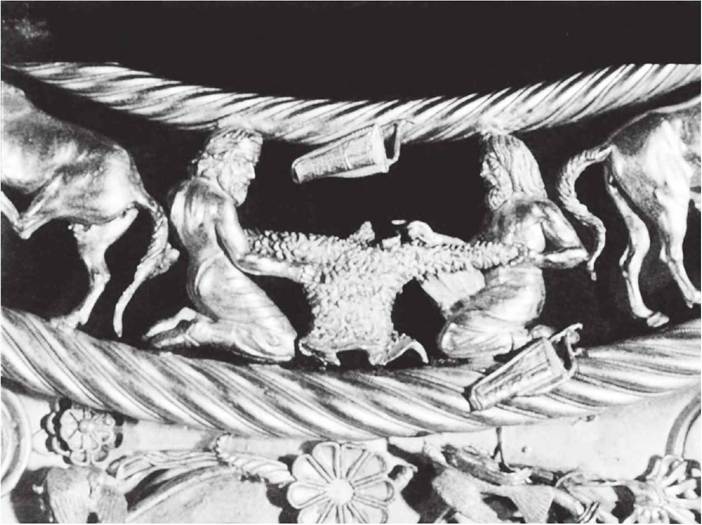
Scythian blood-brothers sharing a shirt-tunic. From a gold pectoral found in the Tovsta Mohyla burial mound of southern Ukraine, 4th century вс. The large mound covered elaborate chambers with a volume of a half million cubic feet, and contained the skeleton of a prince with remains of sacrificial victims.
Greek Ports engaged in commerce. It would not be long before the Scythians themselves realized the advantages of trade and by the 6th century вс Scythia was becoming one of the main suppliers of wheat to the Greek city-states. The Black Sea coast of today s Ukraine harbored Greek ports such as Tyras, Olbia, Chersonnesus, and Theodosia which acted as trade outlets. Athens was an especially important trade partner, and also hired Scythian archers for its defense. With a well-armed and disciplined host the Scythians provided security and peace to the whole Pontic prairie region which began to flourish economically. The Scythian tribes in turn depended on Greek goods which as herders they did not produce or grow themselves, such as olive oil and wine, in return exporting furs, timber, gold, and slaves. Although they quickly acquired a taste for Greek wine, the traditional alcoholic drink of the pastoralists was fermented mare s milk. The Greeks also imported good steel which was produced by Scythian smiths in large supply, and as other pastoral people in the past, the Scythians had built towns in the steppe along rivers where skilled craftsmen produced equipment and weapons, such as the recursive composite bow. The largest excavated town is at Kaminsk on the Dnipro River, dating to the 4th century, вс. The urban settlement occupied some twelve square kilometers and was defended by extensive walls and fortifications, which included a citadel on the southwestern corner.88 Here iron ore was plentiful, was close to the surface, and easy to mine.
The Scythians were sun worshippers and gold was particularly important to them. Theirhighly original and artistic gold artifacts such as goblets, bracelets, combs, and other decorations showhighly detailed reliefs of animal life and the warriors’ daily activities—hobbling horses, stringing bows, and engaged in combat. The gold was at times obtained in ingenious ways. Some Caucasus mountain streams carried invisible gold particles suspended in the moving water and sheepskins would be secured to the bottom of the stream with the wool side facing the surface. With the dense wool acting as a filter the tiny gold particles would be deposited on the fleet filament over a period of several weeks. The method is reportedly still in use today and no doubt was the origin of the Greek legend of “The Golden Fleece.”