The Steppe Hinterland and the Black Sea Cities
The first period of Ukrainian history, or, more precisely, prehistory, lasted from about 1150 все to 850 ce. These twenty-one centuries of human development on Ukrainian territory witnessed a slow evolution from primitive agricultural and nomadic civilization to more advanced societies that attempted to create centrally organized state and socioeconomic structures.
During these millennia, Ukrainian territory was divided into two rather distinct spheres: (1) the vast steppe and forest-steppe zones of the hinterland, and (2) the coastal regions of the Black Sea and Sea of Azov. While in each of these spheres there were quite different socioeconomic and political structures, the two were closely linked in a symbiotic relationship based on a high degree of economic interdependence.In general, the hinterland was inhabited by sedentary agriculturalists ruled by different nomadic military elites who most often originated from the steppes of Central Asia. The Black Sea coast, on the other hand, was characterized by the establishment of Greek and, later, Romano-Byzantine cities that either functioned as independent city-states or joined in federations that had varying degrees of independence or that were dependent on the Greek, Roman, or Byzantine homelands to the south. In effect, the Black Sea coastal cities functioned for over two millennia as appendages or dependencies, whose economic, social, and cultural orientation was toward the classical civilizations of the Aegean and Mediterranean Seas.
The steppe hinterland
The earliest information about the steppe hinterland and its inhabitants comes from contemporary Greek, Roman, Byzantine, and Arab writers, who almost invariably painted negative descriptions of fierce barbarians from the east whose only purpose in life was to destroy the achievements of the civilized world as represented by Greece and, later, Rome and the Byzantine Empire.
The few written sources from this early era give a general picture of an unending swarm of ‘barbaric’ Asiatic peoples with strange-sounding names such as Cimmerians, Scythians, Sarmatians, Alans, Huns, Avars, Bulgars, and Khazars, who successively ruled the steppe hinterland before being driven out by the next nomadic invaders. To be sure, recent archaeological discoveries, especially during the twentieth century, have revealed that these nomadic peoples were neither as uncivilized nor as bent on destruction as the classical Greek and Romano-Byzantine writers made them out to be. In fact, the civilizations established by these nomads from the east were often directed to maintaining a stable environment that would allow their income from trade and commerce to increase.Before turning to the chronological evolution during these two millennia (1150 все to 850 ce), a few general caveats should be kept in mind. When considering the various nomadic groups and their invasions of the Ukrainian steppe, the reader may form the impression - and misconception - that the fierce warriors coming from Central Asia belonged to compact tribes each made up of a particular people. Moreover, it might seem that these nomads entered territory north of the Black Sea that was uninhabited, and that a particular tribe remained as the sole inhabitants until pushed out by another nomadic people, who, in turn, took their place and began the demographic cycle all over again. Such a scenario does not reflect what really occurred.
First of all, the Ukrainian steppe was never virgin uninhabited land into which nomadic hordes poured. Archaeological evidence has shown that the steppe and, for that matter, all Ukrainian territories were inhabited throughout the Stone Age, from its earliest (the Paleolithic, ca. 200,000-8,000 все) to its most recent (the Neolithic, ca. 5,000-1,800 все) stage. The most important change during these hundreds of millennia occurred at the beginning of the Neolithic period (ca.
5,000 все), when the inhabitants of Ukraine changed their means of livelihood from hunting and mobile food-gathering to the cultivation of cereals and the raising of livestock. This sedentary and agricultural way of life continued generally without interruption through the Neolithic or Bronze Age (ca. 2,500-1,800 все), which is also known on Ukrainian territory as the era of late Trypillian culture.The end of the Neolithic or Copper Age was accompanied by a change in the relatively stable and isolated existence of sedentary communities in Ukraine. This change took place because during the second millennium все, Ukrainian lands were exposed to the movement of peoples from east-central Europe, to the arrival of traders from the Aegean and Oriental lands, and, finally, to the disrupting invasions of steppe peoples from the east. Nonetheless, both before and during the period 1150 to 850 все there were always fixed settlements throughout Ukrainian territory inhabited by people who derived their livelihood from agriculture and the raising of livestock and, secondarily, from hunting and fishing.
The other misconception about this period concerns the nomadic invaders. Despite the fact that authors from the Greek and Romano-Byzantine worlds gave names such as Cimmerians, Scythians, Sarmatians, and so on to these groups, none was ever composed of a culturally or ethnolinguistically unified people. Rather, these groups were made up of various nomadic tribes that were sometimes united under the leadership of one tribe that gave its name to (or had its name adopted by classical authors for) the entire group. Furthermore, after its
Nomadic Civilizations on Ukrainian Territory
| Cimmerians | 1150-750 BCE |
| Scythians | 750-250 BCE |
| Sarmatians | 250 BCE-250 CE |
| Roxolani | |
| Alans | |
| Antes | |
| Goths | 250-375 CE |
| Huns | 375-550 CE |
| Kutrigurs | |
| Utrigurs | |
| Avars | 55O-565 CE |
| Bulgars | 575-650 CE |
| Khazars | 65O-9OO CE |
arrival in Ukraine, the sedentary agricultural or pastoral settlers already living there were also subsumed under the name of the nomadic group that had come to rule over them.
It is in this more complex sense that the names Scythians, Sarmatians, and Khazars must be understood.The nomads of the steppe hinterland
The first of these nomadic civilizations on Ukrainian territory about which there is information, albeit limited, was the Cimmerian. The Cimmerians seem to have been an Indo-European group that came to dominate Ukrainian lands north of the Black Sea between 1150 and 950 bce, a period that coincides with the late Bronze Age. Most of what we know about the enigmatic Cimmerians comes from archaeological finds consisting of bronze implements and the remains of bronze foundries. The Cimmerian era lasted on Ukrainian territory about four centuries, and it is only from the last two of these centuries (900-750 bce) that there exist archaeological remains, of bronze implements and weapons, along the Black Sea littoral near Kherson (the Mykhailivka treasure) and from the region just south of Kiev (the Pidhirtsi treasure).
Around the middle of the eighth century (750 bce), the Cimmerian era came to end. The Cimmerian leadership seems to have fled westward (across the Carpathians to Pannonia) and southward (to the Crimea and on to Thrace and Asia Minor) in the face of a new invasion of nomads from the east - the Scythians. The Scythians were known in the classical world for their fierceness as warriors, but this one-sided image has been tempered by archaeological discoveries which have unearthed numerous examples of finely wrought sculpture, ornamentation, and jewellery, primarily in gold. The Scythians actually formed a branch of the Iranian people - more specifically, that branch which remained in the so-called original Iranian country east of the Caspian Sea (present-day Turkestan), as distinct from their Medean and Persian tribal relatives, who established a sedentary civilization farther south on the plateaus of Iran.
Between 750 and 700 все, the Scythians moved westward toward Ukraine, and eventually they settled for the most part first in the Kuban Region and Taman Peninsula (700-550 все) and later along the Dnieper River in south-central Ukraine (550-450 все), where their civilization reached its peak between 350 and 250 все.
Classical sources tell us that Scythian society was composed of four groups: royalty, notables (steppe nomads), agriculturalists (georgoi), and ploughmen (aroteres). Actually, only the first two groups - the royalty and notables - were made up of migrants from the east. This ruling elite, of nomadic origin and way of life, dominated the sedentary agriculturalists living under their control and the residents of the cities. Both these groups, together with their rulers, were known to the outside world as ‘Scythians.’The mention of cities may seem confusing, since this discussion of the steppe hinterland has focused so far on nomads and the sedentary agricultural dwellers under their control. In fact, it seems that the Scythian ruling elite - the royalty and their notables - virtually lived on horseback, roaming the steppes while hunting for food or engaging in war with neighboring tribes. One might speak, however, of mobile Scythian cities, that is, huge caravans of tribes which moved from one place to another. Nonetheless, there were a few cities - or, more properly, fortified centers with permanent settlers engaged in activity other than agriculture - within the Scythian sphere. These were so-called Oriental-type cities, owned by Scythian royalty and notables and inhabited by remnants of the Cimmerians and other peoples, who paid tribute to their Scythian overlords. Among the more important Scythian centers were Kam"ians'k on the lower Dnieper River (on the Left Bank opposite Nikopol') and the capital of Scythia Minor, Neapolis, in the Crimea (north of the mountains, near present-day Symferopol').
The Greeks of the coastal region
The few Scythian settlements were in no way as important as the Greek trading cities along the shores of the Black Sea and Sea of Azov. Not long after the Scythians began to enter Ukraine from the east, in the eighth century все, colonists fleeing civil strife in Greece arrived from the south, especially from Miletus, in Asia Minor.
As a result, between the seventh and fifth centuries все several prosperous Greek cities came into being along the shores of the Black Sea, the Straits of Kerch, and the Sea of Azov. Among the first to be established were Tiras at the mouth of the Dniester River and Olbia at the mouth of the Southern Buh, then Chersonesus at the southwestern tip of the Crimean Peninsula and Theodosia far-MAP 3 THE GREEKS AND THE SCYTHIANS IN UKRAINE
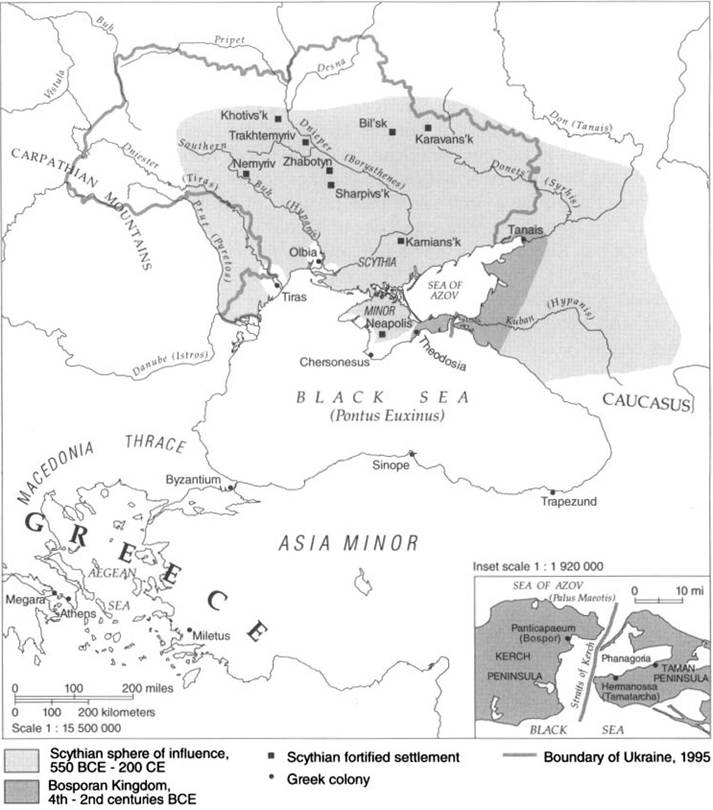
ther east on the Crimean Peninsula, and Panticapaeum (Bospor) and Phanagoria on the west and east banks respectively of the Straits of Kerch.
The Greek homeland along both shores of the Aegean Sea was composed of individual city-states, each of which jealously guarded its independence. By the fifth century bce, however, they had come to form a united civilization whose achievements set a standard for culture in the civilized world that was to outlast the city-states themselves. Like the Aegean homeland, the Greek colonies along the northern Black Sea coast at least initially remained independent of each other, though they were economically and politically dependent on the city-state
which founded them - generally either Miletus, along the Aegean coast in Asia Minor, or Megara, just west of Athens. There were also periods when the Black Sea colonies were completely independent, or when they united into federations or states.
The most important instance of a federation came into being about 480 все, when the Greek cities near the Straits of Kerch began to unite under the leadership of Panticapaeum in what became known as the Bosporan Kingdom. The Bosporan Kingdom became independent of the Greek homeland, and under its dynamic king Levkon I (reigned ca. 389-348 все) came to control all of the Kerch and Taman Peninsulas as well as the eastern shore of the Sea of Azov as far as the mouth of the Don River, where the city of Tanais was established (ca. 375 все). The Bosporan Kingdom included not only Greek cities, but also the regions around the Sea of Azov inhabited by Scythians and related tribes. Until the second century все, the kingdom flourished as a center of grain trade, fishing, wine making, and small-scale artisan craftsmanship, especially metalworking. The following century was to witness a period of political instability and the consequent loss of Bosporan independence. Finally, in 63 все, the Bosporan Kingdom together with other Hellenic states around the Black Sea came under the control of the Roman Empire.
The Pax Scythica, the Sarmatians, and the Pax Romana
During the nearly five centuries from 700 to 250 все, the Greek cities along the Black Sea littoral, in the southern Crimean Peninsula, and in the Bosporan Kingdom all developed a kind of symbiotic relationship with the Scythian hinterland. By about 250 все, the center of Scythian power had come to be based in the region known as Scythia Minor (Mala Skifiia), between the lower Dnieper River and the Black Sea, as well as in the northern portion of the Crimean Peninsula (beyond the mountains), where the fortified center of Neapolis was located. The symbiotic relationship had three elements: (1) the Scythian-controlled Ukrainian steppe, (2) the Black Sea Greek cities, and (3) the Greek city-states along the Aegean Sea.
Bread and fish were the staples of ancient Greece, and the increasing demand for these foodstuffs was met by markets in the Black Sea Greek cities. These and other food products came from Ukrainian lands, which already in ancient times had a reputation for natural wealth. In the fourth book of his History, the Greek historian Herodotus, who had lived for a while in Olbia, wrote the following description of the Dnieper River, or, as he called it, ‘the fourth of the Scythian rivers, the Borysthenes’: ‘It has upon its banks the loveliest and most excellent pasturages for cattle; it contains an abundance of the most delicious fish;... the richest harvests spring up along its course, and where the ground is not sown, the heaviest crops of grass; while salt forms in great plenty about its mouth without human aid.’1 In this region, the Scythians exacted grain and fish from the sedentary populations under their control and traded these commodities in the Greek coastal cities along with cattle, hides, furs, wax, honey, and slaves. These products