The Waning of Congregational Authority
As in the 1820s, opposition to Cornies in the late 1830s and 1840s was led by Jacob Warkentin, elder of the Large Flemish congregation. The confrontation began in 1837, centring around the election of the district mayor.97 The position had been filled since 1833 by Schonsee householder Johann Regier, a member of the Large Flemish congregation but also a supporter of the Forestry and Agricultural societies.
By all accounts Regier was an able administrator, but unfortunately he was also an alcoholic whose sometimes disreputable conduct attracted the opprobrium of his congregation. Faced with the embarrassing possibility that the Large Flemish congregation might have to ban the district mayor, in 1837 Warkentin asked the elders of the other Molochna Mennonite congregations to support him in an appeal to the Guardianship Committee to have Regier and his senior assistant Toews removed from their positions. However, the other elders refused to do this.As Regier’s second term of office came to an end in 1838, Warkentin appealed directly to LN. Inzov, head of the Guardianship Committee, to prohibit Regier from standing for re-election. Meanwhile, Cornies was busy behind the scenes, writing to Fadeev that, although ‘the current Mayor Regier and his senior assistant Toews act and work to the community’s best advantage in cooperation with the society purely out of conscientious conviction... [WarkentinJ wishes to put an end to this fruitful situation and is already making incognito preparations.’98 Comies appealed to Fadeev to ‘as far as it is possible for you, through the Guardianship Committee... make efforts so that Mayor Regier and his assistant Toews keep their positions for another term.’99 Cornies prevailed, and in 1838 Regier was re-elected.
Two aspects of Warkentin1S efforts to unseat Regier deserve attention.
First is the political implications of the dispute. Regier was a political hot potato for Warkentin, for he was at once a member of Warkentin1S congregation, the senior elected figure in the congregational administrative system, and a figure trusted by the Agricultural Society. The latter was rapidly consolidating its position as the most powerful civil agency in Molochna. If Regier were banned, Warkentin’s weight in the balance of political power in the Molochna Mennonite settlement would undoubtedly decline.The second aspect is Warkentin’s willingness to appeal to the Guardianship Committee for support. Warkentin is commonly identified as the champion of congregational over civil authority in Molochna.100 There is no reason to doubt that he, like Cornies, was motivated by a real concern for the welfare of Molochna Mennonite society. However, Warkentin’s readiness to appeal to Inzov to obtain the dismissal of a mayor elected by the community at large and supported by the other elders shows that the era of independent congregational rule was effectively over.
At the next election, in 1841, Warkentin again opposed Regier. This time he tried new tactics, and put forward the widely respected Tiege resident Peter Toews as an alternative candidate.101 The combination of Regier’s alcoholism and Cornies’s increasingly authoritarian manner helped Toews win the election handily. Comies claimed that there had been voting irregularities and, supported by district secretary David Braun, he refused to accept the results. With the backing of Cornies and the Agricultural Society, Regier continued to act as mayor. Warkentin travelled to Odessa and protested to Evgenii von Hahn, newly appointed deputy to the aging Inzov. Von Hahn, now the real seat of power in the Guardianship Committee, ordered a new election. To Cornies’s dismay, Regier then died and Toews won an easy victory.102
Warkentin and his supporters believed themselves to be the clear victors in this struggle for political supremacy in the Molochna Menno- nite settlement.
Rumours even circulated that Cornies was to be exiled to Siberia.103 However, their jubilation did not last long. Without the cooperation of the district administration, Cornies’s programs could not function, and the state was too reliant on Cornies to allow his political authority in Molochna to collapse. Later in 1841, during an inspection tour of Molochna, von Hahn confronted Warkentin, and accused him of meddling in official matters - and dismissed him from his position as congregational elder. At the same time, following the principle of divide and conquer, Hahn dissolved the Large Flemish congregation, and in its place created three smaller congregations.104 This was a shocking violation of congregational autonomy, for Warkentin was in no sense a civil official, nor was the Large Flemish congregation a civil organization. Von Hahn’s decision marked a stunning political victory for Cornies, and he would rule supreme in the Molochna basinFigure 5.2 Livestock and agricultural implements in the Molochna Mennonite settlement, 1835
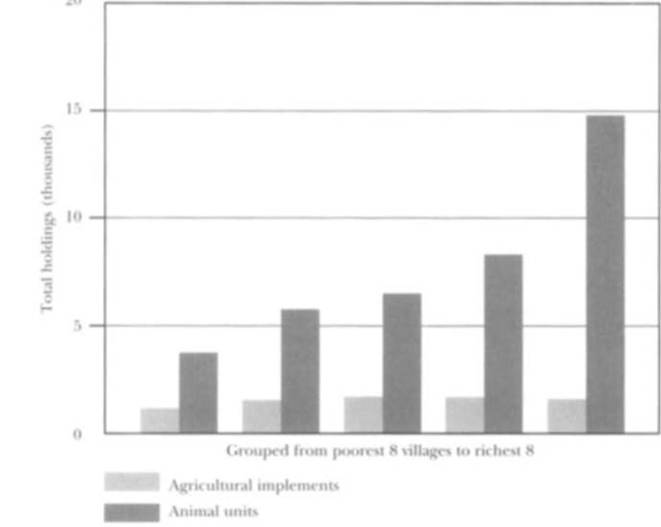
Source: ‘S Vedomostiami mestnykh kolonistakh nachal’stv о sostoianiia koloniia za 1835 god,’ RGIA, f. 383, op. 29, d. 634.
until his death in 1848 (even extending his authority to the Khortitsa Mennonite settlement when he was made head of the Khortitsa Agricultural Society in 1846).105
Cornies’s Economic Accomplishments
The dispute between Cornies and Warkentin should not be interpreted as a social conflict, for the leaders of the Large Flemish congregation were prosperous landowners whose concerns revolved around Cornies’s intrusion into their right to run their own farms. This was, at heart, a political matter. Although significant economic differentiation had oc-
TABLE 5.2
Average annual trade at fairs and total exports from the port of Berdiansk, 1836-1860 (in paper rubles)
| Trade at fairs | Berdiansk exports | ||
| 1843-45 | 263,283 | 1836 | 112,085 |
| 1846-50 | 549,748 | 1838 | 2,971,426 |
| 1851-55 | 1,252,326 | 1840 | 4,282,221 |
| 1856-60 | 1,392,249 | 1860 | 6,423,812 |
Sources: Tavricheskaia Gubernskaia Vedomosti 26 (1 July 1841); Khanatskii, ed., Pamiatnaia Knizhka Tavricheskoi gubernii, 434; PJBRMA, file 1858; 'Otchety tavricheskikh gubernatorov,’ 1843-61, f.
1281, op. 4-6, and f. 1283, op. 1 (for 1854).
curred in Molochna by the mid-1830s (see Figure 5.2), there is no evidence to suggest that there was social conflict before the landless crisis of the 1860s, despite the fact that landlessness was growing rapidly already in the 1830s. This is a testament to the astonishing growth that the Molochna economy experienced between 1836 and 1855 and to Cornies’s efforts to provide a role in this growth for all elements in Molochna Mennonite society.
Cornies’s programs took advantage of the opening of the port at Berdiansk to usher in an era of rapid economic growth. The port, located sixty-five kilometres east of Molochna, provided an outlet for the region’s produce, and for the first time made arable husbandry economically significant. Table 5.2 shows the remarkable pace at which exports from the port, and the closely related trade at fairs, grew. It should be noted that these data, and related statistics on industrial enterprises provided below (see Table 5.5), are two of the few extant sets of sources that show that the villages of tire non-Mennonite Germans shared with the Mennonites in the economic boom.
The explosive growth of trade at fairs is the clearest evidence of economic growth in Molochna, and it requires more careful analysis. Fairs played a vital role in the Russian economy for a variety of reasons. First, because Russian peasants could not travel outside of their own districts, merchants had to come to them. At the same time, before 1863 townsmen were not permitted to operate shops in peasant villages, and fairs helped circumvent this rule. Finally, following changes to tariff laws in 1822, trade at fairs was duty free, making prices particularly attractive.106
Fairs served both the wholesale and retail sectors of the Russian market, trading in raw wool and cotton, textiles, manufactured goods, imported luxury goods, and livestock. They did not trade in grain, which grain brokers bought directly.107
In her study of the Nizhnii Novgorod fair, Anne Lincoln Fitzpatrick breaks the fairs into three categories.
Small fairs, with a turnover of less than 10,000 rubles, catered to local needs and supplied peasants with manufactured goods and a market for the goods they themselves manufactured. Medium fairs, with a turnover of between 10,000 and 100,000 rubles, served as regional markets and included wholesale as well as retail trade. Large fairs, with a turnover in excess of 100,000 rubles, were mainly dedicated to wholesale trade and served as the principal agency for the wholesale market in the empire.108 There were 5,653 fairs in Russia in 1860. Of these, 2 per cent had a trade volume of more than 100,000 rubles, while 85 per cent had a trade volume of less than 10,000 rubles.109 Twenty-one of the largest fairs had a total turnover in excess of one million rubles each, led by the great Nizhnii Novgorod fair where trade exceeded sixty-one million rubles.110In Ukraine there was a circuit of eleven very large fairs, each with a gross trade in excess of one million silver rubles. Largest of all, and second largest in the empire after Nizhnii Novgorod, was the January fair in Kharkov where turnover could top twenty-five million rubles.111 Cotton was the staple of Ukrainian trade, with the exception of the June fair in Kharkov where wool took first place. Horses, cattle, and sheep also played a prominent role.112
In Melitopol and Berdiansk uezds there were twenty-nine fairs in 1843, the first year for which statistics are available. By 1846 the number had grown to fifty, and by 1860 it would reach sixty. The volume of trade at fairs in Melitopol and Berdiansk uezds hit its prereform peak in 1860 at over 1.9 million rubles. On average, fairs were large in these two uezds, and six of the fairs in 1860 fell into the over-100,000-ruble class, placing them among the largest 102 fairs in the entire empire that year.
The 9 May Bolshoi Tokmak fair was the great event of the year in Molochna. Mennonites and other German-speaking settlers, Orthodox state peasants, and Nogai mingled with Jewish hatmakers from Kherson, Tatar wine merchants from the Crimea, wool buyers from Kharkov, and hide buyers from Moscow.
Booths selling wine, vodka, tobacco, perfume, makeup, glassware, and pottery did brisk business, while weary shoppers could stop to take in a performance by travelling comedyTABLE 5.3
Goods imported through Berdiansk, 1860
| Commodity | Quantity (pudsa) | Value (paper rubles) |
| Lumber, shovels, and miscellaneous tools | 29,250 | 3,000 |
| Furniture | 927 | 2,700 |
| Textiles | 5,806 | 14,221 |
| Oranges | 135,977 pieces | 6,000 |
| Fruit and berries | 3,207 | 8,242 |
| Miscellaneous foodstuffs | 2,879 | 4,863 |
| Coffee | 2,952 | 20,520 |
| Peppercorn | 316 | 1,550 |
| Wine | 58 | 120 |
| Olive oil | 481 | 3,600 |
| Cigars | 2 | 120 |
| Tobacco | 117 | 543 |
| Matches | 50 | 450 |
| Coal and charcoal | 4,920 | 19,500 |
| Coinage | 35,889 | |
| Soap | 57 | 300 |
| Miscellaneous | 818 | 1,360 |
| Total | 122,978 |
a Unless otherwise specified.
Source: 'Verzeichnis der aus dem Hafen am Berdiansk im Jahre 1860, aus- ∪nd eingefuhrten,’ 16 Feb. 1861, PJBRMA, file 1877, 2-7.
troupes. Wool took centre-stage, and each year fifty or more wool buyers arrived to obtain a share of local kurdiuch wool production. In 1845 the wool merchants took away over 80,000 puds of wool, and this was by no means atypical.113
The growth of fairs in the region is clearly linked to the opening of the port at Berdiansk. Tables 5.3 and 5.4 list the type and quantity of goods that passed through Berdiansk in 1860. Small quantities of luxury goods and a very small amount of cotton were imported through Berdiansk, but the amounts could hardly have satisfied demand; fairs filled this role. Turning to exports, it is apparent that a very significant proportion of grain production in the region was leaving through Berdiansk. The 608,730 chetverts exported through the port in 1860 probably represented the total of grain exported from the region that year.
Only 13,342 puds of wool were exported, which was less than a fifth of what was traded at Bolshoi Tokmak. The high average price of this
TABLE 5.4
Goods exported through Berdiansk, 1860
| Commodity | Quantity | Value (paper rubles) |
| Butter | 5,876 puds | 32,318 |
| Wheat | 473,370 Chetverts | 4,800,330 |
| Rye | 10,043 Chetverts | 50,200 |
| Barley | 12,073 Chetverts | 42,254 |
| Oats | 5,888 Chetverts | 18,864 |
| 12,306 Chetverts | 50,024 | |
| Flaxseed | 95,050 Chetverts | 940,075 |
| Flour | 11,330 puds | 16,800 |
| Wool | 13,342 puds | 113,394 |
| Rag wool | 1,795 puds | 2,300 |
| Silk cocoons | 55 puds | 2,200 |
| Cowhide | 9,695 puds | 190,778 |
| Horse hair | 112 puds | 1,100 |
| Tallow | 35,877 puds | 161,408 |
| Bast | 17,967 pieces | 1,769 |
| Total | 6,423,814 |
Source: 'Verzeichnis der aus dem Hafen am Berdiansk im Jahre 1860, aus- und eingefuhrten,’ 16 Feb. 1861, PJBRMA, file 1877, 2-7.
wool (8.5 rubles per pud) shows that it was merino wool, and given the over 1.1 million merino sheep in Melitopol and Berdiansk in 1860 the amount exported through Berdiansk cannot have represented much more than 15 per cent of production.114 Thus, of the region’s two primary agricultural products, wool passed northward through the fair system while grain went south through Berdiansk. As for other commercial goods, no doubt they came into the region through both Berdiansk and the fairs, and in fact the fairs must have acted as a distribution network for the goods that arrived in Berdiansk from abroad.
Fairs were not the only suppliers of manufactured goods to Melitopol and Berdiansk, for yet another sign of the growth of the local economy was the rapid growth of local industry. It is impossible to accurately track such growth, for the statistics are spotty, and the total volume of industrial production shown in Table 5.5 is probably seriously underreported. Such industry was primarily a phenomenon of the colonies, but not solely - the largest single industrial enterprise in the region was the tallow factory in Bolshoi Tokmak, while other Orthodox state peasant villages had tallow factories, brick and tile factories, tanneries, and so on.115
TABLE 5.5
Industrial production in Melitpol and Berdiansk uezds, 1843-1861
| Year | No. of enterprises | Sales volume (paper rubles) | Year | No. of enterprises | Sales volume (paper rubles) |
| 1843 | 14 | 92,638 | 1853 | 129 | 340,921 |
| 1844 | 48 | 118,497 | 1854 | 146 | 336,050 |
| 1845 | 218 | 158,622 | 1855 | 80 | 513,442 |
| 1846 | 147 | 195,255 | 1856 | 110 | 411,259 |
| 1847 | 311 | 369,314 | 1857 | 157 | 541,564 |
| 1848 | 364 | 460,041 | 1858 | 206 | 876,776 |
| 1849 | 200 | 228,249 | 1859 | 202 | 538,639 |
| 1850 | 232 | 235,197 | 1860 | 240 | 787,293 |
| 1851 | 237 | 271,240 | 1861 | 308 | 471,927 |
| 1852 | 214 | 274,806 |
Sources: 'Otchety tavricheskikh gubernatorov,' 1843-61, f. 1281, op. 4-6; f. 1283, op. 1 (for 1854).
The clearest evidence that the fruits of this economic growth were enjoyed by landless as well as landed Mennonites comes from records of investment in sheep sharecropping. By the 1840s the philanthropic program that Cornies had established in the 1820s to encourage landed Mennonites to contribute to Nogai economic development (see Chapter 3) had also come to serve as an avenue for agricultural investment for landless Mennonites.
The serious slump in international wool markets, which bottomed out in 1847, in combination with a rise in grain prices, saw Mennonite landowners gradually shift from raising sheep to growing grain. As Table 5.6 shows, between 1835 and 1847 Mennonites increased the amount of their arable land by 55 per cent, while at the same time reducing their cattle and sheep holdings. Only the number of horses, needed as draft animals, stayed roughly constant.
The workings of the sharecropping system in the mid-1840s are detailed in two lists describing 188 contracts concluded between 1843 and 1847.116 Ninety-three Mennonites took part, providing 10,279 sheep to Nogai. Just six contractors, including Cornies, supplied over one-third of the sheep, the remaining eighty-seven providing an average of just seventy-seven sheep each. As for the Nogai, no single sharecropper engaged in more than one contract, and no contract exceeded 120 sheep.
Farm inventories from 1847 are available for twenty-seven of the forty- four Molochna Mennonite villages, providing an economic profile of
TABLE 5.6
Land sown and livestock per Mennonite household, 1835 and 1847
| 1835 | 1847 | |
| Per fullholder | (974 fullholders)a | (621 fullholders)b |
| Desiatinas sown | 12.36 | 19.17 |
| Horses | 6.19 | 5.97 |
| Cattle | 7.93 | 5.88 |
| Sheep | 115.00 | 91.00 |
Sources: Tabellen. Uber den Zustand der Molotschner Mennonisten Gemeinde in Zahlen im Jahre, 1835,’ 1837, PJBRMA, file 1138, 1ob-37ob. This document provides only the number of chetverts of grain and other crops sown. The number of desiatinas sown has been calculated using figures from 'Verzeichnis des Molotschner Mennonisten Gebietsamtes Ober die Aussaat des Sommergetreides im Jahre 1857,' and ‘Uber die Winterssaat in der Kolonie des Molotschner Kolonisten Gebiet,’ 1858, GAOO, f. 6, o. 4, d. 18086; 'Svedomostiami о Wagosostoianii Molochanskago kolonistskago і Hienonistskago okruga,' 1847, GAOO, f. 6, op. 2, d. 10080.
a Includes complete data from all 42 villages.
b Includes data from only 27 villages.
thirty of the ninety-three Mennonite sharecropping contractors.117 As Table 5.7 shows, on average contractors kept substantially more livestock of all kinds than other Mennonites, but sowed less land. As market forces pushed them to put more land under crops, they needed either to sell their livestock or to move it to different land. Sharecropping contracts furnished a way to keep part of the income from displaced sheep without incurring any direct costs for land rental, fodder, or labour at a time when investment was better directed into grain growing.
Most of these contractors continued to keep unusually large herds of sheep on their own land in addition to those they contracted to Nogai, but there were interesting exceptions. Peter Regier of Altona, who kept just seventy-eight sheep on his own land, contracted 852 sheep to Nogai, using sharecropping as a significant form of agricultural investment. In contrast, a few contractors were unusually poor, such as the brothers Heinrich and Gerhard Wiens, who shared a full holding in Blumenort and had only seven sheep between them apart from the 194 they contracted to Nogai.
A second important group of Mennonite sharecropping contractors can also be identified - the landless. Twenty contractors who lived in one or another of the twenty-seven villages for which full-holding inven-
TABLE 5.7
Land sown (in desiatinas) and livestock held by sharecropping contractors and other Mennonites, 1847
| Sharecroppers | All Mennonites | |
| Horses | 6.16 | 5.97 |
| Cattle | 6.39 | 5.88 |
| Sheep | 111.81 | 91.00 |
| Land sown | 17.31 | 19.17 |
Source: ‘S mesiachnymi Vedemostiami о blagosostoianii kolonii berdianskago okruga za Ianvar 1847,’ GAOO, f. 6, op. 2, d. 10063.
tories exist were without land. Unfortunately, little more is known of their circumstances. Peter Loewen of Altona was the single largest contractor, supplying 978 sheep to Nogai sharecroppers. Even at deflated 1840s prices this must have represented an investment of over 20,000 rubles, making the landless Loewen a rich man. By comparison, the other nineteen landless contractors averaged just sixty-five sheep under contract, much fewer than most landowning contractors. The depression in wool prices permitted landless Mennonites to buy merino sheep at deflated prices from landowners who were putting pasture lands to the plough, while sharecropping permitted them to keep the sheep without incurring direct costs beyond the original purchase price. Thus, the sharecropping program, which began as a way to improve Nogai sheep, became a way for landless Mennonites to invest in the agricultural economy.
Sharecropping made economic sense for Nogai, too. Because of the five-fold gap between the price of merino and kurdiuch wool, Nogai could make more money raising merinos with prices at their lowest than they ever did raising kurdiuch sheep. One indication of the profitability of raising merinos comes from a program introduced by Cornies in 1843 to sell sheep to Nogai on credit.118 A record of thirty sales survives. Credit was interest free, averaging 277 rubles per purchase, although whether in silver or paper rubles is unclear. The number of sheep involved is also unclear. Nogai had no difficulty repaying the loans, repaying all but twenty-five rubles within four years, and this suggests that raising merino sheep was profitable.
Such positive evidence must be balanced by contrary indications of problems for both Nogai sharecroppers and their Mennonite suppliers. Cornies had always been less optimistic about Nogai progress in his private correspondence than in official reports. As early as 1836 he wrote to Fadeev: ‘These people lack patience and perseverance, and... knowledge of the methods of raising [merino] sheep.’119 Some Menno- nites apparently lacked ‘patience and perseverance’ with Nogai as well, for that same year Cornies asked the inspector of colonies to caution Mennonites not to ‘mock or ridicule Nogai about their inability to accomplish what they have started.’120 Cornies showed dissatisfaction with the terms of sharecropping contracts in 1837, proposing a revised twenty-two-clause contract that, if implemented, would have rigorously redefined Nogai obligations. It foresaw monthly inspections, and stipulated when sheep would be moved to pasture, when they would be mated, and when they would receive fodder. It also defined procedures for removing weak sheep from the flock and sharply redefined the treatment of sick sheep by specifying that ‘regardless of whether the sheep are well or sick, [the sharecropper] may not slaughter them under any circumstances, and if he does he will have to pay for them, and beyond that will face punishment in court.’121
Nogai also had concerns, and in 1839 a group from Akkerman petitioned their ‘esteemed benefactor’ Cornies for help.122 They described how their merinos had been afflicted since 1837 with a disease that reduced wool production and prevented successful breeding so that in 1837 and 1838 they had realized no profits. Because drought had destroyed fodder crops in 1839, they anticipated even greater losses. Therefore, they said, ‘many of our people want to breed only [kurdiuch] sheep,’ and they asked Cornies to intervene to help cure the disease and end their losses.123
In the 1840s Mennonite contractors began subtly manipulating the terms of contracts to their own advantage. They gradually increased the proportion of lambs included in contracts from 10 per cent to over 19 per cent, thus reducing wool production and, because ewes could not safely be bred before the age of 2.5 years, also reducing reproductive potential. At the same time they began supplying some male lambs in place of female lambs. A herd of fifty ewes - the standard contract number - needed only one ram, so for Nogai the ten to fifteen male lambs that began to be included in some contracts were superfluous, while the corresponding reduction in female lambs reduced the reproductive potential of the herd. Moreover, male sheep were less valuable wool producers because, while they produced more total wool, they produced less clothing wool, which brought a far higher price on international markets.124
The same conditions that made sharecropping a preserve of wealthy Nogai in the 1830s still applied in the 1840s, with important implications for the increase in differentiation in Nogai society. At root the problem was as much demographic as economic. There are no precise demographic data on Nogai in the 1840s, but already by 1837, when their population was 32,058 persons, Nogai holdings of ‘good land’ amounted to just 17.8 desiatinas per male soul. Located on the Azov Lowlands, it was the most arid land in the entire Molochna region, and it could not support their population on the basis of a pastoralist economy. If Nogai were to survive, let alone prosper, it was imperative that they turn to more intensive agricultural methods.
The transformation to arable husbandry would require employing the best Nogai land, located on the Molochna and Iushanlee river flood plains, for cropping. However, commercial sheep breeding demanded the use of precisely the same land as pasturage. This land had been designated as common pasture, and Nogai sharecroppers, with their disproportionately large docks of merino sheep, were monopolizing it. Orthodox peasants in Molochna, faced with the same problem, decreased their commons, increased their arable land, and instituted land repartition on the arable portion. This ensured adequate access to land for the poor (see Chapter 6).125 Poor Nogai may have tried similar tactics, for in November 1846 their Mennonite suppliers began requiring Nogai sharecroppers to provide written guarantees from village elders confirming their right to use the commons for contracted sheep. This implies that this right was in dispute.126 That Nogai sharecroppers successfully obtained such guarantees suggests that, unlike Orthodox state peasants, the Nogai poor were unsuccessful in asserting their claims. Consequently, they could not follow the example of Orthodox peasants and turn to growing grain, for the land best suited to arable husbandry was also that best suited as pasture. The structure of Nogai-Mennonite economic relations thus encouraged a sheep monoculture at just the time when market demand dictated a transition to arable husbandry. Meanwhile, the introduction of pasture guarantees to Nogai sharecroppers was an important symbolic juncture in Nogai history, for it formally abrogated the customary nomadic right of common access to pasture.
Despite the negative potential of the sharecropping system, before 1848 it prompted no crisis in Nogai society. To that date the Nogai seemed to be sharing in Molochna’s economic boom, dragged along on the coat tails of Mennonite prosperity. However, the crisis was looming, and as Chapter 7 will show, when it came its implications were as important for Mennonites as they were for Nogai.