THERE WERE SUCH GREAT TAILORS
In 1924, the Soviet ethnographer Vladimir Bogoraz, better known by his pseudonym V. G. Tan, led an ethnographic expedition to some of the shtetls of Ukraine. Bogoraz's report on the expedition, published in 1926 as The Jewish Shtetl in Revolution, jubilantly celebrated the victory of socialism during the first decade of the Revolution: “Socialist construction has taken off completely among the Jews,” who, he continued, were working as “stonemasons, coachmen, carpenters, bathhouse attendants, street beggars, ex-convicts, prostitutes, pimps, an entire mass of petty and even pettier traders and, as if to make up for it, two or three wealthy people.” Bogoraz contrasted this situation with the prerevolutionary shtetl, where there lived “Jewish holy people, prophets, and soothsayers; women walked around in wigs; men in long caftans.
Elderly people spent the last years of their lives in synagogues in prayer and Bible reading.”1 Bogoraz was, in many ways, returning home—he had left his hometown of Ovruch, where he was born the son of a Jewish schoolteacher in 1865,57
in order to attend a gymnasium in Taganrog. There, he had become a revolutionary activist in the People's Will Party, a crime for which he was imprisoned and exiled to Siberia. In Siberia, he became interested in the Chukchi peoples, studying their folklore and anthropology, and eventually emerging as one of the most prominent ethnographers of his era—beginning in 1897 he collaborated with Franz Boas on the Jesup North Pacific Expedition across the Bering Strait, for five years. After the Revolution, Bogoraz returned to St. Petersburg, where he became a professor of ethnology at the Leningrad Geographical Institute. It was in this capacity that he led his 1924 expedition to the region in which he was born. His optimistic impressions of the pace of revolutionary change, though, were tempered by ambivalence about the social costs of change, as he observed stonemasons and carpenters coexisting with pimps and beggars.
Indeed, despite the impetus to celebrate the achievements wrought by a decade of communist rule, Bogoraz and his team could not but note the sorry economic state of the contemporary Soviet shtetl.Few of the people we interviewed were old enough to have been working before the war—most had just finished their schooling when the Germans invaded—but the picture they paint of their parents' livelihoods demonstrates that the factory jobs the Revolution had promised had yet to materialize. Traditional Jewish occupations continued to dominate the Podolian shtetls and surrounding cities. The evidence suggests that at least in the small towns, few adults had managed to fulfill the educational dreams of their youth. Whereas prior to the Revolution and Civil War the shtetls had been full of young people eager to engage with the world, become educated and cultured, and live better lives as members of the “free professions”—doctors, lawyers, dentists, or even writers or actors—by the first decade of Soviet rule, many of those with ambitious dreams had either left the shtetl or abandoned those dreams in the face of a stark reality.2 Although education and the pursuit of a professional life remained an ideal in the Soviet shtetl, the vast majority continued to work in traditional handicrafts and trade.3
According to the 1926 census, Jews constituted 74 percent of all artisans in Tulchyn and 69 percent of all artisans in Vinnytsya district.4 Put differently, 29 percent of all Jews in Tulchyn and 34 percent in Vinnytsya were artisans.5 Jews also dominated the trade and credit industries—ac-
Social Structure of the Soviet Shtetl
59
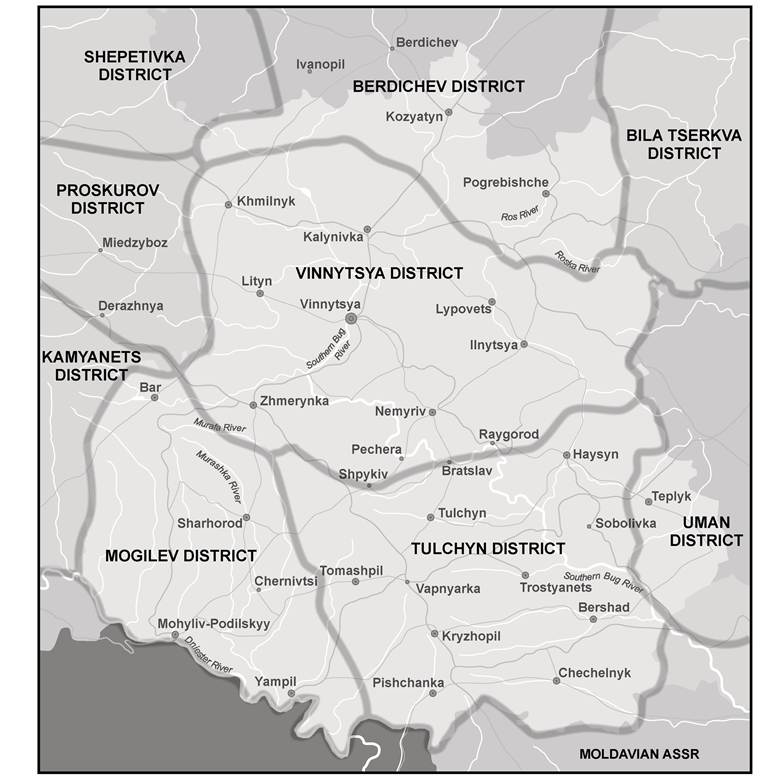
1926-1932 District borders
cording to census figures, Jews constituted 64 percent of the trade and credit industry in Tulchyn and 60 percent in Vinnytsya. In Tulchyn as well, 59 percent of coachmen and porters were Jewish, and 37 percent of those in the free professions were Jewish.
On the other hand, only 5 percent of Jewish workers were engaged in agriculture, and only 3 percent of railroad workers were Jewish. Jews also comprised only 20 percentof all industrial workers in Tulchyn, the most favored profession in the hierarchy of the proletarian state. Notably, Jews also comprised about half of those who were classified as “unemployed,” a category that likely included many engaged in trade and credit on the black market.6
Within the general category of artisans, certain handicraft fields in Tulchyn district were overwhelmingly dominated by Jews: 132 of 144 barbers were Jewish (92 percent); 108 of 140 coopers (75 percent); 80 of 82 glaziers (98 percent); 102 out of 141 coachmen (72 percent); and 1,372 of 1,639 tailors (84 percent). White-collar occupations were less common in Tulchyn than in Ukraine as a whole, but even in those fields Jews were disproportionately represented. Half of the prosecutors, almost half of the defense lawyers, and one-quarter of the judges in the district were Jewish; 10 of the 12 dentists, 5 of the 7 doctors, and 37 of the 73 musician- swere also Jewish.7 In other words, Jews were differentiated not only by religion and language, but also by the trades in which they worked.8 The Jews were almost as much a socioeconomic class as they were followers of a religious faith.
Indeed, almost all the people we interviewed came from artisanal backgrounds and equated the essence of Jewishness with such occupational skills. Maria Yakuta told us that most of the Jews in her native Teplyk were artisans: cobblers, tailors—“there were such great tailors”— “tinsmiths, there were many of them. They used to make tins for baking bread and pails for carrying water and tin for fixing the roof.” Her own father was a hat maker, who specialized in caps and fur hats for winter. He would also make linings and cuffs for winter coats and muffs. Evge- niia Kozak's father, Avrum Gershkovitch, was a furrier: “He would go out to the villages, take an automobile, and make pelts.
By hand, not with a machine—he would sew them by hand.” Chaim Skoblitsky's father “was a locksmith. He knew how to make machines and all types of things.” Moyshe Kupershmidt's grandfather was a mason in a mill: “He hewed the rocks there.... And later my mother became a little wealthier. They bought a cow and my mother used to milk it. And they would bring it to the market.” Raisa Chuk's father worked out of the home, making and selling colanders for flour. Her mother was the manager of an artel, a workers' cooperative, that knitted blankets: “All the blankets in the city were hers.” Moyshe Vanshelboim remembered, “Life was quiet in Berdichev. There were butchers, cobblers, tailors, watchmakers. Therewere jewelers, leather workers. There were a lot. There were carpenters.” Chaim Rubin listed the occupations he recalled from Buki: “There were a lot of artisans: there were many tailors; there were leather workers; there were cobblers. People worked.” His cousin Motl, who was sitting next to him, added to this list, “coopers [bonders], wagon-wheel makers [shtelners],” at which point Chaim clarified, “Coopers are the ones who make barrels, in which you put apples and all types of stuff to ferment.”
The occupational distribution that current residents remember from their childhoods mimics the prerevolutionary structure of the town, in which Jews had been engaged in the same handicrafts for generations. Whereas these occupations were once regarded with low esteem, residents today recall them fondly. Some do so as part of a general nostalgia for a world that is disappearing, some do so out of respect for their parents who earned their livings in this way, and others do so because they remember that it was these “specialists” who were permitted to remain in the ghetto during the war, whereas the intellectuals and Party leadership were sent to camps.9
In addition to labor-intensive handicrafts, such as those associated with cobblers and tailors, Jews were also among the first to embrace newer technologies that did not impose upon them the restrictions built into some of the more established professions.
With less to lose, Jewish artisans tended to be more willing than their neighbors to take on risk and to jump into newer labor markets. One such area was photography, and studios attracted those with artistic bents, like the artists Marc Chagall and Solomon Yudovin, both of whom began their careers by retouching photographs, as well as other laborers who had sufficient education to navigate the new technology. Skoblitsky recalled working in a photography studio as one of his first jobs. He would prepare negatives on glass plates: “In those days they would photograph on glass, it was called ‘making it positive.' I used to retouch them. There was a white print, and it had to be made black.”10 In Sharhorod, one of the last remaining home-workshops in the old town square when we visited in 2002 was Abram Vaisman's photography store, from which a sign hung that was visible from the street. Vaisman had worked as a photojournalist for the local newspaper, having learned the occupation from his brother: “I used to travel around the villages. Their bosses would honor the people who were working better than others; those who received theOrder of Lenin or other orders or medals.... Heroes of work, heroes of the war. I would photograph them.”
In practical terms, this occupational distribution fared poorly for the Jewish population. It was to the detriment of the Jews that handicrafts and trade were precisely the occupations accorded the least value and prestige in the Soviet hierarchy of professional life. About one-third of all Jews worked in the occupations that the Soviet government targeted for elimination—trade and traditional handicrafts. These occupations were already facing challenges from the late nineteenth century onset of industrialization. The nationalization of private enterprise and the criminalization of private trade during the period of War Communism had severely disrupted Jewish occupational life in the shtetl, forcing hundreds of thousands of Jews to flee across the borders or to seek a better fortune in the big city.
Those who remained had to eke out a living amid rampant unemployment and severe shortages. Tailors needed material to stitch, bakers needed wheat to bake, and smiths needed metal to forge. The few wholesale goods that made their way into the shtetl from nearby villages were quickly snatched up by the state factories, leaving those engaged in private artisanal work in desperate need of raw materials. The life of Soviet artisans was not easy.When the state began its campaign against individual artisans, the Jews who made their living in handicrafts and whose very identity was intimately tied to their artisanal skills suffered heavily. The Jewish Sections of the Communist Party and Party cells encouraged the formation of collective labor brigades, or artels, forcing individual artisans to give up their private businesses and throw in their lot with a collective. In practice, many artels provided little more freedom than the worst sweatshops. The journalist and son-in-law of Sholem Aleichem, B. Z. Goldberg, who visited the Soviet Union in 1934, wrote:
Where there had been a score of small Jewish shops there was now one large state store, and the Jewish shopkeepers had become superfluous. State agents picked up all the surplus the peasants could spare, or be compelled to give up, and the Jewish trader in agricultural produce was now unnecessary. Transport had been taken over by the state; besides, nobody went anywhere unless sent on a mission—and so the Jewish coachman had nothing to do. Even the artisan had a desperate struggle, with competition from the new factories, scarcity of raw materials, and the tax on ‘private enterprise' eating up whatever he earned.
There were only two alternatives, Goldberg continued: to join a Jewish collective farm or to join an artel, where “a man worked harder than before, and earned less.”11
Although some Jewish artisans joined artels that were encouraged by the government, the majority continued—at least initially—to work in isolation out of their homes as their parents and grandparents had done. Only 176 of 1,581 Jewish tailors and 38 of 394 Jewish cobblers in Tulchyn district were members of artels in 1926. By contrast, 913 Jewish tailors and 224 Jewish cobblers were sole proprietors?2 Most of the individuals we interviewed recalled their parents and others within the community working out of home workshops rather than communal artels. Some, like Donia Presler's mother, began working as a glazier in the family shop, but then moved into an artel. Tseytl Kislinskaia talked about the industrialization of the shtetl in the mid-1930s, after her father had died in 1933: “Afterward there was progress and people would go there to work. But he didn't go anywhere. In those days, in general, immediately after the Soviet government came in, people worked in their homes. Tailors worked in the home, cobblers worked in the home, and then later factories started appearing and plants started appearing. Even then my father worked out of his home.” In the prewar shtetl, most Jews continued to work out of the family home and in the family business. Even in Kiev only 300 of the 1,500 Jewish cobblers in the city had joined workshops—the remainder worked out of their residences?3 Ultimately the advantages of remaining independent outweighed the benefits of joining a collective. Even those who joined the collectives during the 1928-1932 campaigns often left a few years later, either for a factory job or to migrate to the city. Those who remained in the collectives often supplemented their incomes with independent work on the side?4
Occupations were an important identity marker and continued to have caste overtones—there was little separation between work and home, and communal status was heavily dependent upon one's occupation. The divisions between occupations were further enhanced by the structure of communal life that segregated people based on their trades. Tailors went to the Tailors' Synagogue; cobblers to the Cobblers' Synagogue, and coopers to the Coopers' Synagogue. As ethnographer Marina Khakkarainen reminds us, every occupation had its own reputation, its own indelible traits that were imagined to be ingrained in the blood of its practitioners. Coachmen were said to be melancholy, and because they traveled at night through the forests in peripheral, borderline spaces, were sometimes believed to possess magical abilities and to practice dark arts; smiths were strong and were sometimes credited with defending the city from pogroms and bandits; tailors were lucky; and barbers were independent.15 The caste nature of occupational distribution was reinforced by marriage customs, which encouraged young people to marry within their family's profession. As Tsolik Groysman put it, “We were four brothers and a sister. My father was a watchmaker, and all the brothers were watchmakers, and my sister married a watchmaker.”
Even when pioneering young folk sought out new occupations, they tended not to stray far from those of their parents. Moyshe Kuper- shmidt's father was a coachman: “My father had a horse and wagon. When people had to travel to the mill, for grinding, he took them.” Coachmen were often regarded as the lowest rung on the social ladder, but they were also believed to have influence beyond their evident means: it was widely believed, for instance, that the reason the railroads had bypassed Tulchyn in the nineteenth century was because of the influence of the coachmen who protested?6 Bratslav, where Kupershmidt was born, had also been bypassed by the major railroad built through the region. Like Tulchyn, it was a town best reached by road rather than rail. As a result, coachmen like Kupershmidt's father were much in need in the early twentieth century. It was common for children to follow in the footsteps of their parents, but to be a coachman would have been to look backwards, and the Soviet Union was all about looking forward. So Kupershmidt learned to drive a truck instead of a horse, and became a chauffeur—a “new coachman”—an occupation so romantic that its French name transcended linguistic boundaries. Because of the rarity of highways (the USSR had ten times less highway mileage than Britain), the poor condition of existing roads, the scarcity of automobiles, and the unreliability of Soviet models, most of those traveling by car or truck during the prewar period were professional drivers. In regions poorly served by the railway network, the need for a chauffeur was even more urgent. These chauffeurs commonly doubled as mechanics, able to repair the prewar Soviet trucks that tended to break down on too regular a basis to make them practical for the casual driver. The occupation of chauffeur attracted young men who were in search of adventure, those with a love for the open road, and those with a rugged sense of individuality. A chauffeur also needed to be industrious, mechanically minded, and not mind the smell of benzene in their hair and grease in their fingernails. Alexei Futiran of Tomashpil, whose father was a coachman, told us that coachmen even had to work on the Sabbath to earn money. He remembered several songs about the difficult life of the coachman. Kupershmidt followed his father's line of work, but he adapted to the new world and embraced new technologies.17
Nisen Yurkovetsky, on the other hand, did not go into his family's barber business, probably in part because he had been orphaned during the 1919 pogrom and had been brought up partially in the Nestervarka orphanage. Instead, he attended the same driving school as Kuper- shmidt in Bratslav, and became a professional chauffeur as well. “In '36 they sent me to a Machine Tractor Station and from there to Bratslav to attend a school for chauffeurs, and there I learned to be a chauffeur.” But his two brothers did follow in his father's footsteps and became barbers: “We were left with a barbershop. My father was a barber. We were left with the salon, the premises, the mirrors. There was a worker with us, Isaac. He has since passed away. And when my elder brother was fifteen or twelve years old, he started to work step by step as a barber. That's how we made it through the Soviet period.” The family kept a barbershop in their home on Lenin Street, opposite the market. The children took on this profession simply because they inherited the salon, and so many of the start-up costs had already been paid. Naum Gaiviker of Proskurov (Khmelnytskyy) also became a barber just like his father: “My father opened a barbershop and I learned with him.” He worked as a barber for seventy years.
Practicing traditional crafts, however, was not a generally efficient way to earn a living; a craftsman had to be able to sell his or her wares as well. Arkadii Gelman, who made his living as a cattle dealer in Ka- myanets-Podilskyy, explained: “That's how it was with money. A craftsman was always poor. A rich craftsman had to be both a craftsman and a merchant. You see, the cobbler who could make a pair of boots and sell them was both a cobbler and a merchant. But the cobbler who just stood and worked in his stand was a pauper. The locksmith, to whom you would come and bring a key to fix, or a frying pan, or a samovar, was a real pauper if he was only a craftsman.” Many Jews dabbled in multiple jobs, buying, selling, and making whatever they could manage. As a result, the social status of Jewish artisans was ambiguous: on the one hand they could be considered productive, albeit at the low end of prestige as artisans, but on the other hand, their involvement in petty trade subjected them to scorn from a society that aspired to eliminate the free market.18
Only a small percentage of Jews were engaged in agriculture, the archetypical Ukrainian occupation, where the peasants' ties to the land helped define what it meant to be Ukrainian. In Ukraine as a whole, just 9 percent of all Jews farmed the land compared with 85 percent of all non-Jews.19 The Revolution and the alleged alliance it forged between workers and peasants enhanced the peasants' standing in the strict hierarchy enforced by the communist state. On a more practical level, Jews who lacked access to the countryside usually had fewer opportunities to acquire basic foodstuffs during difficult economic times, as proximity to the fields and orchards often provided farmers with a built-in advantage. Only during the Great Famine of 1932-1933, during which forced requisitions starved the countryside, did the cities fare marginally better.20
Despite their artisanal skills, Jews were poorly represented among factory workers, and remained so through the 1930s. Rather than recruit from among the artisanal class to staff the growing factories, the major plants sought workers from among the peasantry. A skilled tailor had less of a chance of getting a job in a textile factory than a farmer from the village. Jews comprised less than 10 percent of the workers on the floors of the large industrial factories that were established in cities throughout Ukraine. In poorer regions, Jews were even less likely to work in factories: in Podolia as a whole, only 12 percent of Jews worked in factories compared with over 16.5 percent in Kiev.21 By 1935, Jews were still less represented among workers than non-Jews, with only 17 percent of Jews working as blue-collar workers in Vinnytsya Province. 22 Most of those who benefited from the jobs created by urban manufacturing plants were peasant migrants to the city rather than urban Jewish artisans. In short, Jews were less likely than Christians to be getting jobs in the most dynamic sectors of the economy, and were more likely to be working in traditional handicrafts.