1 Ukraine’s Geographic and Elhnolinguislic Setting
Territory and geography
Ukrainian territory can be defined in basically two ways. First, there is the territory as delimited by the political boundaries of a Ukrainian state that evolved in the twentieth century.
Second, there is Ukrainian ethnolinguistic territory. An ethnolinguistic group consists of people who speak the same language or, more properly, varying dialects of one language, and who have common ethnographic characteristics. Accordingly, Ukrainian ethnolinguistic territory, is made up of the contiguous lands where ethnic Ukrainians live that are both within and beyond the boundaries of the Ukrainian state.The state of Ukraine comprises 232,200 square miles (603,700 square kilometers) and is thus larger than any European country except Russia. Put another way, Ukraine is roughly the size of Germany and Great Britain combined, of the states of Arizona and New Mexico combined, or of the province of Manitoba in Canada. Ukrainian ethnolinguistic territory (which includes most, though not all, of Ukraine) comprises 288,800 square miles (750,800 square kilometers). This is approximately the size of Germany, Austria, and Italy combined, or of Texas in the United States.
The geographic setting for both Ukraine and the ethnolinguistic territory inhabited by Ukrainians is not complex. Almost the entire land mass in question consists of vast plains and plateaus which seldom rise more than 1,600 feet (500 meters) above sea level. These include coastal lowlands along the northern shores of the Black Sea and Sea of Azov, a vast plain to the east of the Dnieper River, a low marshy plain in the northwest, and somewhat higher plateaus with slightly rolling hills toward the west and in the far east. Outside the borders of Ukraine but still within Ukrainian ethnolinguistic territory, that is, in the region east of the Sea of Azov, the geography consists of a continuation of a flat lowland similar to that north of the Black Sea.
Thus, the plain and slightly higher plateau are the predominant and somewhat monotonous features of the Ukrainian landscape. This fact prompted the Ukrainian geographer Stepan Rudnyts’kyi, at the beginning of the twentieth century, to comment, “Nine-tenths of Ukrainians have certainly never seen a mountain and do not even know what one looks like.”1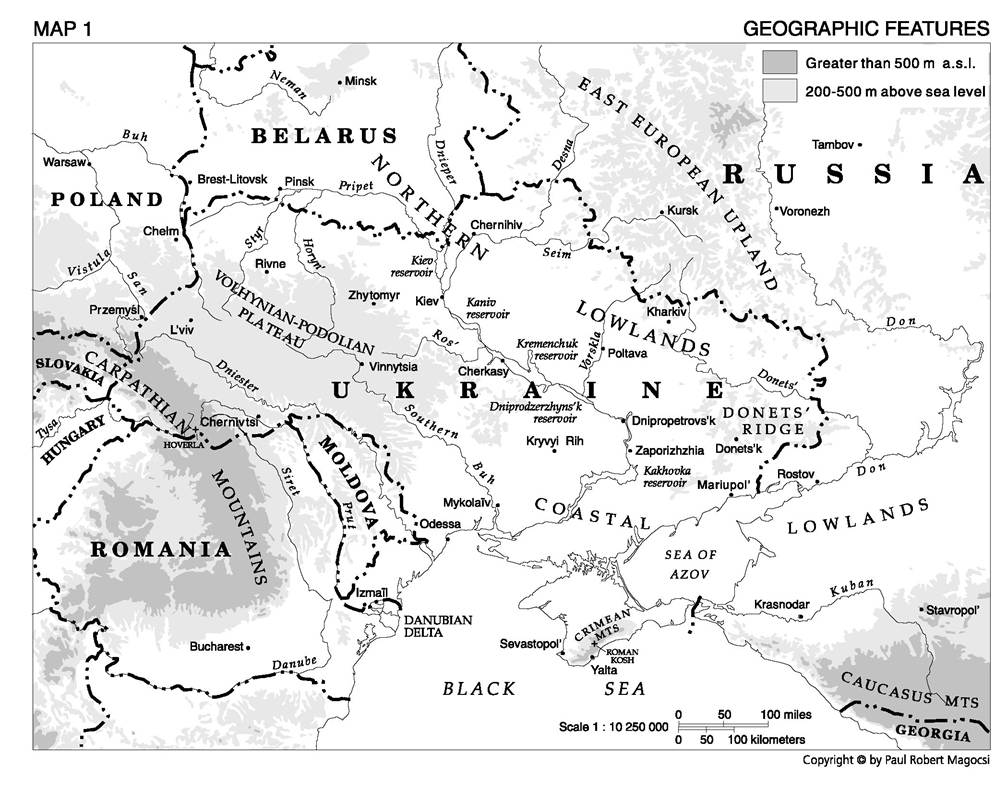
There are mountains within Ukraine, but they are along the extreme edges of its territory. In the far west are the north-central ranges of the Carpathians, whose highest peak (Hoverla) reaches 6,760 feet (2,061 meters). At the southern tip of the Crimean Peninsula - actually outside Ukrainian ethnolinguistic territory - are the Crimean Mountains, whose highest peak (Roman Kosh) is 5,061 feet (1,543 meters). Just beyond the very southern fringes of Ukrainian ethnolinguistic territory in the southeast are the Caucasus Mountains, whose highest peaks reach well over 16,400 feet (5,000 meters). Thus, the only “Ukrainian” mountains are one portion of the Carpathian range, which comprises no more than five percent of all Ukrainian territory.
Dominated as it is by open plains and plateaus, Ukraine lacks any real natural boundaries. Even the Carpathian Mountains, which in any case cover a very small area of Ukraine, contain several passes through which communication has been maintained. Lacking any natural geographic barriers, Ukraine has historically been open to all peoples, friendly or unfriendly, who might wish to come there.
Throughout Ukraine’s broad plains and plateaus, a rather well knit network of rivers has facilitated north-south travel and communication. Most of these rivers are part of the Black Sea or Pontic watershed. The major rivers run essentially in a north-southeasterly or north-southwesterly direction, emptying into the Black Sea or its subsidiary, the Sea of Azov. From west to east, the major rivers are the Dniester (Ukrainian: Dnister), Southern Buh (Pivdennyi Buh), Dnieper (Dni- pro) - all of which empty into the Black Sea - and the Donets’, a tributary of the Don, which in turn empties into the Sea of Azov.
In the far southwest, Ukrainian territory is bounded by the mouths of the Danube River as they empty into the Black Sea; in the far southeast, the Kuban River descends from the Caucasus Mountains, flowing westward through Ukrainian ethnolinguistic territory before reaching the Sea of Azov. Only along the very western edge of Ukrainian territory are there a few rivers that are not part of the Pontic watershed. These include the Buh (Western Buh) and San, which flow north into the Vistula as part of the Baltic watershed. Finally, there is the Tysa/Tisza River, south of the Carpathians, which flows westward and then southward across the Hungarian Plain into the Danube.The Baltic and Pontic watersheds are rather closely interrelated in western Ukraine, where for centuries they have been part of an important communication network. This network links the Baltic Sea to the Black Sea via the Vistula, Buh, San, and Dniester Rivers. Of even greater historical significance has been the Dnieper River, which connects Belarusan and Russian cities in the north with the Black Sea in the south, and from there beyond to the straits of the Bosporus, which connect to the Aegean and Mediterranean Seas.
Climate
Just as its landscape has few extremes, so the temperature throughout Ukraine is relatively moderate, the yearly average for the vast majority of the territory being between +43° and +48° F (+6° and +g°C). Only the very extreme ends of Ukrain-
ian territory have higher temperature averages - these being along the Black Sea coast, with Odessa having +go°F (+g.8°C) and Yalta, in the Crimea, +g6°F (+i3.4°C).
The Ukrainian average of +43° to +48°F (+6° to +g°C) is considerably lower than average temperatures in central or western Europe. For instance, London, which is at a latitude farther north than any city in Ukraine except Chernihiv, has a yearly average temperature of +gi°F (+io.3°C). The more severe winters account for the lower Ukrainian readings. As the following comparison with western European cities reveals, Ukrainian cities have considerably colder average winter temperatures with slightly warmer summer averages:

From the standpoint of temperature, most of Ukraine - with a January mean temperature of +23°F (-5°C) and a July mean of +68°F (+2O°C) - is more like Toronto, Canada, than western Europe.
Natural resources
Because of the large expanse of plains and the relatively moderate continental temperatures with adequate rainfall, Ukraine has traditionally been a rich agricultural region. As much as two-thirds of the country’s surface land consists of the so-called black earth (chomozem), a resource that has made Ukraine one of the most fertile regions in the world and famous as the “breadbasket” of those states which in the past ruled the country, whether the Polish-Lithuanian Commonwealth, the Russian Empire, or the Soviet Union. Ukraine has always had an abundance of truck-farming produce, industrial crops (hemp, sunflower, sugar beets), and grains - wheat, corn, rye, and barley. On the eve of World War I, for instance, Ukraine accounted for g8 percent of all the wheat exports from the Russian Empire, and produced 84 percent of its corn, 75 percent of its rye, and 73 percent of its barley. Historically, however, the ease in obtaining a harvest has played a role in preventing progress and inventiveness in farming methods, which have traditionally come from areas much less richly endowed with favorable natural conditions.
Ukraine is also rich in minerals. Salt, used as a preservative since medieval times, contributed to the wealth of Galicia and the Crimea, where it was found. Beginning in the late nineteenth century, rich deposits of coal, iron ore, and manganese, found especially in the south-central and eastern parts of the country; that is, the Dnieper industrial region (within the triangle formed by the cities of Kryvyi Rih-Dnipropetrovs’k-Zaporizhzhia), and in Donbas (encompassing the Donets’ Ridge and lower Donets’ valley). Since the early twentieth century, these two regions have been among the world’s major centers of heavy industry.
Ukraine is divided into twenty-four regions, called oblasts, and one autonomous republic - Crimea. With few exceptions, the oblasts do not coincide with the historical regions of the country, even if some might use historical names.
It is, however, the historical regions which will be mentioned most often in this text. Among these, from west to east, are Transcarpathia, Bukovina, Galicia, Podolia, Volhy- nia, Chernihiv, Poltava, Sloboda Ukraine, Zaporozhia, the Donbas, the Black Sea Lands, the Crimea, and the Kuban Region.Ukrainian ethnolinguistic boundaries do not coincide with the boundaries of Ukraine. This makes Ukraine similar to many other states in the world, which often have (1) a dominant ethnolinguistic group (also known as a titular nationality) within their own borders as well as members of the same group living on contiguous territory in neighboring states, and (2) one or more ethnolinguistic groups that are different from the titular and often numerically dominant nationality.
Ukrainian is one of the fourteen Slavic languages, which are grouped into West Slavic (Polish, Kashubian, Sorbian, Czech, Slovak), South Slavic (Slovenian, Croatian, Serbian, Macedonian, Bulgarian), and East Slavic (Russian, Belarusan, Ukrainian, Carpatho-Rusyn). As an East Slavic language, Ukrainian is structurally closest to Belarusan and Russian, although some dialects, especially in western Ukraine, have been heavily influenced by either Polish or Slovak.
Linguists generally refer to three major Ukrainian dialectal groups: (1) northern dialects, which are spoken in Polissia, northern Volhynia, the northern Kiev region, and the Chernihiv region; (2) eastern dialects, which are spoken in a vast territory east and south of a line running roughly from Zhytomyr to Odessa; and (3) western dialects, which are spoken in southern Volhynia, Podolia, Galicia, northern Bukovina, and Transcarpathia. In a sense, the Ukrainian language reflects the geographic makeup of the country, with its vast stretches of plains and plateaus. That is, there is little variation in dialects and subdialects throughout the northern, the eastern, and even most of the western dialectal regions. Only in the far west on both sides of the Carpathian Mountains - in Transcarpathia and the East Slavic-inhabited lands of southeastern Poland and northeastern Slovakia - do the number and degree of differences among local dialects increase substantially, so much so that there has often been considerable debate among scholars and the people themselves as to whether they should be considered ethnically Ukrainian or a distinct people called Carpatho-Rusyns.
There are, of course, numerous other languages spoken both in the past and present by several peoples, many of whom - given the fact that they have lived on Ukrainian lands for centuries - can be considered among the country’s indi- geneous inhabitants. Languages from virtually all of Europe’s linguistic families are represented: Slavic (Russian, Belarusan, Carpatho-Rusyn, Polish, Bulgarian); Germanic (German and Yiddish); Romance (Romanian and Moldovan); Turkic (Crimean Tatar, Gagauz, Azerbaijani/Azeri); Finno-Ugric (Hungarian); Greek; and Armenian. Quite often these peoples speak a form of language that differs considerably from the literary norm, such as surzhyk (an uncodified mixture of
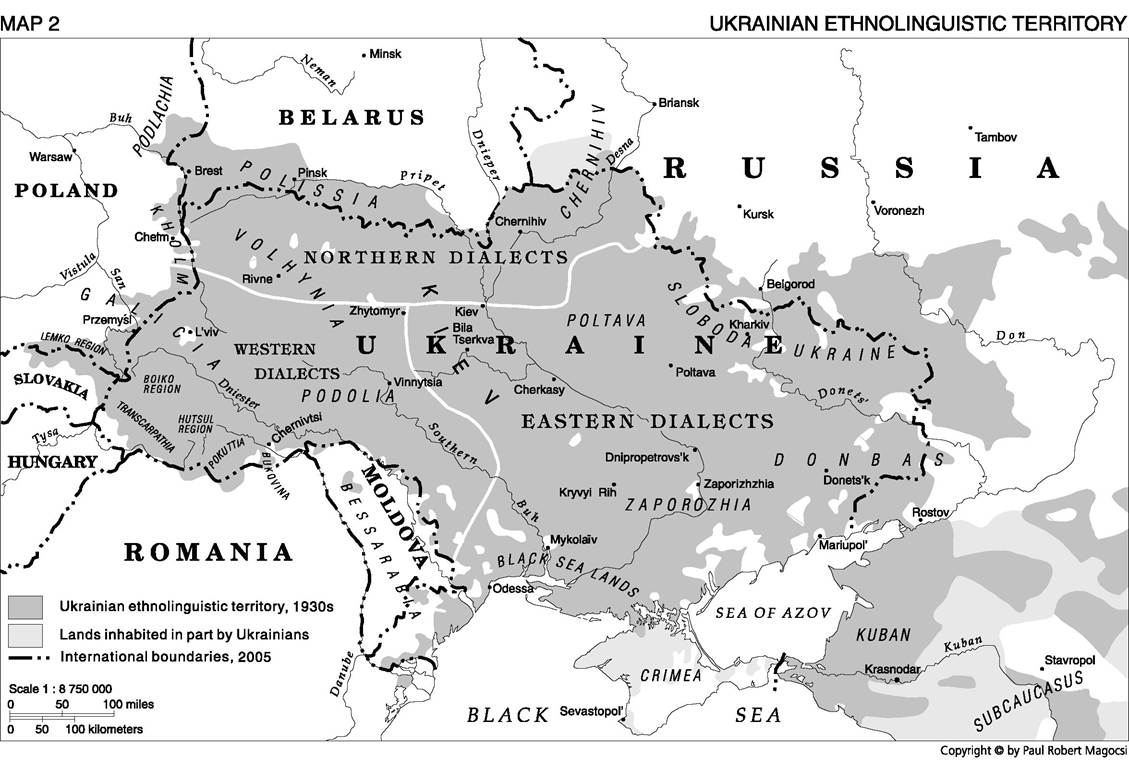
TABLE 1.1
| Nationality composition of Ukraine, 20012 | ||
| Nationality | Number | Percentage |
| Ukrainians | 37,542,000 | 77.8 |
| Russians | 8,334,000 | 17.3 |
| Belarusans | 276,000 | 0.6 |
| Moldovans | 259,000 | 0.5 |
| Crimean Tatars | 248,000 | 0.5 |
| Bulgarians | 205,000 | 0.4 |
| Magyars/Hungarians | 157,000 | 0.3 |
| Romanians | 151,000 | 0.3 |
| Poles | 144,000 | 0.3 |
| Jews | 104,000 | bgcolor=white>0.2|
| Armenians | 100,000 | 0.2 |
| Greeks | 92,000 | 0.2 |
| Tatars | 73,000 | 0.2 |
| Roma (Gypsies) | 48,000 | 0.1 |
| Azerbaijanis | 45,000 | 0.1 |
| Georgians | 34,000 | 0.1 |
| Germans | 33,000 | 0.1 |
| Gagauz | 32,000 | 0.1 |
| Others TOTAL | 177,000 48,241,000 | 0.4 99.4 |
Russian and Ukrainian) among Russian speakers, Tatar Greek among some Greek speakers, and Plattdeutsch (Low German) among some German speakers.
Population
According to the census of 2001, there were 4.2 million people living in Ukraine. Over three-quarters, or 37.5 million inhabitants (77 percent), were ethnic Ukrainians, while the remaining 11 million inhabitants (23 percent) belonged to several ethnolinguistic or national minorities (see table 1.1). Although ethnic Ukrainians have traditionally made up the majority of the country’s population, in the last two centuries there has been a great discrepancy between their numbers in rural and in urban areas. For instance, in 1897, ethnic Ukrainians made up only 30 percent of the urban population of Ukraine, a percentage that has steadily increased since then, reaching 67 percent in 2001. As for other peoples, the Russians live primarily in the urbanized industrial regions of eastern Ukraine, the Jews and Belaru- sans in urban areas throughout the country, and the Crimean Tatars mostly in cities and towns of the Crimea. The remaining groups mostly inhabit rural areas: the Moldovans live in areas adjacent to Moldova; the Poles in islets scattered throughout Volhynia and eastern Galicia; the Bulgarians in southern Bessarabia; the Magyars in southern Transcarpathia; the Romanians in northern Bukovina; and the Greeks along the shores of the Black Sea (near Odessa) and the Sea of Azov (near Mariupol’).
Aside from the 37.5 million ethnic Ukrainians within the boundaries of
TABLE 1.2
Ukrainians beyond Ukraine3
on contiguous ethnolinguistic territory, 2001
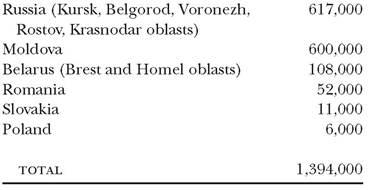
Ukraine, in 2001 there were another 1.4 million Ukrainians living on contiguous ethnolinguistic territory in bordering countries (see table 1.2).
In Belarus, Ukrainians live within the marshland of the Pripet River valley; in Poland, along its eastern border in the Podlachia, Chelm, San, and Lemko regions; in Slovakia, in the far northeast known as the Presov region; in Romania, in the Maramurer district, southern Bukovina, and the Danube Delta; in Moldova, along its northern and eastern border; and in Russia, along the Don and Kuban River valleys.
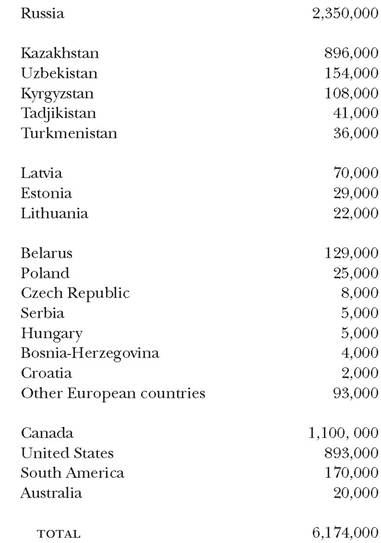
Aside from Ukrainians living in areas contiguous to Ukraine, there are still another estimated 6.2 million Ukrainians in other parts of the former Soviet Union and the world (see table 1.3). They are the descendants of ethnic Ukrainians who migrated to those areas in the course of the nineteenth and twentieth centuries.
The above statistics indicate that there are 46.7 million Ukrainians worldwide. Other sources suggest the figure might be as high as 51.8 million.
Nomenclature
Many different names have been used to designate the inhabitants and territory known today as Ukrainians and Ukraine. Indeed, it is not uncommon for any territory in Europe or elsewhere to have had different names for its inhabitants and its homeland in the past. The very question of nomenclature is frequently an integral part of a given nationality’s historical development. It is not surprising, therefore, that the names used to designate Ukrainians and Ukraine in the distant and not so distant past have often been chosen to reflect a certain political stance, and sometimes even to deny the very existence of ethnic Ukrainians as a distinct nationality.
Until recently, knowledge of Ukraine in other parts of the world derived from Russian secondary sources. After the second half of the seventeenth century, when Muscovy and, later, the Russian Empire came to control most Ukrainian territory, Russian writers included Ukraine within Russian history. As part of this accommodation, old terms took on new meanings. Medieval Kievan Rus’ became Kievan Russia, its culture and inhabitants Kievan Russian or Old Russian. For later periods, Ukraine was referred to in whole or in part as Little Russia, South Russia, West Russia (together with Belarus), or New Russia (the steppe and Black Sea coastal
TABLE 1.3
Ukrainians beyond their contiguous ethnolinguistic territory, ca. 20004
regions), and its indigenous East Slavic inhabitants as Little Russians. In those parts of Ukraine not ruled by Muscovy or Russia, the territory was at times called Ruthe- nia and the East Slavic inhabitants Ruthenians.
The geographic names and ethnonyms, Kievan Russia/Old Russian, Little Rus- sia/Little Russian, Ruthenia/Ruthenian, are still found in older and even in some contemporary publications about Ukraine written by authors from Europe, North America, and other parts of the world. In this volume, which is concerned primarily with the historical evolution of territory within the boundaries of present-day Ukraine, the term Ukeaint· will be used to designate the territory and Ukrainians, or ethnic Ukrainians to designate the major nationality inhabiting that territory. When discussing the medieval period, that is, approximately from the eighth to the fourteenth century, the terms Rus’ or Kievan Rus’ will be used for the territory and the Rus’ or the Rus’ people for its inhabitants. The progressive use of Rus'/Ukraine and Rus ’/Ukrainian people in this volume is analogous to the use of Franks/French, or Romans/Italians in volumes surveying the history of France or Italy.