Ukrainian Autonomy in the Russian Empire
With the end of Mazepa’s hetmanship and the failure of his successor, Pylyp Orlyk, to provoke a revolt on the Right Bank in 1711, Ukrainian territories remained divided between three states: Muscovy, Poland, and the Ottoman Empire.
The most important of these Ukrainian territories were (1) the Het- manate on the Left Bank and Sloboda Ukraine, both within Muscovy; (2) Zaporo- zhia, until 1734 under the protection of the Ottoman Empire; and (3) most of the Right Bank, Volhynia, Podolia, and Galicia, all within Poland. Southern Ukraine was part of the Ottoman Empire, either ruled directly or under the Crimean Khanate. Two smaller regions in the far southwest were Bukovina in the Ottoman vassal state of Moldavia, and Transcarpathia in the Austrian-ruled Kingdom of Hungary. Of interest in this chapter are those Ukrainian territories within Muscovy, namely Sloboda Ukraine, Zaporozhia, and, especially, the Hetmanate.Muscovy becomes the Russian Empire
Peter I’s military ventures at the beginning of the seventeenth century were both extensive and very costly. They did, however, set the stage for the transformation of the tsardom of Muscovy into the Russian Empire. This transformation actually occurred in 1721, when Peter adopted the title Emperor, thereby renaming the tsardom of Muscovy (with its recently acquired territories) the Russian Empire. The change in name was more than symbolic, since under Peter Muscovy, or Russia, became the leading state in eastern Europe. By the second decade of the eighteenth century, the formerly powerful Polish-Lithuanian Commonwealth was becoming a dependency of the Russian Empire, and Sweden’s presence was on the decline. When, in 1721, the second stage of the Great Northern War came to an end, Russia was firmly established on the Baltic Sea, having acquired northern Latvia, Estonia, and the eastern shores of the Gulf of Finland.
Symbolic of the Russian presence were the spires of St Petersburg, Peter’s proverbial ‘window to the West’ at the eastern end of the Gulf of Finland. Begun in 1703, the new capital of the Russian Empire was inaugurated in 1712.While Sweden effectively had been checked in the north, Peter’s military thrusts
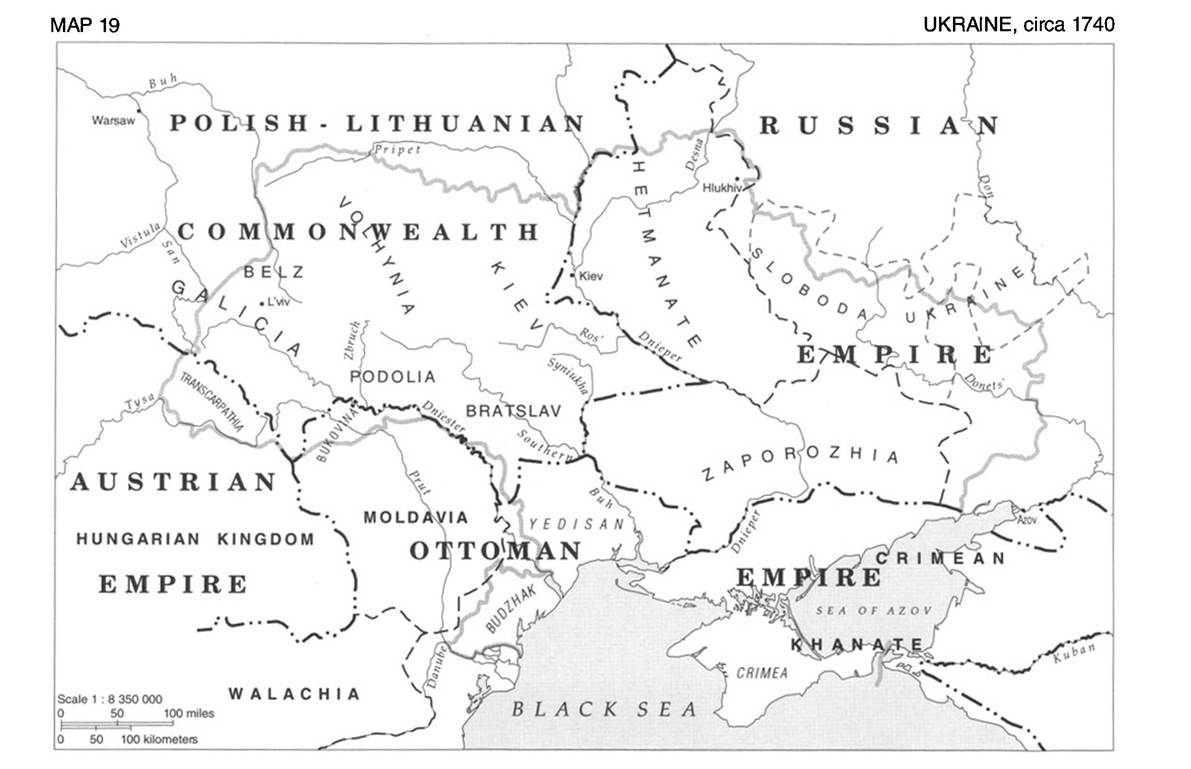
against the Ottoman Empire were less decisive, and it was not until the second half of the eighteenth century that the Russian Empire was finally able to acquire control of the Crimea and the northern shores of the Black Sea. A truce with the Ottoman Empire and peace with Sweden and Poland after 1721, however, provided the Russian imperial government with the respite necessary for it to increase its control over its far-flung domains. Peter I and his successors set out to create an expanded bureaucracy and administration for a centralized state that was more and more anxious to remove any peculiarities of autonomy or even semi-independence that might have existed within lands under the tsar’s sceptre. Ukrainian territories were a particular object of attention, and the last vestiges of autonomy in Ukraine were to disappear by the second half of the eighteenth century. The process occurred in stages. The first territory to be fully incorporated into the Russian imperial governmental structure was Sloboda Ukraine, in 1765; then followed Zaporozhia, in 1775; and finally the Hetmanate, between 1781 and 1785.
Sloboda Ukraine
Sloboda Ukraine (Slobids'ka Ukraina) was the first Ukrainian territory to become part of Muscovy. In Kievan times, it was a sparsely settled frontier region, and from the time of the Mongol invasion in the mid-thirteenth century it had remained largely uninhabited. Then, during the Cossack revolts against Polish rule in the seventeenth century, many people from both the Right Bank and the Left Bank who had hoped to find peace and refuge by going eastward to Muscovy were allowed to establish free settlements, or slobody, along the tsar’s southern frontier, and from these the region derived its name.
Muscovy encouraged such settlements, which together with its own fortified defensive system (the Belgorod Line) helped to protect central Russia from Tatar incursions. Beginning in 1638 and following each subsequent military and political upheaval in Cossack Ukraine, people fled eastward to what by then was known as Sloboda Ukraine. The last major influx of immigrants arrived in the 1730s, following the revolts in the Right Bank. In the late seventeenth century, the population of Sloboda Ukraine was approximately 120,000; a century later, in 1773, that number had increased more than fivefold to 660,000.The newcomers brought with them the Cossack system of joint military and civil administrative organization which they had established on the Left and Right Banks. Already by 1650, four regiments had been formed in Sloboda Ukraine, and in 1685 a fifth was added. They were, from west to east, the Sumy, Okhtyrka, Kharkiv, Izium, and Ostrogozhsk regiments, located on both sides of the present- day northeastern boundary of Ukraine. As in the Hetmanate, each regiment had its own colonel and staff of officers, the starshyna, who constituted the region’s elite. Also as in the Hetmanate, the regiments in Sloboda Ukraine fulfilled both military and civil administrative functions. Unlike in other Cossack territories, the Sloboda regimental colonels were elected for life, and the Muscovite government did not allow them to be united under a higher office, such as that of hetman. Instead, each regiment was directly responsible to the central government in Mos-
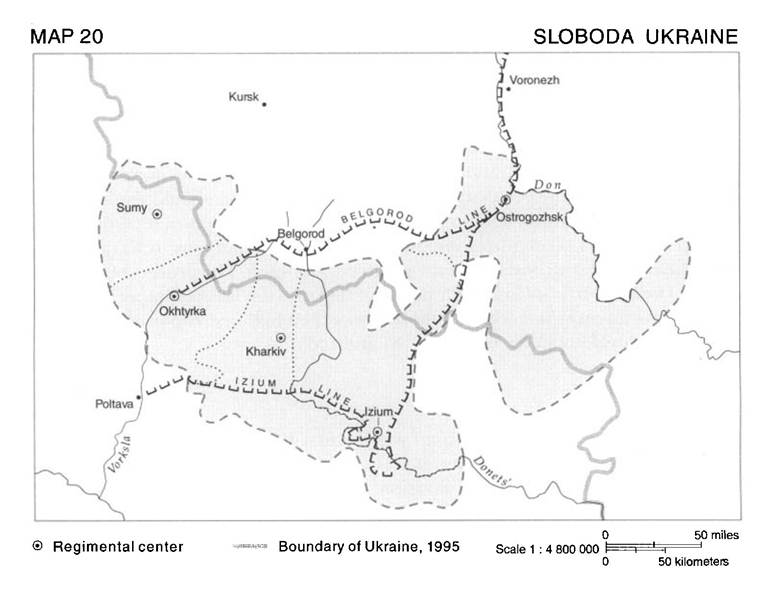
cow, specifically either to the military chancellery, from which each colonel received special charters, or to the tsar’s representative, the resident Muscovite, or Russian, voevoda in Belgorod. Thus, while Sloboda Ukraine enjoyed a high degree of local autonomy, its component regimental parts were forbidden to unite or to become part of the neighboring Hetmanate.
In 1732, the number of registered Cossacks was set at 23,000 in four of the Sloboda regiments, although as many as 85,000 troops could be mobilized at any one time to fight along with the Russian armies. The Sloboda Cossacks were employed by Muscovy in the seventeenth century to fight against recalcitrant hetmans (Vyhovs'kyi, Doroshenko, Briukhovets'kyi) and in the eighteenth century to serve in the Russian Empire’s foreign campaigns (against Persia in 1724, Poland in 1733, and Turkey in 1736-1739). They were also used to build fortifications and canals in various parts of the empire.
The local autonomy of Sloboda Ukraine was left undisturbed until 1732. In that year, the imperial government under Empress Anna (reigned 1730-1740) made the first attempt to dispense with Sloboda Ukraine’s autonomous status. A census was taken; the number of registered Cossacks was fixed at 23,000, with all others being liable to taxes; certain privileges were removed; and all regiments were placed under the responsibility of a Russian official. Protests from Sloboda Ukraine won a temporary cancellation of these reforms, but the Russian government’s longterm intentions were clear. Until the reforms were reinstated, imperial troops were stationed in the area and new cavalry regiments were formed to compete with the Cossack military order. Finally, in 1765, under Empress Catherine II (reigned 1762-1796), the autonomous status of Sloboda Ukraine was entirely abolished. The Cossack regimental structure was replaced by a unified Russian province called Sloboda Ukraine (Slobodsko-ukrainskaia gubemiia), and it was ruled by a governorgeneral resident in Kharkiv. Like other provincial governors in the empire, he was responsible directly to St Petersburg. The registered Cossacks were given the same social status as state serfs, and the Cossack starshyna (officer class) was given a status equal to that of the Russian nobility. Despite some protests, Sloboda Ukraine after 1765 became an integral part of the Russian Empire.
Zaporozhia
The second region, Zaporozhia, had a more turbulent history than Sloboda Ukraine, but its ultimate fate was the same: full incorporation into the Russian imperial governmental structure. From the time of the death of Bohdan Khmel'nyts'kyi in 1657, the Army of Lower Zaporozhia - as the region in question was officially known - followed a course that was independent of, and most often antagonistic toward, the hetmans and registered Cossack elite who ruled the Cossack state on both sides of the Dnieper River and, later, the Left Bank Hetmanate. As part of their anti-hetman policy, the Zaporozhians traditionally favored alliances with Muscovy. In the late seventeenth century, however, they began to be displeased with the tsar’s anti-Crimean wars. The Zaporozhians rightly suspected that these wars would lead to an increase in the authority of the central government over all of southern Ukraine and eventually the Crimea, which would mean an end to the source of the Cossack’s freebooting livelihood. Therefore, under their dynamic leader Kost' Hordiienko the Zaporozhians broke with Peter I in 1709 and allied themselves instead with Ivan Mazepa and his Swedish protector, King Charles XII. The Muscovites responded by destroying the Zaporozhian Sich. This forced the Zaporozhians to establish new headquarters in Ottoman territory at Oleshky, on the lower Dnieper, where between 1711 and 1734 they were under the protection of the Ottoman sultan.
Not surprisingly, the independent-minded Zaporozhians soon became dissatisfied with their new protectors, especially since as Ottoman subjects they were cut off from trade with the Hetmanate and were unable to raid their traditional source of booty, the Crimean Khanate. Almost immediately after 1711, individual Zaporozhians began to ask Muscovy to allow them to return home under the tsar’s protection. Their leader, Hordiienko, stood firm in his anti-Muscovite views, however, and nothing changed for the Zaporozhians as a whole until his death in 1733· By that time, Russia was making preparations for a new campaign against the Ottoman Empire and was receptive to negotiating with the Zaporozhians.
The result was the Agreement of Lubni, signed in 1734. The Zaporozhian Cossacks regained all their former lands, which came to be known as the Free Lands of the Zaporozhian Host (Vol'nosti Viis’ka Zaporiz’koho Nyzovohd), and they were permitted to retain their traditional laws and customs. During wartime, they were to serve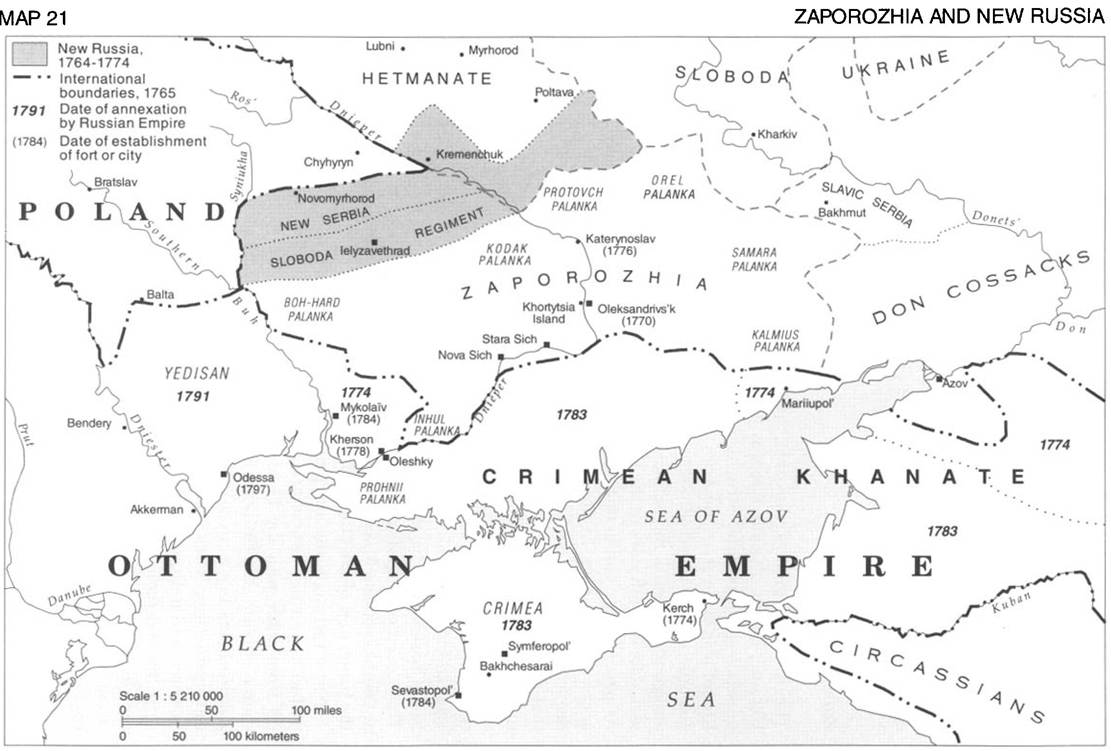
under the command of the Russian army stationed in the Hetmanate, and they were to receive for their services an annual payment of 20,000 rubles. A new sich, the Nova Sich, was established on the Dnieper River, a little downstream from their old headquarters, which had been destroyed earlier in the century by Peter I. The Nova Sich was under the direct control of the imperial Russian governor-general in Kiev and, later, the hetman in the Hetmanate.
The number of Cossacks who returned from the Ottoman Empire was no more than 20,000. This meant that at least initially they had a vast territory in Zaporo- zhia at their disposal. In an attempt to maintain a measure of control over this territory, they introduced a more formal administrative structure. Eight districts (palanky) were formed in Zaporozhia and near Oleshky. Each district was headed by a colonel appointed by the chief (koshovyi otamari) of the Nova Sich, although these colonels never had the degree of power or number of administrative support staff that their counterparts in the Hetmanate had. In addition to building a state administration, the Zaporozhians, who remained concerned with the demographic and political vacuum in their extensive territory and the potential for interference with their status by the Russian imperial government, began to colonize their lands with peasants. Many of these peasants were refugees from the Polish-controlled Right Bank and the Left Bank Hetmanate who resented the increasing burdens of serfdom. By 1762, there were approximately 33,700 Cossacks and over 150,000 peasants in Zaporozhia.
But incursions from the north proved to be inevitable, since the Russian Empire was determined further to integrate the border regions of its increasingly far-flung realm. St Petersburg’s initial steps toward integration were to build fortifications and settle colonists. In 1734, the government built a fortress near the Nova Sich, and in the 1750s it set up a line of fortifications along Zaporozhia’s western border with the Ottoman Empire (the Southern Buh and Syniukha Rivers). Also during the 1750s, the imperial government initiated its own colonization program to encourage an influx of new settlers who would be directly dependent on the central authorities. In 1751, St Petersburg invited over 200 Serbian colonists from southern Hungary, who were joined a year later by Bulgarians, Greeks, Romanians, and more Serbs from the Balkans. The settlers were given the northwest region of Zaporozhia between the Dnieper River in the east and the Syniukha River in the west. Organized into a frontier military region, this area became known as New Serbia (Nova Serbiia), with its center at Novomyrhorod (then on the Russian-Polish border).
In 1754, the Russian government coopted more Zaporozhian land all along the southern border of New Serbia to create a Cossack frontier military region made up of over 6,000 Cossacks from Sloboda Ukraine and the Hetmanate. This became known as the Sloboda regiment (Slobids'kyi polty with its military and administrative headquarters at a fortress that in 1775 became the city of lelysavet- hrad (today Kirovohrad). Finally, beyond the far northeastern corner of Zaporozhia more Serb (as well as Bulgarian, Greek, and Romanian) colonists from southern Hungary were settled in 1752 by the Russian government. As in New Serbia, the colonists were organized as a frontier military regiment, and the whole region, with its center in Bakhmut (today Artemivs'k), came to be known as Slavic Serbia (Slaviano-Serbiia).
The Zaporozhians resented the imperial Russian colonization of their northern frontier, and they often clashed with the Serb colonists. Nonetheless, the Zaporozhians continued to serve faithfully with the imperial army in its wars against the Ottoman Empire between 1734 and 1740, and again between 1769 and 1774. In the context of tsarist Russian policy as a whole, however, the eventual demise of Zaporozhian autonomy was inevitable. That demise was to take place in two stages. In preparation for its war with the Ottomans, the tsarist government in 1764 abolished the Serbian and the Sloboda frontier regions and joined them with fifteen southern companies from the Hetmanate to form an imperial province called New Russia (Novorosiiskaia guberniid), with an administrative center at Kremenchuk.
These administrative changes seem not to have disenchanted the Cossacks, who continued to fight loyally and valiantly with tsarist forces in their campaigns against the Ottomans between 1769 and 1774- At the very same time, Russia’s borderlands to the east of Ukraine were rocked by a series of revolts which seriously threatened tsarist rule. Sporadic uprisings occurred in Zaporozhia as well, but it was among the Don and laik Cossacks just to the east that large-scale revolts took place, culminating in the greatest uprising in eighteenth-century Russia - the Pugachev rebellion of 1773-1774.
Once the Pugachev rebellion was finally put down, Empress Catherine was determined to reorganize all the borderlands so as to impose greater control over their inhabitants. Zaporozhia in particular became an area of concern because it was part of the southern borderland facing the Ottoman Empire. Ironically, although the Zaporozhians had remained staunchly loyal during the Russo- Turkish war (1769-1774), they were among the hardest hit by the new, more stringent tsarist policy. Moreover, the very fact that Russia was successful against its Ottoman adversary (from whom it obtained a very favorable peace settlement at Kuchuk Kainardzha in 1774) made the protection afforded by the Zaporozhian Cossacks seem superfluous.
Accordingly, on 4 June 1775, victorious Russian troops returning from their Ottoman campaigns suddenly attacked and destroyed the Zaporozhian Sich. Some Cossacks were immediately pressed into Russian military service; some were left as free farmers; others sought protection in the Ottoman Empire, where they were allowed to settle near the mouths of the Danube River. That same year, 1775, all of Zaporozhia was annexed to the imperial province of New Russia, governed at the time by Empress Catherine’s favorite, Prince Grigorii Potemkin.
Potemkin was eager to impress his sovereign. To do so, he began a dynamic colonizing program that brought new settlers from various parts of Europe, including especially large numbers of Romanians from nearby Ottoman-ruled Moldavia and smaller groups of Armenians and Greeks from the Crimea, along with Bulgarians, Turks, and Albanians from the Ottoman Empire. From farther afield came Italians, Corsicans, Danzigers, Swedes, and especially Germans. The colonists were attracted to New Russia by the free land and tax-exempt privileges (at least for the first two or three decades of their settlement) they were offered. Germans were especially favored. Besides the aforementioned privileges, they were exempted from military service, granted unlimited duty-free trade across the border, and allowed free sale of salt and spirits. Racked by the Seven Years’ War (1756-1763) in central Europe, Catholic and, especially, Protestant Germans, including Mennonites, took advantage of several Russian imperial decrees (issued in 1763, 1789, and 1790) and immigrated to the Ukrainian steppe. There, in the center of New Russia, they settled on and near Khortytsia Island, a historic center of the Zaporozhian Cossacks. These Germans, and others who followed in even greater numbers during the early part of the nineteenth century, founded numerous colonies along the Black Sea littoral between the Southern Buh and Danube Rivers and became known as Black Sea Germans (Schwarzmeerdeutsche).
Potemkin also succeeded in establishing the basis for several new towns throughout New Russia and the Crimea that grew up around existing or reconstructed fortresses. Among these were lelyzavethrad (today Kirovohrad) and Katerynoslav (today Dnipropetrovs'k) in Zaporozhia; and, from lands acquired from the Ottoman Empire, Sevastopol' and Symferopol' in the Crimea and Kherson, Mykolaiv, and Odessa along the Black Sea littoral east of the mouth of the Dniester River. Potemkin’s investments were often costly and unproductive. His excesses were such that, during Catherine’s trip in 1784 to the recently acquired Crimea, his urge to impress her caused him hastily to set up settlements all along her route through southern Ukraine (i.e., New Russia), many of which were simply facades with nothing behind. This episode gave rise to the proverbial phrase ‘Potemkin village,’ meaning an illusory facade designed to cover an undesirable fact or condition.
In contrast to Potemkin’s empty facades, Catherine’s policies of administrative integration were quite real. In 1775, her government abolished the autonomy of Zaporozhia, just as it had abolished that of Sloboda Ukraine ten years before. Having transformed territory to its east and south into integral parts of the Russian Empire, Catherine was now ready to turn to the last semi-autonomous region on Ukrainian territory.
The Hetmanate
The Hetmanate had the most highly developed form of autonomous selfgovernment in Ukraine. It was the direct successor to Khmel'nyts'kyi’s Cossack state, and, at least until the end of Mazepa’s reign, it maintained control over its own internal affairs, even if it was subject to Muscovy with respect to foreign policy and military ventures. The Hetmanate was hardly helped by Mazepa’s defection to the Swedes. The antagonistic tone was set by Peter I, who in 1723 issued a decree declaring that ‘from the first hetman Bohdan Khmel'nyts'kyi, and even Skoropads'kyi, all hetmans were traitors.’1 Peter’s ultimate purpose was to end all forms of Cossack autonomy in the Hetmanate; the only question was how best to achieve that goal. The decades from Mazepa’s defection in 1708 until the 1780s witnessed several changes in policy on the part of the tsarist government toward the autonomous status of the Hetmanate, changes which reflected in part the requirements of foreign policy and in part the different attitudes of administrators and internal policy makers.
In November 1708, immediately after learning of Mazepa’s defection, Peter had a new hetman, Ivan Skoropads'kyi, appointed. As a personality, Skoropads'kyi was easy to manipulate, and he proved to be no real hindrance to Peter’s plans. The tsar did not reassert the articles of the agreement of Pereiaslav, nor did he negotiate a new agreement with the Cossacks as had previously been done whenever a new hetman was elected. Rather, he chose to confirm a more limited number of traditional rights by tsarist decree. At the same time, he transferred the capital of the Hetmanate from Baturyn farther north to Hlukhiv, near the Muscovite border, and a representative of the tsar was assigned there to oversee the hetman’s activity. The tsar also began to appoint colonels directly to the Cossack regiments, and he made large land grants in Hetmanate territory to his generals, most of whom were of German background (Weissbach, Roop, Munnich). As loyal tsarist subjects with no local roots, these men had little concern for Cossack autonomy. The Cossack military forces were more frequendy than before used to build canals in Russia (at Tsaritsyn in 1716; Lake Ladoga in 1721), to construct fortifications, as in the Caucasus (along the Terek River, in 1718) and Sea of Azov (1731), and to fight in foreign lands (Persia, in 1721, 1724, 1725).
Following the close of the Great Northern War in 1721, Peter had an even greater opportunity to address Ukrainian affairs. As a first step, the governmental branch in St Petersburg responsible for the Hetmanate was changed in 1722 from the College of Foreign Affairs to the Senate, which was concerned with the empire’s internal affairs. That same year, the Little Russian Collegium was established. The Russian government justified these actions on three grounds: that the Cossack system of administration and justice had broken down in the Hetmanate; that the central government had received numerous complaints of illegal Cossack enserfment of the peasantry; and that the tsar’s treasury had received an inadequate share of taxes and revenue.
It was to expedite further complaints, which according to the agreement of Pereiaslav all Cossacks had a right to make directly to the tsar, that in 1722 the imperial Russian government established the Little Russian Collegium, composed of six Russian military officers stationed in the Hetmanate. As a body, the officers were commissioned with the following tasks: (1) to hear complaints lodged against local Cossack courts and, if necessary, decide controversial cases; (2) to control financial affairs; and (3) to intervene against starshyna oppression of the rank-and-file Cossacks and peasantry. The Little Russian Collegium became, in effect, a parallel government in the Hetmanate. Even the malleable Hetman Skoropads'kyi protested this incursion against Cossack autonomy.
But Skoropads'kyi’s complaints had no impact and, in any case, he died two months after the Collegium was established, in July 1722. As his successor, the Cossacks chose Pavlo Polubotok, a more dynamic leader who from the outset protested against the activity of the Little Russian Collegium. The tsar never confirmed Polubotok’s election, however. Instead, he was arrested in St Petersburg, where he died in prison in 1724.
The Hetmanate continued to be ruled exclusively by the Little Russian Collegium, although in 1726, under the new ruler Empress Catherine I (reigned 17251727), plans were made to restore the office of hetman. The change in attitude reflected the government’s desire to avoid any difficulties in its southern regions during preparations for a new war with the Ottoman Empire and, in part, the influence of Catherine’s political ally Aleksandr Menshikov, who had large landholdings in the Hetmanate and was opposed to the Collegium’s introduction of direct taxation. Accordingly, in 1727 the Little Russian Collegium was abolished, and with Menshikov’s intervention the Russian government arranged to have a new hetman, Danylo Apostol, elected. At the same time, a code consisting of twenty-eight articles was drawn up to regulate Russia’s relationship with the Hetmanate. This was, in effect, the first single document to cover all aspects of the Hetmanate, and it remained in force until the demise of the region’s autonomy.
The document came to be known as the 28 Confirmed Articles. According to its provisions, the Hetmanate could not conduct any foreign relations, although it could deal with Poland, the Crimean Khanate, and the Ottoman Empire about purely border problems, provided that any agreements with these countries received the approval of the Russian imperial government. While the Hetmanate continued to maintain ten regiments, it was allowed only three regiments of mercenary troops. Moreover, in time of war the Cossacks were required to serve under the resident imperial Russian commander. With regard to judicial and administrative matters, a general court was established, to consist of three Cossacks and three governmental appointees; a commission was set in place to create a new law code; duties on foreign goods were to revert to the imperial treasury; and Russian and other non-local landlords were permitted to retain their landholdings, although no new peasants from the north could be brought in.
From the standpoint of the imperial government, the 28 Confirmed Articles were a step backward in what seemed to have been Russia’s determined effort since Peter I to abolish the Hetmanate’s autonomous status. It was not long, however, before St Petersburg returned to more restrictive policies. Hetman Apostol died in 1734, and in his stead a Governing Council of the Hetman’s Office was created that consisted of three overnmental appointees and three Cossacks. Together, the six members were to rule the Hetmanate and to work on codifying a body of law for the region. In practice, the head of the Governing Council, or ‘Second Little Russian Collegium’ as some historians (Doroshenko, Polons'ka- Vasylenko) call it, administered the country single-handedly, especially during the costly wars against the Ottomans, in which the Cossacks participated between 1734 and 1739. The only concrete result of these conflicts was that the Ottoman Empire agreed to renounce its protectorate over the Zaporozhian Cossacks, who in any case had already returned to Russian control, in 1734.
In the 1740s, the imperial Russian government once more backed away from its anti-Hetmanate policy. Again, this development was largely owing to the role played by certain individuals. The court favorite - and eventually the husband - of the new empress Elizabeth (reigned 1741-1762) was Oleksii Rozumovs'kyi, the son of a registered Cossack, who because of his musical talent (he was a singer in the imperial choir) and good looks came to her attention. Rozumovs'kyi managed to interest Elizabeth in his homeland. In 1743, he succeeded in winning the restoration of the office of the metropolitan of Kiev, which had been downgraded by Peter I in 1721 to an ordinary archbishopric. Then, in 1747, he pushed through plans for the election of a new hetman. The choice fell on his younger brother, Kyrylo Rozumovs'kyi, a remarkably well educated youth who, as a result of his brother’s connections, had been made president of the Imperial Academy of Sciences in St Petersburg at the age of eighteen. In 1750, Kyrylo was elected hetman in Hlukhiv.
Kyrylo Rozumovs'kyi was an eighteenth-century intellectual dilettante par excellence. Educated in France, Italy, and Germany, he displayed the typical imperial Russian aristocratic predilection for western culture, and he tried to impose this outlook on his new capital in Hlukhiv. In that otherwise small provincial town, he established an Italian opera, opened coffeehouses, introduced French-language schools and Parisian fashions, and erected a Versailles-like hetman’s palace. He even had elaborate plans to return to Mazepa’s old capital at Baturyn and build a more elegant cultural complex there.
But despite these ‘improvements,’ Rozumovs'kyi preferred St Petersburg to provincial Hlukhiv. During his long absences, the Cossack starshyna ran the Hetmanate and held periodic congresses somewhat like noble diets. They succeeded in limiting the rights of the peasants even further (1760), and they introduced a new system of justice whereby local judges could be chosen only from the starshyna. It seemed that the Cossack elite, left to its own devices, was on the verge of introducing a Polish-style administrative system in which all social and legal power rested in the hands of the nobility.
The Cossack starshyna was helped in its efforts by the imperial Russian government. Beginning in the 1730s and especially during the rule of Empress Anna (reigned 1730-1740) and Tsar Peter III (reigned 1761-1762), the nobility was granted several privileges, including permanent exemption from state service. The hope was that, following such improvements in their status, the nobles would pay more attention to the economic well-being of their landed estates. That goal was not achieved, however, until 1785, when Empress Catherine II (reigned 17621796) issued the Charter of the Nobility reconfirming all previous rights and, most important, recognizing all land already held by nobles as their legal property. The result was that many landlords went back to their estates, where, exempt from military and/or civil service to the state, they could devote themselves to the exploitation of their landholdings. While it is true that Russia’s nobles had few political rights, they did have many social and economic privileges. The Cossack starshyna in the Hetmanate eventually were willing to go along with a system that guaranteed them so many privileges.
Centralization and the end of Ukrainian autonomy
Having laid the groundwork to attract the Hetmanate’s elite into Russia’s social structure, the imperial government could once again return to its policy of centralization. Centralization became the dominant goal of Catherine II. Influenced in part by the ideas of the European Enlightenment, which argued that a single territory with a rational system of unified central government could be run more efficiently and manageably than could a variety of regions with antiquated social systems and specific forms of self-government or autonomy, Catherine turned her attention primarily to the Baltic provinces and Finland in the north (a portion of which had been obtained by Russia in 1743) and to the Ukrainian lands in the south. Her attitude toward these regions was summed up in 1764 in instructions to the empire’s new prosecutor-general: ‘To call [these lands] foreign and to treat them on that basis is more than a mistake; it would be sheer stupidity. These provinces... should be russified in the easiest way possible, so that they should cease looking like wolves to the forest. The approach is easy if wise men are chosen as governors of the provinces.’2 Catherine had already done away with the autonomous features of Sloboda Ukraine in 1765 and of Zaporozhia in 1775. Now she was ready to turn to the Hetmanate.
First came the office of the hetman. It was permanently abolished in 1764, after Rozumovs'kyi unsuccessfully tried to have it become the hereditary property of his family. Rozumovs'kyi, who never much cared for ruling in the Hetmanate, was easily placated with a new imperial title and the equivalent of a lavish pension, including large estates in Baturyn, where he finally settled in 1775 and lived comfortably until his death in 1803. In his stead, a new Little Russian Collegium was created, this time composed of four imperial appointees and four Cossacks and headed by a president, Count Petr Rumiantsev. Rumiantsev proceeded cautiously but firmly. While he curbed the excesses of the Cossack gentry in accumulating more land, he also legalized the landlords’ control over their peasants, and thus contributed further to the eventual enserfment of the peasantry in the Hetmanate.
Rumiantsev’s reforms were interrupted for a while in 1769, when Russia renewed its war with the Ottoman Empire. This time the Russians finally won lasting success. By the provisions of the Treaty of Kuchuk Kainardzha, signed in 1774, Russia received from the Ottoman Empire an enormous financial indemnity (4,500,000 rubles). It also acquired a slice of territory between the Dnieper and Southern Buh Rivers; parts of the Crimean Khanate around Mariiupol', the Kerch peninsula, and lands east of Azov; and Istanbul’s recognition of independence for the Crimean Khanate. This increase in the Russian presence along the Black Sea after 1774 allowed St Petersburg to destroy the sich and to put an end to Zaporo- zhian autonomy a year later. The independence of the Crimean Khanate was also short-lived: in 1783, its remaining territories were incorporated into the Russian Empire. With this incorporation, Catherine II finally fulfilled the age-old dream of the Muscovite and Russian rulers, which even Peter I had failed to realize - control of the Crimean Peninsula and most of the coastal region north of the Black Sea and Sea of Azov.
Once the southern fringe of Ukrainian lands had been acquired, the further integration of the Hetmanate into the Russian Empire could be completed. In 1781, the Cossack regimental system of administration was dismantled. The Little Russian Collegium was once again abolished - for the last time - and the Het- manate was divided into three imperial provinces (namestnichestva)·. Novhorod- Sivers'kyi, Chernihiv, and Kiev. In their administrative structure, they were no different from other provinces in the empire. Next, in 1783 the peasantry’s freedom of movement was restricted, and the process of their enserfment thereby completed. That same year, the Cossack military system of regiments was abolished, and the soldiers assimilated into the imperial army.
Finally, in 1785 the process of adaptation to the Russian imperial social structure was completed by means of a definition of the status of the leading social estates in Cossack Ukraine. Responding to a request made to Catherine II a decade earlier by the uppermost echelon of the Cossack elite, the imperial government agreed to recognize most of the Distinguished Military Fellows (there was still some question about the regimental-level Fellows of the Banner) as members of the Russian nobility (dvorianstvo). This recognition assured the Fellows of full rights to their hereditary estates and exemption from compulsory state service. With this act, the leading stratum of the Hetmanate was coopted fully and, for its part, enthusiastically into the Russian imperial social structure. In contrast, the corporate strength of the other leading social estate in the Hetmanate, the clergy, was reduced when, in 1786, as had been the practice in the rest of the Russian Empire, most of the church’s monastic landholdings were secularized and eventually distributed among gentry landlords. In effect, although the church’s hierarchs continued to retain extensive privileges and access to funds, they did so as functionaries of the state who were dependent on the imperial treasury and not on income from their own landed wealth.
While the process of abolishing autonomy may have taken somewhat longer in the Hetmanate than in Sloboda Ukraine and in Zaporozhia, the result was the same. One decade after another, Sloboda Ukraine (1765), Zaporozhia (1775), and, finally, the Hetmanate (1785) were transformed with the result that autonomy on Ukrainian territory located within the Russian Empire was eliminated. A system of administrative division into imperial provinces, each directly responsible to St Petersburg, was put in place instead. By the end of the eighteenth century, Empress Catherine II had succeeded in making all Ukrainian lands under her rule an integral part of the Russian Empire.