Ukrainian Lands in Interwar Romania and Czechoslovakia
Ukrainians in Romania
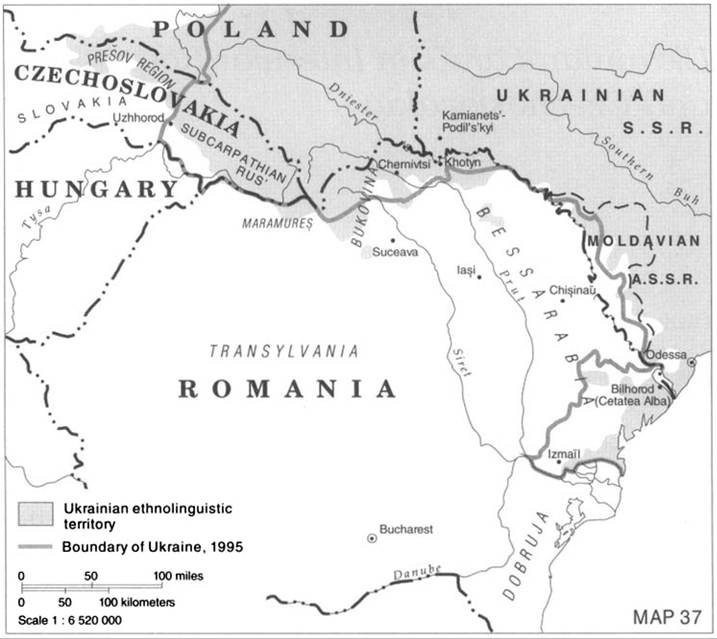
The Ukrainians in interwar Romania, who in 1930 numbered anywhere between 582,000 (official statistics) and one million (unofficial estimates) people, lived in three geographically separate regions: Bukovina, Bessarabia, and Maramurej.
The largest number (461,000) inhabited southern Bessarabia, which until World War I had been part of the Russian Empire. Another 302,000 Ukrainians lived for the most part in the northern half of the former Austrian province of Bukovina. The remaining 17,000 Ukrainians were found in the southern portion of the old Hungarian county of Maramaros (in Romanian, Maramure§). They were separated from their brethren north of the Tysa River in Subcarpathian Rus' (Transcarpathia), which in 1919 became part of Czechoslovakia.Interwar Romania was a parliamentary kingdom ruled by the same Hohen- zollern dynasty that had come to power in 1866. During the 1920s, Romanian political life was dominated by the Liberal party, whose goal was to create a centralized state. The result was that newly acquired regions which before World War I had enjoyed various degrees of autonomy (Bukovina, Transylvania) now found themselves in a state determined to do away with all vestiges of self-rule. During the 1930s, Romania’s new king, Carol II (reigned 1930-1940), succeeded in weakening the role of parliament until, in 1938, the country was transformed into a royal dictatorship.
Bessarabia’s Ukrainians were the first to come under Romanian rule. Tucked in between the Prut and Dniester Rivers and touching the shores of the Black Sea, Bessarabia was the eastern region of historic Moldavia and since 1812 had been a province of the Russian Empire. After the March 1917 revolution, the Central Rada in Kiev laid claim to Bessarabia, and local Ukrainians set up schools and cultural societies (notably Prosvita).
In response, the Romanians of Bessarabia organized a provincial council (Sfatul Tarii). In early December 1917, this council formed a democratic Moldavian republic in federation with Russia; then, in late January 1918, it declared its independence. Meanwhile, a Romanian army had occupied the area, and on 27 March 1918 Moldavia (Bessarabia) proclaimed itsUKRAINIAN/RUSYN LANDS IN ROMANIA AND CZECHOSLOVAKIA, ca. 1930
unification with the Kingdom of Romania. Caught unprepared by this fait accompli, France, Great Britain, Germany, Italy, and Japan - but not the Soviet Union - on 28 October 1920 signed the so-called Bessarabian Protocol, which recognized Romanian rule. During the interwar years, the Ukrainians in southern Bessarabia were permitted to have their own elementary schools (120), a few cooperatives, and representatives in the Romanian parliament.
Whereas Ukrainians in southern Bessarabia enjoyed minimal cultural and national rights, the situation in northern Bukovina was virtually the opposite. Old Austrian Bukovina had enjoyed more cultural and political autonomy than any other Ukrainian-inhabited land within the Habsburg Empire. This was in large part due to the representational balance between Ukrainians, Romanians, Jews, Austro-Germans, and Poles that was set up before the war by the Habsburg government. All this was to change after the beginning of Romanian rule in November 1918.
What had previously been the multinational administrative and cultural center of Chernivtsi was transformed, at least outwardly, into a Romanian city. Alongside the prewar Society for Romanian Literature and Culture in Bukovina, a whole host of new Romanian schools, civic organizations, and newspapers were founded. The linguistically ‘neutral’ German-language university that the Habsburgs had founded in 1875 was transformed into a fully Romanian-language institution. It was renamed the King Carol I University of Chernivtsi, and one of its most prominent rectors, the nationalist historian Ion Nistor, was determined to imbue its students with the conviction that they were being educated in a land that had finally been returned to its rightful place within ‘Greater Romania.’ The Orthodox church, with its metropolitan seat in Chernivtsi, also became Romanian in character.
The language of internal administration became solely Romanian, and parishes in Ukrainian villages were expected to conduct the traditional Church Slavonic liturgy partly in Romanian (an instruction that in practice was rarely followed). Finally, the church’s jurisdictional status was altered. In 1921, its name was changed from the Greek-Oriental to the Orthodox Romanian (ortodox- romana) church, and in 1925 it became the Metropolitanate of Bukovina and Khotyn within the framework of the autocephalous Romanian Orthodox church. Its first prelate was the Ukrainian-born Bukovinian Romanophile and avid promoter of all things Romanian, Metropolitan Nectari Kotlearciuc (reigned 1925-1935).Not surprisingly, the fortunes of Bukovina’s Ukrainians were profoundly affected by the new postwar order, so that during what Soviet Ukrainian authors used to call ‘the years of Romanian boyar occupation,’ they quickly became worse off than their fellows in Czechoslovakia’s Transcarpathia or even Poland’s Galicia. Bukovina’s diet, provincial administration, school board, and district self-government from the Austrian era were all abolished. On paper, Bukovina survived for a while as an administrative unit, but in 1932 it was eliminated and divided into five Romanian counties.
One aspect of Bukovinian life that did not change much was the economic status of the Ukrainian population. As under Austrian rule, the vast majority continued to work as small-scale subsistence farmers, some of whom supplemented their income by raising livestock, in particular sheep. Like Poland and other countries in east-central Europe, Romania introduced a land reform program during the 1920s whose goal was to reduce the size of large landholdings. Although 186,000 acres (75,500 hectares) of land from landed estates in northern Bukovina were offered for sale, most did not go to the indigenous population, but rather to Romanian immigrants from other parts of the country. Moreover, while the newcomers received 10 acres (4 hectares) of land and 2-5 acres (1 hectare) of pasture on average, individual Ukrainian farmers increased their holdings by only half a hectare on average.
Land was paramount, because Ukrainians in Romania had no economic alternatives. In both northern Bukovina and southern Bessarabia industry remained underdeveloped. By 1930, for instance, northern Bukovina had only 15,000 factoryworkers. This meant that throughout the interwar years of Romanian rule the two regions remained economically backward, with their Ukrainian population engaged almost exclusively in small-scale subsistence agriculture or livestock raising.
Although the economic status of Ukrainians did not change, Ukrainian political and cultural life, which had thriven in Bukovina under prewar Austrian rule, came to an end. During the first decade of Romanian rule (1918-1928), Bukovina was ruled by martial law. All Ukrainian cultural societies were closed, the use of Ukrainian was discontinued in the court system, and all Ukrainian newspapers were banned. The educational system was subjected to romanization. The Romanian language began to be introduced as the language of instruction in schools at the very outset of Romanian rule. Nonetheless, by the 1922-1923 school year, there were still 255 Ukrainian schools. In July 1924, however, a law was passed which classified Ukrainians, to quote the Chernivtsi University rector Ion Nistor, as ‘Romanians who had lost the native tongue of their ancestors.’1 Such ‘Romanians’ were not permitted to ‘send their children to any school, public or private, other than a school in which instruction is given exclusively in Romanian.’2 For all intents and purposes, Ukrainians lost their status as a national minority, and the romanization of schools was intensified. By 1927, the process was complete: there were no more Ukrainian elementary schools in Bukovina. Only a few hours a week of Ukrainian instruction was offered, and in 1931 two Ukrainian school superintendents were appointed to supervise this minimal program. At the secondary level, all Ukrainian gymnasia and technical schools were closed in 1920, and the departments of Ukrainian subjects set up during Austrian rule were abolished at Chernivtsi University.
The status of Ukrainians improved somewhat in 1928, when for a few years the National Peasant party dominated Romanian politics. Ukrainian candidates, who previously had been elected on Romanian tickets (Kost' Krakaliia, Antin Luka- sevych, lurii Lysan), now represented the new Ukrainian National party, established in 1927 and headed by the national leader and art historian Volodymyr Zalozets'kyi-Sas. Ukrainian-language daily (Chas, 1928-40) and weekly (Ridnyi krai, 1926-30) newspapers were also permitted.
This brief revival of Ukrainian political and cultural activity soon waned, however, with the return of the Liberal party in 1933. Moreover, by the end of the decade, Romania’s parliamentary democracy had become meaningless. The state was transformed into an authoritarian dictatorship under King Carol II (reigned 1930-1940), whose government had little sympathy with the country’s national minorities.
The Rusyns/Ukrainians of Czechoslovakia
Unlike in interwar Poland and Romania, where the political, cultural, and socioeconomic situation of Ukrainians worsened in comparison with what it had been during the pre-1914 era of Austrian rule, in Czechoslovakia the situation of Rusyns/Ukrainians improved. Their rather unique status was owing to several factors. Officially known by their historic name, the Rusyns or Subcarpathian Rusyns (podkarpats' ki rusyny) voluntarily joined the newly created Czechoslovak republic in May 1919. Moreover, they inhabited the only Ukrainian land to receive specific guarantees for self-government according to international law as outlined in the postwar peace settlements (the Treaty of St Germain). Finally, the republic
Ukrainian Lands in Romania and Czechoslovakia 603 of Czechoslovakia, headed by the renowned scholar and publicist Tomas G. Masaryk, considered itself a Slavic state and was favorably disposed to Rusyns/Ukraini- ans in Transcarpathia as well as to Ukrainian emigres from Galicia and Dnieper Ukraine who settled in the province and elsewhere in the country.
Czechoslovakia’s capital, Prague, became the leading intellectual center of Ukrainian emigres in Europe during the interwar period. Accordingly, the Rusyns/Ukrainians of Transcarpathia found themselves in a favorable political environment.The new Czechoslovak state was formed as a republic. It had a bicameral central parliament in Prague, consisting of the elected House of Deputies (Poslanecka Snemmma) and the Senate (Sen at), and a government headed by an elected president who held office for seven years. Only two presidents held office in Czechoslovakia throughout the interwar period: the founder of the republic, Masaryk, until 1935, and after that his longtime minister of foreign affairs, Edvard Benes. It is useful to note that throughout east-central Europe most of the small so-called successor states (that is, those new countries which had been carved out of the old prewar empires) began as parliamentary democracies. All with one exception, however, had by the 1930s become authoritarian dictatorships. The exception was Czechoslovakia, which until the very end of the interwar period maintained a liberal democratic system characterized by a representative government and the rule of law. This state of affairs was to have a very positive effect on Transcarpathian developments.
There were, nonetheless, certain political problems. Although a distinct province, known officially as Subcarpathian Rus' (Podkarpatskd Rus'), was established in 1920 with its own governor, it did not include all ‘Ruthenes (Rusyns) living south of the Carpathians,’ as called for in the Treaty of St Germain. Of the 458,000 Rusyns recorded in eastern Czechoslovakia in 1921, nearly 86,000 were placed under a Slovak administration in an area popularly known as the Presov region. Although autonomy was promised to Subcarpathian Rus', its specific form was not spelled out.
It is not surprising, therefore, that the very first governor appointed by President Masaryk to administer Subcarpathian Rus', the Rusyn-American lawyer Gregory Zhatkovych, made the questions of autonomy and the unity of all Rusyns into one province his primary concerns. He hoped that autonomy would be implemented (with rights similar to those held by American states) and that the Rusyns under Slovak administration would be united with Subcarpathian Rus'. Failure to obtain these goals prompted Governor Zhatkovych’s resignation in protest as early as 1921.
The Czechoslovak approach was similar to the former Habsburg approach in politics - procrastination. Prague argued that autonomy could not be implemented in Subcarpathian Rus' because the local inhabitants were not yet mature enough to participate in a modern democratic political process and because many of the local leaders, especially the traditionally influential Greek Catholic clergy, favored or anticipated a return to Hungarian rule. Until a transitional or educative period was completed, Prague would have to rule the region directly. It was not clear, however, how long this transitional period was to last. In 1928,
Czechoslovakia was divided into four provinces, one of which was Subcarpathian Rus' (formally renamed the Subcarpathian Rusyn Land - Zeme podkarpatoruska). Each of Czechoslovakia’s provinces was endowed with a provincial diet, and although there were governors appointed from among the local population to head the province of Subcarpathian Rus' (Antonin Beskyd, 1923-1933, and Kon- stantyn Hrabar, 1935-1938), the administration was de facto in the hands of a Czech vice-governor. Thus, Subcarpathia’s political demands - autonomy and the unity of all Rusyns/Ukrainians - were never fulfilled during the era that came to be known as that of the first Czechoslovak republic.
One reason for the Czechoslovak government’s reluctance to grant autonomy to Subcarpathian Rus' was the presence of a large Magyar (Hungarian) population, which was considered a potential threat to the political stability of the region. The Magyars were the second-largest nationality in Subcarpathian Rus', with 192,000 inhabitants, or 17 percent of the population, in 1921. They lived in a compact territory running along the border with Hungary, and they made up a significant portion of the population in the area’s two largest cities, Uzhhorod (18 percent) and Mukachevo (23 percent). In fact, the Magyars lived on lands that were simply an extension of the Hungarian plain, now separated by an international border from what remained of postwar Hungary. In the new Slavic state of Czechoslovakia, the Magyars found themselves in a situation they had never encountered before: they were a minority in their own homeland.
As a national minority, the Magyars continued to have access to education in their native language at all levels through high school (gymnasium), and they enjoyed all the rights granted citizens of democratic Czechoslovakia, including a Magyar-language press free from government control and elected representatives to local legislative bodies as well as the national parliament in Prague, where their deputies and senators addressed the assembly in Hungarian. Nevertheless, many Magyars in Subcarpathian Rus', especially their spokespersons in the National Christian Socialist party and the Magyar National party, assumed that Czechoslovak rule was only temporary and that sooner or later the region would be returned to Hungary. The local Greek Catholic church, in particular during the early 1920s, included many pro-Hungarian priests and hierarchs, and by the 1930s local Magyar politicians led by Count Janos Esterhazy were becoming increasingly susceptible to propaganda from neighboring Hungary that was agitating for the reacquisition of that country’s former Highlands (Felvidek) to the north - Slovakia and Subcarpathian Rus'.
Although the political demands put forth by Rusyns/Ukrainians were not fulfilled, the inhabitants of Subcarpathian Rus' acquired concrete experience with democracy. For the first time, the masses participated in fair elections held at the village, county, provincial, and national levels. Regardless of national background, Subcarpathians were elected to both houses of the Czechoslovak parliament (in 1924, 1928, and 1935), where they took an active part in the legislative process. Political parties also came into being, both local Rusyn/Ukrainian parties and branches of all-Czechoslovak parties. Finally, there were even the trappings of a provincial, state-like identity. According to Czechoslovak law, Rusyns were the
Ukrainian Lands in Romania and Czechoslovakia 605 ‘state nationality’ in Subcarpathian Rus'. They even had their own national anthem (based on the nineteenth-century national leader Aleksander Dukhno- vych’s poem ‘Subcarpathian Rusyns / Arise from Your Deep Slumber’), sung on all public occasions, as well as an official Subcarpathian Rusyn coat of arms, which appeared on publications and governmental documents.
Subcarpathian Rus' had especially important geopolitical significance for Czechoslovakia. The interwar period found Czechoslovakia surrounded on almost all sides by enemies - Poland, Hungary, and, eventually, Germany. The earliest significant threat was that posed by Hungary, which felt that a profound injustice had been done to it by the 1920 Treaty of Trianon. Border revisionism became the dominant slogan of interwar Hungarian foreign policy, and Subcarpathian Rus' as well as Slovakia and Romania’s Transylvania were primary objects of Budapest’s territorial designs. To protect itself against the Hungarian threat, Czechoslovakia formed the so-called Little Entente with Romania and Yugoslavia. Its only geographic link with these allies was through Subcarpathian Rus'. Thus, the province, which Czech and Slovak leaders had never expected to obtain during the postwar repartitioning of Europe, now became an important geopolitical cornerstone of its foreign policy.
In its economic life, Subcarpathian Rus' did not fare well. Agriculture remained the mainstay of the region’s economy, and local industrial development was effectively stifled. This was because it proved economically more beneficial to export products from the highly industrialized western provinces of Bohemia and Moravia-Silesia to Subcarpathian Rus' than to build new factories there. As for products derived from the region’s own natural resources, particularly lumber from the Carpathian forests, businesses in Bohemia and Moravia-Silesia found it cheaper and easier to import forest products from neighboring Slovakia.
The result was that the vast majority of the Rusyn/Ukrainian population - 82 percent in 1930 - was engaged in agricultural or forest-related work. Whatever trade or small-scale industry existed was in the hands of the local Magyar and Jewish inhabitants (who made up respectively 15.4 percent and 12.8 percent of the Subcarpathian population in 1930), or of Czechs, who began to arrive in steadily increasing numbers (by 1930 they comprised 2.9 percent of the area’s population).
The Czechoslovak government did attempt to improve the economic status of Subcarpathian Rus'. In effect, Prague invested more than it extracted in order to construct a hydroelectric system and a network of modern roads and bridges. Governmental agencies also promoted new methods of cultivation, introduced better strains of existing crops, and provided educational assistance to farmers and livestock breeders. Moreover, a land reform was introduced in the 1920s, which in part broke up the largest estates once owned by the Hungarian nobility. The practical results of the land reform were limited, however. Only 57,000 acres (23,000 hectares) were permanently redistributed, to 9,100 farmers; 20 percent of the land in Subcarpathian Rus' (590,000 acres [239,000 hectares]) remained in the hands of large landowners. Also, the authorities were unsuccessful in their effort to move Rusyn/Ukrainian farmers from their mountain villages to the more fertile lowlands in the southern part of the province. Hence, by the late 1930s as
many as 70 percent of the farmers in Subcarpathian Rus' still had less than 5 acres (2 hectares) of land, and another 18 percent had between 5 and 12 acres (between 2 and 5 hectares). Such plots were well below the minimum required to support a single family.
This meant that the need to find supplementary work was as acute as ever. But now there was another problem, one brought about by the geopolitical realignment of postwar east-central Europe. The new international boundaries closed off Rusyn/Ukrainian agriculturalists from the nearby Hungarian plain, where they had traditionally added to their income with seasonal work. The wealthier provinces of Bohemia and Moravia-Silesia, however, were too far away to make it economically feasible to sell surplus agricultural products from Subcarpathian Rus' there. These new realities were only made worse during the world economic depression of the 1930s, when mortgage foreclosures, strikes, grain shortages, and starvation became common phenomena. Economic discontent was translated into support for the Subcarpathian Communists, whose party was one of the strongest throughout the interwar period. Despite the well-meaning efforts of the Czechoslovak government, the province was simply too far away and too underdeveloped for Prague to have been able to make any substantial economic improvements.
It was in the cultural sphere that the Czechoslovak regime made the most marked progress in Subcarpathian Rus'. The contrast could not have been greater between, on the one hand, the prewar Hungarian government, which had ruled an underdeveloped agrarian society and had little interest in the peripheral areas of the old kingdom other than wanting to magyarize those inhabitants of non-Magyar nationality, and, on the other, the democratic Czechoslovak government, which hoped to improve what it considered the backward cultural level of its fellow Slavs at the eastern end of the postwar republic.
TABLE 45.1
Schools in interwar Subcarpathian Rus's
| Type | Number | Number with instruction in East Slavic | ||
| 1920 | 1938 | 1920 | 1938 | |
| Elementary | 475 | 809 | 321 | 469 |
| Municipal | 10 | 52 | 7 | 23 |
| Gymnasia | 4 | 8 | 3 | 5 |
| Teachers’ colleges | 3 | 5 | 3 | 4 |
| Professional/technical | 3 | 5 | 3 | 5 |
| TOTAL | 495 | 879 | 337 | 506 |
Perhaps the longest-lasting changes occurred in the school system. During Czechoslovak rule, there was a dramatic increase in the number of schools (see table 45.1). The expansion of the physical plant was accompanied by an increase in the student body, whose number doubled between 1920 and 1938. This devel-
Ukrainian Lands in Romania and Czechoslovakia 607 opment, combined with programs in adult education, reduced the level of illiteracy from 78 percent in 1910 (near the end of Hungarian rule) to 40 percent in 1930-
The changes in the language of instruction were even more dramatic. During the last years of Hungarian rule before World War I, there were only 34 bilingual elementary schools, which provided a few hours of instruction in the local Rusyn vernacular. The Czechoslovak regime, however, made a concerted effort to offer instruction in some East Slavic medium, whether Ukrainian, Russian, or the local Rusyn speech, with the result that in 1920 there were over 300 such ‘Rusyn’ schools in all categories, a number which had risen to over 500 by 1938 (see table 45.1). The actual language of instruction in ‘Rusyn’ schools varied (sometimes from class to class) among Ukrainian, Russian, and Rusyn, with the choice dependent on the preference of the teacher. In large part, the linguistic variety in schools was a reflection of the unresolved problem of Subcarpathian Rusyn national identity. By 1938, there were also elementary and municipal schools which offered instruction in Czech (206), Magyar (127), German (25), Yiddish (7), and Romanian (4); a Czech-language teachers’ college; and gymnasia and vocational schools with divisions in Czech, Magyar, and Yiddish. Finally, Subcarpathian Rus' boasted the only school in the world with Romani (Gypsy) as the language of instruction.
The first long-lasting cultural organizations came into being under interwar Czechoslovak rule. The most important were the Prosvita Society, established in 1920 on the model of the same society in Galicia, and the Dukhnovych Society, established in 1923 and reflecting the models and national ideology of russophile organizations in Galicia. Each of these societies constructed its own national home in Uzhhorod, the administrative capital, and set up branches and reading rooms throughout the province. By 1929, the Prosvita Society had 96 reading rooms and the Dukhnovych Society 192. Both societies also published numerous books and other works, the most scholarly being the Prosvita Society’s journal Naukovyi zbomyk (Uzhhorod, 1921-38). These two leading cultural societies were supported in part by the Czechoslovak government, which in 1931 also established the Subcarpathian Rusyn National Theater. The remarkable improvements in education and growth in cultural organizations were accompanied by a rise in literary activity (VasyP Grendzha-Dons'kyi, Andrii Karabelesh, lulii Borshosh- Kumiats'kyi, and Aleksander Markush being the leading writers), with the result that the interwar era of Czechoslovak rule witnessed a true cultural and national renaissance for Subcarpathian Rus'.
The cultural sphere was not without its problems, however. One concerned religion and a struggle between competing churches. In the new democratic environment, the traditional predominance of the Greek Catholic church was challenged by the Orthodox, and the consequence was a religious war, notably during the 1920s, and a rise in the number of conversions to Orthodoxy, whose adherents increased from fewer than 1,000 at the outset of Czechoslovak rule to 90,000 in 1930. In part, the rivalry between the churches was related to the nationality question. Those who joined the Orthodox church often turned to a Russian
national identity in reaction to the Greek Catholic church, which initially was dominated by pro-Hungarian (magyarone) elements, until the 1930s, when it became a bastion of the Rusyn national orientation.
It was, in essence, the issue of national identity and the closely related language question which were the most problematic aspects of Subcarpathia’s civic life. Although these problems had existed during the nineteenth century as well, they had been overshadowed by state-imposed magyarization and national assimilation. Now, under the Czechoslovak republic, the local Slavic population and its leaders had the freedom to determine who they were. During the resulting debate, the Subcarpathians were influenced by emigres, both Ukrainophiles (Ivan Pan'kevych and Volodymyr Birchak) and Russophiles (liarion Tsurkanovich, Andrei Gagatko, and the Gerovskii brothers) from Galicia and Bukovina. Thus, as in neighboring eastern Galicia and northern Bukovina during the late nineteenth century, now in Transcarpathia during the interwar period there arose a struggle between ukrain- ophile and russophile intellectuals for the allegiance of the population. An important difference was the presence of a third orientation, the Rusynophiles, who argued that the East Slavic population of Transcarpathia was neither Russian nor Ukrainian, but rather a distinct Subcarpathian Rusyn nationality.
All aspects of interwar Transcarpathian life were affected by the presence of these three orientations - the political parties, the schools, the cultural organizations, and, to some degree, the churches. Although the Czechoslovak administration for the most part remained neutral in the linguistic and national controversy, by the 1930s it clearly favored the Rusynophile orientation, that is, the idea of a distinct and, it hoped, pro-Czechoslovak Subcarpathian Rusyn nationality. The first and last governors of the province, Gregory Zhatkovych and Konstantyn Hra- bar, also favored the rusynophile view.
Although russophilism and rusynophilism had existed in Subcarpathia’s cultural life during the nineteenth century, the Ukrainian orientation did not really make its appearance until the 1920s. Led by capable political and cultural leaders (Avhustyn Voloshyn, luliian Revai, Vasyl' Grendzha-Dons'kyi), the Ukrainian orientation before long came to be the most dynamic. Nevertheless, by the end of the interwar period, all three national orientations in Transcarpathia were exerting more or less equal political influence.
During the interwar years, the Transcarpathian Ukrainians, or Subcarpathian Rusyns as they were known, made remarkable achievements, especially in political and cultural life, under the administration of the democratic first Czechoslovak republic. As a result, of all Ukraine’s territories, Transcarpathia, while among the smallest, was the only one to have some control over its political and national destiny during the interwar years. And because it was at the westernmost edge of Ukrainian territory, it was the first to experience change with the coming of a new crisis in Europe in 1938.