War Against Tsarist Despotism
Not even a decade after Nalyvaiko s and Lobodas revolt, a major uprising against serfdom broke out in Muscovy. The peasants in Muscovywere free men up to the second half of the 15th Centurywhen limitations began to be placed on their right to leave estates owned by the princes, the monasteries, and other lesser landowners.
Nevertheless, a window had been left open, which allowed peasants to move during the two weeks of St. Georges Day (26 November) after they had paid state taxes and the landowner s fees. The Muscovite peasant was still better off than most of his counterparts in Lithuania-Rus and Poland, at least until the reign of Ivan IV (The Terrible) when a decree was passed in 1592 banning the St. George s Day right to move, which in effect bound the peasants to the land. The dissatisfaction, and the uprisings which followed, would almost destroy the Muscovite state. As in the Polish Commonwealth the Cossacks were in the forefront of the peasant revolt led by a Cossack called Bolotnikov.The same conditions that had given rise to the Cossacks along the Dnipro River had produced the town Cossacks of Putivl, in the territory of Chernihiv and the Donets and Don waterways. Cossackhunters and fishermen from the aUkraina* also began to move east. We know of their presence because, when Tatar “mirza* (nobleman) in 1538 complained to Prince Ivan IV that “town Cossacks (from Putivl)* were raiding Tatar settlements, the prince replied, “on the steppe there are many Cossacks... and other troublemakers and you are mistaking them for our Ukraina (Muscovite border) Cossacks.*19
After 1520 Cossack outposts began to appear on the Donets River, and after the establishment of the Sich in the “Down Under* region of the Dnipro River we see Ukrainian Cossack settlements on the lower Don. By 1600 there were many Cossacksettlements in southern Muscovy, reinforced by escaped serfs who sought asylum amongst the Don, Yaik and Terek Cossacks.
ByMuscovite law, if they could elude capture for five years they were free men. Given the virtual slavery of serfdom there were always men who were willing to risk the dangers of the steppe for a free life. We have an early indication OfZaporozhian or “Cherkasian* presence from an old Don Cossack folk song of the Ottoman Mishka Cherkashenin (“The Circassian*), dating to the middle of the 1500s.The free Cossacks have come back safe and sound,
But have brought you back dead, my darling! Theybrought back the dead field ottoman, And his name was Mikhail Cherkashenin.20
The revolt that marked the beginning of the “Smutnoye Vremia* or the Times of Trouble, as the period of Muscovite history has become known, was triggered by two unrelated events. In 1598, Tsar Ivan the Terrible s son Fyodor (Theodore) died without leaving an heir. His son Dmitry (Demitrios) had died as a child in 1591, apparently with some violence during what was probably an epileptic fit, bringing the Rurik dynasty in Muscovyto an end. No known descendants could be found and a “Zemsky Sobor* or a Council of the Land was convened, which proceeded to elect a Wealthyboyar by the name of Boris Godunov as Tsar. He seems to have been a man of some perception and was aware of Muscovy s isolation and relative backwardness. The new Tsar attempted to establish a university in Moscow, a project which failed due to the opposition of the Orthodox Church. Instead he sent 18 young men to study abroad in Europe, none of whom chose to return to Muscovy.
Three years into his reign a great catastrophe struck the realm. Severe frosts in the autumn of 1601 were followed by heavy snows, and a widespread famine broke out which lasted for two years. Hundreds of thousands of people died from starvation and related disease, approximately one third of the population. The city of Moscow itself lost 100,000 people. According to medieval law dating to Jaroslav the Wise of Kyiv, a lord was responsible for feeding his peasants, failing which they could leave his service in search of sustenance.
The failure to honor the Iawbegan to cause great discontent and serfs started to roam the countryside in search of food. Then during the famines peak a large force of serfs and slaves, led by one Khlopko (“brigand*) began to march on Moscow to “seize food, property, and to kill the rich* They were met before the city gates by a large force led by Godunovs General Ivan Basmanov and defeated, with the wounded Khlopko taken prisoner, charged with sedition, and executed.The Khlopko uprising was the beginning of a turmoil. Rumors began to circulate that the young Tsarevich Dimitry had not died and was returning to claim his throne. Boris Godunov was therefore not the rightful Tsar and this was just what the middle class nobility, which was on the verge of revolt, wanted to hear. The structure of government of Greek Orthodox Muscovy was different from that of the Roman Catholic Commonwealth, although both had rigid class divisions built into the state s foundation. Following the traditions of KyivRus and the Eastern Roman Empire, the Tsar s legitimacy came from God and as such he was an undisputed autocratic ruler.21 Supporting the Tsar was a body of about 2,000 nobles who ran the civil service, the army, and sat in the Boyar,s Duma, the Tsar s advisory body. These were what has become known as the senior service class which included the princes, boyars, and men who had come to the Tsars attention by virtue of their performance. They were supported by land holdings, ranging from tens of thousands of acres to as little as a thousand, which were held
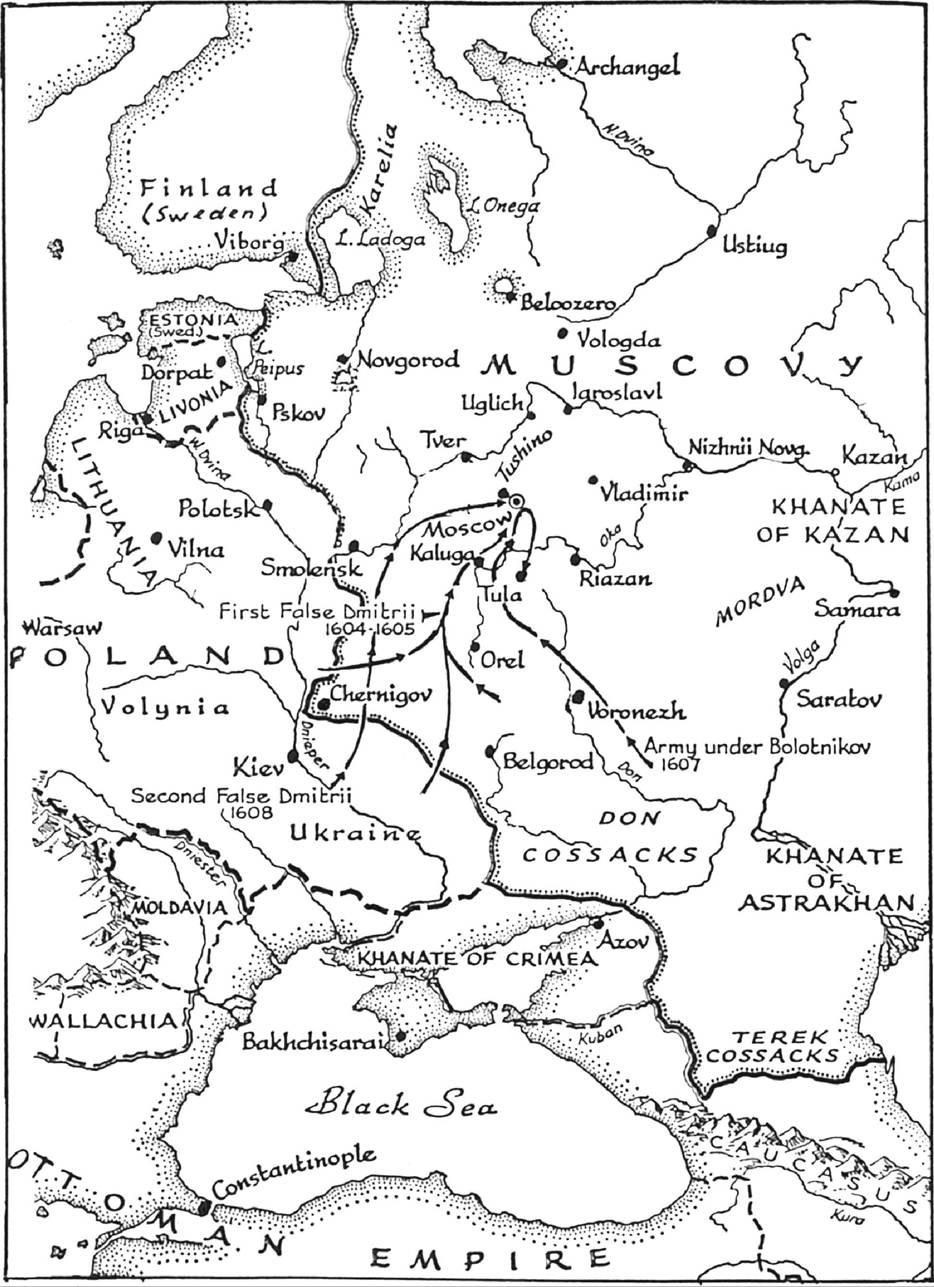
Muscovy and Ukraine during the Cossack-Ied revolution.
either by hereditary right or a grant from the Tsar, and could contain hundreds of peasant households.
The entire system depended on the members of the middle serving class, who were similar to west European knights. These were armored cavalrymen, about 25,000 in all, and comprised the core of the Muscovite military force.
Theywere supported by land grants and also used peasant and serf labor, about 5-6 households each on the average. At the bottom of the military-driven class structure was the so-called lower service class, who were paid annual salaries from the Tsar’s treasury. They were recruited from townsmen and free peasants, and consisted Ofinfantrymusketeers, artillery gunners, and Cossack volunteers.22A man claiming to be Dimitry now appeared to challenge Tsar Boris Godunov, a monk by the name of Gregory Otrepriev who had left his monastery and gone to Putivl, where in the autumn of 1604 he was joined by the town Cossacks and other burghers, as well as Ukrainian border magnates such as Vysh- nevetsky, Ruzhynsky, Strus and Ratomsky. He was also joined by a large force of Zaporozians in December 1604, who for some reason soon abandoned him. Many Cossackbands, however, continued to flock to his banner. The imposter was a man of some intelligence, described as having bright red hair, a big ugly nose, a wart on his face, and arms of unequal length. The revolt was soon joined by peasants and the Don and Terek Cossacks and began to engulf most of Muscovy. Theywere joined by Godunov’s troops sent against them who deserted to the rebels in large numbers. InApril 1605 Boris Godunov suddenly died—probably poisoned—while his son Fyodor was murdered by anti-Godunov boyars to prevent his succession to the throne. The false Dimitry entered Moscow and was installed as Tsar. He began to show intentions to help the people but this was not to be. Eleven months later he was also murdered at the instigation of a powerful boyar called Vasili Shuisky who was pronounced as Tsar by the conspirators.
Matters did not rest there, and a second false Dmitry appeared, this time in the person of a Don Cossack called Bolotnikov. He had apparently been a slave of Prince Teilatovsky and as a youth had run away to join a Cossack band operating in the southern steppe of the Don and Volga rivers.
Taken prisoner by the Crimean Tatars he was sold as a slave to the Turks and spent several years on a galley as an oarsman. He was rescued by a Christian ship following a sea battle in the Mediterranean and was on this way home when he met a Muscovite, Mikhail Molchanov, in Sambir (Galicia). Molchanovhad been sent by a self-styled Prince Grigory Shakhovsky to solicit Polish help in a revolt against Shuisky The “prince” had fought in the false Dmitry’s army, and following the pretender s assassination the new Tsar Shuisky appointed him as Governor of Putivl. The intention was no doubt to post Shakhovsky far from where he could do harm, but this turned out to be a mistake. The Ukraina or frontier region of Muscovy was never far from revolt, and finding himself in like-minded company Shakhovsky began to spread a rumor that Shuisky had failed to kill the “true Tsar Dmitri.”Another imposter was needed for the cause, and Bolotnikov agreed to play the role. He arrived in Putivl in the summer of 1606 with a letter from Molchanov and quickly gained Shakhovsky’s confidence. Shuisky’s men were attacked and killed and another Uprisingbegan to spread from the Ukrainian prairies. The tall, powerfully built Bolotnikovfound himself at the head of some 12,000 men who included many inexperienced peasants, but also veterans of Khlopkos and the (first) false Dmitry’s uprising. The hard core of Bolotnikovs army, however, were men who had deserted Godunov and Shuisky including the Putivl garrison, and above all the Putivl, Za- porozhian, and Don Cossacks who provided much of the discipline and the fighting ability.
Town after town began to fall to Bolotnikov s men as they advanced towards Moscow, with the peasants rising and destroying boyars’ estates. Most of Bolotnikov s men, however, came from towns and included many noblemen who had been driven into poverty by the powerful big landowners such as the leaders of the Riazan militia, the boyars Prokopi Liapunov and his brother Zachary, who had lost their lands.
The misery brought by the famine and pestilence and the end of the Ryrik dynasty transformed the insurrection into a social uprising of the poor, the peasants, the lower military serving class, and many of the middle gentry directed against the Wealthylanded Oligarchywhich had begun to thrive once more under Shuisky.23 Backed by local burghers Bolotnikov s men scaled town walls, threw open prison doors, sacked the treasuries and arsenals, and destroyed all deeds and tax records which fell into their hands.The first major clash between Tsarist forces and the rebels came when, anticipating Bolotnikov s arrival, the strategically located town of Kramny rose in revolt. A strong force under Prince Trubetskoywas sent to recapture it but was forced back when the rebel garrison sortied from behind the walls. When Bolotnikov arrived with the main force, the Tsar s troops refused to fight, even though numbers were on their side. Breaking ranks many headed home, and a good part of Trubetskoy s men joined the rebels swearing allegiance to the “Tsarevich Dmitry.” Another Tsarist force led by Prince Voratynsky which was besieging the rebel town of Elets also put up a half-hearted effort and was easily defeated by a rebel detachment of knights led by the Tula squire Istoma Pashkov. Many others turned against Godunov, and later abandoned Shuiskywhen the former Tsar prohibited entry to the middle service gentry to sons of slaves, peasants, and clergymen while the latter had extended the ban to children of townsmen. The false Dmitry, on the other hand, had raised the compensation scales for the middle serving men- at-arms, and was seeking to distribute some of the monastery lands in their favor. There was nevertheless a distinct class division which remained between the middle serving men and the rest of Bolotnikov’s men, and both fought in separate units under their own commanders. More importantly their interests clashed on the question of serfdom. Tsar Shuiskyhad reaffirmed the middle serving gentry’s right to exploit serf labor, at a time when the peasants and the lower serving class were looking forward to freedom and a more equitable distribution of wealth.
Liapunov and Pashkov conducted their own operations, and when Bolotnikov advanced on Moscow their forces moved in a separate column. On 23 September 1606, Bolotnikovs commoners reached the Oka River south of Moscow, a few miles below Kaluga, where Tsar Shuisky made a stand with a newly assembled army. After bloody fighting Bolotnikov s Cossacks broke through Shuisky s defensive position and forced him to retreat. Theywere followed by Bolotnikov s other men, who proceeded to capture Serpukhov, the last town to stand in the waybetween them and Moscow. Theywere Onlyhalted on the Pokhra River twelve miles from the capital when Shuisky s nephew Mikhail Skopin-Shuisky arrived with fresh reinforcements. In the meantime Pashkov s column was advancing unopposed from the west, but reaching Kolomna they found the stronghold defended by the Tsar s men. The citadel was quickly captured after a sustained assault and subjected to the usual sack and pillage. Pashkovwas now reinforced by the arrival of Liapunov’s men, and a force commanded by Shuisky s brother Dmitry was easily routed, with the fleeing troops pursued to within striking distance of Moscow. While Bolotnikovs main force was delayed on the Pokhra River the gentry took up positions outside of the capital, and on 7 October the siege of Moscow began which was to last for two months.
Shuisky mobilized whatever able-bodied men he could find in Moscow. Realizing many were unreliable, and since the citywas not yet completely surrounded, he also sent his brother Ivan to raise fresh forces in territory beyond the insurgents’ ControLAlthough the Tsarhad the support of Metropolitan Filaret and the Church hierarchy, the burghers and the poor of Moscow shared a secret affinity with the rebels. Informed of the sympathy and to communicate with his potential supporters Bolotnikovhad leaflets smuggled into Moscow urging the citizens to revolt. This was described byJohn Merick, the English chief agent of the Russia Companywho was in Moscow at the time. “They continued the siege and wrote letters to the slaves within the town, to take arms against their masters and possess themselves of their goods and substance.”24
By mid-November the Muscovites were on the verge of revolt, even as Tsar Shuisky was receiving reinforcements and Patriarch Hermogen was appealing for the people’s support, describing the rebels as “agents of Satan.” Most importantly, Shuisky was in secret communication with the leaders of the rebel gentry, who were beginning to have second thoughts about their lower class allies. Many of the middle serving men were realizing the insurrection had taken a radical turn, and that deprived of serf labor they would lose their status as a privileged military class. Then, at the height of the siege events turned for the worse for the rebels. Liapunov decided to desert and with the bulk of his force entered Moscow through a northern gate that had been left open for him. Realizing his error, Bolotnikov launched a major attack on the Tsar’s defenses in Krasnoye Selo to seal off the northern gates along the Moscow River. A large battle broke out during the night and continued into the morning, with both sides throwing in fresh reserves to replace the depleted and exhausted units. Now at the height of the battle Bolotnikov learned that Pashkov had also betrayed him and had gone over to Shuisky, forcing him to break off the battle. On 2 December Shuisky s nephew led a large army against what was left of Bolotnikov’s men consisting of peasants, town burghers, and Cossacks.
The insurgents retreated to their strongholds of Kolomen- skoye and Zaboriye, and not daring to launch a direct attack Shuisky s nephew ordered a heavy cannonade of Kolomen- skoye’s wooden defenses. After three days of bombardment the walls were set on fire forcing the defenders to withdraw south to friendly territory. The stronghold at Zaboriye surrendered without a fight, and the defenders were given as slaves to the nobility. Some of the garrison, however, had fought back, and taken prisoner, they were cut down with swords and their bodies thrown under the ice of the Youza River. Bolotnikov, however, had no intentions of surrendering. With his remaining men he locked himself in Kaluga, a formidable stone citadel which had remained friendly to the rebels. A large army led by Tsar Shuisky himself surrounded the stronghold and a frontal assault was launched but beaten back with heavy losses. Next, heavy siege guns were brought up which made little impression on the thick walls and the Tsar’s men settled down to a long siege. Then a relief force sent to Kaluga was caught by surprise and annihilated. It took six months into the siege for a larger rebel force to assemble and reach the besieged citadel under the command of the dissident boyar Teliatevsky (and Bolotnikov’s previous owner), which forced Shuisky s army to withdraw without a fight. By this time Shuisky s forces were depleted by casualties and desertions, and discipline was difficult to maintain.
Bolotnikovhad also Sufferedheavylosses, and to strengthen his army he moved to Tula to join the other remaining rebel force, which again had become a formidable threat. Shuisky now had the support of most of the middle service gentry and in June at the head of a large army of reportedly some 100,000 men, he attacked the rebel positions. Time after time the Tsar’s men were beaten back from the trenches by Cossack musket fire until their gunpowder ran out, which forced them to fall back to Tula’s citadel. The siege of the city continued but little headway could be made against the thick stone walls which in addition were surrounded by an outer wooden palisade. The Tsar’s nephew was then advised by one of his officers that the Upa River could be diverted to flow into the town and flood out the defenders, and six weeks into the siege Bolotnikovs men woke up to find water flowing through the streets. The volume proved to be inadequate to force Bolotnikov s men out of the citadel but it seems as if the stores of food and gunpowder suffered damages. Promised amnesty on 10 October 1607 Tula surrendered after a four month siege but Shuisky dishonored his word. Only the nobles who had remained with Bolotnikov were pardoned, and Bolotnikov and the other leaders were imprisoned in Moscow and interrogated under torture. In the end all were executed except Bolotnikov, who was taken from Moscow to Kargopol, a small northern town, where he was blinded and later apparently drowned under treacherous circumstances.
The period preceding the beginning of the Thirty Years’ War in 1618 also saw peasant revolts in CentralEurope. Stephen Bocskay s uprising against the Hapsburg occupying armies forced them to withdraw from Transylvania, and then Hungary. The core of Bocskay s army consisted of the so-called “haiduks” or landless peasants who inhabited the central Hungarian plain and lived by hunting, fishing, herding and Occasionallyplunder, much as did the Cossacks. Theywere joined by townsmen and nobles, many of whom were Protestants. Bocskays campaigns were also supported by the Ottoman Empire and came to an end with the Treaty of Vienna in 1595, which ended the Hapsburg-Ied war against the Sublime Porte.