Injecting drug users
HIV transmission between injecting drug users (IDUs) occurs primarily through sharing of HIV-contaminated syringes, needles and injecting equipment. IDUs and their partners are also at risk through sexual transmission.
Since many, particularly female, IDUs support their drug habit through commercial sex they may be at risk of sexual transmission both to and from their commercial and non-paying partners.The epidemiology of HIV infection in IDUs and the social and cultural context of drug use vary substantially between geographical areas. Identifying promising interventions most likely to succeed within a particular setting is reliant upon understanding the local epidemiology and drug-use culture.
Preventing HIV transmission in injecting drug users relies primarily on reducing the frequency of sharing needles, syringes and other paraphernalia used for injecting (“works”), and on ensuring that the risk of sexual transmission for paying and non-paying partners is minimised through safer sex practices. Effective strategies that reduce the risk of HIV transmission through injecting will have other benefits in reducing the incidence of other viral infections (for example, hepatitis B and hepatitis C).
Social, political and legal controversies have hampered prevention strategies to minimise the potential harm of injecting drug use to both the individual and the community, because of particular concerns that increasing the supply of clean injecting equipment would encourage injecting drug use. Research evidence from largely observational evaluations has shown these concerns to be largely unfounded.
Observational studies have demonstrated that needle exchange programmes (i.e. providing sterile needles and syringes in exchange for used ones) are the most effective base for prevention strategies with drug users. Needle exchange has been successfully delivered within health and social services, through outreach workers, and dispensing machines, and has been demonstrated to be associated with reduced HIV prevalence without increasing levels of drug use.
Improved access to bleach cleaning kits (for shared needles and syringes) and training in effective cleaning procedures may reduce HIV transmission through needle sharing. However, the quality of available products and the complex skills required make this a poor substitute to access to clean needles, but better than no intervention at all.Evidence supports outreach and peer-educators as the most effective way to reach drug users in the community. Former injectors and current injectors have been employed successfully in both roles. Other interventions, specifically low-threshold easy-access drug treatment programmes and oral methadone maintenance, have been shown to reduce overall levels of drug injecting. These interventions bring drug users into regular contact with service providers (whether outreach or service based), where opportunities to deliver other information, education and counselling interventions exist. In particular, treatment and methadone maintenance programmes can offer adjunct social, educational and rehabilitation interventions to break the cycle of drug use and increase the possibility of an individual’s integration into routine employment and
Box 16.3 Effective HIV prevention strategies targeting injecting drug users
• Making easily available sterile needles and syringes
• User-friendly, low-threshold drug treatment programmes, including oral methadone maintenance
• Sustained education through outreach programmes and peer education providing information, skills (for example, safer injecting), health services and social support
• Providing access to counselling and HIV testing
• Facilitating access to health care, support and STD services for IDUs with HIV infection
• Special programmes for high-risk subgroups (for example, sex workers, prison inmates, youths in detention)
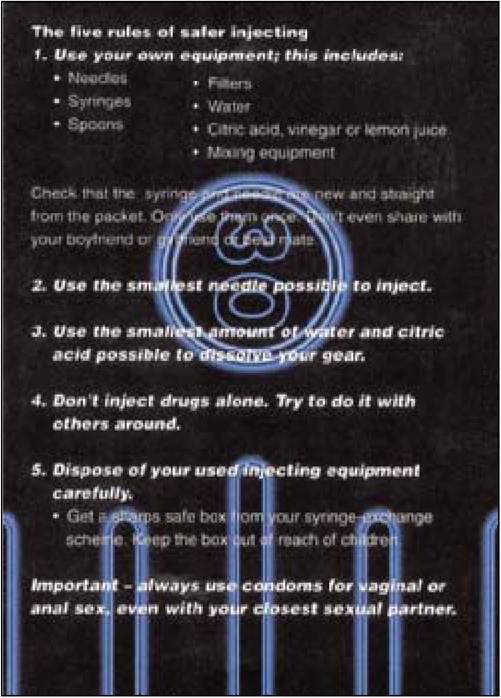
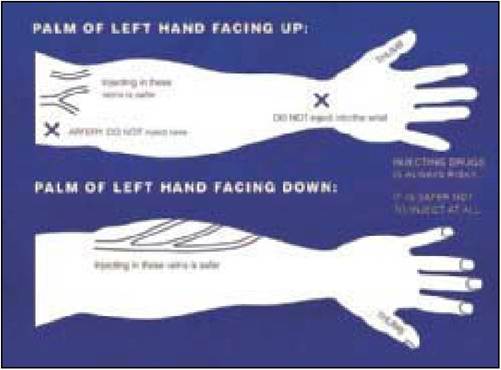
Figures 16.5a and b An example of good practice in provision of effective accurate information for injecting drug users, reproduced from “A Guide to Safer Injecting”.
with permission from HITmainstream culture. A supportive environment including political, financial and legal support for the programmes at both central government and the local level is essential for the longterm success of comprehensive programmes.
In parts of the world such as the USA where IDUs have suffered a particularly severe HIV epidemic, sexual transmission to the partners of IDUs is a major source of increasing heterosexual transmission. Programmes to prevent sexual transmission among IDUs have received much less attention than those for harm minimisation from injecting and there has been little demonstrable success in changing the sexual behaviour of IDUs. Approaches to changing behaviour in this population clearly need to incorporate those shown to be appropriate to all heterosexual populations. In addition, approaches that have shown some promise specifically among drug users include skills training in correct condom use, voluntary HIV testing and counselling, and sexual negotiation skills. Such programmes need to target in-treatment drug users, sex workers and female sexual partners of male drug users.