Myocardial Cytokine Expression as a Factor in Cardiomyopathy
Cytokines play a role in the development of HIV-related cardiomyopathy [23]. Myo-cardi- tis and dilated cardiomyopathy are associated with markedly elevated cytokine production, but the elevations may be highly localized within the myocardium, making peripheral cytokine levels uninformative [23].
When myocardial biopsy samples from patients with HIV-associated cardiomyopathy are compared to samples from patients with idiopathic dilated cardiomyopathy, the former stain more intensely for both TNF-α and inducible nitric oxide synthase (iNOS) (Fig. 4). Staining is particularly intense in samples from patients with a myocardial viral infection and is correlated with CD4 count, independent of antiretroviral treatment [23] (Fig. 5). Staining is also more intense in samples from patients with HIV- associated cardiomyopathy coinfected with coxsackievirus B3, cytomegalovirus, or other viruses [23]. Moreover, staining for iNOS is more intense in samples from patients coinfected with HIV-1 and coxsackievirus B3 or cytomegalovirus than in samples from patients with idiopathic dilated cardiomyopathy and myocardial infection with coxsackievirus B3 or those who had adenovirus infection alone [23].
In patients with HIV-associated dilated cardiomyopathy and more intense iNOS staining, the survival rate was significantly lower: those whose samples stained more than 1 optical density unit had a hazard ratio of mortality of 2.57 (95% confidence interval: 1.11-5.43). Survival in HIV-infected patients with less intense staining was not significantly different from survival in
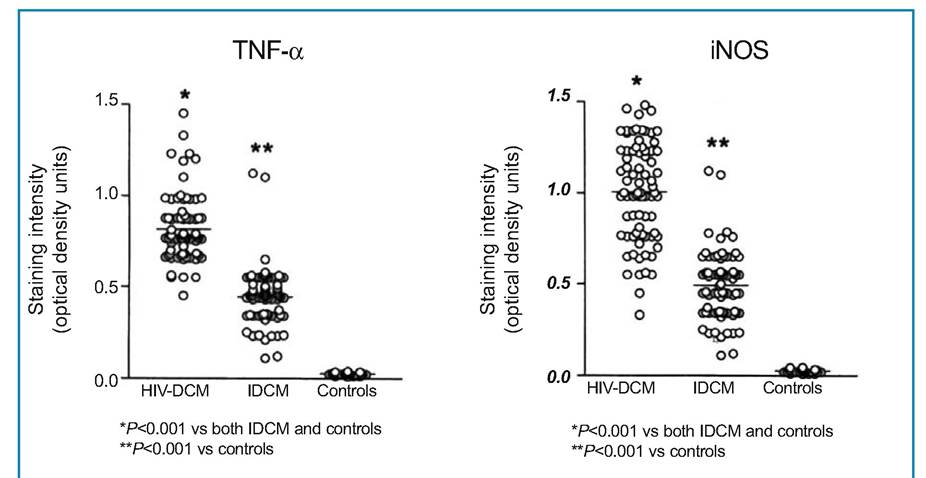
Fig. 4 Mean optical density of staining of TNF-α and iNOS in patients with HIV-associated cardiomyopathy (HIV-DCM), with idiopathic dilated cardiomyopathy (IDCM), and control subjects. Horizontal bars represent mean values. (From [23], with permission)
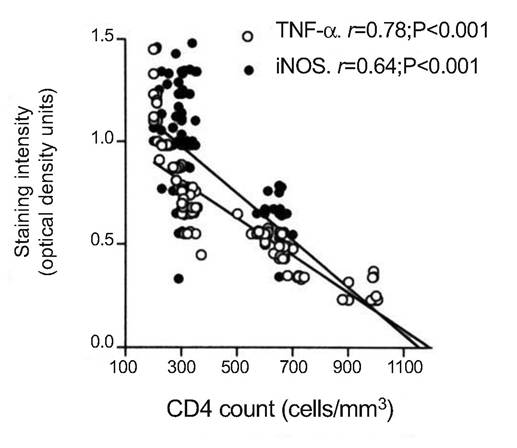
Fig. 5 Correlation between myocardial optical density units of TNF-α and iNOS and CD4 count. (From [23], with permission)
patients with idiopathic dilated cardiomyopathy [23].
The inflammatory response may be enhanced by HIV-1 myocardial infection, by the interaction between HIV-1 and cardiotropic viruses, and by immunodeficiency. These factors may increase both the expression and the cytotoxic activity of specific cytokines such as TNF-α and iNOS and blunt the expected increase of anti-inflammatory cytokines such as IL-10 [31].