AN OVERVIEW OF CLASSIFICATION AND STRUCTURE OF MAMMALIAN DEFENSINS:
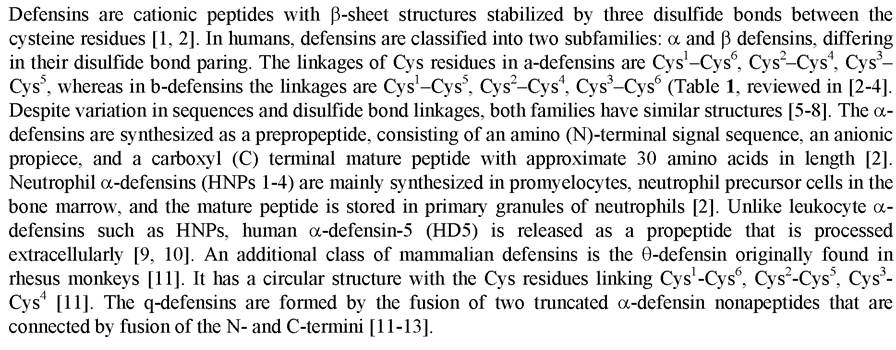
Defensin structure appears to be important for its chemotactic and antiviral activities but not antibacterial activities.
For examples, disulfide bonds are not required for antibacterial functions of HNP1, human β- defensin-3 (HBD3), and cryptdin-4, a mouse Paneth cells α defensin [14-16]. However, properly folded HBD3 is important for its chemotactic activity [15]. Similarly, HNPs 1-3 or θ-defensins after treatment with the reducing agents dithiothreitol and iodoacetamide loose their direct effect of on the virion [17, 18] and HD5 and HD6 linear analogs loose their HIV enhancing effect [19]. Mutagenesis studies of cryptdin-4 indicates that the disulfide bonds may play a role in protection from proteolysis by matrix metalloproteinase-7 [14].
More medical literature on Medic.Studio
More on the topic AN OVERVIEW OF CLASSIFICATION AND STRUCTURE OF MAMMALIAN DEFENSINS::
-
Infectious diseases -
Internal diseases -
Obstetrics and Gynaecology -
Pediatrics -
Veterinary medicine -
-
Conflictology -
Ecology -
Economy -
Finance -
History -
Law -
Medicine -
Philosophy -
Religious studies -