A-, E-, I-, AND O-STATEMENTS
One of the salient and enduring contributions Aristotle made to logic was his identification of four main types of statement that predominate in syllogistic reasoning. Two of them affirm that all or some individuals of one category belong to the other (the universal affirmative and particular affirmative types), while two of them deny that any or some individuals of one category belong to the other (universal negative and particular negative).
In the Middle Ages they were dubbed A-, E-, I-, and O-statements:
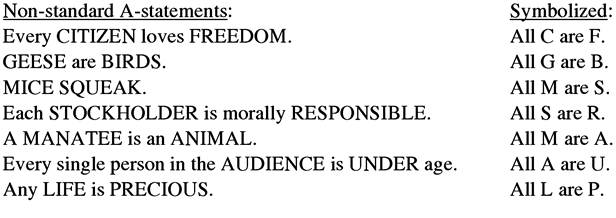
Tradition has it that the A and I are the first two vowels of the Latin affirmo, I affirm, while E and O are the two vowels of nego, I deny. The examples in the second column are all of categorical statements in standard form. Here are some examples in non-standard form, all of which are symbolized in the same way as the standard one of the same type:
Points to note:
• Although “A manatee is an animal” seems to be equivalent to “All manatees are animals,” not every statement of this form is an А-statement: for example, “A man is on the veranda” does NOT mean “All men are on the veranda!” In such cases, as always, you will need to use your judgement.
Points to note:
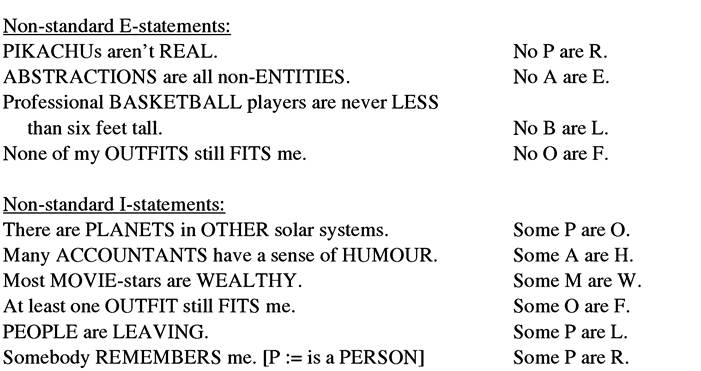
• Just as in statement logic, the symbolizations do not capture all the information contained in the original statements. “Most” and “Many” tell us more than “Some”; but what more they tell us does not affect the validity of categorical syllogisms. “Some” will always be interpreted as “at least one.”
• “People are leaving” seems to be equivalent to iiSome people are leaving,” not iiAll people are leaving.” Contrast with “Geese are birds” above.
• Terms like “somebody,” “someone,” “any body,” “no one” tacitly refer to people. In the exercises, you will be given an explicit hint, such as [P := is a PERSON].

Points to note:
• The last statement is clearly the contradictory of “All referees are blind.” In fact, this is always the case: each О-statement is the contradictory of the corresponding A-statement.
• Likewise, “At least one OUTFIT still FITS me” is the contradictory of “None of my OUTFITS still FITS me.” Again, every !-statement is the contradictory of the corresponding E-statement.
The Square of Opposition:
These last two facts are summarized in the following table:
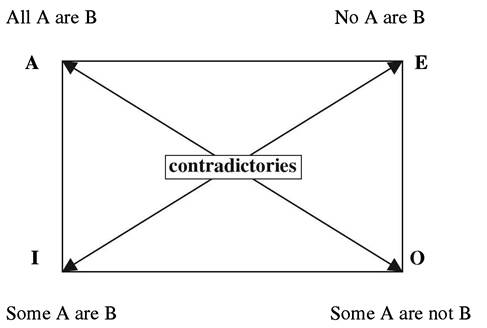
There are several other relationships of opposition between A-, E-, I-, and O-statements that were included in the traditional square of opposition constructed by medieval logicians. However, these other relationships depended on interpreting all A- and E-statements as involving non-empty first categories, e.g., on interpreting a statement such as “All foxes are dogs” to imply that there are foxes, and likewise an E-statement such as “None of my outfits still fits me” as implying the existence of outfits. We won’t be interpreting them in this way, as I shall explain further below.
15.1.3