Appeal to Ignorance
Benjamin W. McCraw
I do not have much information on this except the general statement of the agency that there is nothing in the files to disprove his Communist connections. Senator Joe McCarthy
McCarthy’s point is to show that someone is a communist based on the lack of evidence that he is not a communist.
This maneuver in an argument commits the appeal to ignorance fallacy (or ad ignorantiam). For Copi, Cohen, and McMahon (2010), an argument “commits the fallacy argumentum ad ignorantiam if [it] argues that something is true because it has not been proved false, or false because it has not been proved true” (126). On this definition, ad ignorantiam arguments will exhibit one or the other of the following forms:(a) -[proof that ~ p] → p
(b) -[proof that p] → -p
Put this way, we can see that any instance of the ad ignorantiam fallacy uses lack of evidence as the grounds for accepting some claim. Thus, Woods and Walton (1989) describe the appeal to ignorance as a fallacy “located within confirmation theory as a confusion between the categories of ‘lack of
confirming evidence’ and ‘presence of disconfirming evidence’” (161; also see Walton 1999a). Thus, we might reformulate (a) and (b) with “evidence” replacing “proof”:
(c1) ~ [evidence that ~ p] → p
(c2) ~ [evidence that p] → ~p
As Woods and Walton (1989) note as well, we can give a broad epistemic version of the argumentum ad Ignorantiam whereby “knows” replaces “proof” (or “justified belief,” “warranted belief,” or any other epistemological honorific):
(d1) ~ [knows that ~ p] → p
(d2) ~ [knows that p] → ~p
One can also “modalize” these formulations, shifting the argument from actual proof/evidence/knowledge to possible proof/evidence/knowledge or the ability for one to give proof/evidence/knowledge.
Thus: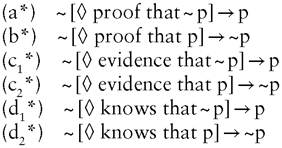
This yields 12 versions of the argumentum ad ignorantiam built on the same general framework.
Richard Robison (1971) develops another way of launching an ad ignorantiam that works by using a rhetorical question to commit the illicit move: “In many inferences from ignorance there is no explicit mention either of ignorance or of knowledge [...]. Instead, the ignorance is implied by putting the argument in the form of a question” (99). He calls this the “interrogative” form of the argumentum ad ignorantiam. It has the following structure:
(e) may it not be that p? → p
The maneuver goes from not answering that it may not be that p to p actually being the case. And when put in those terms, the move common to (a), (b), (c), and (d) reappears.
A slightly different way to frame the fallacy sees it “as an attempt to unfairly shift the burden of proof in a dialectical game” (Woods and Walton 1989, 161). This “burden of proof” model of an ad ignorantiam would look something like this:
(f) A: P
B: Why p?
A: Why ~ p? (Where A takes this question as grounds to reject B’s question)
In (f), A commits the ad ignorantiam fallacy by shifting the burden of proof that B prove the negation of A’s original assertion, effectively arguing that p by B’s non-proving of ~ p. When we see the “shifting the burden of proof” in that light, it clearly fits the schema above in (a)-(e).
Now, why think arguments exhibiting any of these maneuvers to be fallacious? Consider Copi, Cohen, and McMahon (2010):
Just because some proposition has not yet been proved false, we are not entitled to conclude that it is true. The same point can be made in reverse: If some proposition has not yet been proved true, we are not entitled to conclude that it is false. Many true propositions have not yet been proved true, of course, just as many false propositions have not yet been proved false.
The fact that we cannot now be confident rarely serves as good reason to assert knowledge of falsity, or of truth. Such an inference is defective. (126)The point here intuitively underlies thinking of an appeal to ignorance as fallacious: not having a proof, evidence, or knowledge that p isn’t a decent reason (given obvious human cognitive limits) to think that p is false. If this intuitive point is true, then we can see why logicians think of an ad ignorantiam as fallacious or “defective.” Consider Goldbach’s Conjecture (that every odd integer equal to or larger than seven can be expressed as the sum of three primes). It’s either (necessarily) true or false but, as of my writing this, it’s unproven. Does our lack of a proof imply that the Conjecture is false? Certainly not. And the lack of a disproof doesn’t show that the Conjecture is true either.
Another way to approach the argumentum ad ignorantiam as defective comes from Robinson (1971):
The argument from ignorance neglects the facts that every statement has its contradictory and our job is to choose between the two contradictories. To the argument that “we don’t know that not-p, therefore”, the answer is that “we don’t know that p, therefore not-p”; and the strength or weakness of the two arguments, once they are contrasted, is obviously exactly the same. (102)
Thus, Robinson’s assessment of the ad ignorantiam fallacy comes to the point that not knowing p doesn’t favor grounds to think that p or ~ p. That is, lacking a proof for p doesn’t settle the truth of p or~p and, therefore, such ignorance won’t give one reason to deny or to accept p.
A few passages from classical philosophical texts may (arguably) commit an argumentum ad ignorantiam. Consider a famous point from Kant’s Groundwork of the Metaphysics of Morals:
[I]t cannot be assumed here that [a shopkeeper] had, besides, an immediate inclination toward his customers, so as from love, as it were, to give no one preference over another in the matter of price.
Thus the action was done neither from duty nor from immediate inclination but merely for the purposes of self-interest. (G 4:397)Given one plausible reading, Kant is arguing that the shopkeeper acts from self-interest because we cannot assume that he has an immediate inclination (of love) to be impartial with respect to price. That is, we can’t know (assume) he has an inclination toward his customers; hence, we know that he has no inclination toward them (but, rather, himself). This moves from ignorance of his motives toward customers to claiming that he has no motives toward them. And, supposing that’s the correct reading, the ad ignorantiam fallacy as described above is committed.
Also, Descartes makes the following point in his Third Meditation’s proof of God’s existence: “For how could I understand that I doubted or desired - that is, lacked something - and that I was not wholly perfect, unless there were in me some idea of a more perfect being which enabled me to recognize my own defects by comparison?” This seems to be an instance of the “interrogative” ad ignorantiam of (e): how could it not be the case that p? → p.
Could there be non-fallacious instances of the argumentum ad ignorantiam? Wreen (1989) has argued that the ad ignorantiam maneuver is not fallacious (full stop), whereas other philosophers accept the general fallacy of an appeal to ignorance but note some instances where lack of evidence does provide good inductive grounds for some statement. More specifically, Wreen (1989) claims, “There are only inductive arguments, inductive arguments which differ in strength, some very strong, some very weak, most somewhere in-between [...]. Far and away the weakest ad ignorantiams I know of occur as examples, made up by authors, in logic texts” (314). The most obvious instance where ignorance does play a positive role would be in courts. The US courts have an “innocent until proven guilty” standard whereby a defendant has a default status of “not guilty” unless proven otherwise.
Thus, when the prosecution is unable to prove guilt, this is thereby adequate for a “not guilty” verdict. But this maneuver is allowed as a substantive principle of jurisprudence rather than a general point of logic.More interesting for a wider logical discussion would be cases of what Walton (1996, 15-17) calls “negative proof” (also see Walton 1999a). In some cases, it seems plausible to think that a lack of evidence or proof for something does give one reason to accept its denial. Ex silentio (from silence) arguments generally occur in history: moving from the claim that we haven’t seen evidence of p, so ~ p. What makes this sort of reasoning work is the following principle: if p were the case, then we’d have evidence/proof that p. The presumption is that historical documents would provide evidence of important events, practices, persons, and so on, so lack of evidence in these documents is at least prima facie evidence for their falsity. What makes this non-fallacious, I suggest, is the plausibility of the principle above. When it’s false, then the ex silentio becomes the defective ad ignorantiam.
Similarly, scientific research can turn on what looks like an ad ignorantiam. Suppose, for instance, that after a significant run of particle collisions, we have detected no sign of the Higgs boson. Intuitively, this would have been some reason to deny its existence. But that’s because we’re assuming some principle like the following: if there were such a particle, we would have some evidence for it (after running n tests).
What these non-fallacious appeals have in common is the truth of the following: if p were the case, then we’d have proof/evidence/knowledge that p. Walton (1999b, 57) calls this the “depth of search premise” presuming that p’s truth would be available on an in-depth search or inquiry. Denying the proof/knowledge of p in question, under this principle, would be a successful argument. Thus “negative evidence has the kind of plausibilistic modus tollens form characteristic of typical ad ignorantiam arguments: ‘if A then one would normally expect B; not B, therefore (plausibly) not A’” (Walton 1999b, 60).
Thus, if this principle holds, an ad ignorantiam simply converts to a straightforward modus tollens.We can see, then, that the truth or falsity of this sort of principle can settle whether an argument type is an instance of a fallacious ad ignorantiam or a valid modus tollens. For instance, in considering the argument from evil in philosophy of religion, a heated issue concerns our cognitive situation with respect to any reasons why God would permit evil. Some argue that any reasons God would have to permit evil would be known to us, and others (skeptical theists) deny this - arguing that our ignorance of God-justifying reasons is not evidence that there are no such grounds (because we’d plausibly lack cognitive access to such reasons). Arguments from evil presuppose, using Stephen Wykstra’s (1996) language, a “noseeum” principle: if God has evil-justifying reasons, we would know them. If this is true, then ignorance of such reasons cuts against the rationality of belief in God. Whether the evidential argument from evil succeeds then turns on whether this “noseeum” principle is true. But that principle is just an instance of the “depth of search premise” above. Thus, how one views the plausibility of this instance of the premise (the “noseeum” principle) will determine whether one thinks the argument from evil is categorized as an argumentum ad ignorantiam or a modus tollens, and that sort of question determines the argument’s success or failure.
References
Copi, Irving M., Carl Cohen, and Kenneth McMahon. 2010. Introduction to Logic. Upper Saddle River, NJ: Prentice Hall.
Robinson, Richard. 1971. “Arguing from Ignorance.” Philosophical Quarterly (21): 97-108.
Walton, Douglas. 1999a. “The Appeal to Ignorance, or Argumentum Ad Populum” Argumentation (13): 367-377.
Walton, Douglas. 1999b. “Profiles of Dialogue for Evaluating Arguments from Ignorance.” Argumentation (13): 53-71.
Walton, Douglas. 1996. Arguments from Ignorance. University Park, PA: Pennsylvania State University Press.
Woods, John, and Douglas Walton. 1989. Fallacies: Selected Papers 1972-1982. Dordrecht: Foris Publications.
Wreen, Michael. 1989. “Light from Darkness, From Ignorance Knowledge.” Dialectica (43): 299-314.
Wykstra, Stephen. 1996. “Rowe’s Noseeum Argument from Evil.” In The Evidential Argument from Evil, edited by Daniel Howard-Snyder. Bloomington, IN: Indiana University Press, 126-150.