Awareness
The logical omniscience problem is that in epistemic logics all tautologies are known and knowledge is closed under consequence, both of which are unreasonable. In Fagin and Halpern (1988) a simple mechanism for avoiding the problems was introduced.
One adds to the usual Kripke model structure an awareness function A indicating for each world which formulas the agent is aware of at this world. Then a formula is taken to be known at a possible world u if (1) the formula is true at all worlds accessible from u (the Kripkean condition for knowledge) and (2) the agent is aware of the formula at u. The awareness function A can serve as a practical tool for blocking knowledge of an arbitrary set of formulas. However, as logical structures, awareness models exhibit abnormal behavior due to the lack of natural closure properties. For example, the agent can know A ^ A but be unaware of A and hence not know it.Fitting models for justification logic, presented in Chapter 4, use a forcing definition reminiscent of the one from awareness models: For any given 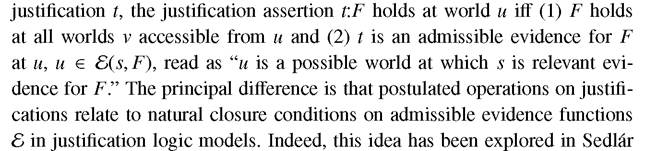 (2013), which works with the language of LP and thinks of it as a multiagent modal logic, and taking justification terms as agents (more properly, actions of agents). This shows that justification logic models absorb the usual epistemic themes of awareness, group agency, and dynamics in a natural way.
1.5
More on the topic Awareness:
-
Contemporary philosophical research -
Fundamentals of philosophy -
Logic -
Philosophy of Science and Technology -
Political philosophy -
Social philosophy -
-
Conflictology -
Ecology -
Economy -
Finance -
History -
Law -
Medicine -
Philosophy -
Religious studies -