AXIOMS AND THE PROPOSITIONAL CALCULUS (CHALLENGE LEVEL)
Another way of presenting the system of statement logic, perhaps modelled more closely on geometry, was pioneered by Gottlob Frege. Here one begins by taking a set of statement forms as axiom schemas.
Each of these axiom schemas corresponds to what would be a theorem in a natural deduction system like ours, that is, the conclusion of a valid premiseless sequent. The idea is that each of these axiom schemas represents a true statement form, and all other true statement forms are then derivable from them by the application of very simple rules of inference. Thus any valid argument form corresponds to such a valid sequent form whose conclusion is a statement form provable from the axiom schemas. Statement logic presented in this manner is traditionally called Propositional Calculus.An axiom schema is a statement form assumed without proof in the Propositional Calculus. A valid argument form is represented by a statement form derivable from these axiom schemas using certain rules of inference, understood as representing the conclusion of a valid premiseless sequent form.
In Frege’s system for statement logic the only rules of inference are Modus Ponens and a Rule of Substitution allowing you to substitute one statement form for any other, so long as it is done consistently. Frege presented six axiom schemas, all involving only the operators i-∣, and ς→. ’ But as the eminent Polish logician Lukasiewicz showed in the 1920s, the following three will suffice: 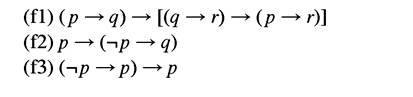
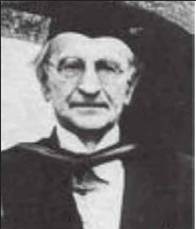
Apart from his elegant axiomatization of logic, Jan Eukasiewicz (1878-1956) is famous for having invented the so-called Polish notation for logical operators, the basis for the memory store used in many calculators and programming languages.
He was also a pioneer of manyvalued logics.The first of these is the conclusion of our sequent form (4) above representing the Hypothetical Syllogism. The second represents one of the so-called Paradoxes of Material Implication, first discovered by Duns Scotus in the Middle Ages (on these paradoxes, see chapter 11, exercise 23; this chapter, exercise 12 below; and Appendix 1). The third represents a sequent with a fascinating history, the Consequentia mirabilis, or marvellous consequence: see Appendix 2.[55]
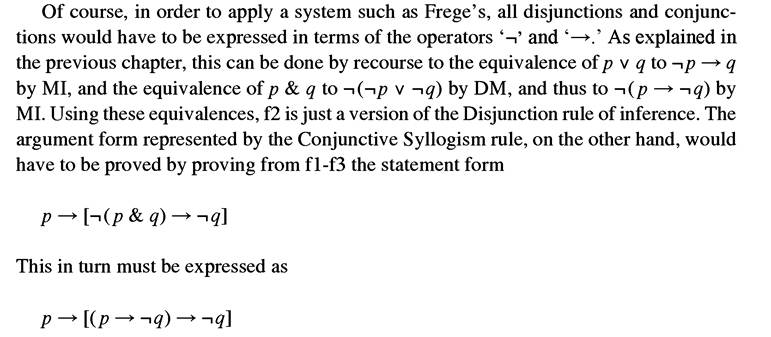
which is readily seen to be a version of MP.
Converting all disjunctions and conjunctions into conditionals and negations certainly gives an economy of expression. Actually, greater economy of expression still can be achieved through the use of either of two new operators, Peirce’s Arrow Operator ς j,’ and Sheffer’s Stroke Operator Ί,’ in terms of either of which all the other operators can be defined.[56] Peirce’s Arrow expresses the meaning of “neither... nor...,” and is therefore sometimes called the NOR operator:
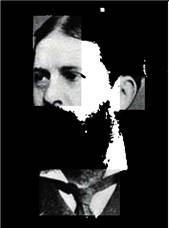
The founder of pragmatism, the American philosopher Charles Sanders Peirce (1839-1914) was a polymath who wrote Prolifically on his hugely varied interests. A practising chemist and geodesist, he was the founder of semiotics, an evolutionary metaphysician, and made numerous contributions to logic, including the theory of relations.
Photo courtesy of: National Oceanic and Atmospheric AdministrationZDepartment of Commerce; www.photolib. noaa.gov/historic/c&gs/theb3558.htm

while Sheffer’s Stroke expresses “not both... and...,” and is therefore sometimes called the NAND operator:
Sheffer’s Stroke Operator:
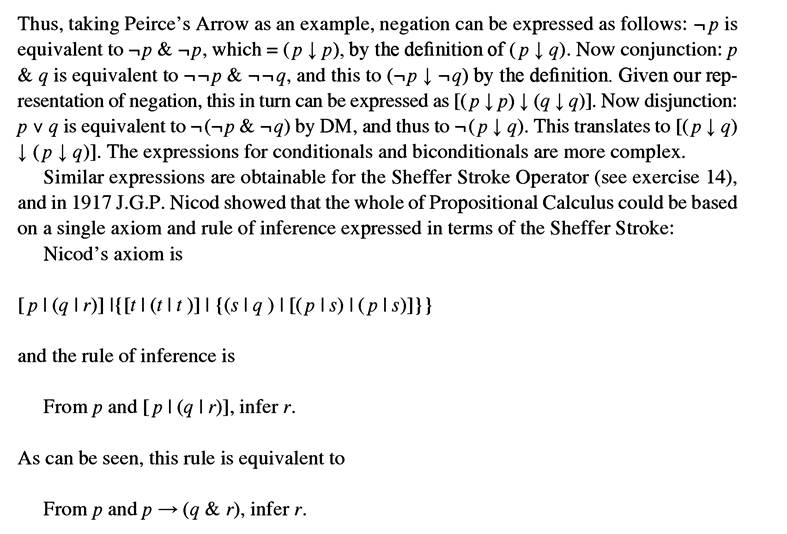
Clearly, there is nothing intuitive about such a system, and it is almost impossible to create proofs in it except by converting the statements into the familiar operators and back.
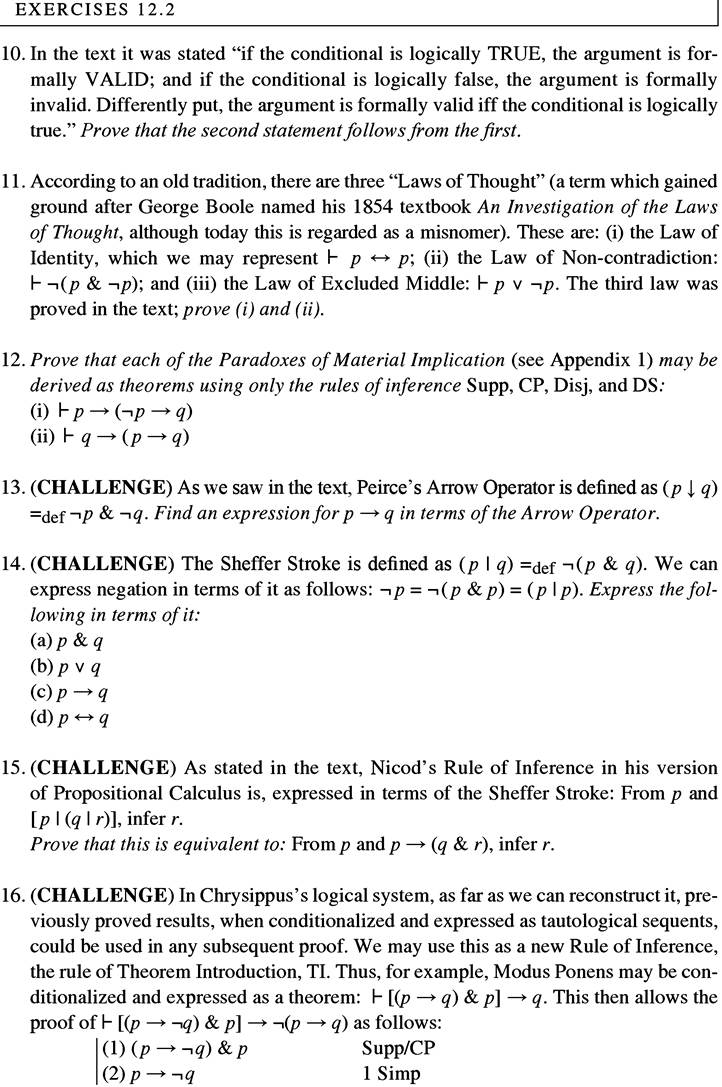
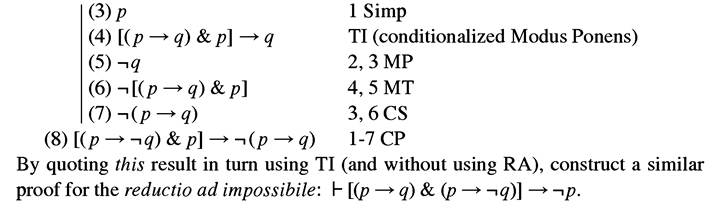
17. Despite his neglect of Statement Logic, Aristotle certainly used it. The following is an early instance of the Consequentia mirabilis (see Appendix 2):
Either we OUGHT to philosophize or we ought not. If we ought, then we ought. If we ought not, then also we ought [i.e., in order to justify this view]. Hence in any case we ought to philosophize.—Aristotle, Protrepticus
(a) Symbolize and prove the formal validity of this argument, (b) Two of the premises are redundant. Ifyour proof does not already show this, show it by constructing a proof using only the non-redundant premise.
18. (CHALLENGE) St. Anselm of Canterbury (1033-1109) argued in his Monologion:
Finally, if truth had a beginning or end, before the truth began it was true at that time that there was no truth; and after it is ended, it will be true at that time that there will be no truth. But something cannot be true without truth. Therefore there was truth before there was truth, and there will be truth after truth has ended, which is utterly self-contradictory. Therefore, whether truth is said to have a beginning or end, or is understood to have neither, truth cannot be circumscribed by beginning or end. Wherefore the same thing follows concerning the whole of nature, for the whole itself is truth.[57]
That this is an instance of Consequentia mirabilis is brought out by St. Thomas Aquinas’ apparent allusion to and summary of this argument:
But truth follows on the destruction of truth, since, if there is no truth, then it is true that there is no truth, and nothing can be true without truth. Therefore truth is eternal.—De veritate, qu. 1, art. 5 (2)

(b) Interpreting “truth is eternal” by T, prove that this follows too.