CONSISTENCY AND COMPLETENESS
Each of our rules of inference corresponds to a valid argument form, as we have argued in each case, either by proving validity through appeal to the definition of formal validity, or by proving its validity using the rules already proved valid by that means.
It follows that any argument form that is provable using the rules of inference of statement logic is itself formally valid. That being so, we say that the set of rules of inference of statement logic—the “primitive” rules identified in the previous chapter as MP, CP, Conj, Simp, Disj, DS, RA, and DN, as well as all the rules of inference derived from them—is consistent.[54]A system of rules of inference is said to be consistent if and only if any argument form that is provable using the rules is itself formally valid.
We have not, however, proved that any argument form that is valid according to the definition of formal validity is provably valid by these rules. If that is so, the set of rules is said to be complete.
A system of rules of inference is said to be complete if and only if any argument form that is formally valid is provably valid by these rules.
To demonstrate completeness is a little beyond the scope of a first course in logic. We will, however, prove the consistency and completeness of the closely related tree rules of chapter 14 below, as well as of the Truth Tree method itself.
EXERCISES 12.1
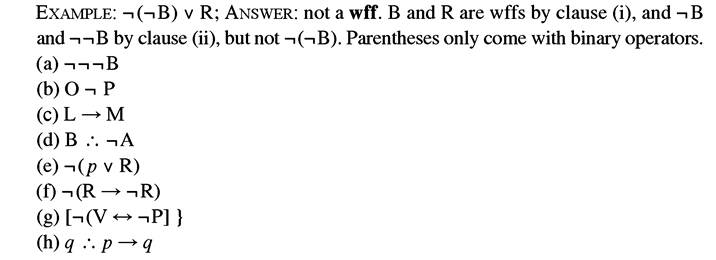
1. Identify which of the following formulas are wffs, giving a brief explanation for your answer.
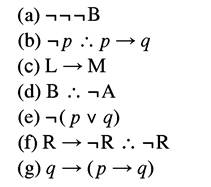
2. Each of the following is either (i) an abstract statement, (ii) an abstract argument, (iii) an argument form, or (iv) a statement form. Identify which each is.
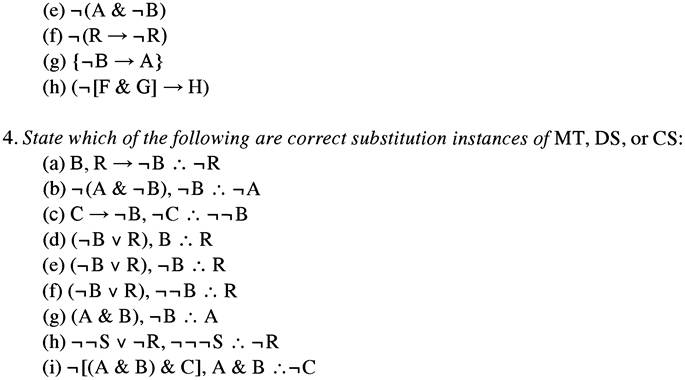
3. Determine the governing operator of each of the following wffs, i.e., the last to be applied in building it up by the rules of formation. Use this to determine whether the corresponding abstract statement is (i) a simple statement; (ii) a negation; (iii) a conditional; (iv) a conjunction; (v) a disjunction; or (vi) a biconditional: 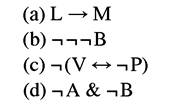
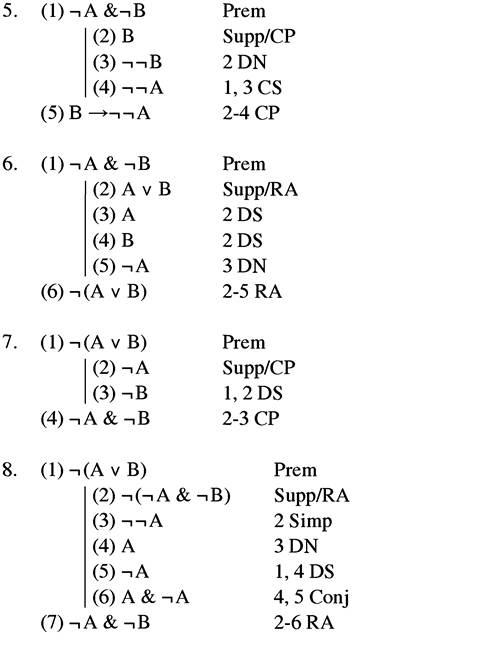
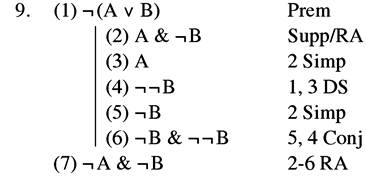
Identify the errors in the following incorrect “proofs”:
12.2