Geach Logics
The modal axiom, was introduced by Peter Geach and is com
monly known as G. Added to S4 it gives the modal logic known as S4.2, which we considered in Sections 2.7.4,4.3.6, and 4.5.5.
In Lemmon and Scott (1977) the axiom was generalized to an infinite family that included many familiar axioms. It was shown that all logics axiomatized by members of the family were canonical. This was a significant forerunner of Sahlquist's later work, which goes beyond our considerations here. We call the family of modal logics thus axiomatized Geach logics (they are also called Lemmon-Scott logics). Our major result is that Geach logics all have justification counterparts, with realization theorems connecting them. This tells us that realization is a phenomenon that is not rare—infinitely many modal logics have justification counterparts.The Lemmon-Scott generalization allows iterated ? and O occurrences and, semantically, needs iterated accessibility relations. Here are the formal definitions.
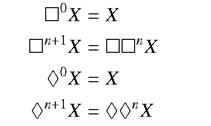
Definition 8.1 Syntactically:
And semantically:

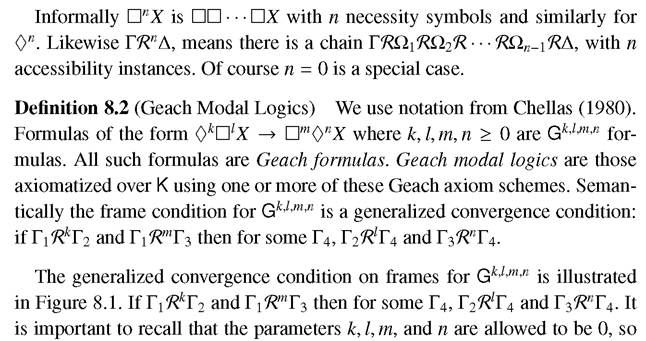
some of the possible worlds mentioned may coincide. Many standard modal logics are Geach logics.
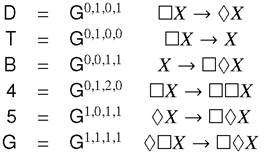
Axiomatic Geach logics are canonical with respect to the corresponding possible world semantics. A proof of this can be found in Chellas (1980). Essentially, what we do here is transfer the modal argument from Chellas (1980) to justification logics, paying careful attention to details.
Much of the background material that we need consists of rather technical results. We begin with this in Section 8.3. In Section 8.4 we show completeness for all justification counterparts of Geach logics with respect to their Fitting
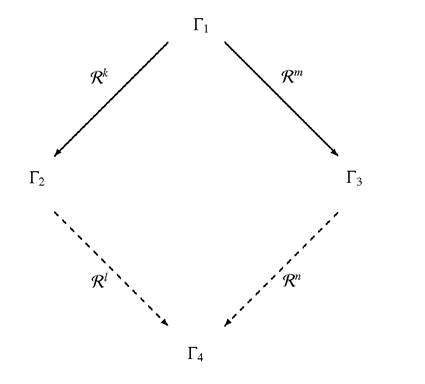
Figure 8.1 Frame Condition for Gk∙l∙m∙n
models. For the special case of JT4.2 the parameters k, l, m, and n can all be set to 1 in Section 8.4 and much of the technical material can be ignored. Thinking about this special case first might help in understanding what is going on in the general case.
8.3