IIFT 2008
1. Three children won prizes in the ‘Tech India Quiz’ contest. They are from three schools: Lancer, Columbus and Leelavati, which are located in different states. One of the children is named Binod.
Lancer school’s contestant did not come first. Leelavati school’s contestant’s name is Rahman. Columbus school is not located in Andhra Pradesh. The contestant from Maharashtra got third place and is not from Leelavati School. The contestant from Karnataka did not secure first position. Columbus school’s contestant’s name is not Badal.Which of the following statements is TRUE?
(a) 1st prize: Rahman (Leelavati), 2nd prize: Binod (Columbus), 3rd prize: Badal (Lancer)
(b) 1st prize: Binod (Columbus), 2nd prize: Rahman (Leelavati), 3rd prize: Badal (Lancer)
(c) 1st prize: Rahman (Leelavati), 2nd prize: Badal (Lancer), 3rd prize: Binod (Columbus)
(d) 1st prize: Binod (Columbus), 2nd prize: Badal (Lancer), 3rd prize: Rahman (Leelavati)
2. Mother Dairy sells milk packets in boxes of different sizes to its vendors. The vendors are charged ' 20 per packet for up to 2000 packets in a box. Additions can be made only in a lot size of 200 packets. Each addition of one lot to the box results in a discount of one rupee an all the packets in the box. What should be the maximum size of the box that would maximise the revenue per box for Mother Dairy?
(а) 2400 packets (b) 3000 packets
(с) 4000 packets (c) None of the above.
3. All employees have to pass through three consecutive entrance doors to enter into the office and one security guard is deployed at each door. These security guards report to the manager about those who come to office after 10 am. Ms. Rani is an employee of this office and came late on the annual day. In order to avoid report to the manager she had to pay each security guard half of the money she had in her purse and 2 rupees more besides that.
She found only one rupee with her at the end. How much money Ms. Rani had before entering the office on the annual day?(a) '40 (b)' 36
(b) ' 25 (d)' 42
Directions for Questions 4 and 5: Answer the questions based on the following information.
The director of an institute wants to distribute teaching assignments of HRM, Psychology, Development Studies, Trade Policy and Finance to five of six newly appointed faculty members. Prof. Fotedar does not want any assignment if Prof. Das gets one of the five. Prof. Chaudhury desires either HRM or Finance or no assignment. Prof. Banik opines that if Prof. Das gets either Psychology or Trade Policy then she must get the other one. Prof. Eswar insists on an assignment if Prof. Acharya gets one.
4. Which of the following is a valid faculty-assignment combination if all the faculty preferences are considered?
(a) Prof. Acharya - HRM, Prof. Banik - Psychology, Prof. Chaudhury - Development Studies, Prof. Das - Trade Policy, Prof. Eswar - Finance
(b) Prof. Chaudhury - HRM, Prof. Das - Psychology, Prof. Acharya - Development Studies, Prof. Banik - Trade Policy, Prof. Eswar - Finance
(c) Prof. Acharya - HRM, Prof. Banik - Psychology, Prof. Eswar - Development Studies, Prof. Das - Trade Policy, Prof. Fotedar - Finance
(d) Prof. Banik - HRM, Prof. Fotedar - Psychology, Prof. Eswar - Development Studies, Prof. Chaudhuri - Trade Policy, Prof. Acharya - Finance
5. IfProf Acharya gets HRM and Prof. Chaudhury gets Finance, then which of the following is not a the correct faculty-assignment combination assuming all faculty preferences are considered?
(a) Prof. Das - Development Studies, Prof. Banik - Trade Policy
(b) Prof. Fotedar - Development Studies, Prof. Banik - Trade Policy
(c) Prof. Banik - Development Studies, Prof. Eswar - Trade Policy
(d) Prof. Banik - Development Studies, Prof. Das - Trade Policy
Directions for Questions 6 to 8: Answer the questions based on the following information.
Five women decided to go for shopping to South Extension, New Delhi.
They arrived at the designated meeting place in the following order: 1. Aradhana, 2. Chandrima, 3. Deepika, 4. Heena and 5. Sumitra. Each of them spent at least' 1000. The woman who spent' 2234 arrived before the woman who spent' 1193. One of them spent' 1340 and she was not Deepika. One woman spent '1378 more than Chandrima. One of them spent '2517 and she was not Aradhana. Heena spent more than Deepika. Sumitra spent the largest amount and Chandrima the smallest.| 6. | What was the amount spent by Heena? | |
| (a)' 1193 | (b)' 1340 | |
| (c)' 2234 | (c)'2517 | |
| 7. | Which of the following amount is spent by one of the women? | |
| (a)' 1139 | (b) ' 1378 | |
| (c)'2571 | (d)'2518 | |
| 8. | The lady who spent' 1193 is: | |
| (a) Aradhana | (b) Chandrima | |
| (c) Deepika | (d) Heena | |
Directions for Questions 9 to 11: Answer the questions based on the following information.
In a motor race competition certain rules are given for the participants to follow. To control direction and speed of the motorists, guards are placed at different signal points with caps of different colour. The guard with red cap indicate the direction of participant’s movement and guards with green cap indicates the speed of the participant’s movement. At any signal point presence of three guards, two guards and one guard with red cap means the participant must stop, turn left and turn right respectively.
Signal points with three guards, two guards and one guard with green cap means the participants must move at 10, 4 and 2 km/hour respectively.Kartikay, one of the participants, starts at a point where his car was heading towards north and he encountered signals as follows: at start point one guard with green cap; after half an hour two guards with red cap and two guards with green cap at the first signal; after fifteen minutes one guard with red cap at second signal; after half an hour one guard with red cap and three guards with green caps at the third signal; after 24 minutes two guards with red cap and two guards with green cap at fourth signal; after 15 minutes three guards with red cap at fifth signal. (Time mentioned in each case is applicable after crossing the previous signal).
9. The total distance travelled by Kartikay from starting point till the last signal is:
(a) 9 km (b) 10 km
(c) 8 km (d) 12 km
10. What would be the final position of Kartikay if one guard with red cap and two guards with green caps were placed at the first signal point after the starting point?
(a) 3 km to the west and 2 km to the south
(b) 3 km to the west and 4 km to the north
(c) 5 km to the east and 4 km to the north
(d) 2 km to the west and 4 km to the south
11. Ifat the starting point Kartikay was heading towards south what would be his final position?
(a) 3 km to the east and 4 km to the south
(b) 5 km to the east and 4 km to the south
(c) 3 km to the west and 4 km to the south
(d) 5 km to the west and 2 km to the north
Directions for Questions 12 to 15: Answer the questions based on the following information.
Mr. Mansingh has five sons - Arun, Mahi, Rohit, Nilesh and Saurav, and three daughters - Tamanna, Kuntala and Janaki. Three sons of Mr. Mansingh were born first followed by two daughters. Saurav is the eldest child and Janki is the youngest. Three of the children are studying at Trinity School and three are studying at St.
Stefan. Tamanna and Rohit study at St. Stefan school. Kuntala, the eldest daughter, plays chess. Mansorover school offers cricket only, while Trinity school offers chess. Besides these the schools offer no other games. The children who are at Mansorover school have been born in succession. Mahi and Nilesh are cricketers while Arun plays football. Rohit who was born just before Janki, plays hockey.| 12. | Arun is the__________ child of Mr. Mansingh. | |
| (a) 2nd (c) 6th | (b) 3rd (d) 5th | |
| 13. | Saurav is a student of which school? | |
| (a) Trinity | (b) St. Stefan | |
| (c) Mansorover | (d) Cannot be determined | |
| 14. | What game does Tamanna play? | |
| (a) Cricket | (b) Hockey | |
| (c) Football | (d) Cannot be determined | |
| 15. | Which of the following pairs was not born in succession (ignore the order)? | |
| (a) Mahi and Nilesh | (b) Kuntala and Arun | |
| (c) Rohit and Janki | (d) Arun and Rohit | |
Directions for Questions 16 and 17: Answer the questions based on the following information.
In each question below three statements (I, II, III) are given followed by four conclusions numbered 1, 2, 3 and 4. You have to take the given statements to be true even if they seem to be at variance with commonly known facts.
Read all the conclusions and then decide which of the given conclusions logically follows from the given statements, disregarding commonly known facts. Choose the correct options given below.16. Statements:
I. Some drivers are technicians
II. All technicians are engineers
III. Some engineers are lecturers
Conclusions:
1. Some technicians are lecturers
2. Some lecturers are drivers
3. All engineers are technicians
4. Some engineers are drivers
(a) Only 3 follows
(b) Only 4 follows
(c) Only 3 and 4 follows
(d) None of the above
17. Statements:
I. Some barbers are fashion designers
II. No fashion designers are businessmen
III. Some businessmen are traders
Conclusions:
1. No Fashion designers are traders
2. Some traders are not fashion designers
3. Some fashion designers are traders
4. Some barbers are not businessmen
(a) Either 1, 2 and 4 or 3, 2 and 4 follow
(b) Either 1 and 4 or 3 and 4 follow
(c) Either 1 and 2 or 3 and 2 follow
(d) None of the above
18. Pointing to Priya, father of Pritu says, ‘She is the daughter of the daughter of the
wife of the only son of the grandfather of my sister.’ How is Sushma related to
Priya if Sushma is the sister of Pritu?
(a) Mother (b) Aunt
(c) Niece (d) None of the above
Directions for Questions 19 and 20: Answer the questions based on the following information.
To get admission in a management course at Dadhichi Institute of Management (DIM) following criteria are given. A candidate must:
1. be a graduate from a recognised university with minimum 54 percent marks.
2. not be more than 33 years of age as on 1.4.2008.
3. have secured 60 per cent or more marks in the entrance test.
4. pay one-time deposit fee of' 2,00,000 at time of admission.
5. pay tuition fee of Rs.4,000 per month.
Any candidate who fails to fulfill condition (4) above, he/she may be referred to the Chairman-Admission. Any candidate who has scored 80 per cent marks in the entrance test but does not fulfill condition (1) above, he/she may be referred to the Director.
Any candidate having work experience of at least 10 years in supervisory cadre does not satisfy but condition (2) above, he/she may be admitted under the sponsored quota. Given the above information and condition in each of the following questions, you have to decide which of the following course of action should be taken. You should not assume anything in case of any of the candidates. Mark answer
I. if the candidate is admitted
II. if the candidate is not admitted
III. if the candidate is referred to the Director
IV. if the candidate is referred to the Chairman-Admission
V. if the candidate is admitted under sponsor quota
19. Kamaljeet secured 60 per cent marks in graduation and was born on 15th April 1976. He scored 56 per cent marks in the entrance test. He can pay one-time deposit of' 2,00,000 and monthly tuition fee of' 4,000.
(a) I (b) II
(c) III (d) IV
20. Gourav is a first-class science graduate who obtained 81 per cent marks in the entrance test. He has 12 years of work experience in the supervisory cadre. He can pay the stipulated one-time deposit and monthly tuition fees. His date of birth is 20th October, 1970.
(a) I (b) IV
(c) III (d) V
Directions for Questions 21 to 23: Read the following information and answer the questions given below it. For selection of films produced before December 2007 for the National FilmFestival of India, following criteria are given.
1. The film must be submitted to the National Film Development Corporation (NFDC) by 31.10.2007.
2. The production cost of the film should not exceed Rupees Five crores.
3. The director of the film should have passed a three year course either from the Film and Television Institute of India (FTII) or from Satyajit Ray Film & Television Institute.
4. The length of the film should not exceed 150 minutes.
5. The film must have been approved by the film censor board of India.
6. However, if the film fulfils all the above criteria except
(a) criteria 2 above, it must be sent to the Finance Secretary.
(b) criteria 3 above, the director has done at least a one year course from FTII or Satyajit Ray Film & Television Institute, the film is kept as a stand-bye.
On the basis of the above information and information provided below, decide the course of action in each case. No further information is available. You are not to assume anything. Mark answer
I. if the film is to be selected
II. if the film is not to be selected
III. if the film should be sent to the Finance Secretary
IV. if the film should be kept as a stand-bye
V. if the data given about the film are not adequate to make a decision.
21. Film Dainandini was produced at the cost of Rupees 2.5 crore. It was submitted to the NFDC on 29th September 2007. The director of the film Govind Chadha passed a З-year course from FTII. Length of film was 120 minutes and has been approved by the censor board of India.
(a) I (b) II
(с) IV (d) V
22. Bhadrasalam is a 135-minute film directed by Katyani, who was a student of Satyajit Ray Film & Television Institute from 1996 to 1999. The cost of producing the film was Rupees 2.3 crore and it was submitted to NFDC on 24th July 2007. The film has been approved by the censor board of India.
(a) I (b) V
(c) III (d) IV
23. Rakesh Mohan, the director of film Ek Bar Achanak, has successfully completed a 2-years course at Satyajit Ray Film & Television Institute. The 150-minute Iilmwas produced at a cost of Rupees 4.85 crore. It was been approved by the censor board of India and submitted to NFDC on 30th Nov. 2007.
(a) I (b) III
(с) IV (d) II
Directions for Questions 24 to 27: Answer the questions based on the following information.
A number arrangement machine, when given a particular input, rearranges it following a particular rule. Illustrations of the input and the steps of arrangement are given below. Input: 245, 316, 436, 519, 868, 710, 689
Step 1: 710, 316, 436, 519, 868, 245, 689
Step 2: 710, 316, 245, 519, 868, 436, 689
Step 3: 710, 316, 245, 436, 868, 519, 689
Step 4: 710, 316, 245, 436, 519, 868, 689
Step 4 is the last step for the given input.
24. If the input is given as “655, 436, 764, 799, 977, 572, 333”, which of the following step will be “333, 436, 572, 655, 977, 764, 799”?
(a) Step 3 (b) Step 2
(c) Step 4 (d) None of the above
25. How many steps will be required to get the final output from the following input?
Input: 544, 653, 325, 688, 461, 231, 857
(a) 6 (b) 5
(c) 4 (d) None of the above
26. Step 3 for an input is “432, 433, 542, 666, 734, 355, 574” What will be the first step for the input?
(a) 666, 542, 432, 734, 433, 574, 355
(b) 542, 666, 734, 432, 433, 574, 355
(c) 355, 574, 433, 432, 734, 666, 542
(d) Cannot be determined
27. What will be the third step for the following input?
Input: 653, 963, 754, 345, 364, 861, 541
A. 541, 345, 754, 963, 364, 816, 653
B. 541, 345, 364, 653, 963, 754, 861
C. 541, 345, 364, 963, 754, 861, 653
D. 541, 345, 364, 653, 861, 754, 963
Directions for Questions 28 to 30: Answer the questions based on the following information.
A word arrangement machine, when given a particular input, rearranges it following a particular rule. Following is the illustration of the input and the steps of arrangement: Input: She was interested in doing art film
Step 1: art she was interested in doing film
Step 2: art was she interested in doing film
Step 3: art was in she interested doing film
Step 4: art was in film she interested doing
Step 5: art was in film doing she interested
Step 5 is the last step of the given input. Now study the logic and rules followed in the above steps and find out the appropriate step for the questions given below for the given input.
28. Which of the following will be the last step for the input given below?
Input: he is going out to search air
(a) out is air to going search he
(b) out is air to search going he
(c) search he out is air to going
(d) None of the above
29. If Step 2 of an input is not “not is the casino considering legal action”, which step is: “not is casino action legal the considering?”
(a) Step 3 (b) Step 6
(c) Step 4 (d) None of the above
30. How many steps will be required to get the final output from the following input?
Input: Father needs to check on the boy
(a) Four (b) Five
(c) Six (d) None of the above
31. Among Anil, Bibek, Charu, Debu, and Eswar, Eswar is taller than Debu but not as fat as Debu. Charu is taller than Anil but shorter than Bibek. Anil is fatter than Debu but not as fat as Bibek. Eswar is thinner than Charu, who is thinner than Debu. Eswar is shorter than Anil. Who is the thinnest person?
(a) Bibek
b) Charu d) Eswar
(c) Debu
32. Pointing to a photograph Yuvraj says, “He is the only brother of the only daughter of my sister’s maternal grandmother.” Pointing to another photograph Sourav says, “he is the only brother of the only daughter of my sister’s maternal grandmother.” If among the two photographs, one was either of Sourav or Yuvraj, and the photograph, towards which Yuvraj was pointing, was not of Sourav, then how is Yuvraj related to Sourav?
(a) Paternal uncle
(b) Maternal uncle
(d) None of the above
(c) Grandfather
Answer Key
| 1. (a) and (c) | 2. (b) | 3∙(b) | 4. (b) |
| 5. (d) | 6. (b) | 7. (a) | 8. (c) |
| 9. (a) | 10. (a) | 11. (c) | 12.(c) |
| 13. (a) | 14. (d) | 15. (b) | 16. (b) |
| 17. (d) | 18. (d) | 19. (b) | 20. (d) |
| 21. (a) | 22.(b) | 23. (d) | 24. (a) |
| 25. (b) | 26. (d) | 27. (b) | 28. (b) |
| 29. (d) | 30. (d) | 31. (d) | 32. (b) |
Solutions:
1. The following grid structure needs to be created for this question:
| Prize | School | State | Contestant Name |
| 1 | |||
| 2 | |||
| 3 |
The first direct clue is that the contestant from Maharashtra got the third place. It is also given in that statement that he is not from the Leelavati school. If we insert this information into our grid we get the following figure:
| Prize | School | State | Contestant Name |
| 1 | |||
| 2 | |||
| 3 | Lancer/Columbus | Maharashtra |
The next couple of clues we use are:
Leelavati school’s contestant is named Rahman. Also, it is given to us that Columbus school’s contestant is not Badal. Hence, The contestant from Columbus school would be Binod.
Thus, we know the contestant names from each of the three schools:
Leelavati-Rahman; Columbus-Binod; Lancer-Badal.
However, this information is not usable directly into our table at this point of time.
At this point we also know that the contestant from Karnataka did not come first and that the third contestant is from Andhra Pradesh.
Using this information into our current table we get:
| Prize | School | State | Contestant Name |
| 1 | Andhra Pradesh | ||
| 2 | Kamataka | ||
| 3 | Lancer/Columbus | Maharashtra |
We further know that:
(i) The Lancer School’s contestant did not come first and
(ii) Columbus school is not located in Andhra Pradesh.
It follows that the contestant from Andhra Pradesh must be from Leelavati and must be the winner.
The table become:
| Prize | School | State | Contestant Name |
| 1 | Leelavati | Andhra Pradesh | Rahman |
| 2 | Kamataka | ||
| 3 | Maharashtra |
We now need to fix the positions for Lancer-Badal and Columbus-Binod. However, looking at the clues we can see that there is no way to find out who comes second and who comes third.
Thus, there are two possible solution tables:
| Prize | School | State | Contestant Name |
| 1 | Leelavati | Andhra Pradesh | Rahman |
| 2 | Lancer | Kamataka | Badal |
| 3 | Columbus | Maharashtra | Binod |
OR
| Prize | School | State | Contestant Name |
| 1 | Leelavati | Andhra Pradesh | Rahman |
| 2 | Columbus | Kamataka | Binod |
| 3 | Lancer | Maharashtra | Badal |
Thus, both options (a) and option (c) are correct.
2. The revenue chart can be constructed according to the given discount structure as follows:
| Number of packets | Price per packet | Revenue | |
| 2k | 20 | 40k | |
| 2.2k | 19 | 41.8k | 10% increment in number of packets and 5% reduction in price per packet → revenue goes up |
| 2.4k | 18 | 43.2k | 1/11 increment in number of packets and 1/19 reduction in price per packet JE revenue goes up |
| 2.6k | 17 | 44.2k | 1/12 increment in number of packets and 1/18 reduction in price per packet JE revenue goes up |
| 2.8k | 16 | 44.8k | 1/13 increment in number of packets and 1/17 reduction in price per packet JE revenue goes up |
| 3k | 15 | 45 | 1/14 increment in number of packets and 1/16 reduction in price per packet JE revenue goes up |
| 3.2k | 14 | 44.8k | 1/15 increment in number of packets and 1/15 reduction in price per |
| packet JE revenue comes down | |||
| Subsequently it can be seen that revenue would progressively reduce. |
Thus, at an order of 3000 packets, the revenue would be maximised.
3. Using trial and error with the options we get that if she started with' 36 she would have Re. 1 with her at the end based on the following thought process:
| Original amount | Amount after the first security guard | Amount after the second security guard | Amount after the third security guard |
| 36 | 16 | 6 | 1 |
Solutions for Questions 4 and 5:
In this situation, we essentially have to understand each of the constraints and check whether the constraints are being met by the option. The constraints in the problem can get identified as follows Ifomwhat is stated in the question:
CONSTRAINT 1: The statement “Prof.Fotedar does not get an assignment if Prof. Das gets one” should be interpreted as—we can give an assignment to either Das or Fotedar and not to both. This also means that of the 6 people, since we have to provide an assignment to 5, the one to be left out has to be either Das or Fotedar.
Thus, Acharya, Banik, Chaudhary and Eswar must always be selected for an assignment. CONSTRAINT 2: We also know that Chaudhary has to be given either HRM or Finance.
CONSTRAINT 3: The other constraint in the problem is that if we give an assignment to Das (from either Trade Policy or Psychology), Banik should get the other one. Once we realise these points we can solve the questions individually.
4. The first option fails as it gives us a situation where Chaudhary gets Development Studies- whereas we know that he has to be given either HRM or Finance.
The second option satisfies all conditions while the third one fails as it gives both Das as well as Fotedar an assignment.
The fourth option is also wrong as Chaudhary does not get either HRM or Finance. Thus, Option (b) is correct.
5. Clearly the option (d) is incorrect as it gives Das Trade Policy but it does not give Banik Psychology.
Solutions for Questions 6 to 8:
From the given information it is clear that four numbers which must have been the values of money spent would be: 2517 (clue 4), 2234 (clue 1), 1340 (clue 2) and 1193 (clue 1 again).
We need to work out the fifth value.
Also, since Chandrima is the least and Sumitra is the max and since one woman spent 1378 more than Chandrima a little bit of introspection will give you the following possibilities for the five numbers:
Possibility 1: If 1193 is the least value
A The five numbers are:
1193, 1340, 2234, 2517 and 2571 (since 2571 - 1193 + 1378)
Possibility 2: If 2517 is the maximum value
1139 (since 1139-2517- 1378), 1193, 1340, 2234 and 2517
Accordingly we have the following possible arrangements for the five women and the amount they spent:
| Possibility 1 | Possibility 2 | |
| A (x 2517) | 2234 | |
| C (least) | 1193 | |
| D (x 1340) | 2517 | |
| H | 1340 | |
| S (Max) | 2571 |
Note: The thought structure for placing the 5 values with 5 women in the case of possibility 1, goes as follows:
Step 1:
| A | |
| C | 1193 |
| D | |
| H | |
| S | 2571 |
After Placing the least and maximum.
Step 2: 2234 should be before 1193 and Deepika has not spent 1340.
| A | 2234 |
| C | 1193 |
| D | 2517 |
| H | 1340 |
| G | 2571 |
A close look at the above table shows that clue 5 (H > D) is not obeyed by this arrangement. Hence, this solution is wrong.
We thus move into possibility 2 i.e.:
1139, 1193, 1340, 2234, 2517, are the five values. The thought structure for placing the five numbers for the five women goes as:
Step 1: Place the maximum and least values for G and C respectively.
| A | (x 2517) | |
| C | (least) | 1139 |
| D | (x 1340) | |
| H | ||
| G | (Maximum) | 2517 |
This leaves us with 1340, 1193 and 2234 to place.
Step 2: We need to keep 2 constraints in mind while doing this.
(a) 2234 has to come before 1193 (remember not = immediately before). At the same time H > D. (Clue 5)
We can arrange 2234 before 1193 in 3 ways as shown below and then 1340 automatically falls into the vacant space.
| 1 | |
| A | 2234 |
| C | 1139 |
| D | 1193 |
| H | 1340 |
| G | 2517 |
2
(Not possible since Deepika cannot be 1340)
| A | 2234 |
| C | 1139 |
| D | 1340 |
| H | 1193 |
| G | 2517 |
3
(Not possible since H should be greater than D).
A 1340
C 1139
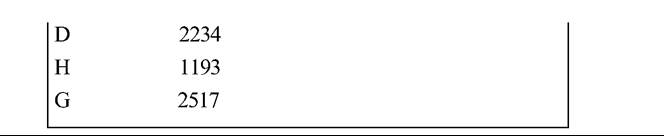
Hence, the Onlypossible arrangement is as in (1) above. Hence the answers are:
6. (b) Heena spent' 1340.
7. (a)'1139
8. (c) Deepika
Solutions for Questions 9 to 11:
9. The basic structure of the movement that Kartikay would exhibit would look as follows:
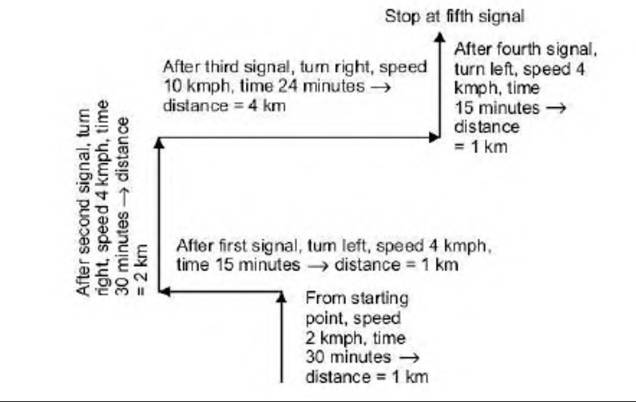
Thus, the total distance he would travel would be 9 km. Option (a) is correct.
10. If the first signal had 1 guard with red cap and 2 guards with green cap he would need to turn right at the first signal. His speed for this part of the journey would not get affected. Also, it would not affect his subsequent turns and his subsequent distances too.
His journey path would look as below and it can be clearly seen that he would be 3 km west and 2 km south at the end of his journey.
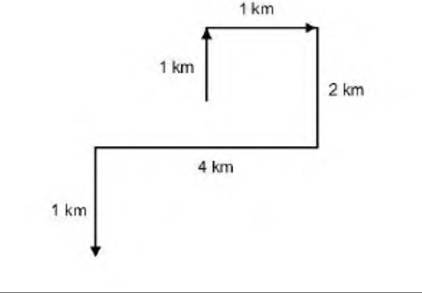
Option (a) is the correct answer.
6. If he were heading south the figure would change from the figure in the 9th question and it would just be the inverse of the figure in the 9th question, i.e. everytime he is moving north in the figure for the 9th question he would move south for this question and every time he is moving east he would now be moving west. Also, every time he is moving west he would now be moving east.
Hence, the final result would also be the opposite of the final position in question 9. In the figure for question 9 it can be seen that Kartikay ends up 4 km north and 3 km east. Hence, for this question his final position would be 3 km west and 4 km south. Option (c) is correct.
Solutions for Questions 12 to 15:
Based on an initial reading of the question set it is clear that there are three variables, which are being measured. These are the order in which the children are born, the game they play and the School they go to. Besides the sex of the child is another variable being measured. Also, the boys can be represented byA,M,R,N,S while the girls can be represented by T,K,J. Based on these realisations, the starting grid structure for the given question would look like below:
| Order of birth | Name of child | Sex ofchild | Sport | School |
| 1 | ||||
| 2 | ||||
| 3 | ||||
| 4 | ||||
| 5 | ||||
| 6 | ||||
| 7 | bgcolor=white> | |||
| 8 |
With this starting point we start using the information in the question. The first direct clue is Saurav is the eldest while Janki is the youngest. Besides, we also know that Mr. Mansingh first had three sons and then had two daughters in succession. With this information placed into the grid, we would get the following:
| Order of birth | Name of Child | Son/Daughter | Sport | School |
| 1 | Saurav | Son | ||
| 2 | Son | |||
| 3 | Son | |||
| 4 | Daughter | |||
| 5 | Daughter | |||
| 6 | Son | |||
| 7 | Son | |||
| 8 | Janaki | Daughter |
We then know that Kuntala is the eldest daughter and she plays chess and that Rohit was born just before Janaki- and he plays hockey Also, Tamanna and Rohit study at St. Stefan.
| Order of birth | Name of Child | Son/Daughter | Sport | School |
| 1 | Saurav | Son | ||
| 2 | Son | |||
| 3 | Son | |||
| 4 | Kuntala | Daughter | Chess | |
| 5 | Tamanna | Daughter | St. Stefan | |
| 6 | Son | |||
| 7 | Rohit | Son | Hockey | St. Stefan |
| 8 | Janaki | Daughter |
At this point, from the statement that three of the children are studying at Trinity school and three are studying at StStefan we also know that two students are studying at Mansarovar. Also, we know that these two must be born in succession and since Mansarovar school offers only cricket it follows that Mahi and Nilesh must be from the Mansarovar school and that they must be placed second and third in the birth order. This also means that Arun’s position gets fixed as the sixth child.
We also know that Trinity only offers chess (as it is given that “these schools offer no other games.) The table evolves to:
| Order of birth | Name of Child | Son/Daughter | Sport | School |
| 1 | Saurav | Son | Chess | Trinity |
| 2 | Mahi/Nilesh | Son | Cricket | Mansarovar |
| 3 | Nilesh/Mahi | Son | Cricket | Mansarovar |
| 4 | Kuntala | Daughter | Chess | Trinity |
| 5 | Tamanna | Daughter | St. Stefan | |
| 6 | Arun | Son | Football | St. Stefan |
| 7 | Rohit | Son | Hockey | St. Stefan |
| 8 | Janaki | Daughter | Chess | Trinity |
The answers can be read off the table:
12. Arun was born sixth. Option (c) is correct.
13. Saurav studies at Trinity. Option (a) is correct.
14. Tamanna’s game we cannot determine. Option (d) is correct.
15. Kunatala and Arun were not born in succession. Option (b) is correct.
Solutions for Questions 16 and 17:
16. The figure for “all technicians are engineers” will look as below:
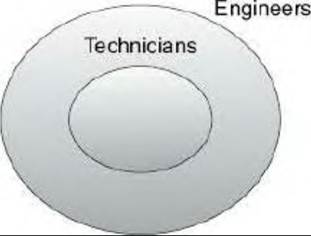
Since some drivers are technicians it follows that the circle for drivers would necessarily intersect the circle for technicians.
This means that some (or all) drivers would be engineers and also that some engineers would definitely be drivers.
Conclusion 4 definitely follows.
17. The figure for “No fashion designers are businessmen” is

Once you have the above picture in front of you, you can try to visualise the circles for barbers and for traders.
The first conclusion - no fashion designers are traders, is rejected as we can draw an intersection area between traders and fashion designers.
Similarly the third conclusion cannot be regarded as necessarily true as we can easily visualise a circle for traders such that no fashion designers are traders.
Conclusions 2 and 4 are true and the thinking for this is:
Conclusion 2: Traders who are businessmen would definitely not be fashion designers and hence conclusion 2 is valid.
Conclusion 4: Barbers who are fashion designers are necessarily not businessmen and hence the conclusion “Some barbers are not businessmen” is a valid conclusion.
Looking at the options, there is no option which gives us 2 and 4 as correct. Thus, Option (d) is the correct answer.
Solutions for Questions 18:
“Only son of the grandfather of my sister” - refers to my father.
Hence, “wife of the only son” refers to “wife of father” which means “mother”.
Further, Priya being the daughter of the daughter of the mother, means that Priya is Pritu’s mother’s grand daughter. Also, since Pritu’s sister is Sushma, it follows that Priya might be either the daughter of Pritu in which case Sushma would be Priya’s aunt or otherwise Priya might be the daughter of Sushma in which case Sushma would be Priya’s mother. Hence, the correct answer should be “either aunt or mother” and hence option (d) is correct.
Solutions for Questions 19 and 20:
In order to solve these kinds of questions it is normally a good idea to put all the requirements for admission in the given situation in one place.
The requirements in this case are:
(i) Graduate with minimum 54% marks but this can be bypassed by getting 80% marks in the entrance test in such a situation the case may be referred to the Director.
(ii) Not more than 33 years of age as on 1.4.2008 which can be bypassed if a candidate has at least 10 years of experience in the supervisory cadre;
(iii) Scoring 60% or more marks in the entrance test is compulsory as it has no go around.
(iv) Pay one time deposit fee—which can be bypassed as the case may be referred to the ChairmanAdmissions.
(v) Pay tuition fee of' 4000 per month (again something that cannot be bypassed).
Thus conditions (iii) and (v) cannot be bypassed and are compulsory for any candidate else he would be rejected.
19. Kamaljeet would not be admitted because he has failed the admission test and hence does not satisfy condition (iii). Option (b) is correct.
20. Gourav satisfies conditions 1, 3, 4 and 5. However, since he has a 12 year work experience he would be admitted under sponsor quota. Option (d) is correct.
Solutions for Questions 21 to 23:
21. The film Dainandini obeys all the 5 criteria laid down for a film to be selected, i.e. it’s been submitted in time; it’s production cost is less than 5 crore; the director has passed a З-year course from FTII; the length of the film is less than 150 minutes and the film has been approved by the Censor Board. Thus, the film should be selected. Option (a) is correct.
22. In this question, the IilmBhadrasalam obeys criteria 1, 2, 4 and 5. However, we do not know whether the director of the film passed a three year course from the Satyajit Ray Film and Television Institute. We just know that he was a student of that institute. Hence, we do not have enough data to make a decision about the film. Option (b) is correct.
23. The film Ek Bar Achanak is to be rejected because it was submitted after the deadline of 31st October 2007. Thus, option (d) is correct.
Solutions for Questions 24 to 27:
From the analysis of the input-output of the given string it is evident that what the machine is doing is essentially placing the numbers in such an order that the sum of digits of the numbers is placed from minimum to maximum. Also, it does so by first placing the number with the least sum of digits in the first place by switching it’s position with the first number in the string. The focus then shifts to put the number with the second least sum of digits in the second place and so on.
Based on an understanding of this logic we can solve the questions that follow based on the same logic.
24. 655,436,764,799,977,572,333 has Sumofdigits as 16,13,17,25,23,14,9.
In the first step the string would become:
655,436,764,799,977,572,333
Step 1: 333,436,764,799,977,572,655
Step 2: 333,436,572,799,977,764,655
Step 3: 333,436,572,655,977,764,799
which is the required string of numbers. Thus, the required step number is the third step.
25. 544,653,325,688,461,231,857 can be seen as:
13,14,10,22,11,6,20
First step: 6,14,10,22,11,13,20
Secondstep: 6,10,14,22,11,13,20
Third step: 6,10,11,22,14,13,20
Fourth step:6,10,11,13,14,22,20
Fifth step: 6,10,11,13,14,20,22.
26. The logic of this situation is such that the third step for an input as mentioned can be possible due to any of many possible inputs. Hence, answering this question definitively is not possible. Note that the question has asked, “What will be the first step of the input?” as against “what could be the first step of the input?” in which case it could have been one of the options which could have been checked to give us a third step as defined in the question.
27. 653,963,754,345,364,861,541 can be seen as 14,18,16,12,13,15,10 if we look at the sum of digits of the numbers. Then we have:
INPUT: 14,18,16,12,13,15,10
FirstStep: 10, 14,18,16,12,13,15
Secondstep: 10,12, 14,18,16,13,15
Third Step: 10,12,13, 14,18,16,15 which means 541,345,364,653,963,754,861. Option (b) is the correct answer.
Solutions for Questions 28 to 30:
A close inspection of what the word arrangement machine is doing tells us that since “She was interested in doing art film” gets converted to “art was in film doing she interested” it is essentially arranging the words on the basis of the ‘reverse alphabetical order arrangement’ of the last alphabets in each word of the word string. If you look at the final output “art was in film doing she interested” the last alphabets of the words follow the order: t-s-n-m-g-e-d and is the reverse alphabetical order of the last letters in each of the seven words. Also notice that the standard move of the machine is to just get the appropriate word in its place in the string by just displacing the incorrect word which stands in it’s place. This is contrary to the previous question where the standard move of the machine was to interchange the wrong word with the right word’s position. Based on this understanding of the logic of the word series we can then move towards solving questions 28 to 30.
28. In the word string “he is going out to search air” the last alphabets are: e-s-g-t-o-h-r. Their reverse alphabetical order would be: t-s-r-o-h-g-e which means that the output string would be “out is air to search going he”. Option (b) is the correct answer.
29. Step 2 is “t-s-e-o-g-l-n” and we are asked to trace the step number for “t-s-o-n- 1-e-g”.
Step 2: t-s-e-o-g-l-n;
Step 3: t-s-o-e-g-l-n;
Step 4: t-s-o-n-e-g-1;
Step 5: t-s-o-n-l-e-g which means “not is casino action legal the considering”.
Thus the machine would reach the given situation in step 5 and hence option (d) is the correct answer.
30. “Father needs to check on the boy” can be looked at as
Input: r-s-o-k-n-e-y (by looking at the last alphabet of each word in the given string). Now the objective of the machine is to put these letters in the reverse alphabetical order which means that the final output has to be: y-s-r-o-n-k-e.
Then we have:
Input: r-s-o-k-n-e-y
Step 1: y-r-s-o-k-n-e
Step 2: y-s-r-o-k-n-e
Step 3:y-s-r-o-n-k-e.
Thus it can be seen easily that the machine would take exactly 3 steps to reach the output required.
Hence, option (d) is correct.
31. Since the question is asking us to find out the thinnest person we can keep our processing focused on doing so; hence we concentrate on the fatter/thinner clues ignoring the taller/shorter clues.
In terms of fatness/thinness, the following structures exist:
D>E (from the first sentence in the question)
Also, B>A>D (from the second sentence in the question)
Combining the two we get:
B>A>D>E
The third sentence tells us that Eswar is thinner than Charu, who is thinner than Debu. This means D>C>E.
Combining these we get:
B>A>D>C>E
Hence, Eswar is the thinnest.
32. The key to this question is in understanding that both the clues are exactly the same. And both the people are essentially pointing out to their maternal uncle’s photograph as can be seen from the following which can be seen from Sourav’s perspective about the statement he is making:
| Generation 1 | REACTION 1: My sister’s maternal grandmother= my maternal grandmother | |
| Generation 2 | REACTION 2: Only daughter of my sister’s maternal grandmother = only daughter of my maternal grandmother = my mother | REACTION 3:PERS0N IN PHOTO = Only brother of my sister’s maternal grandmother = Only brother of my mother = Matemal Uncle. |
| Generation 3 | bgcolor=white>Me My sister |
Also, since one of the photographs belongs to Sourav or Yuvraj and it is known that Yuvraj is not pointing to Sourav’s photo, it means that Sourav must be pointing to Yuvraj ,s photo. Hence, Yuvraj would be Sourav’s maternal unlce. Option (b) is correct.