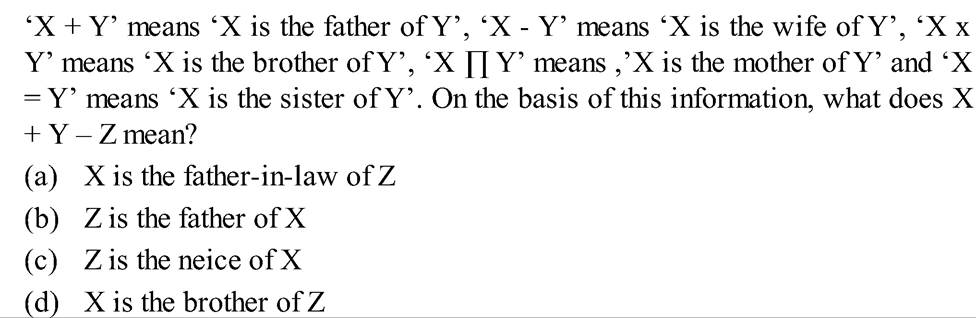
ILLUSTRATION 4
Direction for Questions 1 to 4: Answer the questions based on the following information.
Hello, Ciao and Vanakkam are related to each other.
I. Among the three, one is Hello’s legal spouse, another is Ciao’s sibling and the third is Vanakkam’s sister-in-law.
II. Hello’s legal spouse and Ciao’s sibling are of the same sex.
(Assume: There are no gay marriages.)
1. Who is the married man?
a. Hello
b. Ciao
c. Vanakkam
d. Cannot be determined
2. Who is the married woman?
a. Hello
b. Ciao
c. Vanakkam
d. Cannot be determined
3. The number of males amongst the group is
II. 2
a. I
b. II
c. I or II
d. Neither I nor II
4. Who is the Ciao’s sibling?
a. Hello
b. Ciao
c. Vanakkam
d. Cannot be determined
Solutions
Illustration 1
While solving logical reasoning questions, always try to place the direct information first and keep any indirect clues aside for later use.
In this question you will find that:
Emily likes Coke............. → Direct clue
Deepak is the father of Fatima → Direct clue
Deepak does not like Thumsup or Pepsi → Indirect clue,.... and so on.
Keep in mind the following points while solving all questions on logical reasoning:
1. First use the direct clues.
2. In the case of a family tree the diagram should essentially be a multilevel diagram to ensure clarity of being able to see multiple generations on the same diagram.
3. Males and females should be marked separately with some symbols. One suggestion is the females can be marked inside a circle/bracket or with an underlined letter as A or alternately males can be marked with a + sign and females with a - sign.
4. Relationships should be marked using horizontal links or vertical links.
The following diagrams will emerge from the clues
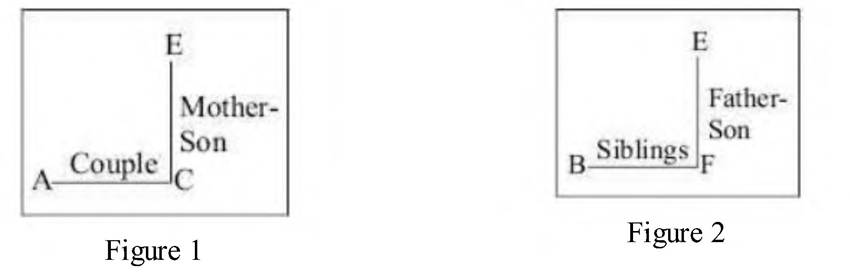
At this stage, you know that A, B and E are the three females and C, D and F are the three males; you also know that A and C are one of the two couples.
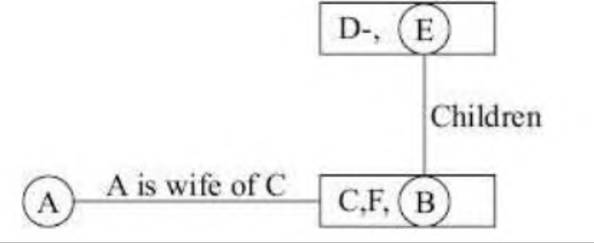
Hence, the other couple must be D and E. (They must be married to each other since they have children.)
This leads to a combined diagram which looks as below:
To this information, add the likes and dislikes Ofindividuals as follows:
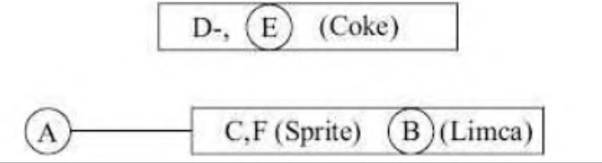
Further, D does not like Thums Up or Pepsi, hence he must like Fanta; Cathy does not like Pepsi (hence Thums Up) and Abhay likes Thums Up.
The answers are:
1. Cathy
2. Fatima is Emily’s son
3. Deepak-Emily is a married couple
4. Thums Up
5. Two sons (C & F).
Illustration 2
The family needs to have a minimum of 12 people.
GFl-GMl, GF2, GM2
Fl-Ml, F2, М2

| Generation 2 | Father-Mother (husband-wife pair) | Father | |
| Generation 3 | Two boys | Two girls |
The above table gives us a total of 11 people who are compulsorily present. We need to add 1 more female (who is a mother) to this group as there are 4 mothers in the gathering.
Thus a total of 12 people.
Option b is correct.
Illustration 3
The following family relationships emerge
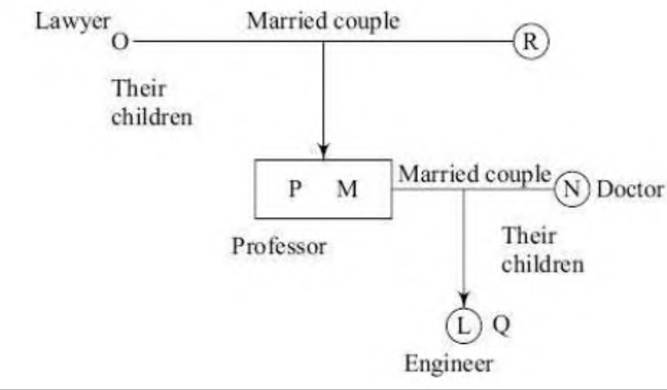
The answers are:
7. Option 2 (Brother)
8. Option 3 (Grandson)
9. O is M’s father. Option a is correct.
Illustration 4
Fromthe statement that Ciao’s sibling and Hello’s legal spouse are of the same sex, we can conclude that Hello cannot be the sibling of Ciao (because Hello’s sex would be different from his/her legal spouse’s sibling). Hence, Ciao’s sibling must be Vanakkam. This gives us four basic possibilities for the husband wife pair:
(1) Hello (male) - Vanakkam (female; Hello’s wife as well as Ciao’s sibling); Ciao (Vanakkanfs sibling; sex not known).
In this case, the situation does not allow for Vanakkam’s sister-in-law. Hence, we can reject this as a possible solution to the situation.(2) Hello (female) - Vanakkam (male; Hello’s husband as well as Ciao’s sibling); Ciao (Vanakkam’s sibling - sex not known). In this case again, the situation does not allow for Vanakkam’s sister-in-law. Hence, we can reject this as a possible solution to the situation.
(3) Hello (male) - Ciao (female; Hello’s wife as well as Vanakkam5S sibling); Vanakkam (Ciao’s sibling - female as she has to be the same sex as Hello’s spouse). In this case, again the situation does not allow for Vanakkam5S sister- in-law. Hence, we can reject this as a possible solution to the situation.
(4) Hello (female) - Ciao (male; Hello’s husband as well as Vanakkam5S sibling); Vanakkam (Ciao’s sibling - male as she has to be the same sex as Hello’s spouse). In this case, the last condition of Vanakkam5S sister-in-law is met because Hello is the sister-in-law of Vanakkam. Thus, we conclude that this is the Onlypossible Solutiongiventhe clues. The answers then become:
1. Ciao is the married man—Option b.
2. Hello is the married woman—Option a.
3. There are exactly 2 males—Ciao and Vanakkam— Option b.
4. Vanakkam—Option c.
(B) Statement based relationship finding questions: In this question type, we typically have to determine the relationship between two individuals whose relationship is mentioned in a roundabout manner.
In such questions, it is advisable to look at a problem from one’s own perspective, i.e., if you place yourself as the central figure in the relationship matrix, the solving of the question becomes much easier as the solution anchors itself to pre-existing relationships in your own mind. The following examples would make things clear to you.
Example 1
1. Introducing a boy, RaIf said, “His mother is the only daughter of my mother-in-law.” How is Ralf related to the boy?
(a) Uncle (b) Father
(c) Brother (d) Husband
Example 2
2. Pointing to a man in a photograph, a woman said, “His brother’s father is the only son (and child) of my grandfather.” How is the woman related to the man in the photograph?
(a) Mother
(c) Aunt
(b) Sister
(d) Daughter
Example З
3. IfNina says, “Anna’s father Rick is the only son of my father-in-law Mick.” Then how is Bridgette, who is the sister of Anna, related to Mick?
(a) Daughter (b) Wife
(c) Daughter-in-law (d) None of these
Example 4
4.