Inferences and Arguments
There are plenty of times when we reason in an attempt to draw a conclusion from another claim or claims that we think or know to be true. For example, let’s say that you have a convertible that is parked out front in your driveway, you left the top down, and you hear from the local meteorologist on TV that there’s a 100% chance of rain in the next hour.
You think to yourself, “If it rains outside, then the interior of my convertible gets wet.” This is a little piece of reasoning, actually, where you are assuming that the claim, “The interior of my convertible gets wet” follows logically from the claim, “It rains outside.” Follows logically from means the same thing as can be legitimately inferred from - one can legitimately infer that “The interior of my convertible gets wet” from “It rains outside.” So, if we know it’s true that “If it rains outside, then the interior of my convertible gets wet” and we know it’s true that “It rains,” then we can logically infer (or it follows logically that) “The interior of my convertible gets wet.”Here are some other examples:
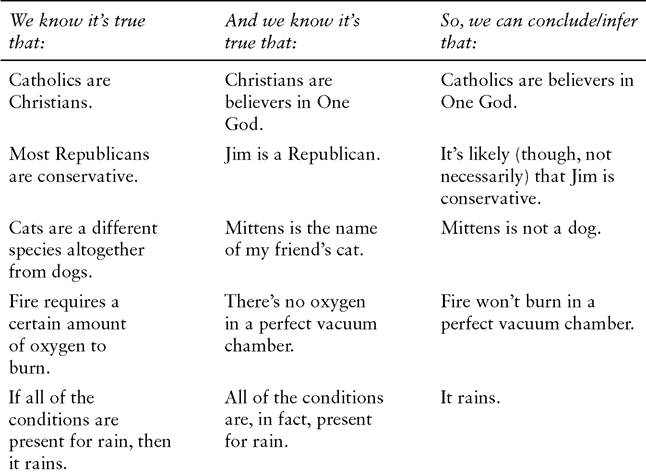
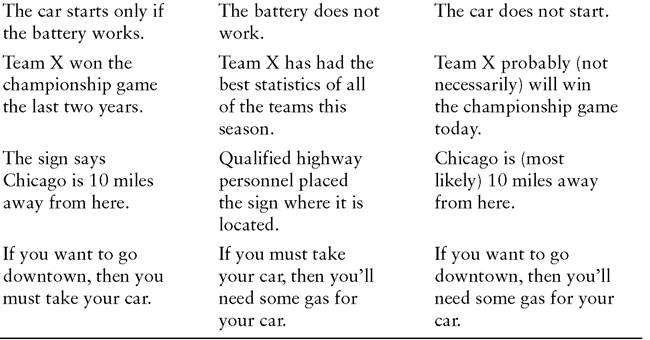
When we try to show what claim follows from or can be inferred from another claim or claims we take to be true, we are putting forward an argument. An argument is made up of at least two claims, one of which plays the role of the conclusion, while the other plays the role of a premise. A premise is the claim that is supposed to support, back up, justify, or give a reason for accepting the conclusion, while a conclusion is the claim that is supported by, backed up by, justified by, or shown to be what follows from the premise. The following is a simple argument with one premise and a conclusion:
Premise: Given that Frank is a bachelor.
Conclusion: This shows us that Frank is an unmarried male.
We can see that the claim “Frank is an unmarried male” follows from the claim “Frank is a bachelor” because what it means to be a bachelor is to be an unmarried male. That Frank is a bachelor (stated as a premise) supports, backs up, justifies, or gives the reason for accepting that Frank is an unmarried male (stated as the conclusion). Here is another simple argument with one premise and a conclusion that is straightforwardly obvious:
Premise: Jane has two apples and two oranges in her shopping cart.
Conclusion: Thus, Jane has four fruits in her shopping cart.
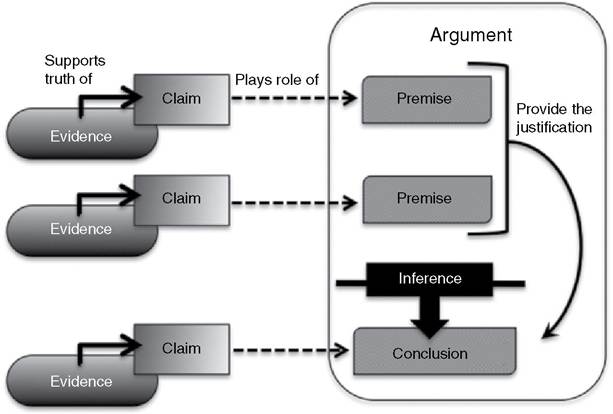
Usually an argument has more than one premise, as in the examples in the table above, a few of which we can put in argument form below. Note that an argument in argument form usually has the premises of the argument listed first, then a horizontal line - demarking premise(s) from conclusion - followed by the conclusion of the argument. Also, often (though, not always) there will be a premise-indicating word such as because, since, given that, as, for, or for the reason(s) that (there are others) that indicates a premise in an argument, while often (though, not always) there will be a conclusion-indicating word such as So, Hence, Thus, Therefore, This shows us that, or We can then conclude/infer that (there are others) that indicates a conclusion in an argument. A few of these indicating words are evident in the examples given above and below.
(1) Since Catholics are Christians.
(2) And Christians are believers in One God.
(3) Therefore, Catholics are believers in One God.
(1) Because most Republicans are conservative.
(2) And because Jim is a Republican.
(3) Hence, it’s likely (though, not necessarily) that Jim is conservative.
(1) The car starts only if the battery works.
(2) The battery does not work.
(3) This shows us that the car does not start.
(1) Given that Team X won the championship game the last two years.
(2) And given that Team X has had the best statistics of all of the teams this season.
(3) So, Team X probably (not necessarily) will win the championship game today.