LOGIC AND LANGUAGE
The ancient Greeks were the first to study logic as a subject in depth. The lack of any systematic notation for the process of logic during its initial development led the Greeks to rely extensively on the use of language to explain logic.
Each one of us even today instinctively uses language to explain what we are doing. Thus we use logical language in each of the following cases—1. Where is my key?
Ans: It’s on the blue table.
Or
It’s in the second shelf from the bottom inside your cupboard.
2. Could you direct me to Mr Mehta’s house?
Ans: Proceed straight from here and take the right turn from the second crossing. Move about 100 metres after the right turn and you will reach a Ύ’ junction. Take the left leg of the Y and this road leads to a dead end. Mr Mehta lives on the second floor of the second last house on the left of this road.
3. If I put water in a working refrigerator it will become cold.
4. To turn on the car, one needs to switch on the ignition.
Thus, each of us comes across millions of such everyday situations where we use logic inherently as part of our day-to-day language.
The study of logic by the Greeks was largely confined to the study and documentation of logical language. However, the problems of understanding logic through language are very high, since this approach becomes extremely complex and unwieldy the moment the logical string becomes longer. This complexity was the reason that when Aristotle summed up Greek logic in his Treatise on Logic in the 4th century вс, many of the greatest minds were at a loss to understand it.
Symbolic logic
It was only in the late 19th century when Gottlob Frege brought about a revolution in the whole field of reasoning by inventing ‘symbolic logic’— the use of symbols to represent ideas; that the next phase of development in logical thought started.
With this improvement of notation, logical and mathematical ideas could be precisely written down for perhaps the first time. The inconsistencies and vagueness of language were overcome through the use of symbols to denote logical thoughts. The development of symbolic logic further led to the development of‘logical thinking’.Consider the statement “ If a car has poor air conditioning or low fuel efficiency then it is not a nice car, then the fact that a car is nice means that it will have neither poor air conditioning nor low fuel efficiency.
This long language string used to express the above logic can be condensed using the following symbols:
P (poor А/С) & L (low fuel efficiency) & N(C) (Nice car).
Thus, if P or L then not N (C) then N (C) means not P or L.
The words OR, NOT & AND all can have their own logical symbols.
Thus OR is ‘V’, NOT is ~ AND is +.
Thus, the above sentence can be condensed in its logical formas:

In fact, to reduce ambiguity, tediousness and complexity of language based interpretation, solving logical problems involves as its first step the interpretation of the language of the question and conversion of the language of the question into symbolic form. Moreover, this also aids in cutting down the time required to solve complex reasoning questions.
Thus, when the language of logic is converted to symbolic form, then the truth of such a sentence depends only on its logical form and not on its content.
Any similar sentence, (using totally different language) which uses the same logical form will be true under the same circumstances. The process of mastering reasoning then has to take as its first step the understanding of the process of conversion of language into symbolic logic. In fact, the process of solving logical problems is greatly eased through the use of symbols to document the language.
Some Standard Symbols that You can Use for Logical Language
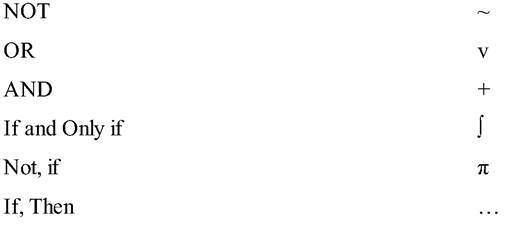
Besides, you would do well to keep in mind the following factors while creating a symbolic framework for your question:
JE Proper Nouns should always be denoted by capitals.
JE In Questions where the sex of the proper noun is crucial to the solving of the question, you can denote the female by underlining the capital letter used.
√zE As you start solving Reasoning Questions, create your own set of symbols for standard relational sentence structures. (See the highlighted box):
(1) Is next to
Thus, A is next to B can be: AB v BA
(2) (a) Is to the immediate left of
Thus, A is to the immediate left of B can be: AB
(b) Is to the left of
Thus, A is to the left of B can be: A______________ B
(3) (a) Are at the ends
Thus A and B are at the ends means:

(b) Is at the extreme left
Thus A is at the extreme left means:

(4) Is more than/taller than/greater than
Thus A is greater than/ taller than/ more than B & C can be symbolically represented by:
A > (B + C) [Note here that we do not know the relationship between B & C]
(5) Is less than/shorter than/lower than
Thus A is less than/shorter than/lower than B & C can be symbolically represented by:
A < (B + C) [Again, note here that we do not know the relationship between B &C]
(6) Is between
Thus, A is between B & C means that A can be anywhere between B & C.

(7) Is the son of
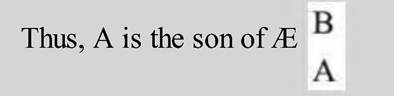
(8) Is the daughter of

(9) Is the Parent of

(10) Is the spouse of

(11) Is the wife of
id="Picutre 10" class="lazyload" data-src="/files/uch_group76/uch_pgroup316/uch_uch7362/image/image010.jpg">
(12) Is the sibling of

Some Important LogicalManoeuvers:
(1) If, Then
The condition If A, then B leads to the following valid conclusions
Valid Reasoning 1: A therefore B.
Valid Reasoning 2: Not B, therefore not A.
At the same time If A then B also throws up the following invalid conclusions.
Invalid Reasoning 1: B, therefore A.
Invalid Reasoning 2: Not A, therefore not B.
The above structures of logical thought can be illustrated through the following examples:
If A teaches, B will go to the movies.
Valid Reasoning 1: A teaches, therefore B will go to the movies.
Valid Reasoning 2: B has not gone to the movies, therefore A did not teach.
Invalid Reasoning 1: B went to the movies, therefore A must have taught. This is an invalid line of reasoning.
Invalid Reasoning 2: A did not teach, therefore B did not go to the movies. This too is invalid.
(2) If and Only If
The condition If and Only If A, then B leads to the following valid conclusions.
Valid Reasoning 1: A, therefore B.
Valid Reasoning 2: Not B, therefore not A.
Valid Reasoning 3: B therefore A.
Valid Reasoning 4: Not B therefore not A.
The above structures of logical thought can be illustrated through the following examples:
If and only if A teaches, B will go to the movies.
Valid Reasoning 1: A teaches, therefore B will go to the movies.
Valid Reasoning 2: B has not gone to the movies, therefore A did not teach.
Valid Reasoning 3: B went to the movies, therefore A must have taught.
Valid Reasoning 4: A did not teach, therefore B did not go to the movies.
(3) Either Or
Either A or B
Valid Reasoning 1: Not A then B
Valid Reasoning 2: Not B then A
Invalid Reasoning 1: A then Not B
Invalid Reasoning 2: B then Not A
The above structures of logical thought can be illustrated through the following examples:
Either A teaches or B goes to the movies.
Valid Reasoning 1: A does not teach, therefore B will go to the movies.
Valid Reasoning 2: B has not gone to the movies, therefore A must have taught.
Invalid Reasoning 1: A taught, then B did not go to the movies.
Invalid Reasoning 2: B went to the movies, then A did not teach.
(4) If, Then Not
If A then Not B:
Valid Reasoning 1: A then not B
Invalid Reasoning 1: Not B then A
Invalid Reasoning 2: B then Not A
The above structures of logical thought can be illustrated through the following examples:
If A teaches, then B will not go to the movies.
Valid Reasoning 1: A teaches, therefore B will not go to the movies.
Invalid Reasoning 1: B has not gone to the movies, therefore A taught.
Invalid Reasoning 2: B went to the movies, therefore A did not teach.
As a student it is important for you to follow a few standard steps while solving logical questions:
1. Take a complete ‘preview of the situation’ clearly understanding the context.
Remember to accept the situation as it is given.
2. Read each and every part of the question carefully. You should concentrate hard and focus fully while reading the question. This is a very important prerequisite for solving questions on logic since very often in long sentences there will be individual single words which will transform the meaning of the sentences. If you fail to take into account these words, the end result will be errors in logic & deduction.
Let us now proceed to understand how all this applies to real life problem solving through examining questions which have been asked in different competitive exams and CAT.
Example 1 A party is held at the house of the Mehtas. There were five other couples present (besides Mr and Mrs Mehta), and many, but not all, pairs of people shook hands. Nobody shook hands with anyone twice, and nobody shook hands with his/her spouse. Both the host and hostess shook some hands.
At the end of the party, Mr Mehta polls each person present to see how many hands each person (other than himself) shook. Each person gives a different answer. Determine how many hands Mrs Mehta must have shaken.
(Canwe prove that it was not Mrs Mehta who shook 10 hands?)
Solution Let there be 5 couples: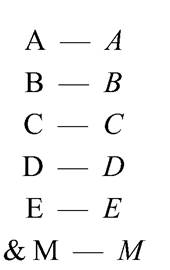
Deduction 1 Fromthe condition that nobody shook hands with his/her spouse, it is clear that none of the twelve people in the party shook more than 10 hands.
(Since, nobody shakes hands with himself or his/her spouse, it leaves a maximum of 10 people to shake hands with).
Deduction 2 Mr Mehta has asked the question to eleven different people and each of them has given a different answer. Also, the highest answer anyone could have possibly given is 10. Hence, the only way to distribute different numbers of hand shakes amongst the 11 people is:
0,1,2,3,4,5,6,7,8,9,10. [ Note∖ somebody shook 0 hands and somebody shook 10]. Deduction 3 Since, the host & hostess have both shaken some hands, the person who shook ‘0’ hands cannot be either M or M. It has to be one of the other 10 people in the party.
[At this point you need to realise that in the context of this problem A, A B,B,C, C, D, D, E &E are alike, і e. there is no logical difference amongst these 10 and you have exactly the same information about each of these 10 people. However, Mrs Mehta is different because she stands out as the hostess as well as the wife of the person who has asked the question].
Since all ten guests are the same, assume ‘A’ shook no hands. This leads us to the following deduction.
Deduction 4 Take any one person apart from A & A; say B. B will not shake hands with himself & his wife. Besides B will also not shake hands with A (who has shaken no hands). Thus, B can shake a maximum of 9 hands and will thus not be the person to shake 10 hands.

Note'. The main result here is that, out of the people to whom M has asked the question, and amongst whom we have to distribute the numbers 0 to 10 there has to be a couple who has had 0 & 10 handshakes. It could be any of the five couples, but it cannot be M who has either 0 or 10 handshakes.
We now proceed, using the same line of reason as follows.
Deduction 5 Suppose B has 1 handshake — he must have shaken hands with A (who has shaken everybody’s hands she can).
Then, B wouldn’t have shaken hands with anyone out of At
At
this point the following picture emerges: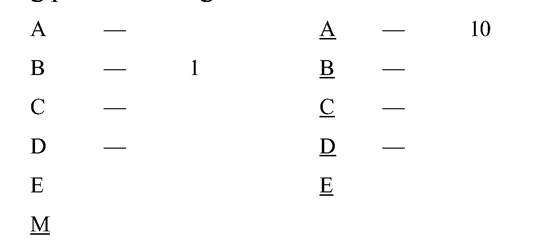
Numbers left to be allocated — 2, 3, 4, 5, 6, 7, 8, 9.
Considering C, as a general case, he cannot shake hands with C, A (Who shook no hands) & B (Who shook hands only with A. This is mandatory since A has shaken hands with 10 people).
Thus, C can shake hands with a maximum of 8 people and this deduction will be true for  too. Hence, the only person who could get 9 handshakes is B.
Thus, we conclude that just like 0 and 10 handshakes were in one pair, similarly 1 and 9 handshakes too have to be part of one pair of husband and wife.
Similar deductions, will lead to the realisation that 2 & 8, 3 & 7 and 4 & 6 handshakes will also occur for couples amongst the 11 people questioned.
Hence, M must have shaken 5 hands.
The above question was solved on the basis of a series of deductions, which were based on a series of Logical Form (LF), then logical structures.
Let us consider another example:

Each letter in the above grid represents a different digit from 0 to 9, such that
L ¥ M ¥ N - M ¥ O ¥ Q - P ¥ Q ¥ R. Find the value of O’.
Solution In order to solve such a question, one needs to proceed systematically making one deduction at a time.
Deduction 1 There are seven alphabets and ten digits. We need to somehow eliminate 3 of these 10 to define the 7 digits required to be allocated.
It is obvious, that ‘0’ cannot be used since if we make any alphabet ‘0’ we will end up with a product that ‘0’ in one or a maximum of two of the three cases.
Deduction 2 You need to find a product which can be made in three different ways.
Deduction 3 Two of these three ways have to be independent of each other with no matching digits and the third way has to be drawn out of one digit each from the first two ways and one independent digit that has not been used.
Also, at this point there are 9 digits and 2 more to be eliminated.
Now we move to the process of Trial & Error.
I Notes on Interpretation
Trial & Error is one of the most useful processes for solving questions based on reasoning. Principally there are three ways for carrying out trial & error search.
(1) Complete trial & error.
(2) Directed trial & error.
(3) Blind trial & error.
The blind trial and error is what most students practice and hence are unable to solve logical questions. Since they do not use their deductive logic to do a more focused search, they end up going round in circles while trying to solve such questions.
Instead directed trial & error and comprehensive trial & error are superior problem solving processes and therefore score above the complete trial and error method.
Application of Directed Trial & Error The question above is a classical situation warranting a directed trial & error. Hence, this is best illustrated through the example.
At this stage we are at a situation where we know: 1, 2, 3, 4, 5, 6, 7, 8 and 9 have to be allocated to L, M, N, O, P, Q and R.
At this point, take a call as to whether you want to use 9 or not? Nine and 1 are different from the other numbers primarily because they are the highest and lowest numbers respectively and also because 9 gives us “maximum room for manoeuvering” the question as compared to the other numbers, while 1 is a useful tool for a third multiplier if we do not want to change the value of the multiplication.
Note'. The student should analogise the thinking process applied here to the thinking process used to unravel a ball of wool which has got entangled.
To disentangle an entangled ball of wool, we need to search the end of the ball. Once you identify either end, the remaining process of disentangling the ball requires very elementary logic coupled with patience and perseverance. The logic for picking up the end point of the ball of wool is that it is different from all other points in the ball.
Similarly, in reasoning questions, we need to identify things/objects/people which are different from other things∕objects∕ people and start our solution from there.
After that, the whole process becomes one of use of elementary logic for elementary deductions coupled with patience and perseverance.
In the question under consideration, if we take a call on using ‘9’ and decide to do so, we can then deduce that the required product has to be a multiple of 9.
[Remember that at this point of time we have ignored the line of thinking that neglects 9. We will have to consider it, if we do not get an answer by using 9].
Since the product has to be a multiple of 9, assume that the product is 36. But, this product eliminates the use of 8,7 & 5 and leaves only 6 digits. Going below 36 as a product for further trial and error will further reduce the number of possibilities. Hence, let us try to go to the higher extreme & try to experiment with the number 72.
We see that 72 = 32 ¥ 23 and can be formed by9¥8¥lor6¥3¥4or9¥4¥2.
This satisfies our deduction that 72 gives three ways of solving the question. Also, the second requirement that there should be two ways which are independent of each other and a third way which uses one term each from the two independent ways and one unique term is also satisfied.
Since 6 ¥ 3 ¥ 4 is independent of 9 ¥ 8 ¥ 1 in all its digits. Also, 9 ¥ 4 ¥ 2 uses the no. 9 from 9 ¥ 8 ¥ 1 & 4 from 6 ¥ 3 ¥ 4.
T TZ-X z-*. 4-l^t 42-х 1 1 Z-X-« -W r « ⅛-> J-W 1-х Z-χ j-1 j-1 W L⅛. ∙ 1« 4-r T i-∖-Λr∖ i^ 1-rr∖ J-I ∙
You need to understand here that, the digit ‘2’ is the only one which is fixed to its place in the grid. All the other digits can be changed. Thus, we can have alternative arrangements like: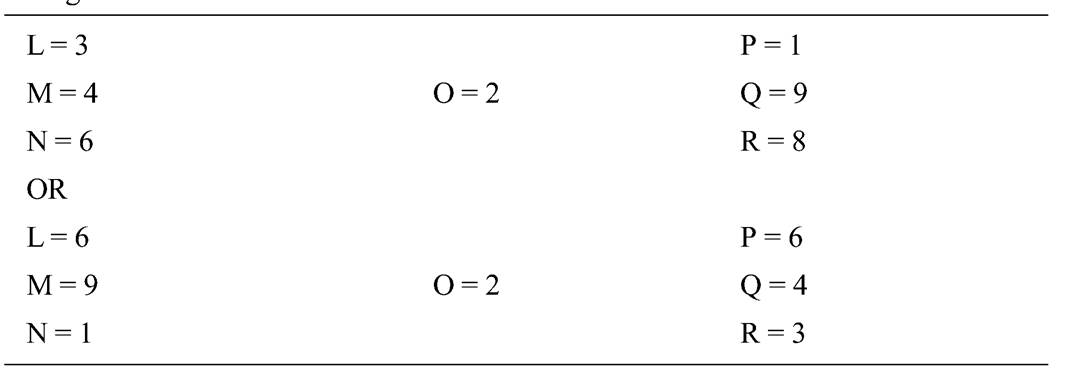
The only thing that is fixed is the number 2 for O.
Example 3 Let us now consider another question, which is a classic case of complete or comprehensive trial & error method.
Two people A & B are playing a game. Both A & B are logical people. There are two boxes on the table. One of them contains 9 balls, the other contains 4 balls. In this game, the players are supposed to take alternate turns of picking up balls according to the following rules:
(a) Pick up as many balls as you want to from any box.
(b) Pick up an equal number of balls from both boxes.(if you pick from both boxes). The person who picks up the last ball wins the game. In his/her turn it is mandatory to pick up at least one ball. A has to play first. What should he do to ensure a win?
Solution
Deduction 1 The rules of the game define that there are two legal moves:
Picking up an equal number from each box or picking up any number from either box (at least 1).
Deduction 2 A has 17 possible moves to make and since the question asks for one particular move that will ensure a win, one of these 17 must be the winning move. It is at this stage that you should realise that the question calls for a comprehensive trial & error which should result in the elimination of 16 possibilities.
The starting position is 9, 4.
A’s options at the start of the game can be basically divided into three options:
I Pick up balls from the first box. II Pick up balls from the second box. Ill Pick up balls from both the boxes.
The position after A plays his move can be documented as follows (in terms of the number of balls B has in front of him.):
[There are 9 moves in option I.] (Balls from first box are picked by A.) If
(a) A picks up 1 ball, B will be left with 8, 4.
(b) A picks up 2 balls, B will be left with 7, 4
(c) A picks up 3 balls, B will be left with 6, 4
(d) A picks up 4 balls, B will be left with 5, 4
(e) A picks up 5 balls, B will be left with 4, 4
(I) Apicks up 6 balls, B will be left with 3, 4
(g) A picks up 7 balls, B will be left with 2, 4
(h) A picks up 8 balls, B will be left with 1, 4
(i) A picks up 9 balls, B will be left with 0, 4
Similarly, if he picks up balls from the second box(option II) he will have an end result of: If
(a) A picks up 1 ball, B will be left with 9, 3
(b) A picks up 2 balls, B will be left with 9, 2
(c) A picks up 3 balls, B will be left with 9, 1
(d) A picks up 4 balls, B will be left with 9, 0
And for option III, If:
(a) A picks up one ball each from both boxes, B is left with 8, 3
(b) A picks up two balls each from both boxes, B is left with 7, 2
(c) A picks up three balls each Ifomboth boxes, B is left with 6, 1
(d) A picks up four balls each from both boxes, B is left with 5, O
Out of these 17 options, the options of leaving (0,4), (9,0) and (5,0) are infeasible since it will result in an immediate win for B, who can clean up the board in one move. Similarly leaving (4, 4) will also cause an immediate win for B. This leaves A with 13 options which he needs to consider. These are:
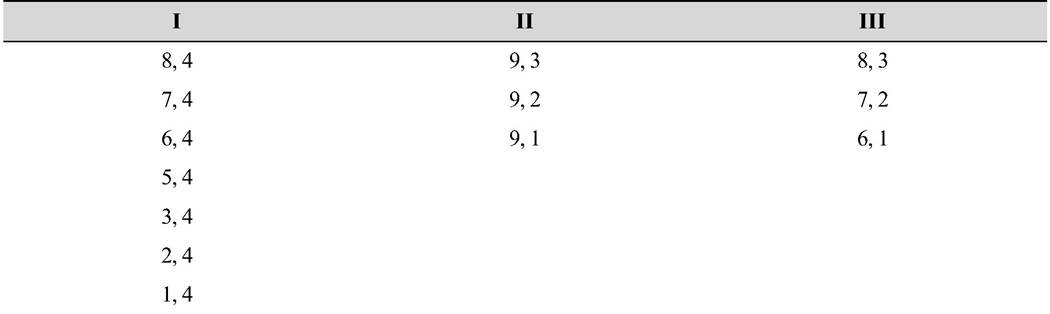
From these 13, the easiest option to check is 1,4. If B gets 1,4 he has the following options:

Obviously, he cannot play (0, 4), (1, 0), (1, 1) or (0, 3). This means he can leave A with ((1, 2) or (1, 3). These need to be further investigated.
IfB leaves (1,2):
A has the following options to leave for B

Obviously, if he plays any of this, A will lose. Hence, if B leaves A with (1, 2) A will definitely lose.
Deduction 3 A cannot leave B with a situation in which B can make into (1, 2) or (2, 1). Evaluating the 13 options left for A, we get that (1, 4), (2, 4), (3, 4), (5, 4), (9, 1), (9, 2), (6, 1) & (6, 2) are situations from which B can reach (2, 1) or (1, 2) in one move. This means B will win if A leaves him with any of these eight situations.
Thus, A will eliminate these eight options from his list of 13 and come down to five options which need further checking. These are: (6, 4), (7, 4), (8, 4), (9, 3) and (8, 3). At this stage we further need to eliminate four of these five options to come to the correct answer.
Now let us start our investigation with (6, 4). If B is left with (6, 4) he has the following options:
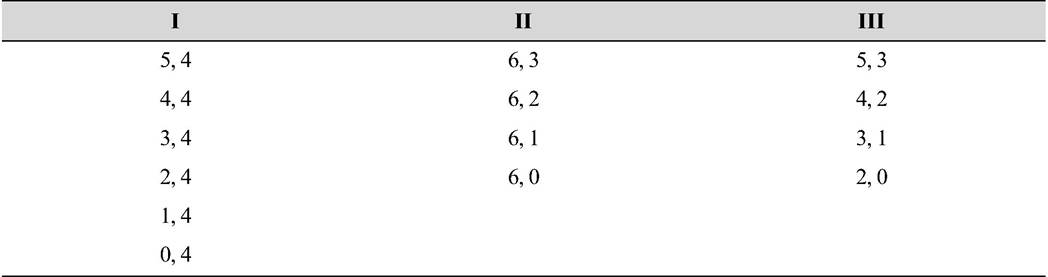
Ofthis, B cannot play (0,4), (1, 4), (2, 4), (3, 4), (4, 4), (5, 4), (6, 0), (6, 1), (6, 2), (2, 0), (3, 1) & (4, 2) [Since these lead to a (2, 1) or a clean win in one move.] Thus, B can either leave (6, 3) or (5, 3).
IfB leaves (5, 3) for A, A’s options are:
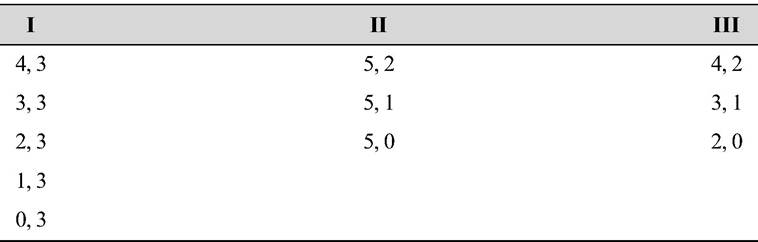
In each of these cases, B will either win in one move or get to (2, 1) in one move. Thus, A cannot do anything if B leaves (5, 3) in return for A leaving (6, 4).
Deduction 4 Just like being left with (2, 1) means a definite loss, so does being left with (5, 3).
Hence, A cannot allow a situation in which B can make it (5, 3) in one move.
Thus, A cannot leave B with (6, 4), (9, 3) or (8,3) since, each of these will result in B giving back (5, 3) in one move.
Thus A’s option are down to (7, 4) or (8, 4). These need to be further investigated now: Let us consider A leaving (7, 4) for B.
B’s options: 
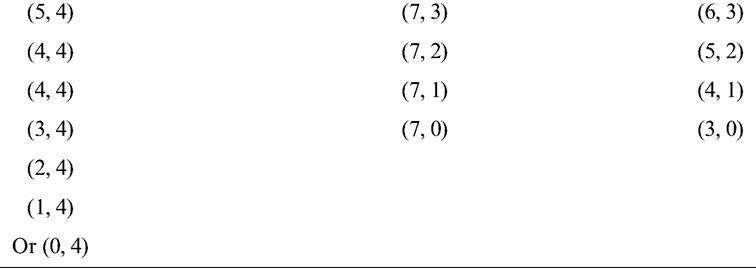
After closely evaluating each of these, all possible options will get eliminated because in one move they lead to either a straight win or a (2, 1) situation or a (5, 3) situation.
If A does any of this, then B cannot do anything to stop from losing the game.
The above question obviously is extremely long and complicated. However, what needs to be noticed is that even for this extremely long question, at no point of time is there any big logical jump i.e. from one logic emerges the next one and so on.
I Notes on Interpretation
Normally CAT questions only use 10% of this logic. However, let us now consider a question (Example 1.4) which appeared in CAT 2004 and was found to be extremely tough to crack. In fact, the question has been put down as unsolvable by most famous national level coaching centres on their website.
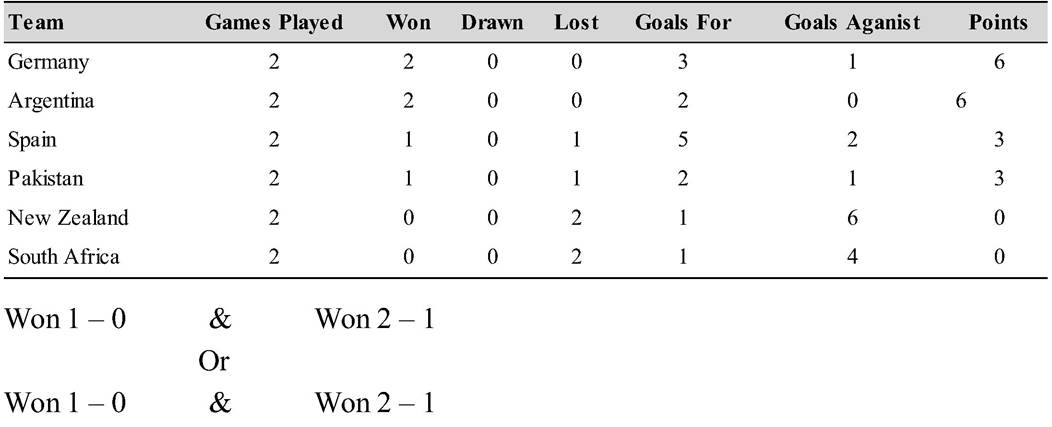
Example 4 The year was 2006. All six teams in Pool A of World Cup Hockey play each other exactly once. Each win earns a team three points, a draw earns one point and a loss earns zero points. The two teams with the highest points qualify for the semifinals. In case of a tie, the team with the highest goal difference (goals for-goals against) qualifies. In the opening match, Spain lost to Germany. After the second round (after each team played two matches),the (pool A) table looked as shown on the next page.
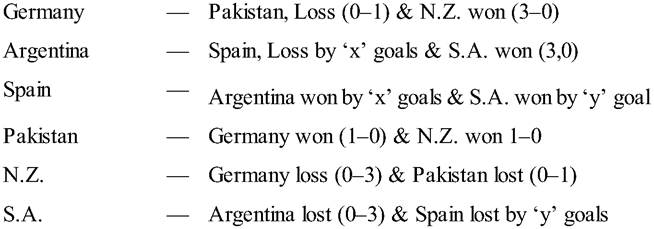
In the third round, Spain played Pakistan, Argentina played Germany, and New Zealand played South Africa. All the third round matches were drawn. The following are some results from the fourth and fifth round matches.
(a) Spain won both the fourth and fifth round matches.
(b) Both Argentina and Germany won their fifth round matches by 3 goals to 0.
(c) Pakistan won both the fourth and fifth round matches by 1 goal to 0.
SolutionFor solving the above question, one requires tremendous alacrity, logical consistently and above all a cool head.
Also, the solution of the above question is dependent on your ability to interpret the table and find out the appropriate linkages (something that might not be as easily done as said).
Let us look at the table and create our interpretations:
Deduction 1 Germany and Argentina have both won their matches while New Zealand and South Africa have lost both theirs.
Let us start by making tables for the possible result of the first two rounds for each of the six teams.
Germany
| Round one Opponent | Result |
| 1. Spain | Won 1-0/2-1 |
| 2. Рак/New Zealand/South Africa | Won 2-1/1-0 |
| 3. Argentina |
It is given that Germany has played Spain in the opening match (and obviously won that game).
Looking at the goals for & goals against columns and the fact that Germany has won both the first and second round matches, we deduce that its two wins must have been in one of the following combinations:
(Pool A)
I Notes on Interpretation
Germany cannot win either match by 2-0 or 3-0 or 3-1 margins since it will not be able to win the other match and maintain a 3-1 goals for goals against situation.
Deduction If Germany had won the first game 2-1 against Spain, Spain would have won its second round match by 4-0, while if Germany won by 1-0, then Spain would have won its second round match 5-1 (since Spain has Goals For = 5 and Goals Against -2).
Further, since only two teams — New Zealand and South Africa have conceded 4 or more goals, Spain must have played one of them. Looking into SouthAfrica5S G.F/G.A columns, if South Africa had conceded 4 goals in the second round, then it should have won the first round (1,0). But, South Africa has lost both rounds.
Hence, Spain played its second round against New Zealand. Further, if this is true, no other team can play New Zealand in round two.
At this stage, the following possibilities emerge.
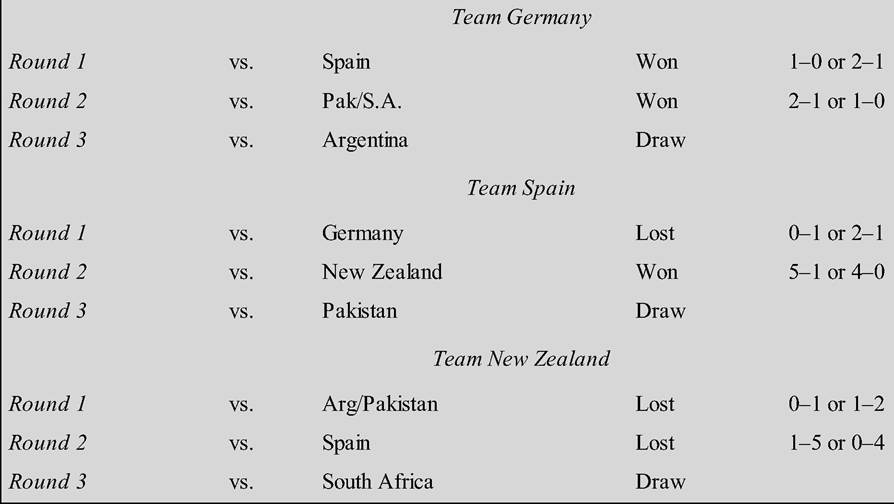
Deduction Team Pakistan won one round and lost one and GF/GA 2/1. Hence, won 2-0 and lost 0-1.
Now, since New Zealand played its first round against Pakistan or Argentina it could not have lost 1-2. This is because in the case of Pakistan, if Pakistan had won 2-1 against NZ in round 1, its round 2 would have been a draw.
Further, Argentina has conceded no goals. Hence, it could not have won 2-1 against N.Z.
This means that N.Z. must have lost 0-1 in its first match to Argentina (that cannot happen against Pakistan, because Pakistan cannot win 1-0 in the first round since it will result in a 1-1 draw in round 2).
Consequently N.Z. lost 1-5 in its second match to Spain and hence Spain must have lost
0-1 to Germany.
The following scenario emerges Ifomthese deductions:
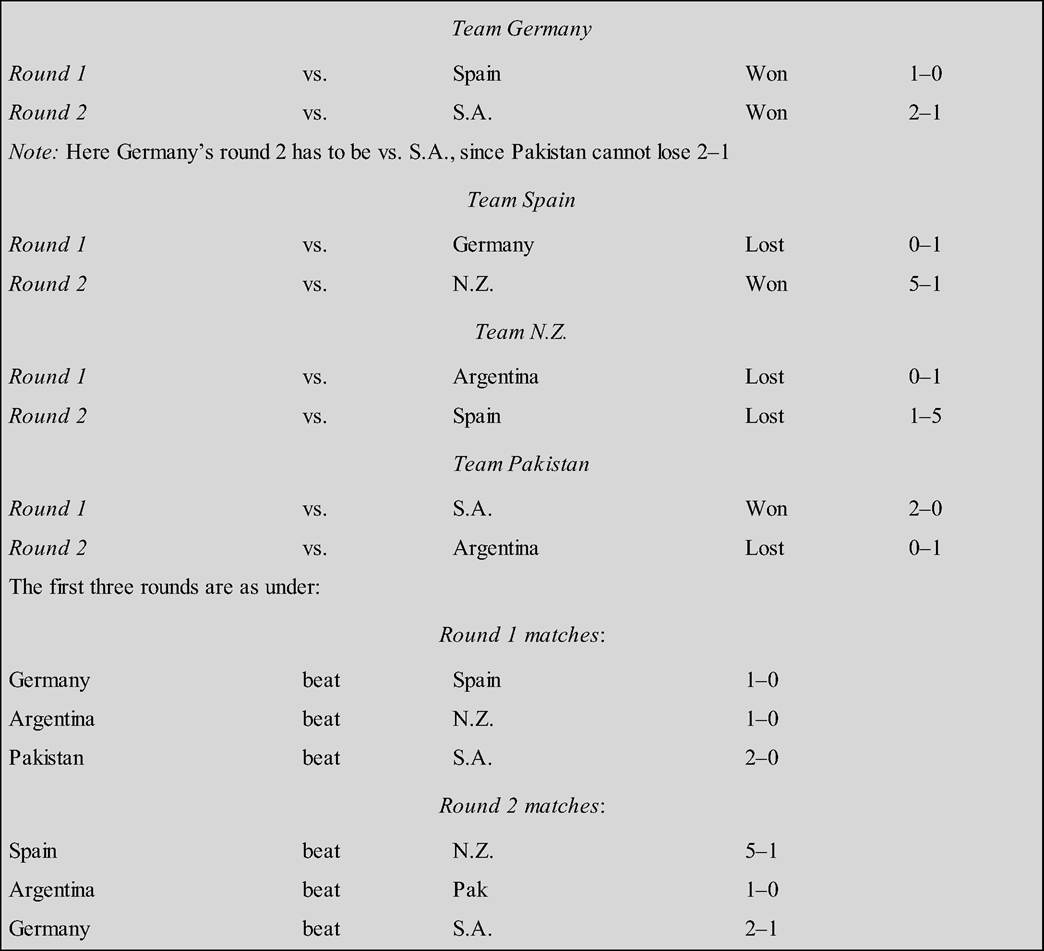
Putting all deductions into one table, the following picture emerges:
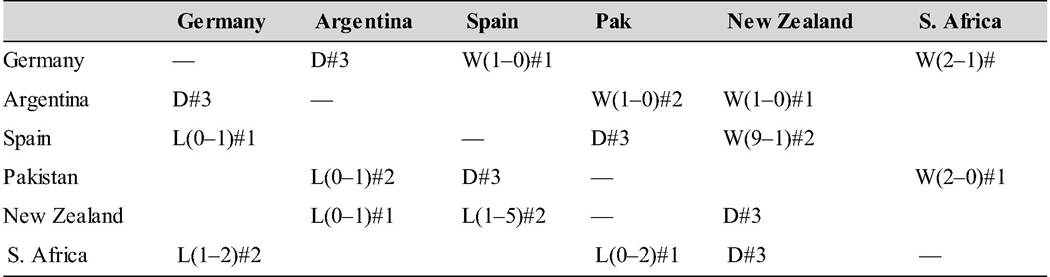
According to the information available about the fourth and fifth round of matches:
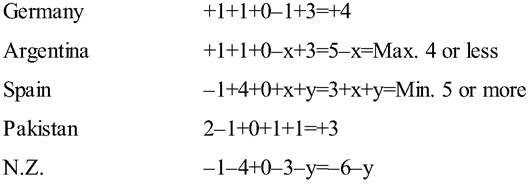
And the goal differences for the six teams are:
Based on these deductions, the following questions can be answered.
1. Which one of the following statements is true about the matches played in the first two rounds?
(a) Pakistan beat South Africa by 2 goals to 1.
(b) Argentina beat Pakistan by 1 goal to 0.
(c) Germany beat Pakistan by 2 goals to 1.
(d) Germany best Spain by 2 goals to 1.
2. Which one of the following statements is true about the matches played in the first two rounds?
(a) Germany beat New Zealand by 1 goal to 0.
(b) Spain beat New Zealand by 4 goals to 0.
(c) Spain beat South Africa by 2 goals to 0.
(d) Germany beat South Africa by 2 goals to 1.
3. Which team finished at the top of the pool after five rounds of matches?
(a) Argentina (b) Germany
(c) Spain (d) Cannot be determined
Spain must be top of the pool since it has the best goal difference even in it’s
worst case scenario.
4. If Pakistan qualified as one of the two teams from Pool A, which was the other team that qualified?
(a) Argentina (b) Germany
(c) Spain (d) Cannot be determined
I Notes on Interpretation
This question has an ambiguity since according to the deductions, Spain and Germany both should be above Pakistan in terms of goal difference and hence Pakistan cannot qualify. However, if Pakistan qualifies, so do both Spain and Germany.
The above question was basically testing the ability of the student to analyse data. In the very same paper (CAT 2004), another question on data analysis went as follows:
Example 5 Prof. Singh has been tracking the number of visitors to his homepage. His service provider has provided him with the following data on the country of origin of the visitors and the university they belong to:
Number of Visitors/Day
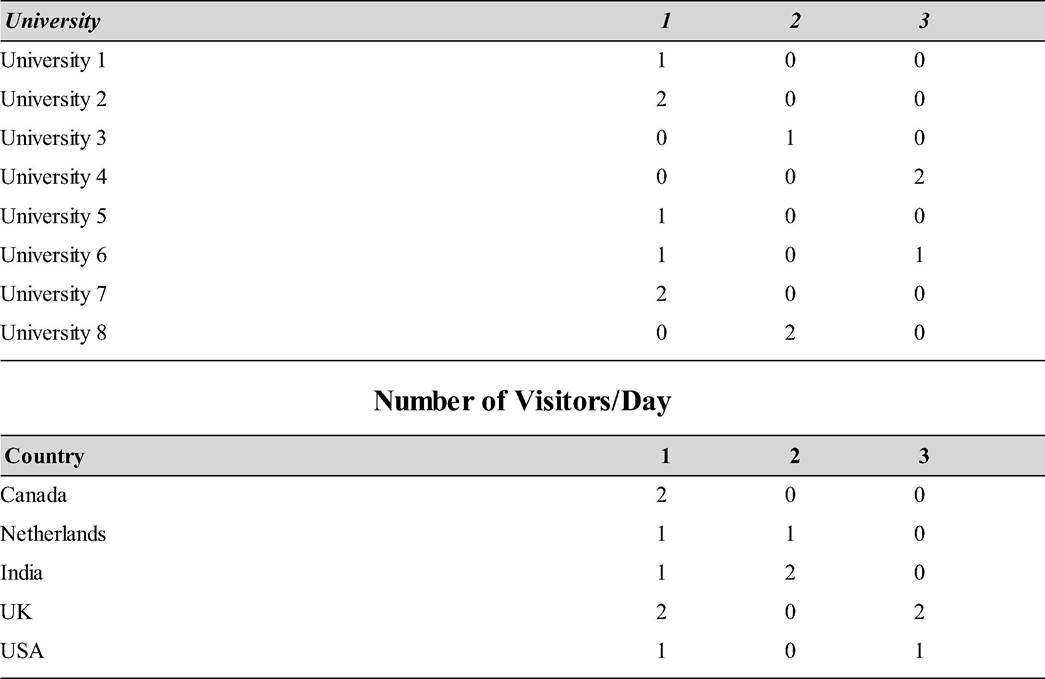
Deduction 1 Looking at Day 3, University 4 must belong to the UK and University 6 must belong to the USA.
Deduction 2 From Day 2 it is clear that University 8 has to be an Indian University while University 3 has to be IromNetherlands.
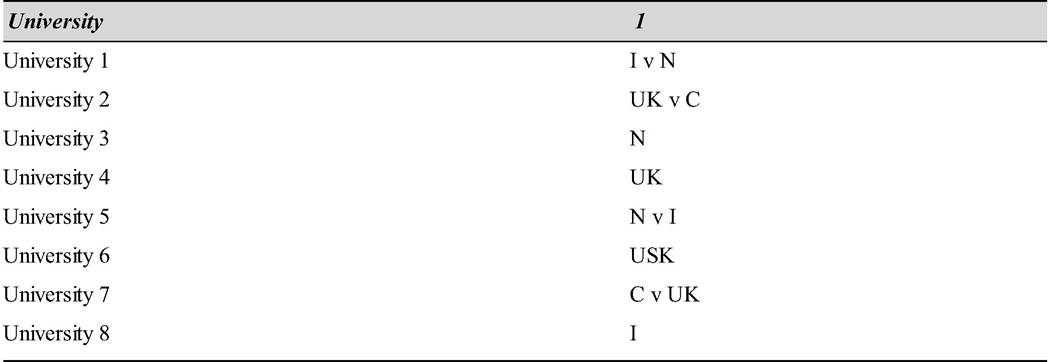
Deduction 3 From the analysis of Day 1 data, University 2 and University 7 should be distributed amongst UK and Canada in either order, i.e. 2 belongs to UK and 7 to Canada or 2 belongs to Canada and 7 to UK. [Symbolically, (2UK + 7 Canada) vs (2 Canada + 7 UK)]
Deduction 4 The visitor from USA on Day 1 must come from University 6. Hence, University 1 and University 5 should be distributed between India and Netherlands.
With this set of deductions, we get the following table. Using this table the answers to the following questions become quite elementary.
Number of Visitors/Day
1. To which country does University 5 belong?
(a) India or Netherlands but not USA
(b) India or USA but not Netherlands
(c) Netherlands or USA but not India
(d) India or USA but not UK
2. Universitylcanbelongto:
(a) UK (b) Canada
(c) Netherlands (d) USA
3. Which among the listed countries can possibly host three of the eight listed universities?
(a) None (b) Only UK
(c) Only India (d) Both India and UK
4. Visitors from how many universities from UK visited Prof. Singh’s homepage in three days?
(a) 1 (b) 2
(c) 3 (d) 4