APPENDIX A An Alternative Formulation of the IS–LM Model: The Recent Approach to the IS–LM Model
The equilibrium in the goods market is represented by the IS curve. The IS curve is a graphic representation of the goods market equilibrium showing the different combinations of the output levels and the interest rates at which planned spending is equal to income.
The derivation of the IS curve can be done in two stages;
Stage 1: The Investment Demand Curve
In the earlier chapters, investment has been assumed to be exogenous. However as the interest rate is being introduced in our analysis, investment is now taken as endogenous.
Investment is expenditure on the additions to the firm’s capital in the form of building, machinery, etc.
Investment is expenditure on the additions to the firm’s capital in the form of building, machinery, etc. Firms borrow for purposes of making investments. The higher is the rate of interest on the borrowings, the lower are the profits of the firm. Hence at high rates of interest, the firm will borrow and invest less as compared to low rates of interest. Thus, the investment function can be expressed as

where,
 = autonomous investment spending (or investment spending that is independent of both the income level and the interest rate)
b = responsiveness of investment spending to the rate of interest
r = the rate of interest
Equation (1) states that
The lower the interest rate the higher is the planned investment.
A large b implies that a relatively small increase in the rate of interest will lead to a large decrease in the level of investment.
Figure A.1 shows the firm’s investment demand curve showing the firm’s investment at different rates of interest.
The position of the curve depends on the following: or the level of autonomous investment spending. A change in will lead to a shift in the curve. A rise in
  implies a higher investment at each level of the rate of interest. A fall in
  implies a lower investment at each level of the rate of interest.
b or the responsiveness of investment spending to the rate of interest.
1. A large b implies that the responsiveness of investment to the rate of interest is high. Thus, a small decrease in the rate of interest will lead to a large increase in the level of investment. Hence, the investment demand curve is nearly flat.
2. A small b implies that the responsiveness of investment to the rate of interest is low. Thus, a small decrease in the rate of interest will lead to a small increase in the level of investment. Hence, the investment demand curve is nearly vertical.

Figure A.1 Investment Demand Curve
Stage 2: The Investment Demand Curve and the Aggregate Demand Curve
In the earlier chapters in a two sector economy, investment was defined to include consumption and investment but with investment as exogenous. We now include investment as a function of the interest rate in the aggregate demand function. Thus,
|
| AD = C + I |
| where, | C =  + bY (consumption function) + bY (consumption function) |
| I = – br (investment function) |
Substituting in the aggregate demand function for the consumption function and the investment function, we get

A Derivation of the IS Curve
Figure A.2 shows the derivation of the IS curve.
Suppose the rate of interest is r1 The aggregate demand curve will be

In equation (3), the term  +
+  – br1 is a constant. Hence, the intercept of the aggregate demand curve, AD1 is equal to +
  – br. AD1 intersects the guideline at point E1 to determine the equilibrium level of income at Y1. (Y1, r1) form one combination of income and the rate of interest at which planned spending is equal to income or at which the goods market is in equilibrium. This can be plotted as in Figure A.2(b) to obtain point E1.
A decrease in interest rate to r2 leads to a shift in the aggregate demand curve from AD1 to AD2. The intercept of the aggregate demand curve, AD2 is equal to  + I – br2. AD2 intersects the guideline at point E2 to determine the equilibrium level of income at Y2. Thus, (Y2, r2) form another combination of income and the rate of interest at which the goods market is in equilibrium. This again can be plotted in Figure A.2(b) to obtain point E2.
Similarly, the other combinations can be derived. Joining these points at which the goods market is in equilibrium we can arrive at the IS curve as in Figure A.2(b). At each and every point on the IS curve, the goods market is in equilibrium. The IS curve is downward sloping indicating the negative relationship between income and the rate of interest.
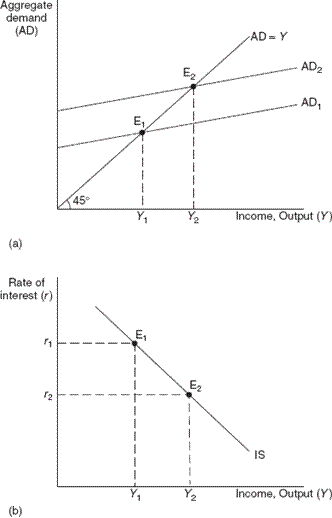
Figure A.2 A Derivation of the IS Curve THE MONEY—MARKET EQUILIBRIUM: THE LM CURVE
The equilibrium in the money market is represented by the LM curve. The LM curve is a graphic representation of the money—market equilibrium showing the different combinations of the output levels and the interest rates at which the demand for money is equal to the supply of money. A Derivation of the LM Curve
The derivation of the LM curve can be shown in two stages:
Stage 1: The Demand for Money
The demand for money is actually a demand for real (and not nominal) money. The demand for real money depends on two factors:
Real income, as individuals hold money to finance their expenditures which depend on their real income.
Rate of interest which is the opportunity cost of holding money. Thus, at a high interest rate the demand for money is low.
Thus, the demand for real balances can be expressed as


Figure A.3 A Derivation of the LM Curve
| where, | L = demand for real money balances |
| k = responsiveness of demand for real money balances to the income level | |
| Y = income level | |
| h = responsiveness of demand for real money balances to the interest rate | |
| r = rate of interest |
Stage 2: The Equilibrium in the Money Market-Demand for Money Equals the Supply of Money
As far as the supply of money is concerned, the nominal quantity of money, M in an economy is determined by the central bank.
Given the price level, the real supply of money is at the level Hence, the supply of money curve is a vertical line, independent of the rate of interest in Figure A.3(b).
 As far as the demand for money is concerned, initially suppose the income level is Y1. The corresponding demand curve for money is
L1 = kY1 – hr.

Figure A.4 The Goods and Money Markets
The demand for money is equal to the supply of money at point E1 while the equilibrium rate of interest is r1. Thus, (Y1, r1) form one combination of income and the rate of interest at which demand for money equals the supply of money. This can be plotted in Figure A.3(a) to obtain point E1.
An increase in the income level to Y2 leads to a shift in the demand curve for money from L1 to L2 (as more money is now demanded at each level of the interest rate). The money supply, however, remains unchanged at  The demand for money is equal to the supply of money at point E2 while the equilibrium rate of interest is r2. Thus, (Y2, r2) form another combination of income and the rate of interest at which demand for money equals the supply of money. This can again be plotted in Figure A.3(a) to obtain point E2.
Similarly, the other combinations can be derived. Joining these points at which the money market is in equilibrium, we can arrive at the LM curve. At each point on the LM curve, the money market is in equilibrium. The LM curve is upward sloping indicating the positive relationship between income and the rate of interest. THE GOODS MARKET AND THE MONEY—MARKET EQUILIBRIUM
Figure A.4 depicts the goods and money market. At point E in the figure, the IS and LM curves intersect. Hence, there exists simultaneous equilibrium in both the markets at point E, with the equilibrium rate of interest at r* and the equilibrium level of income at Y*. Thus at this particular point, (Y*, r*) while on the one hand, planned spending is equal to income, on the other hand the demand for money is equal to the supply of money.