Appendix A The Growth Rate Form of Okun's Law
To derive the growth rate form of Okun's law, Eq. (3.6), we start with the basic form of Okun's law, Eq. (3.5):
After multiplying by -1, we rewrite Eq.
(3.5) as
We now calculate the change from the previous year to the current year for each side of this equation. Setting the change on the left side equal to the change on the right side, and assuming that is constant (so that
 ,, we get

Using the formula that states that the growth rate of a ratio is approximately the growth rate of the numerator minus the growth rate of the denominator
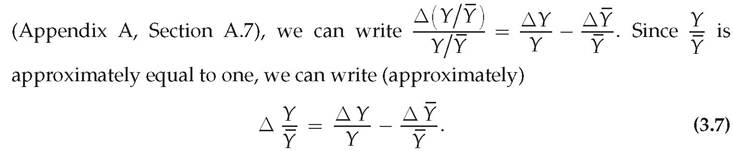
Then, since the left-hand side of Eq. (3.7) is the same as the left-hand side of Eq. (3.6), we can equate the right-hand sides of the two equations to get
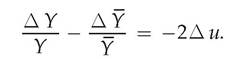
In the United States, the average growth rate of full-employment output is 3% per year. Substituting 3% into this equation and rearranging gives the growth rate form of Okun's law, Eq. (3.6).