15 Demand for Money: The Post-Keynesian Approach
After studying this topic, you should be able to understand
· The post Keynesian theories like the portfolio theories lay emphasis on the store of value function of money.
· The transactions theories lay more emphasis on the medium of exchange function of money.
· The Baumol-Tobin model of transactions demand for money lays stress on the fact that the holding of money by the individual transactor in his asset portfolio involves both a cost and a benefit.
· Friedman’s theory of demand for money is partly Keynesian and partly non-Keynesian.
· Friedman ignores the motives for holding money and takes it for granted that people will certainly hold money. INTRODUCTION
As already discussed in Chapter 14 that Keynes believed that there exist only two kinds of assets between which individuals make a choice: money and bonds. One of the most important post Keynesian developments was the realization that besides money and bonds, there exist a variety of assets between which the individual chooses. This chapter makes an attempt at analysing some of these theories, which came after Keynes had presented his theory. PORTFOLIO THEORIES OF DEMAND FOR MONEY: TOBIN’S PORTFOLIO BALANCE THEORY
Money is demanded because it performs many functions. While the classical economists had laid emphasis on the medium of exchange function of money (as in the QTM), Keynes had realized the importance of both the medium of exchange function and the store of value function of money. The post Keynesian theories like the portfolio theories lay emphasis on the store of value function of money.
In comparison to other assets, money offers a different combination of risk and return. While bonds and stocks are subject to price fluctuations money is at least safe in comparison. Hence, according to some economists like James Tobin, people have a preference for money in their optimal asset portfolio.
As per the portfolio theories, the demand for money is influenced by many factors; some of them are as follows:
The total amount of wealth to be divided between money and the other assets.
The risk and return on money in comparison to the other assets a household holds.
The demand function for money can be written as:
|
| ( M/P) d = L ( r s, r b, π e, W ) |
| where, | (M/P) d = demand for real money |
| r s = expected real return on stocks | |
| r b = expected real return on bonds | |
| π e = the expected rate of inflation in the economy | |
| W = real wealth |
A look at the demand for money function shows that:
A decrease in rs or rb leads to an increase in the demand for money as the other assets are now less attractive.
A decrease in πe will lead to an increase in demand for money because money is now more attractive.
An increase in W will lead to an increase in the demand for money because a larger wealth is associated with a larger asset portfolio.
Thus, according to the portfolio theories, the demand for money, which is the safest asset, depends not only on the expected yields from the other assets but also on the risk on the yields expected from these other assets. Thus, the demand for money is a function of the expected returns on the other assets, the expected rate of inflation and the real wealth. In general, an increase in the risk perception of the yields accruing on the other assets will result in an increase in the demand for money as this will decrease the opportunity cost of holding money.
The usefulness of the portfolio theories in evaluating the demand for money will depend on the definition of money which is under consideration:
(1) The narrow measure of money is M1,
M1 = C + DD
It is clear as since currency and demand deposits are safe assets but earn zero or very low rates of interest, M1, as a store of value is much below the other assets.
Thus portfolio theories are not able to explain the demand for currency and demand deposits, which form a part of M1.
(2) The broad measure of money is M2
M2 = C + DD + Saving Deposits with Post Offices + Net Time Deposits of Banks
Since saving deposits and time deposits have the same risk but pay a higher yield than currency and demand deposits, portfolio theories are able to explain the demand for such assets like saving deposits and time deposits.
The portfolio theories, thus, are able to explain the demand for M2 better than M1. Tobin’s Portfolio Balance Theory
In the year 1958 in his famous article Liquidity Preference as Behaviour towards Risk, Tobin had put forward the view that the individual wealth holder in his asset portfolio, in addition to other capital assets, always prefers to hold money which is a safe asset with a nominal value which is certain. He does so as an insurance against those capital assets whose prices tend to fluctuate in an uncertain manner.
Tobin’s portfolio balance theory analyses the behaviour of such an individual wealth holder. Keynes had emphasized that the individual wealth holder will hold either nothing or bonds or nothing but money in his asset portfolio. However, empirical evidence goes against Keynes’ beliefs. People prefer to hold a diversified asset portfolio, where they hold money, bonds, and many other assets. They do so because they are uncertain about the future. If the individual wealth holder had been certain regarding the future he would hold only that asset from which he expects the highest returns.
We consider an individual who gets a certain income once in a time period. A part of this income is put aside as savings to be invested in assets. Tobin’s analysis is based on certain assumptions which are as follows:
The assets that are available to him for his asset portfolio are only bonds and money.
The individual treats wealth as a good, which increases his utility and risk as a bad which decreases his utility.
Money involves no risk and does not give any returns.
Bonds are subject to price fluctuations. They do yield an income but which is subject to uncertainty. This income has two parts:
1. The interest on the bond, which is a certain amount.
2. The capital gains and losses, which are subject to risks and uncertainty.
There exists a trade-off between risk and return. Thus, an individual with a higher proportion of bonds in his portfolio is expecting to earn more wealth but is at a higher risk.
Figure 15.1 depicts the utility maximization by an individual wealth holder where
Vertical axis = expected wealth in the next period, w Horizontal axis = risk, σ
I0, I1 = indifference curves where each curve represents the different combinations of risk and expected wealth between which the individual is indifferent.
Unlike the standard indifference curve, here each curve slopes upwards towards the right because while wealth is a good which increases the individual’s utility, risk is a bad which decreases his utility. Thus as an individual’s wealth increases, he will be better off unless there occurs an increase in the risk.
A movement upwards and towards the left represents indifference curves with higher levels of utility indicating that the individual is in a better position.
As against the standard convex to the origin indifference curves, the indifference curves here are convex downwards. The larger the wealth the individual has, lesser would be the importance of each incremental unit. Thus, the smaller will be the additional risk that he will be willing to undertake to add to his wealth.
w – w (1 + i0) = line depicting the budget constraint of the individual. It shows the different combinations of risk and expected wealth among which he makes a choice while he is arranging his asset portfolio.
Along this line, the options available to the individual are as follows:
Point w, which represents the wealth he begins with. If he continues to hold his entire wealth in the form of money, he would have the same wealth in the end.
Point w (1 + i0), which represents the situation when he holds his entire wealth in form of bonds. At this particular point, 
Figure 15.1 Maximization of Utility by the Individual Wealth Holder
BOX 15.1
The main difference between Keynes and Friedman exists in their opinion with respect to the sensitivity of the demand for money to the rate of interest and regarding the stability of the demand for money function over time. Tobin on the basis of his research had concluded that the demand for money is sensitive to the rate of interest. Others also came up with similar conclusions. However, as far as the stability of the demand for money in the US is concerned, while it was stable initially but later on from the 1970s it became quite unstable and created problems for the Federal Reserve.
1. If the rate of interest is i0, his expected wealth will be w (1 + i0).
2. Since he would be holding all his assets in the form of bonds, he would be undertaking the maximum risk, σMax.
Any point on the line w – w (1 + i0) which represents a combination of money and bonds in his asset portfolio.
Given the interest rate and the risk on the bonds, the individual wealth holder aims at maximizing his utility from his asset portfolio. Such a point is E where the indifference curve I0 is tangential to the budget constraint. At this point, his portfolio consists of a combination of both money and bonds.
Effects of a Change in the Interest Rate on the Individual Wealth Holder’s Asset PortfolioSuppose while the risk remains the same, there is an increase in the interest rate on the bonds, from i0 to i1. In Figure 15.2, there is a shift in the budget line and the individual wealth holder is now in equilibrium at point E1 which is on a higher indifference curve than point E. At point E1, the individual is earning more returns as compared to point E but he is able to do so by undertaking greater risk. More risk implies that the individual is holding more bonds and thus less of money. Therefore, it is obvious that an increase in the interest rate leads to a decrease in the demand for money. This analysis helps in the derivation of what Keynes called the speculative demand for money, showing the inverse relationship between the rate of interest and the demand for money.

Figure 15.2 Effects of a Change in the Interest Rate on the Individual Wealth Holder’s Asset Portfolio

Figure 15.3 Effects of a Change in the Interest Rate on the Individual Wealth Holder’s Asset Portfolio: The Substitution Effect and the Wealth Effect Effects of a Change in the Interest Rate on the Individual Wealth Holder’s Asset Portfolio: The Substitution Effect and the Wealth Effect
In Figure 15.2, we had analysed the effect of a change in the interest rate leading to a shift in the budget line with the individual wealth holder in equilibrium at point E1. Figure 15.3 splits up the movement from E to E1 into the substitution effect and the wealth effect:
A movement from E to E2 is the substitution effect. Due to this effect there occurs a movement along the indifference curve I0, leading to an increase in risk undertaken and thus in the holding of bonds. Thus, there is a decrease in the demand for money.
A movement from E2 to E1 is the wealth effect. This effect can take any direction. With an increase in the individual’s wealth if his bond holding increases, then in that case the substitution effect gets reinforced by the wealth effect. Hence, with an increase in the rate of interest the individual wealth holder increases his holdings of bonds and decreases his demand for money. Effects of a Change in the Shape of the Indifference Curves on the Individual Wealth Holder’s Asset Portfolio
Figure 15.4 (a) shows an indifference curve map where an increase in the rate of interest rate leads to situation where the individual is willing to undertake less risk. Less risk implies that the individual is reducing his holding of bonds and increasing the demand for money.
Figure 15.4 (b) shows an indifference curve map where an increase in the rate of interest rate leads to situation where the individual is willing to undertake the same amount of risk, and thus his holding of bonds and the demand for money remains unchanged.
Thus, it is important to note that the shape of the indifference curves plays an important role in determining the demand for money.
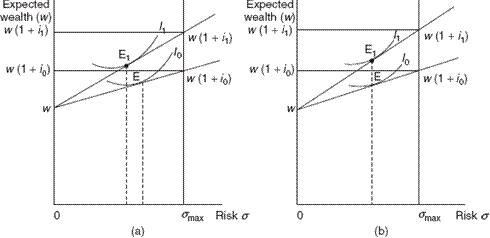
Figure 15.4 Effects of a Change in the Shape of the Indifference Curves on the Individual Wealth Holder’s Asset Portfolio Effects of a Change in the Risk on Bonds on the Individual Wealth Holder’s Asset Portfolio
In Figure 15.5, an increase in the risk on bonds leads to a downward shift of the budget constraint. There is a change in equilibrium from E1 to E. Thus with the increase in risk on bonds, the individual is less willing to hold bonds and thus his demand for money goes up.
Similarly with a decrease in the risk on bonds, there will be an upward shift of the budget constraint with a change in equilibrium. The individual is now more willing to hold bonds and thus his demand for money goes down.
Thus we find that the demand for money, according to Tobin, depends on the following factors:
the individual’s wealth;
the interest rate or the expected yield on the bonds; 
Figure 15.5 Effects of an Increase in the Risk on Bonds on the lndividual Wealth Holder’s Asset Portfolio
the risk on the bonds;
the price level; and
shape of the indifference curves.
RECAP
· The demand for money is a function of the expected returns on the other assets, the expected rate of inflation and the real wealth.
· The portfolio theories are able to explain the demand for M2 better than M1.
· When there is an increase in the rate of interest, the individual wealth holder increases his holdings of bonds and decreases his demand for money.
· When there is a decrease in the risk on bonds, the individual is more willing to hold bonds and thus his demand for money goes down. TRANSACTIONS THEORIES OF DEMAND FOR MONEY: BAUMOL–TOBIN MODEL OF CASH MANAGEMENT
Unlike some of the post Keynesian theories like the portfolio theories which lay emphasis on the store of value function of money, the transactions theories lay more emphasis on the medium of exchange function of money. According to these theories, even though money does not yield any returns people continue to hold it because it has the advantage of making it more convenient to conduct transactions. Hence, they are in a position to explain the demand for even the narrow measure of money M1. Of the many transactions theories, one theory which became quite popular is the Baumol-Tobin model. Baumol–Tobin Model of Transactions Demand for Money
The model was developed in the 1950s by William Baumol and James Tobin. The model analyses the behaviour of an individual transactor (who may be a firm or even a household) who continues to hold money in his asset portfolio. This holding of money involves both a cost and a benefit:
The cost of holding money has two components:
1. An opportunity cost in terms of the interest that would have accrued had the money been deposited in some saving deposits.
2. The cost, which is involved per transaction of moving between bonds and money.
The benefit of holding money is the ease with which the transactions can be conducted with the money.
The model is based on certain assumptions, which are as follows:
1. An individual receives an income Y once in a certain time period but spends it gradually over a year.
2. The individual’s cash purchases (or expenditures) are spread evenly throughout the year.
3. The individual holds a combination of money and risk free income yielding bonds in his portfolio.
4. There is a given cost involved per transaction of moving between bonds and money.
The individual will aim at achieving an optimal size of his money holding. This will further depend on the number of trips he makes to the bank in a year:
He makes one trip to the bank in a year. He withdraws the entire income Y at the beginning of the year and then spends it uniformly over the year. Figure 15.6(a) shows that his money holdings:
1. At the beginning of the year is Y;
2. At the end of the year are zero.
3. Average money holdings over the whole year are Y/2.

Figure 15.6 The Individual’s Average Money Holdings Over a Year
He makes two trips to the bank in a year. Figure 15.6(b) shows that his money holdings:
1. At the beginning of the year is Y/2 as he withdraws an income of Y/2 at the beginning of the year and then spends it uniformly over the first half of the year.
2. At the end of the year are zero as in the middle of the year he makes another trip to the bank to withdraw the rest of his income, Y/2 to spend uniformly in the latter part of the year.
3. Average money holdings over the whole year are Y/4.
He makes N number of trips to the bank in a year. Figure 15.6 (c) shows that his money holdings:
1. At the beginning of the year is Y/N.
2. At the end of the year are zero.
3. Average money holdings over the whole year are Y/2N since in every trip that he makes to the bank he withdraws an income Y/N to spend uniformly over the year.
The smaller is N (that is, the fewer the number of trips that he makes to the bank).
The more is the money holding of the individual (on an average).
The higher is the loss of interest.
The less are the hassles involved in making frequent trips to the bank. Optimal Level of Transactions Demand for Money
To determine this, we first need to determine the optimal value of N. We assume
i = interest rate T = the fixed cost per transaction involved in moving between bonds and money
Total cost of N trips = Costs of trips + Interest forgone
or

where,
TN = the total cost of making N trips to the bank

Now since

to find the optimal number of transactions we minimize the total cost with respect to N

But at the optimum

Thus,

or

or
iY = 2TN 2
or,

where N* is the optimal number of transactions.
Thus, an individual would make more transactions if
the lower is the transactions cost.
the higher is the income.
the higher is the interest rate.
The theory arrives at the following conclusions:
The transactions demand for money increases less than proportionately with the increases in income. This is because there exist economies of scale in an individual’s transactions demand for money.
The transactions demand for money varies inversely with the interest rate.
Empirical evidence suggests that while the income elasticity seems to be between 1/2 and 1, the interest elasticity seems to be between 0 and 1/2.
BOX 15.2
Milton Friedman is one of the most well known and influential political commentators and economist of the century. He was a very strong opponent of the Keynesian economics and the Keynesian orthodoxy. He attacked the Keynesian theory with his article. The Quantity Theory of Money, A Restatement (1956), followed by a historical study on the Monetary History of the United States, in 1963 with Anna J. Schwartz. Friedman also wrote on the different aspects of economic policy. In general, he advocated laissez-faire policies. In the year 1976, Friedman won the Nobel Prize.
RECAP
· According to the Baumol–Tobin model of transactions demand for money, the transactions demand for money increases less than proportionately with the increases in income and inversely with the interest rate. MODERN QUANTITY THEORY OF MONEY: FRIEDMAN’S MODEL
The main proponent of the modern quantity theory of money is Milton Friedman who has developed his own version of the quantity theory of money (QTM). Friedman’s theory of demand for money is partly Keynesian and partly non-Keynesian. Unlike Keynes, he ignores the motives for holding money and takes it for granted that people will certainly hold money. The crux relates to the question as to how much money people will hold.
To identify the determinants of the demand for money, Friedman divides the holders of money into two categories:
The ultimate wealth holders
The business firms
However in putting forward his theory, Friedman has laid more emphasis on the ultimate wealth holders as compared to the business firms. Demand for Money by the Ultimate Wealth Holders
It is important to note the following:
The ultimate wealth holders are the households.
For the households, money is just like any other durable good; hence, we can apply the standard theory of demand for consumer durable goods to the demand or money.
Households are interested in real (and not nominal) money and its command over the goods and services.
According to Friedman, the key determinants of the demand for money are as follows:
Wealth: The concept of wealth is similar to the budget constraint of the standard consumer theory. Friedman defines wealth to include both physical wealth (non-human wealth) and human wealth. While estimates are available for the former, it is extremely difficult to measure human wealth, which can be taken as the present value of the expected future flow of labour income.
The solution to the problem of measuring wealth is to use income, which includes both labour income and physical income, as a proxy for wealth. But as far as income is concerned, Friedman had suggested the use of the ‘permanent income’ rather than the current income. Thus in Friedman’s analysis, income is a proxy for wealth and is not money earned for work done.
The division of wealth between human wealth and physical wealth: While physical wealth can be easily bought and sold, there is no market for human wealth and thus there cannot be substitution between human and physical wealth in the asset portfolio.
Friedman suggests that the ratio of human wealth to physical wealth should be considered as an important variable. Given the total wealth, the higher the component of human wealth, the higher will be the demand for money to make up for the lack of a market in human wealth.
Expected rate of return on money and other assets: This is similar to the concept of the price of the good under consideration and the price of substitutes and complements in the standard consumer theory of demand.
As far as the nominal rate of return is concerned, it may be:
1. positive as in the case of saving deposits,
2. zero as in the case of currency or
3. negative (only theoretically) when there are net service charges on the current account deposits.
In general, the nominal rate of return on assets can be divided into two components, which are as follows:
1. The interest income on the assets.
2. Expected change in the nominal price of these assets.
Although we have taken the rates of returns on the different assets as separate variables, in reality, a change in any one of them will have an impact on others as well.
Price level: An increase in the price level will lead to a decrease in real value of the nominal money holdings. Hence, the expected rate of change in prices is an important variable as it exercises an influence on the expected rate of return to money.
Other variables: This includes variables like the extent to which economic stability is expected to prevail in the economy in the future. Wealth holders will prefer to hold more liquidity during unstable economic conditions.
Friedman’s theory of demand for money can be expressed in the form of the following function:
|
|  |
| where, | M = Demand for nominal money |
| P = Price level | |
 = Demand for real money = Demand for real money | |
| y = Real income | |
| w = Ratio of human wealth to non-human wealth | |
| r m = Expected rate of return on money | |
| r b = Expected rate of return on fixed value securities | |
| r e = Expected return on equities | |
| p e = Expected rate of change of prices of goods | |
| u = variables other than income, which influence the utility of money |
Thus, we have Friedman’s demand function for money. However, this equation is subject to certain qualifications which are as follows:
It is the aggregate demand for money function.
M, y and w refer to aggregate magnitudes.
We are ignoring the distribution of income among the households and the firms.
RECAP
· According to Friedman, the key determinants of the demand for money are wealth, the division of wealth between human wealth and physical wealth, and the expected rate of return on money and other assets.
SUMMARY INTRODUCTION
The chapter makes an attempt at analysing some of those theories, which came after Keynes had presented his theory. PORTFOLIO THEORIES OF DEMAND FOR MONEY: TOBIN’S PORTFOLIO BALANCE THEORY
The post Keynesian theories like the portfolio theories lay emphasis on the store of value function of money.
According to some economists like James Tobin, people have a preference for money in their optimal asset portfolio.
As per the portfolio theories, the demand function for money can be written as: 
Thus, the demand for money is a function of the expected returns on the other assets, the expected rate of inflation and the real wealth.
As to the usefulness of the portfolio theories in evaluating the demand for money, the portfolio theories are able to explain the demand for M2 better than M1. TOBIN’S PORTFOLIO BALANCE THEORY
Tobin’s portfolio balance theory analyses the behaviour of an individual wealth holder who is uncertain about the future and thus holds a diversified asset portfolio, where he holds money, bonds, and many other assets.
The individual wealth holder aims at maximizing his utility. His indifference curves slope upward with wealth as a good and risk as a bad. His budget constraint shows the different combinations of risk and expected wealth among which he makes a choice while he is arranging his asset portfolio.
Given the interest rate and the risk on the bonds, the individual wealth holder will be in equilibrium at a point where the indifference curve is tangential to the budget constraint. At this point, his portfolio consists of a combination of both money and bonds. EFFECTS OF A CHANGE IN THE INTEREST RATE ON THE INDIVIDUAL WEALTH HOLDER’S ASSET PORTFOLIO
Suppose while the risk remains the same, there is an increase in the interest rate on the bonds.
There occurs a shift in the budget line and the individual wealth holder moves to new equilibrium, which is on a higher indifference curve.
At this point he is undertaking a greater risk that he can do only by holding more bonds and less of money.
Thus, an increase in the interest rate leads to a decrease in the demand for money.
The effects of a change in the interest rate can be discussed in terms of the substitution effect and the wealth effect. EFFECTS OF A CHANGE IN THE SHAPE OF THE INDIFFERENCE CURVES ON THE INDIVIDUAL WEALTH HOLDER’S ASSET PORTFOLIO
Depending on the shape of the indifference curves, it is possible for an increase in the rate of interest to lead to a situation where
The individual is willing to undertake less risk and he thus reduces his holding of bonds thereby increasing the demand for money.
The individual is willing to undertake the same amount of risk and, thus, his holding of bonds and the demand for money remains unchanged. EFFECTS OF A CHANGE IN THE RISK ON BONDS ON THE INDIVIDUAL WEALTH HOLDER’S ASSET PORTFOLIO
An increase in the risk on bonds leads to a downwards shift of the budget constraint and thus a change in equilibrium. The individual is less willing to hold bonds and thus his demand for money goes up.
A decrease in the risk on bonds leads to an upwards shift of the budget constraint with a change in equilibrium. The individual is now more willing to hold bonds and thus his demand for money goes down. TRANSACTIONS THEORIES OF DEMAND FOR MONEY: BAUMOL–TOBIN MODEL OF CASH MANAGEMENT
The transactions theories lay more emphasis on the medium of exchange function of money. Hence, they are in a position to explain the demand for even the narrow measure of money M1. BAUMOL–TOBIN MODEL OF TRANSACTIONS DEMAND FOR MONEY
The model analyses the behaviour of an individual transactor who continues to hold money in his asset portfolio.
The holding of money involves both a cost (opportunity cost in terms of the loss of interest and the cost per transaction of moving between bonds and money) and a benefit (in terms of the ease with which the transactions can be conducted with the money).
The individual will aim at achieving an optimal size of his money holding. This will depend on the number of trips he makes to the bank in a year.
In general, the fewer the number of trips that he makes to the bank.
1. the more is the money holding of the individual (on an average).
2. the higher is the loss of interest.
3. the less are the hassles involved in making frequent trips to the bank.
Thus, an individual would make more transactions if.
1. the lower is the transactions cost.
2. the higher is the income.
3. the higher is the interest rate.
The theory arrives at the conclusions that transactions demand for money increases less than proportionately with the increases in income and also that it varies inversely with the interest rate. MODERN QUANTITY THEORY OF MONEY: FRIEDMAN’S MODEL
Friedman’s theory of demand for money is partly Keynesian and partly non-Keynesian.
To identify the determinants of the demand for money, Friedman divides the holders of money into two categories: the ultimate wealth holders and the business firms.
The ultimate wealth holders are the households who hold money like any other durable good and are interested in only real money.
According to Friedman, the key determinants of the demand for money are as follows:
1. Wealth where Friedman defines wealth to include both physical wealth (non-human wealth) and human wealth. He uses income, which includes both labour income and physical income, as a proxy for wealth.
2. The division of wealth between human wealth and physical wealth is important in that, given the total wealth, the higher is component of human wealth the higher will be the demand for money.
3. Expected rate of return on money and other assets play an important role. In general, the nominal rate of return on assets can be divided into two components: interest income on the assets and expected change in the nominal price of these assets.
4. An increase in the price level will lead to a decrease in real value of the nominal money holdings.
5. Other variables include extent to which economic stability is expected to prevail in the economy in the future.
Friedman’s demand for money function can be expressed in the form of the following function:  = (y, w, rm, rb, re, pe, u)
REVIEW QUESTIONS TRUE OR FALSE QUESTIONS
The post Keynesian theories like the portfolio theories lay emphasis on the store of value function of money.
The portfolio theories are able to explain the demand for M1 better than M2.
Tobin’s portfolio balance theory analyses the behaviour of such an individual wealth holder who holds either nothing or bonds or nothing but money in his asset portfolio.
When there is a decrease in the risk on bonds, the individual demand for money goes down.
The transactions theories lay more emphasis on the medium of exchange function of money. VERY SHORT-ANSWER QUESTIONS
Why do people have a preference for money in their optimal asset portfolio?
Even though money does not yield any returns, why do people continue to hold it? Explain with the help of the transactions theories of demand.
What are the main conclusions of Baumol—Tobin Model of transactions demand for money?
Discuss Friedman’s demand for money function explaining its variables.
Compare the transactions theories of demand for money with the portfolio theories of demand for money. SHORT-ANSWER QUESTIONS
Discuss the effects of a change in the interest rate on the individual wealth holder’s asset portfolio. What are the substitution effect and the wealth effect?
Analyse the effects of a change in the risk on bonds on the individual wealth holder’s asset portfolio.
What are the key determinants of the demand for money in the Friedman’s theory of demand for money? Explain.
How does the individual wealth holder maximize his utility? Show with the help of the upward sloping indifference curves where wealth is a good and risk is a bad.
Discuss in brief
1. Tobin’s portfolio balance theory
2. Baumol–Tobin model of transactions demand for money LONG-ANSWER QUESTIONS
(a) Write a short note on the demand function for money.
(b) Discuss the usefulness of the portfolio theories in evaluating the demand for money.
Discuss Tobin’s portfolio balance theory.
Explain with diagrams:
1. Effects of a change in the interest rate on the individual wealth holder’s asset portfolio.
2. Effects of a change in the shape of the indifference curves on the individual wealth holder’s asset portfolio.
3. Effects of a change in the risk on bonds on the individual wealth holder’s asset portfolio.
Explain Baumol–Tobin model of transactions demand for money
Discuss modern quantity theory of money: Friedman’s model.
ANSWERS TRUE OR FALSE QUESTIONS
True. While the classical economists had laid emphasis on the medium of exchange function of money, Keynes emphasized the medium of exchange function and the store of value function of money and the post Keynesian theories lay emphasis on the store of value function of money.
False. The portfolio theories are able to explain the demand for M2 better than M1.
False. Tobin’s portfolio balance theory analyses the behaviour of an individual wealth holder whose asset portfolio consists of a combination of both money and bonds.
True. When there is a decrease in the risk on bonds, the individual is more willing to hold bonds and thus his demand for money goes down.
True. Unlike some of the post Keynesian theories like the portfolio theories which lay emphasis on the store of value function of money, the transactions theories lay more emphasis on the medium of exchange function of money.