Different Conceptions of Technology
12.1.1. Types of Technological Change. The literature on technological change often distinguishes between different types of innovations. A first common distinction is between process and product innovation.
While the latter refers to the introduction of a new product (for example, the introduction of the first DVD player), the former is concerned with innovations that reduce the costs of production of existing products (for example, the introduction of new machines to produce existing goods). Although the distinction between process and product innovations is important in the literature and in practice, we will shortly see that many models with process innovation, in particular, those in which new innovations introduce new types of inputs, are mathematically identical to models of product innovation. Nevertheless, the distinction is still useful in mapping some of these theories to data.A somewhat different type of process innovation is perhaps most important in practice and involves the introduction of a cost-reducing technological improvement or a higher-quality version of an existing good. Both the introduction of a better DVD player, when there are already DVD players in the market, and the innovation to manufacture exactly the same DVD player at lower costs would be examples of this type of innovation. The most important implication is that these types of innovations will typically lead to the replacement of older vintages of the same good or machine and also to potential competition between existing producers and the innovator. In addition, in the context of this type of innovation, one might want to distinguish between the introduction of a higher-quality DVD player and the production of a cheaper DVD player because heterogeneous consumers may have differential willingness to pay for quality than for quantity. Issues of differential willingness to pay for quality are important in the theory of industrial organization and for constructing accurate quality-adjusted price indices.
However, most growth models represent the consumer side by a representative household and also implicitly assume perfect substitution between quality and quantity. These features create a close connection between innovations that increase the quality of existing products and process innovations. The following example illustrates why, in the context of the typical growth models, quality improvements and cost reductions are essentially equivalent.EXAMPLE 12.1. Consider an economy admitting a representative household with preferences U (c (q),y | q), where y stands for a generic good (perhaps representing all other goods), c is a particular consumption good available in different qualities. Here c (q) denotes the amount consumed of the “vintage” of this good of quality q. The utility function is also conditioned on q. This specification implies that quality and quantity are perfect substitutes, so that higher-quality increases the “effective units” of consumption. This is a typical assumption in growth models, though it is clearly restrictive; the consumption (use) of five Pentium I computers would not give the same services as the use of a single Pentium III computer.
Let the budget constraint of the representative consumer be

where p (q) is the price of a good of quality q, the price of the generic good is normalized to 1, and m denotes the resources available to the consumer. The problem of the consumer can then be equivalently written as
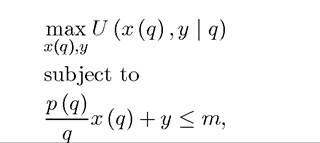
where x (q) ? qc (q) corresponds to the effective units of consumption of good c. It is straightforward to see from this problem formulation that an s% increase in quality q and an s% decline in the price p (q) have exactly the same effect on the effective units of consumption and on welfare. This justifies the claim above that in many models, process innovations reducing costs of production and quality improvements have identical effects.
Another important distinction in the technological change literature is between “macro” and “micro” innovations (see Mokyr, 1990).
The first refers to radical innovations, perhaps the introduction of general-purpose technologies, such as electricity or the computer, which potentially changed the organization of production in many different product lines. In contrast, micro innovations refer to the more common innovations that introduce newer models of existing products, improve the quality of a certain product line, or simply reduce costs. Most of the innovations we will be discussing can be viewed as “micro innovations”. Moreover, empirically, it appears that micro innovations are responsible for most of the productivity growth in practice (see the evidence and discussion in Freeman (1982), Myers and Marquis (1969) and Abernathy (1980)). We will discuss the implications of macro or general-purpose innovations below.12.1.2. A Production Function for Technology. A potentially confusing issue in the study of technological progress is how to conceptualize the menu of technologies available to firms or individuals. Since our purpose is to develop models of endogenous technology, firms and/or individuals must have a choice over different types of technologies, with greater effort, research spending and investment leading to better technologies. At some level, this implies that there must exist a meta production function (a production function over production functions), which determines how new technologies are generated as a function of inputs. We will sometimes refer to the meta production function as the innovation possibilities frontier or as the R&D production function.
While a meta production function may appear natural to some, there are various economists and social scientists who do not find this a compelling approach. Their argument against the production function approach to technology is that, by its nature, innovation includes the discovery of the “unknown”; thus how could we put that in the context of a production function where inputs go in and outputs come out in a deterministic fashion?
Although this question has some descriptive merit (in the sense that describing the discovery of new technologies with a production function obscures some important details of the innovation process), the concern is largely irrelevant. There is no reason to assume that the meta production function for technology is deterministic.
For example, we can assume that when a researcher puts l hours and x units of the final good into a research project, then there will be some probability p (l, x) that any innovation will be made. Conditional on an innovation, the quality of the good will have a distribution F (q | l,x). In this particular formulation, both the success of the research project and the quality of the research output conditional on success are uncertain. Nevertheless, all this can be formulated as part of the meta production function with stochastic output. Therefore, the production function approach to technology is not particularly restrictive, as long as uncertain outcomes are allowed 447and we are willing to assume that individuals can make calculations about the effect of their actions on the probability of success and quality of the research project. Naturally, some may argue that such calculations are not possible. But, without such calculations we would have little hope of modeling the process of technological change (or technology adoption). Since our objective is to model purposeful innovations, to assume that individuals and firms can make such calculations is entirely natural, and the existence of individuals and firms making such calculations is equivalent to assuming the existence of a meta production function for technologies.
12.1.3. Non-RivalryofIdeas. Another important aspect of technology is emphasized in Paul Romer’s work. As we already discussed in the previous chapter, Romer’s first model of endogenous growth, Romer (1986), introduced increasing returns to scale to physical capital accumulation. The justification for this was that the accumulation of knowledge could be considered a byproduct of the economic activities of firms. Later work by Romer, which we will study in the next chapter, took a very different approach to modeling the process of economic growth, but the same key idea is present in both his early and later work: the non-rivalry of ideas matters.
By non-rivalry, Romer means that the use of an idea by one producer to increase efficiency does not preclude its use by others. While the same unit of labor or capital cannot be used by multiple producers, the same idea can be used by many, potentially increasing everybody’s productivity. Let us consider a production function of the form
F (K, L, A),
with A denoting “technology”. Romer argues that an important part of this technology is the ideas or blueprints concerning how to produce new goods, how to increase quality, or how to reduce costs. We are generally comfortable assuming that the production function F (K, L, A) exhibits constant returns to scale in capital and labor (K and L), and we adopted this assumption throughout the first three parts of the book. For example, replication arguments could be used to justify this type of constant returns to scale; when capital and labor double, the society can always open a replica of the same production facility, and in the absence of externalities, this will (at least) double output.
Romer, then, argues that when we endogenize A, this will naturally lead to increasing returns to scale to all three inputs, K, L and A. To understand why “non-rivalry” is important here, imagine that A is just like any other input. Then the replication argument would require the new production facility to replicate A as well, thus we should expect constant returns to scale when we vary all three inputs, K, L and A. But, instead, assume that ideas are non-rival. The new production facility does not need to re-create or to replicate A, because 448
it is already out there available for all firms to use. In that case, F (K, L, A) will exhibits constant returns in K and L, and increasing returns to scale in K, L and A.
Thus the non-rivalry of ideas and increasing returns to scale to all factors of production, including technology, are intimately linked. This has motivated Romer to develop different types of endogenous growth models, exhibiting different sources of increasing returns to scale, but the non-rivalry of ideas has been a central element in all of them.
Another important implication of the non-rivalry of ideas is the market size effect, which we will frequently encounter below. If, once discovered, an idea can be used as many times as one wishes, then the size of its potential market will be a crucial determinant of whether or not it is profitable to implement it and whether to research it in the first place. This is well captured by a famous quote from Matthew Boulton, James Watt’s business partner, who wrote to Watt:
“It is not worth my while to manufacture your engine for three countries only, but I find it very well worth my while to make it for all the world.” (quoted in Scherer, 1984, p. 13).
To see why non-rivalry is related to the market size effect, imagine another standard (rival) input that is also essential for production. A greater market size will not typically induce firms to use this other input more intensively, since a greater market size and thus greater sales means that more of this input has to be used. It is the fact that, once invented, non-rival ideas can be embedded in as many units desired without further costs that makes the market size effect particularly important. In the next section, we will discuss some empirical evidence on the importance of the market size effect.
Nevertheless, the non-rivalry of ideas does not make ideas or innovations pure public goods. Recall that pure public goods are both non-rival and non-excludable. While some discoveries may be, by their nature, non-excludable (for example, the “discovery” that providing excessively high-powered incentives to CEOs in the form of stock options will lead to counterproductive incentives and cheating), most discoveries can be made partly excludable by patenting. An important aspect of the models of technological progress will be whether and how discoveries are protected from rivals. For this reason, intellectual property rights protection and patent policy often play an important role in models of technological progress.
12.2.