eferences and Literature
This chapter relates to a large literature in political economy and political science. Because of space constraints, I will not provide a comprehensive literature review. Instead, I will simply refer to the relevant books and papers on which the material I presented draws on.
The literature on the relationship between political regimes and economic growth, discussed in Section 23.1, is relatively large, but the key references are discussed in that section, so it is not necessary to repeat them here.Section 23.2 built on the models presented in the previous chapter, which themselves were based on Acemoglu (2006). Section 23.3 is directly based on Acemoglu (2007b). Other models that discuss the functioning of oligarchic societies include Leamer (1998), Bourguinon and Verdier (2000), Robinson and Nugent (2001), Galor, Moav and Vollrath (2005), and Sonin (2003). Section 23.4 provided an abstract discussion of the issues related to the modeling of political change based on Acemoglu and Robinson (2006a) and Acemoglu, Johnson and Robinson (2005a). The distinction between de jure and de facto political power is introduced in Acemoglu and Robinson (2006a) and is also discussed in Acemoglu, Johnson and Robinson (2005a). There are more details on the historical examples discussed in this section in both of these references. Interesting examples of the use of de facto political power by elites in the context of Latin America are provided by Paige (1997) for Central America, by Smith (1979) for Mexico, by Klein (1999) and Mazzuca and Robinson (2004) for Colombia, and by Key (1949), Woodward (1955), Wright (1986), and Ransom and Sutch (2001) for the US South after the Civil War.
Key references on changes in political and economic institutions in medieval Europe include Tawney (1941), Brenner (1976, 1982, 1993), Brewer (1988), Hilton (1981), Ertman (1997), and North and Weingast (1989).
The role of Atlantic trade in changing the economic and political landscape of many European nations is emphasized in Davis (1983) and Acemoglu, Johnson on Robinson (2005b). The literature on democratization in Europe and Latin America is summarized in Acemoglu and Robinson (2006a). Important modern reference include Evans (1983), Lee (1994), Lang (1999) and Collier (2000). The fiscal reforms following democratization are documented and discussed in Lindert (2000, 2004), and the educational reforms are discussed in Ringer (1979) and Mitch (1983).Engerman (1981), Coatsworth (1993), Eltis (1995), Engerman and Sokoloff (1997), and Acemoglu, Johnson and Robinson (2002) provide information on the prosperity the United States in the 17th and 18th centuries relative to the Caribbean and South America. The 1089
contrast of industrialization in Britain and France against the experiences of Russia and Austria-Hungary draws on Acemoglu and Robinson (2006b), which includes references to the original literature. Mosse (1992) and Gross (1973) provide an excellent introduction to the policies of Russian and Austria-Hungarian monarchies concerning industrialization and economic development. The model sketched at the end of Section 23.4 builds on Acemoglu and Robinson (2000a, 2006a). Finally, the model presented in Section 23.5 is based on Acemoglu and Robinson (2007).
23.8. Exercises
Exercise 23.1. Consider the following infinite horizon economy populated by two groups of equal size, denoted 1 and 2. All agents in both groups maximize the expected present discounted value of income, with discount factor β. In any period one of the groups is in power while the other group is out of power. When either group is in power, it loses
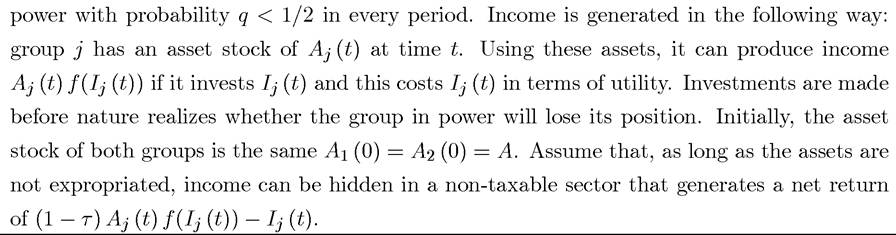
Suppose that the net return to the group is

where Tj (t) is a tax rate faced by this group, ej (t) ∈ [0,1] denotes the proportion of group j’s assets that are expropriated in period t, and Gj (t) is a transfer to group j in period t.
The law of motion of assets, as a function of expropriation of assets, is given by:
(1) First suppose that asset expropriation is not allowed, so ej (t) = 0, and the only decision each group takes is the tax rate it sets when in power. Characterize the pure strategy Markov Perfect Equilibria (MPE) of this repeated game. Show that the output level is less than first-best and is constant over time.
(2) Next suppose that the group in power can expropriate the assets of the other group (so the two decisions now are taxes and expropriation). Characterize the MPE, and show that output can actually be higher in this economy than the economy without asset expropriation. Explain why. Show also that now output is no longer constant, but fluctuates over time.
(3) Next consider a model endogenizing q. In particular, imagine that the group out of power can choose to take power in any period but to do so must pay a non-pecuniary 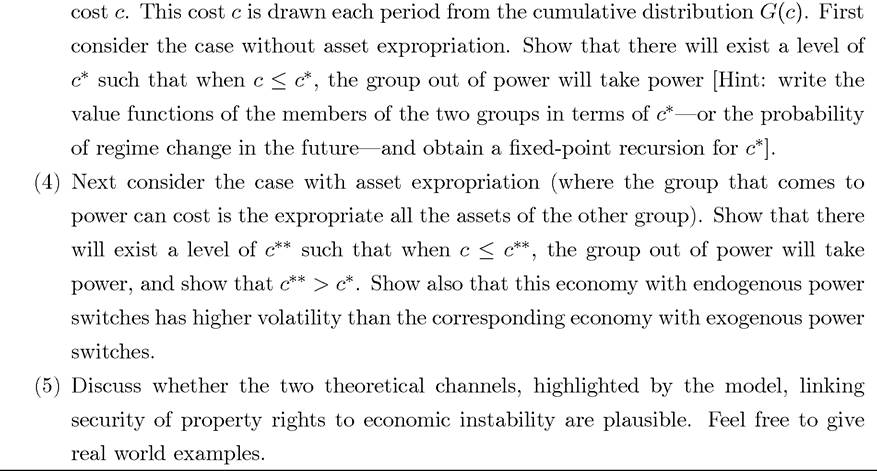 Exercise 23.2. Prove Proposition 23.1.
Exercise 23.3. (1) Prove Proposition 23.2.
(2) Generalize the result in Proposition 23.2 to the case where θe = θm. In particular, derive an inequality that determines when the dictatorship of the elite will generate greater output per capita than the dictatorship of the middle class.
Exercise 23.4. Prove Proposition 23.3. [Hint: to prove the second part of this proposition, first note that equilibrium wage will be given by whichever group has lower net (after tax) productivity. Then write the utility of workers under two scenarios, first, when the elite have lower net productivity, and second when the middle class have lower net productivity. In writing these expressions, recall that the group with the lower productivity will employ  workers, since Condition 22.1 holds.
Exercise 23.7. Derive equation (23.8).
Exercise 23.8. Prove Proposition 23.5.
Exercise 23.9. Prove Proposition 23.6.
Exercise 23.10. Suppose that Condition 23.1 does not hold. Generalize the results in Propositions 23.5 and 23.6.
Exercise 23.11. (1) Prove Proposition 23.7.
(2) Show that Condition 23.1 and (23.32) can be jointly satisfied.
(3) Prove Proposition 23.8.
Exercise 23.12. Consider the model in Section 23.3, starting with μ (0) = 1 and an oligarchic regime. Suppose that at some time t' < ∞ a new technology arises, which is ψ > 1 as productive as the old technology. However, entrepreneurial skills with this new technology are uncorrelated with entrepreneurial skills relevant for the old technology. In particular, suppose that entrepreneurial skills for new technology are given by

(1) Show that there exists ψ such that if ψ > ψ, all existing entrepreneurs will increase entry barriers and switch to the new technology.
(2) Show that if then again entry barriers will be increased and now only entrepreneurs who have low skills with the old technology will switch to the new technology.
(3) Now analyze the response of democracy to the arrival of the same technology.
(4) Compare output per capita in democracy and oligarchy after the arrival of new technology, and explain why democracy is more “flexible” in dealing with the arrival of new technologies.
Exercise 23.13. This exercise shows that entry barriers typically lead to multiple equilibrium wages in dynamic models. Consider the following two-period model.
The production function is given by (23.3) and the distribution of entrepreneurial talent is given by a continuous cumulative density function G (a). There is an entry cost into entrepreneurship equal to b at each date and each entrepreneur hires one worker (does not work as a worker himself). Total population is equal to 1.(1) First, ignore the second period and characterize the equilibrium wage and determine which individuals will become entrepreneurs. Show that the equilibrium is unique.
(2) Now consider the second period and suppose that all agents discount the future at the rate β. Show that there are multiple equilibrium wages in the second period and as a result, multiple equilibrium wages in the initial period.
(3) Now suppose that a fraction ε of all agents die in the second period and are replaced by new agents. New agents have to pay the entry cost into entrepreneurship if they want to become entrepreneurs. Suppose that their talent distribution is also given by G (a). Characterize the equilibrium in this case and show that it is unique.
(4) Now consider the limiting equilibrium in part 3 with ε → 0. Explain why this limit leads to a unique equilibrium while there are multiple equilibria at ε = 0.
Exercise 23.14. Prove Proposition 23.8.

rate, τ, the proceeds of which are redistributed lump-sum. Each agent can hide their money in an alternative non-taxable production technology, and in the process they lose a fraction φ of their income. There are no other costs of taxation. The poor can undertake a revolution, and if they do so, in all future periods, they obtain a fraction μ (t) of the total income of the society (i.e., an income of The poor can not revolt against
a democracy. The rich lose everything and receive zero payoff after a revolution.
At the beginning of every period, the rich can also decide to extend the franchise to the poor, and this is irreversible. If the franchise is extended, the poor decide the tax rate in all future periods.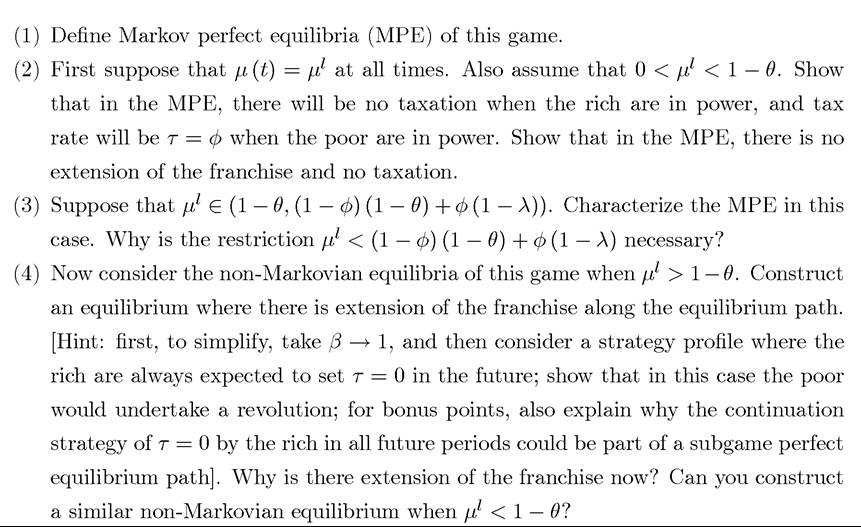
(5) Explain why the MPE led to different predictions than the non-Markovian equilibria. Which one is more satisfactory?
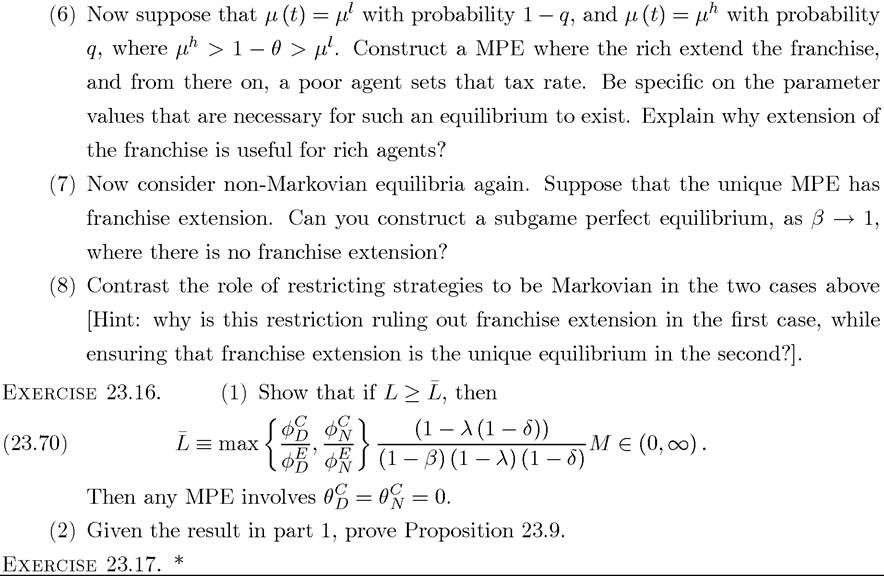
(1) Generalize Proposition 23.10 to non-symmetric Markovian strategies.
(2) Now consider any subgame perfect equilibria. Show that for β sufficiently high, subgame perfect equilibria that are on the Pareto frontier for the elite (meaning that it is impossible to make one elite agent better off without making another one worse off), have the same qualitative features as the equilibrium in Proposition
23.10.
Exercise 23.18. Prove Proposition 23.12.
Exercise 23.19. Prove Proposition 23.13.
Exercise 23.20. Generalize the results on the effects of ∆R, β and M on equilibrium objects in Proposition 23.13 to the case where