Endogenous Labor-Augmenting Technological Change
One of the advantages of the models of directed technical change is that they allow us to investigate why technological change might be purely labor-augmenting as required for balanced growth.
We will see that models of directed technological change create a natural reason for technology to be more labor-augmenting than capital-augmenting. However, under most circumstances, the resulting equilibrium is not purely labor-augmenting and as a result, a BGP fails to exist. However, in one important special case, the model delivers long-run purely labor-augmenting technological changes exactly as in the neoclassical growth model, thus providing a rationale for one of the strong assumptions of the standard growth models.In thinking about labor-augmenting technological change, it is useful to consider a two- factor model with H corresponding to capital, that is, H (t) = K (t), in the aggregate production function (15.3). Given the focus on capital, throughout the section we use Nl and Nk to denote the varieties of machines in the two sectors. Let us also simplify the discussion by assuming that there is no depreciation of capital. Note also that in this case the price of the second factor, K (t), is the same as the interest rate, r (t), since investing in the capital stock of the economy is a way of transferring consumption from one instant to another.
Let us first note that in the context of capital-labor substitution, the empirical evidence suggests that an elasticity of substitution of σ < 1 is much more plausible (whereas in the case of substitution between skilled and unskilled labor, the evidence suggested that σ > 1). An elasticity less than 1 is not only consistent with the available empirical evidence, but it is also economically plausible. For example, with the CES production function an elasticity of substitution between capital and labor greater than 1 would imply that production is possible without labor or without capital, which appears counterintuitive.
Now, recall that when σ < 1, factor-augmenting and factor-biased technologies are reversed. Therefore, labor-augmenting technological change corresponds to capital-biased technological change. Then the question becomes: under what circumstances would the economy generate relatively capital-biased technological change? And also, when will the equilibrium technology be sufficiently capital biased that it corresponds to Harrod-neutral technological change? What distinguishes capital from labor is the fact that it accumulates. In other words, most growth models feature some type of capital-deepening, with K (t) / L increasing as the economy grows. This implies that in contrast to our analysis so far, where the focus was on the effect of one-time changes in relative supplies, our interest will now be on the implications of continuous changes in the relative supply of capital on technological change. In light of this observation, the answer to the first question above is straightforward: capital deepening, combined with Proposition 15.3, implies that technological change should be more labor-augmenting than capital-augmenting.
The next proposition summarizes the main idea of the previous paragraph. For simplicity, this proposition treats the increase in K (t) /L as a sequence of one-time increases (full equilibrium dynamics are investigated in the next two propositions).
Proposition 15.12. In the baseline model of directed technological change with H (t} =

Proof. Equation (15.27) or equation (15.37) together with σ < 1 implies that an increase
 ?
?
This result already gives us important economic insights. The reasoning of directed technological change indicates that there are natural reasons for technology to be more laboraugmenting than capital-augmenting.
While this is encouraging, the next proposition shows that the results are not easy to reconcile with the fact that technological change should be purely labor-augmenting (Harrod neutral). To state this result in the simplest possible way and to facilitate the analysis in the rest of this section, let us simplify the analysis and suppose that capital accumulates at an exogenous rate, i.e.,
Then the next proposition shows a negative result on the possibility of purely laboraugmenting technological change.
PROPOSITION 15.13. Consider the baseline model of directed technological change with the knowledge spillovers specification and state dependence. Suppose that δ < 1 and capital accumulates according to (15.46). Then there exists no BGP.
Proof. See Exercise 15.22. ?
Intuitively, even though technological change is more labor-augmenting than capitalaugmenting, there is still capital-augmenting technological change in equilibrium. This, combined with capital accumulation, is inconsistent with balanced growth. In fact, even a more negative result can be proved (see again Exercise 15.22): in any asymptotic equilibrium, the interest rate cannot be constant, thus consumption and output growth cannot be constant.
In contrast to these negative results, there is a special case that justifies the basic structure of the neoclassical growth model. This takes place when there is extreme state dependence, that is, δ = 1. This case is, in many ways, quite natural and posits that spillovers are limited

592
following relationship in BGP (see Exercise 15.23):

Thus, directed technological change implies that in the long-run the share of capital is constant in national income.
Long-run constant factor shares (combined with capital deepening) means that asymptotically all technological change must be purely-labor-augmenting. More specifically, recall from (15.19) that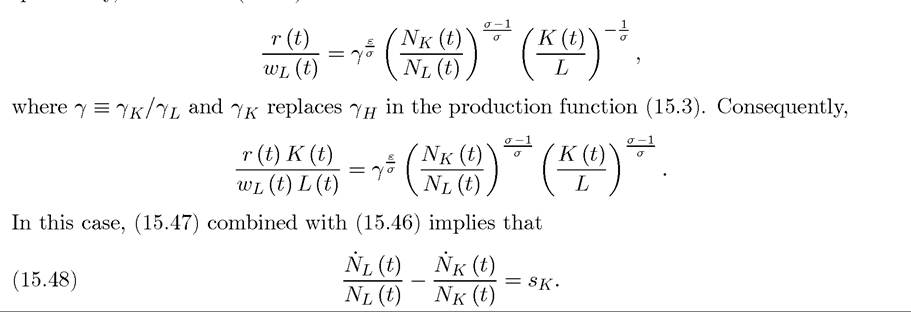
Moreover, it can be verified that the equilibrium interest rate is given by (see Exercise 15.24):

Let us now define a constant growth path as one in which consumption grows at a constant rate. From (15.22), this is only possible if r (t) is constant and equal to some r*. Equation (15.48) then implies that (Nl (t) L) / (Nk (t) K (t)) is constant, thus Nk (t) must also be constant. Therefore, equation (15.48) implies that for the economy to ultimately converge to a constant growth path, long-run technological change must be purely labor-augmenting. This is summarized in the following proposition:
PROPOSITION 15.14. Consider the baseline model of directed technological change with the two factors corresponding to labor and capital. Suppose that the innovation possibilities frontier is given by the knowledge spillovers specification and extreme state dependence, i.e., δ = 1 and that capital accumulates according to (15.46). Then there exists a constant growth path al location in which there is only labor-augmenting technological change, the interest rate is constant and consumption and output grow at constant rates. Moreover, there cannot be any other constant growth path allocations.
Proof. Part of the proof is provided by the argument preceding the proposition. Exercise 15.25 asks you to complete the proof and show that no other constant constant growth path allocation can exist. ?
Notice that Proposition 15.14 does not imply that all technological change must be Harrod neutral (purely labor-augmenting). Along the transition path, there can be (and in fact there will be) capital-augmenting technological change.
However, in the long run (that is, asymptotically or as t → ∞), all technological change will be labor-augmenting.It can also be verified that the constant growth path allocation with purely laboraugmenting technological change is globally stable if σ < 1 (see Exercise 15.26). This is reasonable, especially in view of the results in Proposition 15.7, which indicated that the stability of equilibrium dynamics in the model with the knowledge spillovers requires σ < 1∕δ. Since here we have extreme state dependence, δ = 1, stability requires σ < 1. Intuitively, if capital and labor were gross substitutes (σ > 1), the equilibrium would involve rapid accumulation of capital and capital-augmenting technological change, leading to an asymptotically increasing growth rate of consumption. However, when capital and labor are gross complements (σ < 1), capital accumulation would increase the price of labor and the profits from labor-augmenting technologies. This will then encourage further labor-augmenting technological change. These strong price effects are responsible for the stability of the constant growth path allocation in Proposition 15.14. Intuitively, we can interpret this as an elasticity of substitution less than 1 inducing the economy to strive towards a balanced allocation of effective capital and labor units (where “effective” here refers to capital and labor units augmented with their complementary technologies). Since capital accumulates at a constant rate, a balanced allocation implies that the productivity of labor should increase faster, in particular, the economy should converge to an equilibrium path with purely labor-augmenting technological progress.
The results in Proposition 15.14 are important, since they provide a justification for the assumption in the Solow and neoclassical growth models that long-run technological change is purely labor-augmenting. Naturally, whether or not this is the case in practice is an empirical matter and is an interesting topic of future empirical research.
15.7.