Exercises
Exercise 15.1. Derive equation (15.1).
Exercise 15.2. Complete the proof of Proposition 15.1. In particular, verify that in any BGP, (15.27) must hold and derive the equilibrium growth rate as given by (15.29).
Also prove that (15.28) ensures that the two free entry conditions (15.20) and (15.21) must hold as equalities. Finally, check that this condition is also sufficient to guarantee that the transversal- ity condition is satisfied. [Hint: calculate the equilibrium interest rate and then use (15.22)]. Exercise 15.3. Prove Proposition 15.2. [Hint: use (15.9) to show that when Nh (0) /Nl (0) does not satisfy (15.27), (15.20) and (15.21) cannot both hold as equalities].Exercise 15.4. Derive equation 15.30.
Exercise 15.5. Explain why in Proposition 15.1 the effect of γ on the BGP growth rate, (15.29), is ambiguous. When is this effect positive? Provide an intuition.
Exercise 15.6. Derive equation 15.31.
Exercise 15.7. Prove Proposition 15.5. [Hint: first substitute for C (t) from the constraint.

Exercise 15.8. Derive the free entry conditions (15.34) and (15.35). Provide an intuition for these conditions.
Exercise 15.9. Derive equation (15.37).
Exercise 15.10. Prove Proposition 15.6. In particular, check that there is a unique BGP and that the BGP growth rate satisfies the transversality condition.
Exercise 15.11. In the model of Section 15.4, show that an increase in η∣∣ will raise the number of scientists working in H-augmenting technologies in the BGP, Sfi, when σ > 1 (and σ < 1∕δ) and reduce it when σ < 1. Interpret this result.
Exercise 15.12. (1) Prove Proposition 15.7. In particular, use equation (15.9) and
show that when (15.37) is not satisfied, both free entry conditions cannot hold simultaneously.
Then show that if σ < 1∕δ, there will be greater incentives to undertake research for the technology that is relatively scarce, and the opposite holds when σ > 1∕δ.
Exercise 15.13. Prove Proposition 15.8.
Exercise 15.14. Characterize the Pareto optimal allocation in the model with knowledge spillovers and state dependence (Section 15.4). Show that the relative technology ratio in the stationary Pareto optimal allocation no longer coincides with the BGP equilibrium. Explain why this result differs from that in Section 15.3.
Exercise 15.15. Derive equation (15.42).
Exercise 15.16. Show that in the model of Section 15.5, if λ = 1, there exists no BGP.
Exercise 15.17. Derive equations (15.43) and (15.44).
Exercise 15.18. Generalize the model of Section 15.4 so that there are no scientists and the R&D sector also uses workers. Thus the labor market clearing condition is

(1) Define an equilibrium in this economy.
605
(2) Specify the free entry conditions for each machine variety.
(3) Characterize the BGP equilibrium, show that it is uniquely defined and determine conditions such that the growth rate is positive and the transversality condition is satisfied.
(4) Show that the equivalents of Propositions 15.3 and 15.4 hold in this environment.
(5) Characterize the transitional dynamics and show that they are similar to those in Proposition 15.2.
(6) Characterize the Pareto optimal allocation in this economy and show that the Pareto optimal ratio of technologies in the stationary equilibrium are also given by (15.27).
Exercise 15.19. Consider a version of the baseline directed technological change model introduced above with the only difference that technological change is driven by quality improvements rather than expanding machine varieties.
In particular, let us suppose thatthe intermediate goods are produced with the production functions:
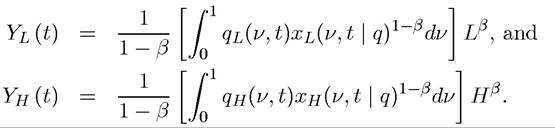
Producing a machine of quality q costs ψq, where we again normalize ψ ? 1 — β. R&D of

the unconstrained monopoly price.
(1) Define an equilibrium in this economy.
(2) Specify the free entry conditions for each machine variety.
(3) Characterize the BGP equilibrium, show that it is uniquely defined and determine conditions such that the growth rate is positive and the transversality condition is satisfied.
(4) Show that the relative technologies in the BGP equilibrium are given by (15.27).
(5) Show that the equivalents of Propositions 15.3 and 15.4 hold in this environment.
(6) Characterize the transitional dynamics and show that they are similar to those in Proposition 15.2.
(7) Characterize the Pareto optimal allocation in this economy and show that the Pareto optimal ratio of technologies in the stationary equilibrium are also given by (15.27).
(8) What are the pros and cons of this model relative to the baseline model studied in Section 15.3.
Exercise 15.20. As a potential application of the models of directed technological change, consider the famous Habakkuk hypothesis, which claims that technology adoption in the U.S.
606
economy during the 19th century was faster than in Britain because of relative labor scarcity in the former (which increased wages and encouraged technology adoption).
(1) First, consider a neoclassical-type model with two factors, labor and technology, F (A,L), where F exhibits constant returns to scale. Show that an increase in wages, either caused by a decline in labor supply or an exogenous increase in wages because of the minimum wage, cannot increase A.
(2) Next, consider the model here with H interpreted as land and assume that Nh is fixed (so that there is only R&D for increasing Nl).
Show that if σ > 1, the opposite of the Habakkuk hypothesis obtains. If in contrast, σ < 1, the model delivers results consistent with the Habakkuk hypothesis. Interpret this result and explain why the implications are different from the neoclassical model considered in 1 above.Exercise 15.21. Consider the baseline model of directed technological change in Section 15.3 and assume that it is in steady state.
(1) Show that in steady state the relative price of the two intermediate goods, p, is proportional to (H∕L)β.
(2) Now assume that the economy opens up to world trade, and faces a relative price of intermediate goods p' < p. Derive the implications of this for the endogenous changes in technology. Explain why the results are different from those in the text. [Hint: relate your results to the price effect].
Exercise 15.22. (1) Prove Proposition 15.13. In particular, show that in any BGP
equilibrium (15.37) must hold, and that this equation is inconsistent with capital accumulation.
(2) * Prove that there exists no equilibrium allocation in which consumption grows at the constant rate. [Hint: show that a relationship similar to (15.37) must hold, and this will lead to an increase in N∕√ (t), which then implies that the interest rate cannot be constant].
Exercise 15.23. Derive equation (15.47).
Exercise 15.24. Derive equation (15.49).
Exercise 15.25. Complete the proof of Proposition 15.14 and show that there cannot exist any other constant growth path equilibrium.
Exercise 15.26. * Show that if σ < 1, the constant growth path equilibrium in Proposition 15.14 is globally stable. Show that if σ > 1, it is unstable. Relate your results to Proposition
15.7.
Exercise 15.27. Now let us use the results of Proposition 15.14 to revisit the discussion of the experiences of continental European economies provided in Blanchard (1997). Consider the model of Section 15.6. Discuss how a wage push, in the form of a wage floor above the
607
market clearing level will first cause unemployment and then if σ < 1, it will cause capital- biased technological change.
Can this model shed light on the persistent unemployment dynamics in continental Europe? [Hint: distinguish two cases: (i) the minimum wage floor is constant; (ii) the minimum wage floor increases at the same rate as the growth of the economy].Exercise 15.28. * The analysis in the text has treated the supply of the two factors as exogenous and looked at the impact of relative supplies on factor prices. Clearly, factor prices can also affect relative supplies. In this exercise, we look at the joint determination of relative supplies and technologies.
Let us focus on a model with the two factors corresponding to skilled and unskilled labor. Suppose a continuum υ of unskilled agents are born every period, and each faces a flow rate of death equal to υ, so that population is constant at 1 (as in Section 9.8 above). Each agent chooses upon birth whether to acquire education to become a skilled worker. For agent x it takes Kx periods to become skilled, and during this time, he earns no labor income. The distribution of Kx is given by the distribution function Γ(K) which is the only source of heterogeneity in this economy. The rest of the setup is the same as in the text. Suppose that Γ(K) has no mass points. Define a BGP as a situation in which H/L and the skill premium remain constant.
(1) Show first that in BGP, there is a single-crossing property: if an individual with cost of education Kx chooses schooling, another with Kx∣ < Kx must also acquire skills. Conclude from this that there exists a cutoff level of talent, K, such that all Kx > K do not get education.
(2) Show that, along BGP relative supplies take the form:
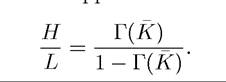
Explain why such a simple expression would not hold away from the BGP.
(3) How would you determine K? [Hint: agent with talent K has to be indifferent between acquiring skills and not].
Show that the relative supply of skills as a function of the skill premium must satisfy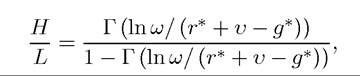
where r* and g* refer to the BGP interest-rate and growth rate.
(4) Determine the BGP skill premium by combining this equation with (15.27) and (15.30). Can there be multiple equilibria? Explain the intuition.
Exercise 15.29. * Consider an economy with a constant population and risk neutral consumers discounting the future at the rate r. Utility is defined over the final good, which is 608
produced as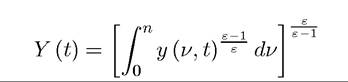
where ε > 1 and intermediate y (ν, t) can be produced using either skilled or unskilled labor. In particular, when a new intermediate is invented, it is first produced using skilled labor only, with the production function y (ν, t) = h (ν, t), and eventually, another firm may find a way to produce this good using unskilled labor with the production function y (ν, t) = l (ν, t). Assume that when there exist n goods in the economy and m goods can be produced using unskilled labor, we have

where Xn (t) and Xm (t) are expenditures on R&D to invent new goods and to transform existing goods to be produced by unskilled labor. A firm that invents a new good becomes the monopolist producer, but can be displaced by a new monopolist who finds a way of producing the good using unskilled labor.
(1) Denote the unskilled wage by w (t) and the skilled wage by v (t). Show that, as long as v (t) is sufficiently larger than w (t), the instantaneous profits of a monopolist producing skill-intensive and labor-intensive goods are

where L is the total supply of unskilled labor and H is the total supply of skilled labor. Interpret these equations. Why is the condition that v (t) is sufficiently larger than w (t) necessary?
(2) Define a balanced growth path as an allocation where n and m grow at the same rate g (and output and wages grow at the rate g/ (ε — 1)). Assume moreover that a firm that undertakes R&D to replace the skill-intensive good has an equal probability of replacing any of the existing n — m skill-intensive goods. Show that the balanced growth path has to satisfy the following condition

where μ ? m/n and λ ? m/ (n — m) = gμ/ (1 — μ). [Hint: Note that a monopolist producing a labor-intensive good will never be replaced, and its profits will grow at the rate g (because equilibrium wages are growing). A monopolist producing a skillintensive good faces a constant flow rate of being replaced, and while it survives, its profits grow at the rate g.] 
Exercise 15.30. Consider the model presented in Section 15.8.
(1) Show that if capital and labor are allocated in competitive markets, in general more than one technique will be used in equilibrium. [Hint: construct an example in which there are three ideas i = 1, 2 and 3, such that when only one can be used, it will be i = 1, but output can be increased by allocating some of labor and capital to ideas 2 and 3].
(2) * Show that in this case the exact aggregation result used in Section 15.8 does not apply.