Exercises
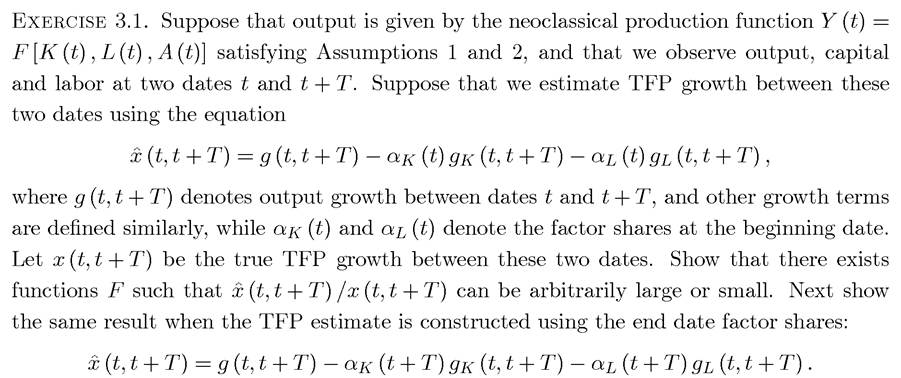
Explain the importance of differences in factor proportions (capital-labor ratio) between the beginning and end dates in these results.
EXERCISE 3.2. Consider the economy with labor market imperfections as in the second part of Exercise 2.15 from the previous chapter, where workers were paid a fraction β > 0 of output. Show that in this economy the fundamental growth accounting equation leads to biased estimates of TFP.
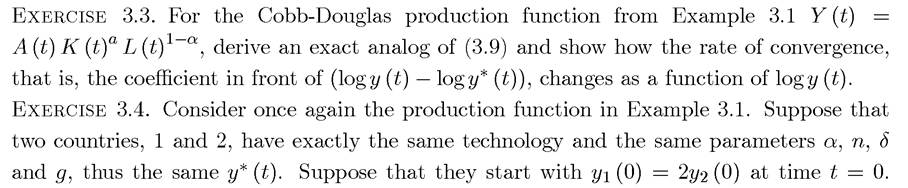
Using the parameter values in Example 3.1 calculate how long it would take for the income gap between the two countries to decline to 10%.
Exercise 3.5. Consider a collection of Solow economies, each with different levels of δ, s and n. Show that an equivalent of the conditional convergence regression eq. (3.11) can be derived from an analog of (3.9) in this case.
Exercise 3.6. Prove Proposition 3.2.
Exercise 3.7. In the augmented Solow model (cfr Proposition 3.2) determine the impact of increases in.⅛,.⅛ and n on h* and k*.
Exercise 3.8. Consider a world economy consisting of countries represented by the augmented Solow growth model, with the production functions given by (3.14). Derive the equivalent of the fundamental growth accounting equation in this case and explain how one might use available data in order to estimate TFP growth using this equation.
Exercise 3.9. Consider the basic Solow model with no population growth and no technological progress, and a production function of the form F (K, H), where H denotes the efficiency units of labor (human capital), given by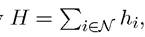 where N is the set of all individuals in
the population and hi is the human capital of individual i. Assume that H is fixed.
Suppose there are no human capital externalities and factor markets are competitive.(1) Calculate the steady-state equilibrium of this economy.
(2) Prove that if 10% higher h at the individual level is associated with α% higher earnings, then a 10% increase in the country’s stock of human capital H will lead to a% increase in steady-state output. Compare this to the immediate impact of an unanticipated 10% increase in H (that is, consider the impact of a 10% increase in H with the stock of capital unchanged).
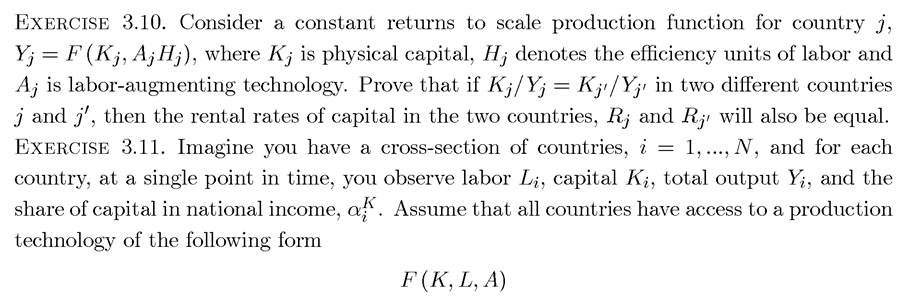
where A is technology. Assume that F exhibits constant returns to scale in K and L, and all markets are competitive.
(1) Explain how you would estimate relative differences in technology/productivity across countries due to the term A without making any further assumptions. Write down the equations that are involved in estimating the contribution of A to crosscountry income differences explicitly.
(2) Suppose that the exercise in part 1 leads to large differences in productivity due to the A term. How would you interpret this? Does it imply that countries have access to different production possibility sets?
(3) Now suppose that the true production function is F (K, H, A), where H denotes efficiency units of labor. What other types of data would you need in order to estimate the contribution of technology/productivity across countries to output differences.
(4) Show that if H is calculated as in Section 3.5, but there are significant quality-of- schooling differences and no differences in A, this strategy will lead to significant differences in the estimates of A.