Exercises
Exercise 11.1. Deriveeq. (11.14).
Exercise 11.2. Prove Proposition 11.2.
Exercise 11.3. Consider the following continuous-time neoclassical growth model:
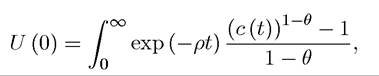
with aggregate production function

where A, B > 0.
(1) Define a competitive equilibrium for this economy.
(2) Set up the current-value Hamiltonian for an individual and characterize the necessary conditions for consumer maximization. Combine these with equilibrium factor prices and derive the equilibrium path. Show that the equilibrium path displays non-trivial transitional dynamics.
(3) Determine the evolution of the labor share of national income over time.
(4) Analyze the impact of an unanticipated increase in B on the equilibrium path.
(5) Prove that the equilibrium is Pareto optimal.
Exercise 11.4. Consider the following continuous-time neoclassical growth model:

with production function

(1) Define a competitive equilibrium for this economy.
(2) Set up the current-value Hamiltonian for an individual and characterize the necessary conditions for consumer maximization. Combine these with equilibrium factor prices and derive the equilibrium path.
(3) Prove that the equilibrium is Pareto optimal in this case.
(4) Show that if σ ≤ 1, sustained growth is not possible.
(5) Show that if A and σ are sufficiently high, this model generates asymptotically sustained growth due to capital accumulation. Interpret this result.
(6) Characterize the transitional dynamics of the equilibrium path.
(7) What is happening to the share of capital in national income? Is this plausible? How would you modify the model to make sure that the share of capital in national income remains constant?
(8) Now assume that returns from capital are taxed at the rate τ. Determine the asymptotic growth rate of consumption and output.
Exercise 11.5. Derive eq.’s (11.19) and (11.20).
Exercise 11.6. Consider the neoclassical growth model with Cobb-Douglas technology y (t) = Ak (t)α (expressed in per capita terms) and log preferences. Characterize the equilibrium path of this economy and show that as α → 1, the equilibrium path approaches that of the baseline AK economy. Interpret this result.
Exercise 11.7. Consider the baseline AK model of Section 11.1 and suppose that two otherwise-identical countries have different taxes on the rate of return on capital. Consider the following calibration of the model where A = 0.15, δ = 0.05, ρ = 0.02, and θ = 3. Suppose that the first country has a capital income tax rate of τ = 0.2, while the second country has a tax rate of τ0 = 0.4. Suppose that the two countries start with the same level of income in 1900 and experience no change in technology or policies for the next 100 years. What will be the relative income gap between the two countries in 2000? Discuss this result and explain why you do (or do not) find the implications plausible.
Exercise 11.8. (1) Verify that Theorems 7.13 and 7.14 from Chapter 7 can be applied
both to the two-sector model in Section 11.2. [Hint: use a similar argument that in Section 7.7 in Chapter 7].
(2) Prove that the necessary conditions for consumer optimization in Section 11.2 lead to the conditions enumerated in (11.25).
Exercise 11.9. Prove Proposition 11.3.
Exercise 11.10. Prove that the competitive equilibrium of the economy in Section 11.2, characterized in Proposition 11.3, is Pareto optimal and coincides with the solution to the optimal growth problem.
Exercise 11.11. Show that the rate of population growth has no effect on the equilibrium growth rate of the economies studied in Sections 11.1 and 11.2. Explain why this is. Do you find this to be a plausible prediction?
Exercise 11.12. * Show that in the model of Section 11.3, if the Cobb-Douglas assumption is relaxed, there will not exist a BGP with a constant share of capital income in GDP.
Exercise 11.13. Consider the effect of an increase in α on the competitive equilibrium of the model in Section 11.3. Why does it increase the rate of capital accumulation in the economy? Exercise 11.14. Consider a variant of the model studied in Section 11.3, where the technology in the consumption-good sector is still given by (11.27), while the technology in the investment-good sector is modified to

where β ∈ (α, 1). The labor market clearing condition requires Lc (t) + L∣ (t) ≤ L (t). The rest of the environment is unchanged.
(1) Define a competitive equilibrium.
(2) Characterize the steady-state equilibrium and show that it does not involve sustained growth.
(3) Explain why the long-run growth implications of this model differ from those of Section 11.3.
(4) Analyze the steady-state income differences between two economies taxing capital at the rates τ and τ0. What are the roles of the parameters α and β in determining these relative differences? Why do the implied magnitudes differ from those in the one-sector neoclassical growth model?
Exercise 11.15. In the Romer model presented in Section 11.4, verify that Theorems 7.13 and 7.14 from Chapter 7 can be applied both to the representative household’s problem and to the social planner’s problem.
Exercise 11.16. In the Romer model presented in Section 11.4, let g* be the growth rate of consumption and g* the growth rate of aggregate output.
Show that gC > g* is not feasible, while g* < g* would violate the transversality condition.Exercise 11.17. Consider the Romer model presented in Section 11.4. Prove that the allocation in Proposition 11.5 satisfies the transversality condition. Prove also that there are no transitional dynamics in this equilibrium.
Exercise 11.18. Consider the Romer model presented in Section 11.4 and suppose that population grows at the rate n > 0. Characterize the labor market clearing conditions. Formulate the dynamic optimization problem of a representative household and show that any interior solution to this problem violates the transversality condition. Interpret this result.
Exercise 11.19. Consider the Romer model presented in Section 11.4. Provide two different types of tax/subsidy policies that would make the equilibrium allocation identical to the Pareto optimal allocation.
Exercise 11.20. Consider the following infinite-horizon economy in discrete time that admits a representative household with preferences at time t = 0 as
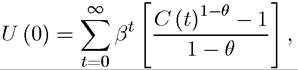
where C (t) is consumption, and β ∈ (0,1). Total population is equal to L and there is no population growth and labor is supplied inelastically. The production side of the economy consists of a continuum 1 of firms, each with production function

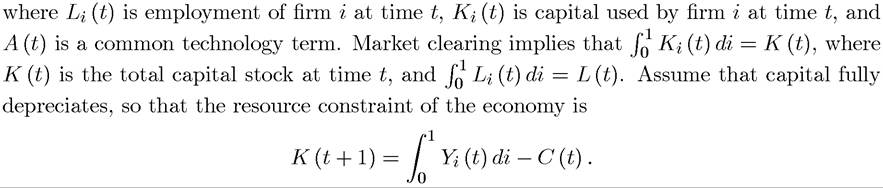
Assume also that labor-augmenting productivity at time t, A (t), is given by

(1) Explain (11.42) and why it implies a (non-pecuniary) externality.
(2) Define a competitive equilibrium (where all agents are price takers).
(3) Show that there exists a unique BGP competitive equilibrium, where the economy grows (or shrinks) at a constant rate every period.
Provide a condition on F, β and θ such that this growth rate is positive, but the transversality condition is still satisfied.(4) Explain why any equilibrium must be along the BGP characterized in part 3 at all points.
Exercise 11.21. * Consider the following endogenous growth model due to Uzawa and Lucas.
The economy admits a representative household and preferences are given by

where C (t) is consumption of the final good, which is produced as

where K (t) is capital and H (t) is human capital, and Hp (t) denotes human capital used in production. The accumulation equations are as follows: 
for capital and
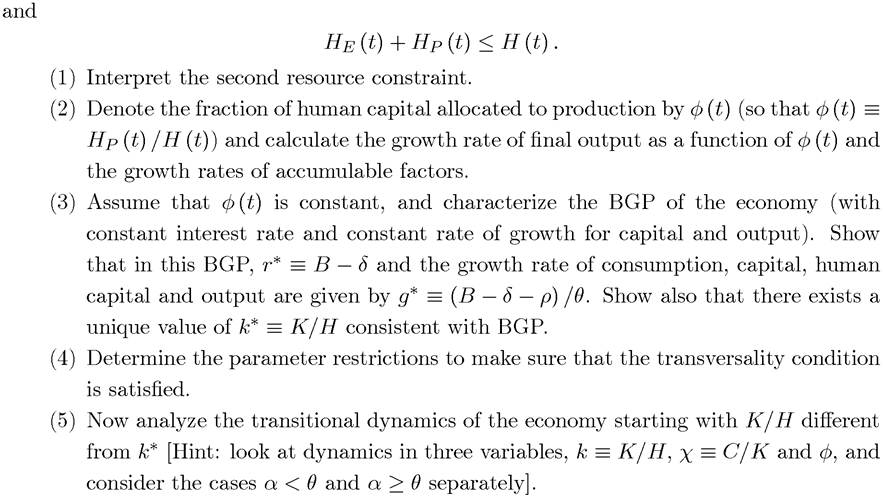
where He (t) is human capital devoted to education (further human capital accumulation), and the depreciation of human capital is assumed to be at the same rate, δ, as physical capital for simplicity. The resource constraints of the economy are

More on the topic Exercises:
- STRUCTURE
- Schooling Investments and Returns to Education
- References and Literature
- Abel A.B., Bernanke B., Croushore D.. Macroeconomics. 10th Edition, Global Edition. — Pearson,2021. — 690 pp., 2021
- BREAKING NEW GROUND
- The Idiomorphic Constitution of Cyprus
- The Yogi's Way of War
- Uganda: The Next Destination for Orphan Addicts
- Chapter 39 Amenorrhea and Abnormal Uterine Bleeding
- FIVE COMPONENTS OF LEGAL COMPETENCIES