Government Policies to Raise Long-Run Living Standards
Discuss government policies for raising long-run living standards.
Increased growth and a higher standard of living in the long run often are cited by political leaders as primary policy goals.
Let's take a closer look at government policies that may be useful in raising a country's long-run standard of living.Policies to Affect the Saving Rate
The Solow model suggests that the rate of national saving is a principal determinant of long-run living standards. However, this conclusion doesn't necessarily mean that policymakers should try to force the saving rate upward, because more saving means less consumption in the short run. Indeed, if the "invisible hand" of free markets is working well, the saving rate freely chosen by individuals should be the one that optimally balances the benefit of saving more (higher future living standards) against the cost of saving more (less present consumption).
Despite the argument that saving decisions are best left to private individuals and the free market, some people claim that U.S. residents save too little and that U.S. policy should aim at raising the saving rate. One possible justification for this claim is that existing tax laws discriminate against saving by taxing away part of the returns to saving; a "pro-saving" policy thus is necessary to offset this bias. Another view is that people in the United States are just too shortsighted in their saving decisions and must be encouraged to save more.
What policies can be used to increase saving? If saving were highly responsive to the real interest rate, tax breaks that increase the real return that savers receive would be effective. For example, some economists advocate taxing households on how much they consume rather than on how much they earn, thereby exempting from taxation the income that is saved. But, as we noted in Chapter 4, although saving appears to increase when the expected real return available to savers rises, most studies find this response to be small.
An alternative and perhaps more direct way to increase the national saving rate is by increasing the amount that the government saves; in other words, the government should try to reduce its deficit or increase its surplus. Our analysis of the twin deficits debate (Chapter 5) indicated that reducing the deficit by reducing government purchases will lead to more national saving. Many economists also argue that raising taxes to reduce the deficit or increase the surplus will also increase national saving by leading people to consume less. However, believers in Ricardian equivalence contend that tax increases without changes in current or planned government purchases won't affect consumption or national saving.
Policies to Raise the Rate of Productivity Growth
Of the factors affecting long-run living standards, the rate of productivity growth may well be the most important in that—according to the Solow model—only ongoing productivity growth can lead to continuing improvement in output and consumption per worker. Government policy can attempt to increase productivity in several ways.[108]
Improving Infrastructure. Some research findings suggest a significant link between productivity and the quality of a nation's infrastructure—its highways, bridges, utilities, dams, airports, and other publicly owned capital.[109] The construction of the interstate highway system in the United States, for example, significantly reduced the cost of transporting goods and stimulated tourism and other industries. In the past decade the rate of U.S. government investment in infrastructure has fallen, leading to a decline in the quality and quantity of public capital.[110] Reversing this trend, some economists argue, might help achieve higher productivity. However, not everyone agrees that more infrastructure investment is needed. For example, some critics have pointed out that the links between productivity growth and infrastructure aren't clear.
If rich countries are more likely to build roads and hospitals, perhaps higher productivity growth leads to more infrastructure, rather than vice versa. Others worry that infrastructure investments by the government may involve political considerations (for example, favoring the districts of powerful members of Congress) more than promoting economic efficiency.Building Human Capital. Recent research findings point to a strong connection between productivity growth and human capital. The government affects human capital development through educational policies, worker training or relocation programs, health programs, and in other ways. Specific programs should be examined carefully to see whether benefits exceed costs, but a case may be made for greater commitment to human capital formation as a way to boost productivity growth.
One crucial form of human capital, which we haven't yet mentioned, is entrepreneurial skill. People with the ability to build a successful new business or to bring a new product to market play a key role in economic growth. Productivity growth may increase if the government were to remove unnecessary barriers to entrepreneurial activity (such as excessive red tape) and give people with entrepreneurial skills greater incentives to use those skills productively.[111]
Encouraging Research and Development. The government also may be able to stimulate productivity growth by affecting rates of scientific and technical progress. The U.S. government directly supports much basic scientific research (through the National Science Foundation, for example). The rationale for such support comes from the fact that it is often difficult for inventors to profit from their inventions, even when such inventions greatly benefit society.[112] So, in the absence of government support, the private sector will engage in less research and development than is socially optimal. Examples of government support for research and development that have proved to be beneficial for society include hybrid seed corn, genetic engineering, the lithium-ion battery, and research on cancer.
The government can support research and development through a variety of mechanisms: funding government research facilities, providing grants to researchers, engaging private-sector contractors for particular projects, or giving tax incentives. It is important to keep in mind that government-supported research and development is a long-term investment that aims to improve the standard of living many years in the future, rather than an investment that will have a quick payoff. For example, the basics of the Internet came from research in the 1970s and 1980s, even though the Internet didn't get widespread use until the 1990s. Finally, the government can support research and development through education policies; for example, the government could encourage students to become scientists and engineers.
Application
Trends in Income Distribution in South Africa
The aim of this chapter is to shed light on how and why some countries grow faster than others and what kind of policies, if any, can be used to increase the national income for countries performing below expectations. While GDP per capita is used as a measure for economic growth and provides useful information concerning the amount of goods and services produced in an economy over time, it does not provide sufficient data about the incomes of citizens. To understand how national income is divided among a country's residents, economists use
(continued)
income distribution as a statistical measure. To illustrate this concept, let's assume that South Africa's income per head is R855,357 (the rand, R, is the official currency of South Africa). Although South Africa's income seems higher than that of other countries in the continent, it does not mean that the income is distributed fairly among its residents.
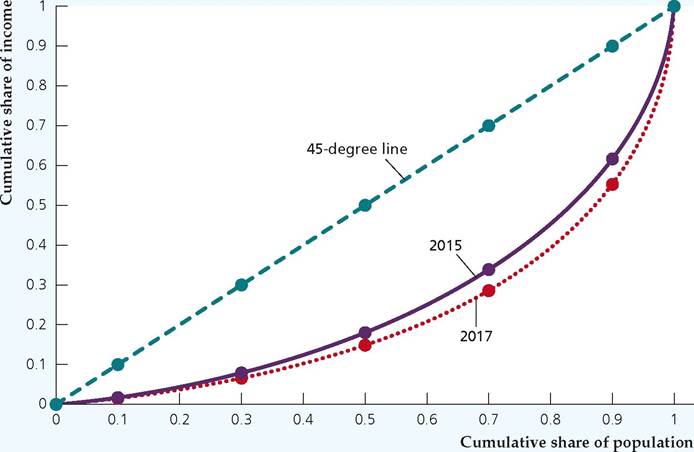
What does the income distribution look like in South Africa, and how has it changed over time?The Lorenz curve is a graphical representation of income distribution as displayed in Figure 6.11. It shows trends in percentiles of the population on the horizontal axis and the income cumulative share of the population on the vertical axis for the period 2008 to 2017. What stands out in Figure 6.11 is that, although income inequality was already high in 2008, it increased further in 2017.
Perhaps the most frequently used measure of income distribution by economists is the Gini coefficient, also called the Gini index or Gini ratio. The Gini coefficient can be calculated from the Lorenz curve in Figure 6.11 through the area between the Lorenz curve and the line of equality (or the 45-degree line), which is then expressed as a percentage of the area under the line of equality; that is, the 45-degree line. If income was equally distributed, then the Lorenz curve and the 45-degree line would be the same; that is, the Gini coefficient would be zero.
The Gini coefficient ranges from 0 to 1, with 0 signifying perfect equality and 1 demonstrating perfect inequality. For example, if all individuals in South Africa were to earn the same income, then the Gini coefficient would be 0. Similarly, if one individual in South Africa earned all the income while everyone else earned nothing, then the Gini coefficient would be 1.
A natural question to ask is, how does inequality manifest itself and affect the economy? In his keynote address, Vimal Ranchhod, an associate professor at the
FIGURE 6.12
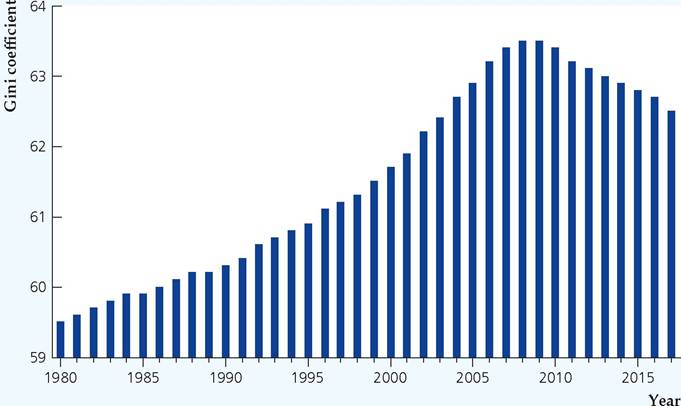
Evolution of the Gini coefficient from 1980 to 2017 for South Africa
We observe that, by and large, the Gini coefficient increased between 1980 and 2008-2009 but has diminished since.
Source: Frederick Solt, “The Standardized World Income Inequality Database, Versions 8-9,” 2019, https://doi. org/10.7910/DVN/LM4OWF
Southern Africa Labour and Development Research Unit (SALDRU), highlighted various ways through which inequality manifests itself, such as rural-urban, gender, educational, and racial inequalities.
By way of example, he noted that educational inequalities mean that some children will never get an opportunity to attain the same skills as others. Consequently, only a portion of the youth entering the labor market will have the same high levels of secondary and tertiary education.► CHAPTER SUMMARY
1. Economic growth is the principal source of improving standards of living over time. Over long periods, even small differences in growth rates can have a large effect on nations' standards of living.
2. Growth accounting is a method for breaking total output growth into the portions resulting from growth in capital inputs, growth in labor inputs, and growth in productivity. All three factors have contributed to long-run economic growth in the United States. However, the slowdown in U.S. output growth after 1973 (and in other countries) primarily reflects a sharp decline in productivity growth. The increase in output growth in the late 1990s mainly occurred because of faster productivity growth from improvements in information and communications technologies, combined with investment in intangible capital.
3. The Solow model of economic growth examines the interaction of growth, saving, and capital accumulation over time. It predicts that in the absence of productivity growth the economy will reach a steady state in which output, consumption, and capital per worker are constant.
4. According to the Solow model, each of the following leads to higher output, consumption, and capital per worker in the long run: an increase in the saving rate, a decline in the population growth rate, and an increase in productivity.
5. Endogenous growth theory attempts to explain, rather than assumes, the economywide rate of productivity growth. One strand of this approach emphasizes the formation of human capital, including the acquisition of skills and training by workers. A second strand focuses on research and development activity by firms. Endogenous growth theorists argue that, because growth in capital and output engenders increased human capital and innovation, the marginal productivity of capital may not be diminishing for the economy as a whole. An implication of this theory is that the saving rate can affect the long-run rate of economic growth.
6. Government policies to raise long-run living standards include raising the rate of saving and increasing productivity. Possible ways of increasing productivity involve investing in public capital (infrastructure), encouraging the formation of human capital, and increasing research and development.
►